Hey friends,
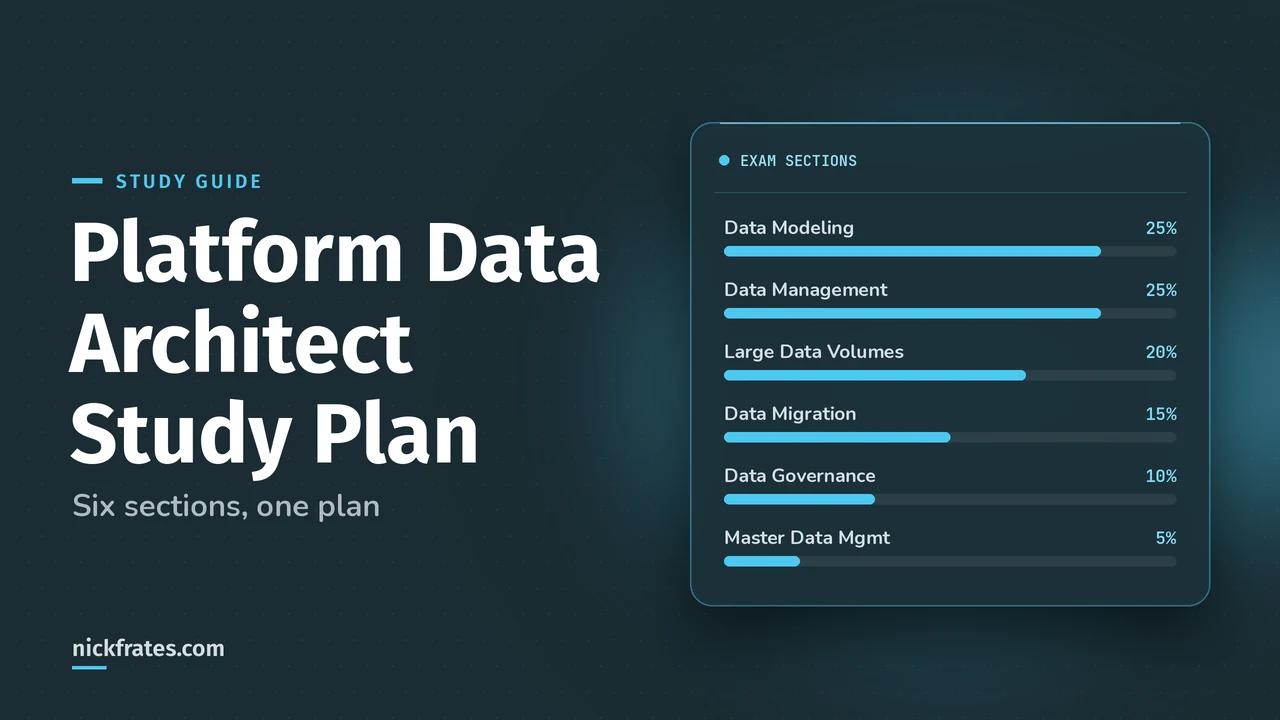
To pass the Salesforce Certified Platform Data Architect exam you need 58% on 60 multiple-choice questions in 105 minutes, and three sections carry 70% of the score: Data Modeling/Database Design (25%), Salesforce Data Management (25%) and Large Data Volume Considerations (20%). I built this plan from the official exam guide and the Salesforce docs it points to. It tells you what to study first, what to build in a Developer Edition org and which numbers are worth memorizing.
This is the short plan. If you want the long section-by-section walkthrough, I also wrote a deeper Platform Data Architect study guide. Use this page to decide what to do each week.
What is on the Salesforce Platform Data Architect exam?
Six sections, weighted like this in the exam guide:
| Section | Weight | What it tests |
|---|---|---|
| Data Modeling/Database Design | 25% | Comparing ways to design a data model, scaling it under the sharing model, metadata management, big objects vs standard and custom objects, and avoiding data skew |
| Master Data Management | 5% | MDM implementation styles, survivorship rules, a golden record or system of truth, and picking the winning attributes |
| Salesforce Data Management | 25% | License types and objects, keeping data consistent, a single view of the customer, and consolidating data from several Salesforce orgs |
| Data Governance | 10% | A GDPR-friendly data model, identifying and classifying personal data, and running a governance program |
| Large Data Volume Considerations | 20% | Scalable data models, archiving and purging plans, and when to use virtualized data |
| Data Migration | 15% | Data quality at load time, loading large volumes fast, and exporting data from Salesforce |
Data modeling plus data management is half the exam. Add large data volumes and you're at 70%, so that's where I'd spend most of your time.
How many questions, how long and how much does it cost?
| Detail | What the exam guide says |
|---|---|
| Questions | 60 multiple-choice questions, plus up to five unscored ones |
| Time | 105 minutes |
| Passing score | 58%, which is about 35 of the 60 scored questions |
| Registration fee | US$400 plus applicable taxes |
| Retake fee | US$200 plus applicable taxes |
| Delivery | Proctored, at a testing center or online |
| During the exam | No hard-copy or online materials |
| Prerequisite | None |
| Release alignment | Questions align to the Spring '23 release |
Unscored questions are mixed in at random, so treat every question as if it counts. I don't claim any exact split between single-answer and multi-select questions, because the exam guide doesn't give one.
Who should take the Platform Data Architect exam?
The guide describes someone with 2 to 3 years of Salesforce experience and 5+ years supporting or implementing data-centric solutions. Typical roles are Advanced Administrator, Data Architect, Technical or Solution Architect and Advanced Platform Developer. Salesforce recommends, but doesn't require, the Platform App Builder, Platform Developer and Platform Developer II certifications first. For the cost side of the decision, see my Salesforce certification cost post.
The guide is just as clear about what you don't need: non-Salesforce database concepts, configuring integration tools, hands-on experience with MDM tools, Lightning development, or a programming language. That tells you the questions are about design choices on Salesforce, not syntax.
Is the Salesforce Data Architect exam hard?
It's a scenario exam. Most questions describe a company, a problem and a few options that all sound reasonable, and you pick the best design. Admins usually know the objects but haven't felt large-data pain, so skew, indexes and bulk loading catch them out. Developers know the limits but sometimes miss the governance and master data vocabulary.
The good news is that the same few ideas keep coming back: keep parents from getting too many children, filter on indexed fields, load parents before children, and decide which system owns each piece of data.
How should I study for the Platform Data Architect exam?
Here's the order I'd use, weighted by the exam. It's my plan, not an official one. Read the exam guide once first so you know the objectives, then:
- Week 1, data modeling (25%). Build a junction object with two master-detail relationships, add a roll-up summary field and look at Object Manager's limits page. Then read about data skew in the Trailhead LDV module. My posts on the standard object data model and lookup vs master-detail help here.
- Week 2, data management (25%). Practice duplicate and matching rules, merging records, external IDs and upserts. My duplicate rules post and the master data management guide cover the thinking.
- Week 3, large data volumes (20%). Learn the index thresholds, skinny tables, big objects and external objects. Start with my large data volumes guide.
- Week 4, data migration (15%), data governance (10%) and master data management (5%). Run a real load with Data Loader using external IDs. Then tag a few fields with Data Classification. The data migration guide walks through it.
- Last days, timed practice. Do my 20 Platform Data Architect practice questions, read every explanation and note which section each miss came from.
Cert Lab by Nick Frates
Find your weak sections before exam day
Rapid-fire questions for all six Platform Data Architect sections, with every option explained and current doc links.
Start the Platform Data Architect Cert Lab for $9.99 →Not ready to buy? Try a free lesson and see how fast you learn.
What should I study in each section?
These are the topics I'd make sure I can explain out loud, with where I'd practice them.
| Section | Know these | Where to practice |
|---|---|---|
| Data Modeling/Database Design | Master-detail vs lookup, junction objects, big objects vs custom objects, account, ownership and lookup skew, sharing and the data model, data classification metadata | Standard object data model, lookup vs master-detail, the security model |
| Master Data Management | Registry, consolidation, coexistence and centralized MDM styles; golden record; survivorship; match vs merge | Master data management in Salesforce |
| Salesforce Data Management | External IDs and upsert, duplicate and matching rules, merge limits, external objects and data virtualization, multi-org design | Duplicate rules, Data Import Wizard vs Data Loader |
| Data Governance | Data Owner, Field Usage, Data Sensitivity Level and Compliance Categorization, stewardship, GDPR-friendly design | Data governance section of the MDM guide, Field Audit Trail vs field history |
| Large Data Volume Considerations | Selective queries, standard and custom indexes, skinny tables, archiving to big objects, external objects, deferred sharing calculation | Large data volumes guide |
| Data Migration | Load order, external IDs, audit fields, Bulk API and Bulk API 2.0, PK chunking for exports, bypassing automation during loads | Data migration guide, Batch Apex |
Which numbers should I memorize?
Salesforce docs are full of numbers, and exam scenarios lean on a handful of them. These are the ones I'd know, each from an official Salesforce page:
| Number | What it is |
|---|---|
| 10,000 | Child records per parent, or records per owner, where skew starts to hurt performance |
| 30% and 15% | Standard index: used if the filter matches under 30% of the first million records and under 15% beyond that |
| 10% and 5% | Custom index: used if the filter matches under 10% of the first million records and under 5% beyond that |
| 2 and 40 | A custom object can have at most two master-detail relationships, and the default limit on lookup plus master-detail fields is 40 (hard maximum 50) |
| 25 | Default roll-up summary fields per object, with a hard maximum of 40 |
| 3 | Records you can merge in one merge |
| 10,000 | Maximum records in a Bulk API ingest batch |
| 100,000 and 250,000 | PK chunking default and maximum chunk size for Bulk API queries |
Sources are linked in my posts on large data volumes, data migration and the data model.
What mistakes do people make on this exam?
- Treating it like an Administrator exam. It's about design trade-offs, not where to click.
- Fixing a skew problem with a bigger batch size instead of changing the data model.
- Assuming an account hierarchy gives users access to child accounts. The role and territory hierarchies do that, the account hierarchy doesn't.
- Mixing up registry MDM, which links records, with coexistence MDM, which decides the value and sends it back.
- Forgetting that audit fields can only be set when a record is created.
- Picking a big object when the scenario needs triggers, flows or standard sharing rules, which big objects don't support.
- Memorizing numbers without knowing which feature they belong to.
How do I keep the certification current?
The exam guide says you must complete the Platform Data Architect certification maintenance badge on Trailhead once a year. If you miss the due date, the certification expires, so check the current due dates on Trailhead.
A bit about how I study. Focus on Force was my favorite resource on the way to 17 Salesforce certs. I started the traditional way, reading the study guide first and testing second, but rapid-fire practice tests are what actually made things stick. That's the loop Cert Lab is built on: quick questions, then explanations with current links, then go again.
FAQ
What is the official name of the exam?
Salesforce Certified Platform Data Architect.
How many questions are on the exam?
60 multiple-choice questions plus up to five unscored ones, in 105 minutes.
What is the passing score?
58%.
How much does the exam cost?
US$400, and a retake is US$200, plus applicable taxes.
Which sections are the biggest?
Data Modeling/Database Design and Salesforce Data Management at 25% each, then Large Data Volume Considerations at 20%.
Is there a prerequisite?
No. Salesforce suggests 2 to 3 years of Salesforce experience and 5+ years with data-centric solutions.
Can I use notes during the exam?
No. The exam guide says no hard-copy or online materials may be referenced.
Where should you go next?
- Platform Data Architect practice questions, 20 original questions weighted like the exam.
- Salesforce standard object data model for the data modeling section.
- Salesforce large data volumes for skew, indexes, skinny tables and archiving.
- Salesforce data migration for loading, exporting and data quality.
- Master data management in Salesforce for golden records and governance.
Nick Frates, a senior Salesforce developer with 17 certifications, built the Platform Data Architect Cert Lab at nickfrates.com: rapid-fire practice questions for every exam section, each answer explained.
Cert Lab by Nick Frates
Let the Platform Data Architect Cert Lab test you to success
Lessons, flashcards, a quiz for each of the six exam sections and full practice exams, every answer explained.
Start the Platform Data Architect Cert Lab for $9.99 →Not ready to buy? Try a free lesson and see how fast you learn.
Hope this helps!
Best,
Nick