Hey friends,
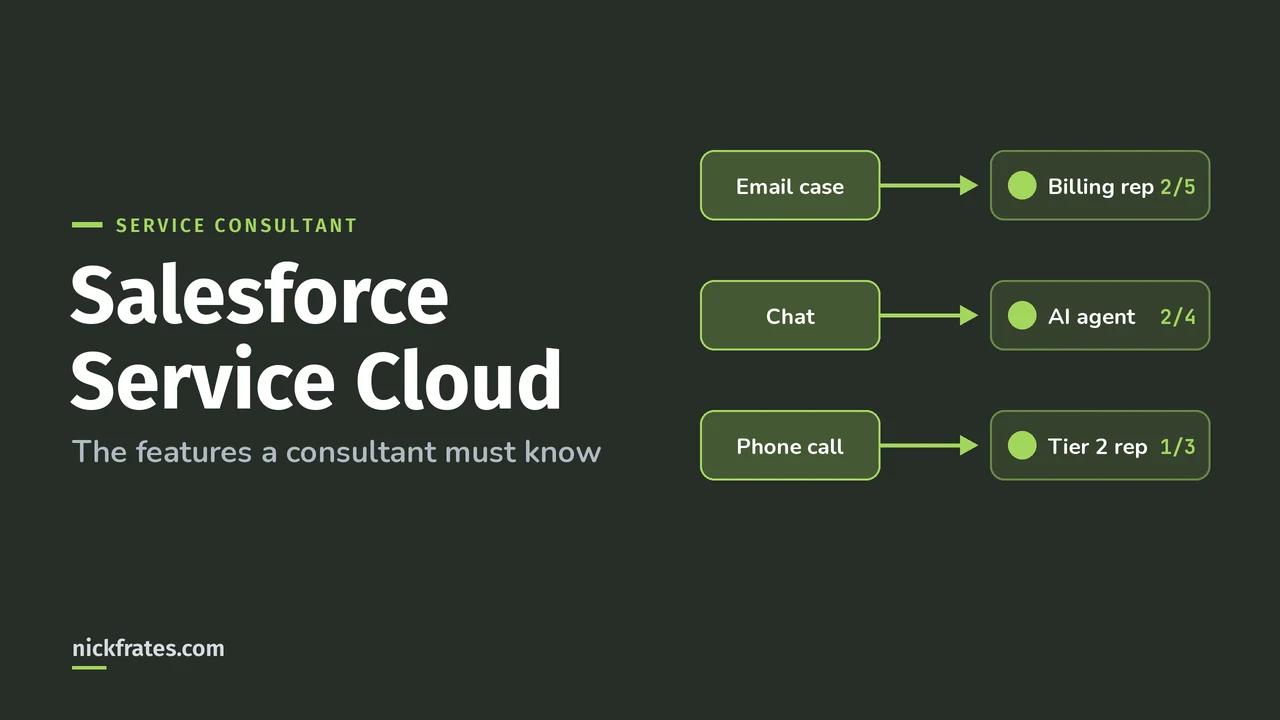
Salesforce Service Cloud, now called Agentforce Service, is Salesforce's customer service app: it turns every email, chat, call and web form into a case, routes that work to the best rep or AI agent, and gives reps Knowledge, automation and a console to resolve it fast. You'll still see the Service Cloud name all over Salesforce docs and apps.
If you're studying for the Agentforce Service Consultant exam, this is your map. Learn how these features fit together and the scenario questions get a lot friendlier, because most of them ask which feature solves a business need. Every fact here comes from Salesforce Help.
What is Service Cloud used for?
Service Cloud manages customer support from first contact to resolution. Salesforce frames each support contact as a chance to build a stronger relationship, and automatic routing to the most qualified rep or AI agent means faster, better resolutions (Case Management).
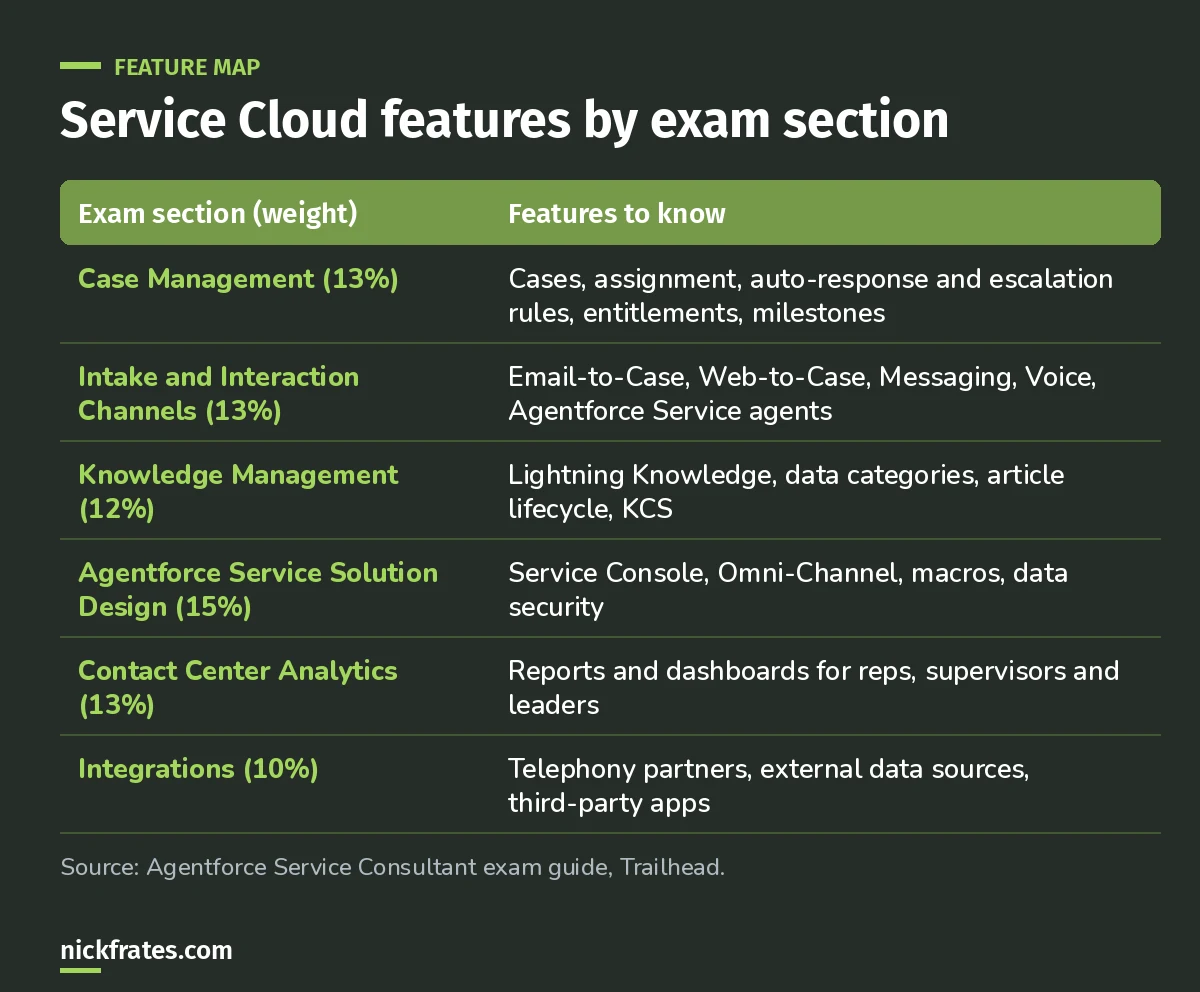
Use this map to connect each feature to the exam section that tests it.
How do cases work in Service Cloud?
A case is the record of one customer question, problem or request, and case management is the core of Service Cloud. Salesforce's setup basics are case teams, custom fields and page layouts, email templates, assignment rules, auto-response rules, escalation rules and channels that capture cases (Case Management).
- Auto-response rules email customers when a case comes in from Web-to-Case or Email-to-Case. Only one case rule can be active at a time (Create Auto-Response Rules).
- Escalation rules act on cases that sit too long. You can have only one active escalation rule, with multiple entries, and actions run only during the business hours tied to them (Set Up Escalation Rules).
- Entitlements show whether a customer is eligible for support, like phone or web support. Entitlement processes are timelines of the steps reps must complete (Entitlement Management), with up to 1,000 processes and 10 milestones per process (Entitlement Processes).
I go deeper in Salesforce case management.
Which channels bring cases into Service Cloud?
The main intake channels are Email-to-Case, Web-to-Case, Messaging and Voice, plus self-service and AI agents. Customers pick their channel, and the work still lands in one place.
- Email-to-Case creates cases from emails to your support addresses and fills in case fields. Threading keeps replies on the same case (Email-to-Case).
- Web-to-Case turns a web form into cases. Salesforce recommends requiring reCAPTCHA so spam doesn't become cases (Set Up Web-to-Case).
- Messaging covers Enhanced Chat for websites and apps, plus WhatsApp, Facebook Messenger, LINE, Apple Messages for Business and SMS, all from the Service Console (Messaging). See Messaging and chat setup.
- Voice brings phone calls into Salesforce. My Service Cloud Voice setup guide covers the options.
- Help Center gives you a self-service site without the extra management of a full Experience Cloud site (Help Center).
How does Omni-Channel route work?
Omni-Channel routes work to the most available and qualified reps, so they stop cherry-picking from queues. You can route by queue or by skills, use Omni-Channel flows, and give supervisors real-time insight with Command Center for Service (Omni-Channel).
Two facts worth remembering: standard Omni-Channel was retired with Summer '26, and orgs were upgraded to Enhanced Omni-Channel automatically. And routing logic runs when work is assigned, so changing fields afterward doesn't reroute it. More in Omni-Channel routing explained.
One thing that helped me more than any video course. On my way to 17 Salesforce certifications, I learned that rapid-fire practice tests beat rereading every time. I loved Focus on Force for that. You find your weak spots in minutes, study just those, and go again. Cert Lab does the same thing for this exam, with an explanation for every option.
Cert Lab by Nick Frates
Let the Service Consultant Cert Lab test you to success
Scenario questions on cases, channels, routing, Knowledge and every other exam section, with an explanation for every option.
Start the Agentforce Service Consultant Cert Lab for $9.99 →How does Knowledge fit into Service Cloud?
Salesforce Knowledge is the built-in knowledge base that reps use to answer cases and customers use to help themselves. Articles can be published internally, to customer and partner sites, and to public websites (Salesforce Knowledge).
For setup, read Salesforce Knowledge setup. For writing and versioning, read how to create Knowledge articles.
What tools make service reps faster?
The Service Console and macros do most of the heavy lifting. A Lightning console app lets reps work several records at once without losing case context, with Knowledge, softphones and chat in the same view (Salesforce Console).
Macros run several actions in one click, like filling an email subject and updating case status. Bulk macros run on many records at once. A macro with a Submit Action is irreversible, so users need the Manage Macros Users Can't Undo permission to create, edit or run it (Macros).
Where does Agentforce fit in Service Cloud?
Agentforce Service agents are AI agents that handle customer conversations, and they need Enterprise, Performance, Unlimited or Developer Edition plus add-on licenses that vary by agent type. You build one from a template in Agentforce Studio, after setting up Einstein Generative AI and enabling Agentforce. Each agent runs as an agent user with only the permissions it needs (Set Up Agentforce Service Agents).
See Agentforce for Service for use cases.
Worked example: what a consultant would recommend
A retailer gets support email, website chat and phone calls. Gold customers must get a response within two hours. Here's a simple design:
- Email-to-Case and Messaging for intake, with Voice through a telephony partner.
- Omni-Channel skills-based routing, so returns questions reach reps with the Returns skill.
- An entitlement process with a first-response milestone for Gold customers.
- Knowledge articles in the console, plus an Agentforce Service agent that answers order-status questions on chat.
- Macros for the five most common replies.
What do people get wrong about Service Cloud?
- Thinking it's just cases. The exam spreads weight across channels, Knowledge, analytics and integrations too.
- Forgetting the one-active-rule limits for case auto-response and escalation rules.
- Expecting reroutes after field changes. Omni-Channel routing applies at assignment.
- Missing the rename. Service Cloud and Agentforce Service are the same product in current docs.
Where should you go next?
- The Agentforce Service Consultant study guide covers every exam section with weights.
- Service Cloud editions to see what each tier includes.
- Service Cloud use cases for ten consultant scenarios.
- Field Service basics if your cases turn into on-site visits.
- What a Service Cloud consultant does if you're eyeing the job.
Cert Lab by Nick Frates
Practice the whole Service Consultant exam
Short quizzes for each of the eight exam sections plus full practice exams, every answer explained with links to current Salesforce docs.
Start the Agentforce Service Consultant Cert Lab for $9.99 →Hope this helps!
Best,
Nick