Hey friends,
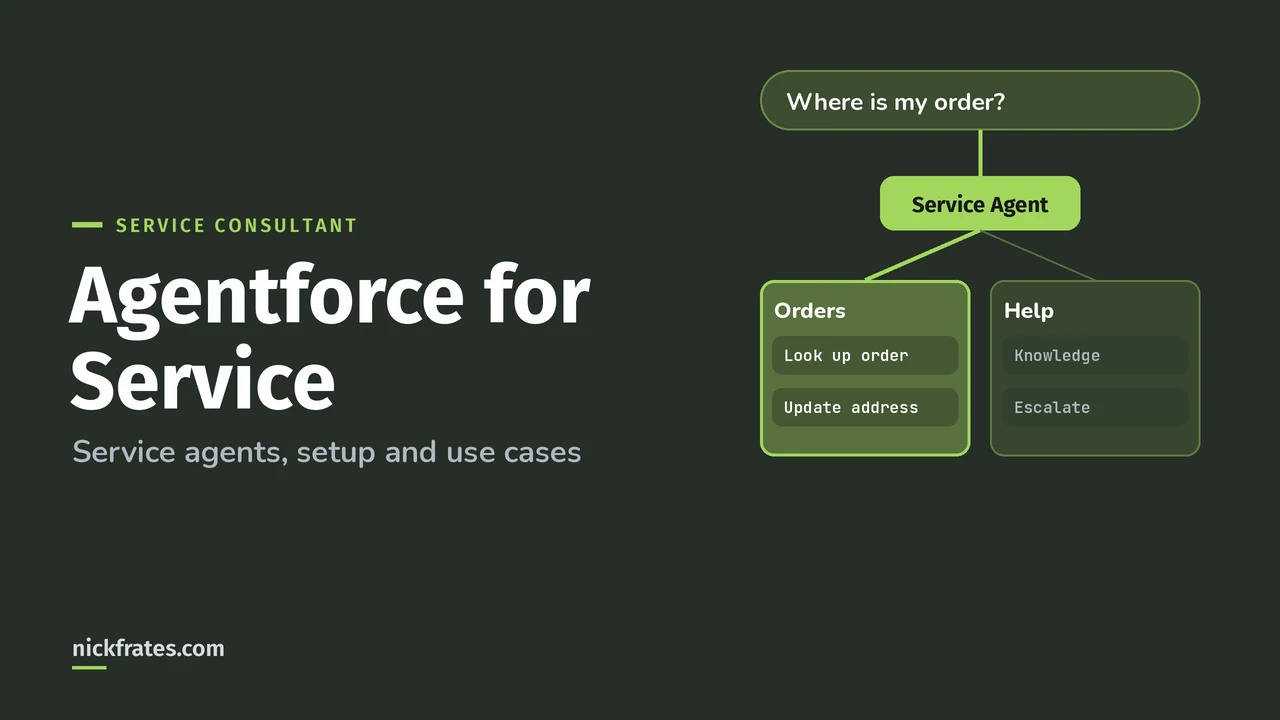
Agentforce for Service is Salesforce's AI layer for customer service, and its headline feature is the Agentforce Service agent: an autonomous AI agent that answers customers on messaging, chat, voice and self-service sites 24/7, takes actions in Salesforce, and hands off to a human rep with full context when it should.
Salesforce describes Agentforce Service as the next generation of what used to be called Einstein for Service (Trailhead). Service Cloud itself is now called Agentforce Service, so you'll see both names in docs for a while. On the Agentforce Service Consultant exam, Intake and Interaction Channels (13%) asks you to recommend where AI agents belong in the service process and to explain agentic capabilities, use cases and configuration.
What can an Agentforce Service agent actually do?
Unlike a scripted bot, an AI agent uses the Salesforce reasoning engine to hold a natural conversation, decide which action to run and complete it. Salesforce Help puts it this way: bots rely on scripted conversations, while AI agents act as an autonomous member of your support team (Messaging introduction).
In practice that means three things:
- Answer questions grounded in your Knowledge articles and other data you choose.
- Take actions like looking up an order or updating a record, through the subagents and actions you give it.
- Escalate to a rep or queue when it can't or shouldn't finish the job.
Quick vocabulary note: what used to be called topics are now subagents in the new Agentforce Builder. If you've read my Agentforce topics and actions post, same idea, new label.
How do you set up an Agentforce Service agent?
You build it in Agentforce Studio from a Service agent template, give it an agent user, choose its subagents, actions and data library, test it in Preview, connect it to a channel, then commit and activate a version. Here's the sequence from Salesforce Help:
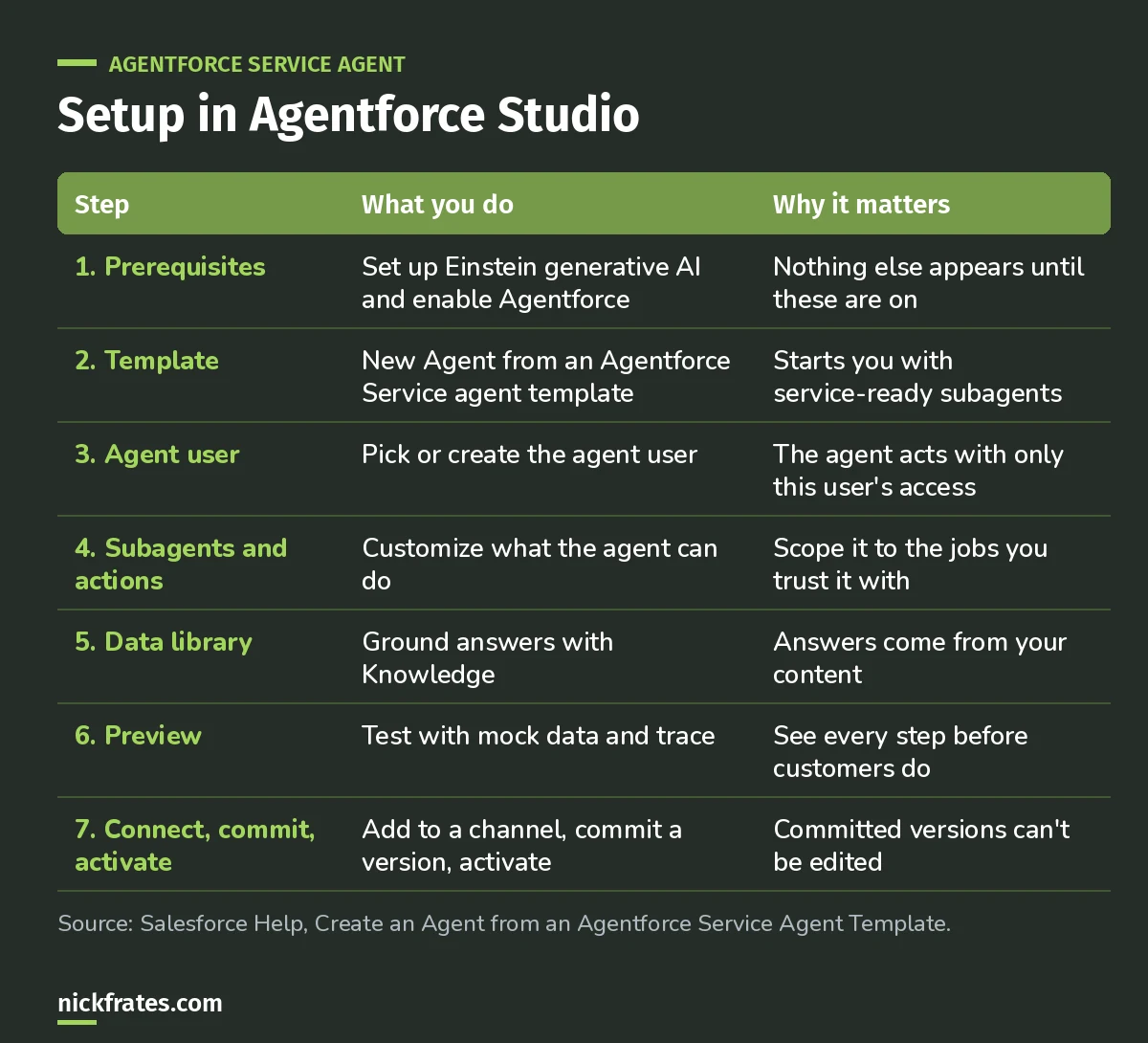
Seven steps, and the agent user step is the one people rush.
A few details that matter on the job and on the exam:
- Editions: Enterprise, Performance, Unlimited and Developer editions, with add-on licenses that vary by agent type.
- Permissions: Manage Agentforce Service Agents and Manage AI Agents, or Customize Application.
- Agent user: the agent runs as a Salesforce integration user. Give it only the access its job needs.
- New builder only: since the week of July 13, 2026, you can't create new agents in the legacy builder in Setup. Existing legacy agents keep running.
- Versions: you must commit a version before activating it, and committed versions can't be edited. Make a new version to keep changing things.
Here's why I care about practice questions so much. I earned 17 Salesforce certifications, and Focus on Force was a big part of that. My early approach was study guide first, tests later. Flipping it, taking practice tests fast and often, cut my study time way down. Cert Lab is my version of that: fast testing with explanations that link to current Salesforce docs and screenshots.
Cert Lab by Nick Frates
Let the Service Consultant Cert Lab test you to success
Scenario questions on AI agents, channels, routing and case management, with every option explained so you learn how Salesforce wants you to reason.
Start the Service Consultant Cert Lab for $9.99 →How do customers reach the agent?
Through a messaging channel whose routing sends conversations to the agent, usually with an Omni-Channel flow. Trailhead's enhanced messaging upgrade unit spells out the options: a queue and routing configuration can't route to an enhanced bot or AI agent; an Omni-Channel flow can route to reps, queues, enhanced bots and agents.
Give the flow a fallback path to a queue, so if the agent escalates or isn't available, a human picks it up.
Where does an Agentforce Service agent fit best?
These are the patterns I'd start with, because they're high volume, low risk and easy to measure:
| Use case | Why it fits | What the agent needs |
|---|---|---|
| Order or case status | Same question, thousands of times | Read access to orders or cases, a lookup action |
| Answering how-to questions | Answers already live in Knowledge | A data library pointed at published articles |
| Simple updates | Address or contact changes are rule-bound | An update action scoped to those fields |
| Triage before a human | Gathers details so reps don't start cold | Escalation to the right queue with context |
| After-hours coverage | Customers still get help at 2 a.m. | Clear escalation rules for what waits for a rep |
I'd keep refunds, legal complaints and anything emotional with humans at first. Prove value on the boring stuff, then expand.
How do you know it's working?
Start with the KPIs the exam guide names, deflection and average handle time, and add customer satisfaction. Salesforce's Trailhead ties the agent to higher rep productivity and first-contact resolution, because reps spend their time on the complex cases.
What mistakes should you avoid?
- Giving the agent user admin-level access. It does what its user can do. Keep it minimal.
- Grounding on stale Knowledge. The agent is only as accurate as the articles behind it. Clean those first.
- No fallback queue. Escalations with nowhere to go frustrate customers fast.
- Skipping Preview and trace. Test realistic and messy customer messages, not just the happy path.
- Routing with a plain queue. Queues can't route to AI agents; use an Omni-Channel flow.
FAQ
Is Agentforce for Service the same as Einstein for Service?
It's the next generation of it. Salesforce now groups predictive, generative and agentic service AI under Agentforce Service.
Do I need Knowledge for an Agentforce Service agent?
Not strictly, but the Answer Questions with Knowledge action uses a data library to ground answers, and most service agents rely on it.
Can an Agentforce Service agent hand off to a human?
Yes. Escalation to a rep or queue is a core part of the design, which is why routing and a fallback queue matter.
Can I convert an Einstein bot into an agent?
Salesforce released a Create Agent from Bot option (beta) that generates agent topics and actions from a bot's intents and dialogs, and the bot stays active while you test the agent.
Where should you go next?
- The Agentforce Service Consultant study guide covers all eight exam sections.
- Einstein Trust Layer explains how Salesforce protects data in AI prompts.
- Agentforce tutorial if you want to build your first agent hands-on.
Cert Lab by Nick Frates
Let the Agentforce Service Consultant Cert Lab test you to success
Lessons, flashcards, a quiz for each of the eight exam sections and full practice exams, every answer explained.
Start the Service Consultant Cert Lab for $9.99 →Hope this helps!
Best,
Nick