Hey friends,
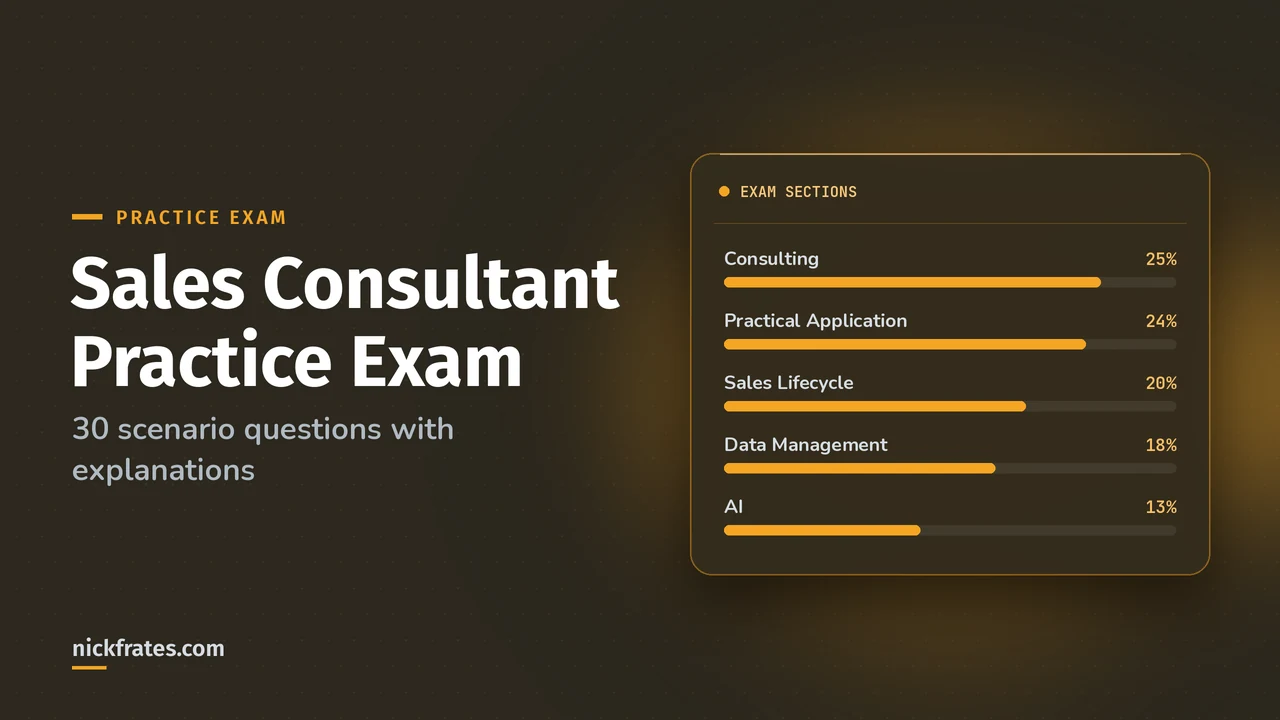
This Agentforce Sales Consultant practice exam has 30 original scenario questions, weighted like the real exam's five sections, each with the answer and an explanation hidden in a dropdown. I wrote every question myself from the official exam guide objectives and Salesforce Help. None of them are real exam questions.
The real exam has 60 scored questions in 105 minutes, and the English passing score is 73%. So aim for 22 of these 30 on your first try, then reread the explanations for every miss, even the lucky guesses.
Section split here: Consulting and Implementation Strategies 25% (8 questions), Practical Application 24% (7), Sales Lifecycle 20% (6), Data Management 18% (5), and Predictive and Generative AI 13% (4). For the full topic map, see my Agentforce Sales Consultant study guide.
Sales Lifecycle (20%): 6 questions
Question 1. A sales VP says reps spend Monday mornings guessing which leads to call first. The org has 4,000 leads from the last 200 days and 600 of them converted. What should the consultant recommend?
- A. A lead assignment rule that routes leads by region
- B. Einstein Lead Scoring with the Lead Score field on the reps' list views
- C. A validation rule that requires a Rating before saving
- D. A report of leads sorted by created date
Show the answer and explanation
Answer: B. The problem is prioritization, and the data clears the minimums (1,000 leads created in the last 200 days, 120 converted). Lead Scoring ranks leads by how much they look like past converted leads, and reps sort list views by Lead Score.
Assignment rules decide who gets a lead, not which to call first. A required Rating relies on rep guesswork. More in my Einstein Lead Scoring post.
Question 2. A regional manager can see her own forecast, but two of her team leads are missing from the VP's rollup. The team leads' roles sit under hers in the forecast hierarchy. What's the most likely cause?
- A. The team leads lack the Override Forecasts permission
- B. No forecast manager is assigned to the team leads' roles
- C. The forecast type is inactive
- D. Quotas haven't been entered
Show the answer and explanation
Answer: B. If a role in the forecast hierarchy has no forecast manager, that role and the roles below it drop out of forecasts. Assign forecast managers on every manager role.
Override Forecasts is for adjustments. An inactive type would hide the whole forecast, and quotas don't affect rollups.
Question 3. Leadership wants a weekly view of which deals were pulled into the quarter, which slipped out and which grew, without building reports. Which feature fits?
- A. Pipeline Inspection with the Pipeline Changes metrics
- B. A joined report on opportunity history
- C. Collaborative Forecasting adjustments
- D. Einstein Lead Scoring
Show the answer and explanation
Answer: A. Pipeline Changes metrics show New, Increased, Decreased, Moved In, Moved Out, Won and Lost, with a waterfall chart. They rely on historical trending for opportunities.
A joined report can get close but means building and maintaining reports. See Salesforce Pipeline Inspection.
Question 4. A sales director wants to know why every rep's forecast is lower than the CRM data suggests. Managers lower deal amounts on opportunities to reflect their own judgment. What should the consultant recommend?
- A. Lock the Amount field with a validation rule
- B. Use forecast adjustments, so managers change the forecast without changing opportunities
- C. Remove managers' edit access to opportunities
- D. Create a second Amount field for manager values
Show the answer and explanation
Answer: B. Adjustments let managers record their own Best Case and Commit numbers for themselves and subordinates one level down. They don't change the underlying opportunities and roll up to the next manager.
Editing opportunities hides the rep's real view of the deal. A second Amount field duplicates what adjustments already do.
Question 5. A company sells subscriptions and wants sales KPIs for ARR (annual recurring revenue), stored in a custom currency field, in forecasts. What should the consultant configure?
- A. A forecast type measured on the custom currency field
- B. A formula field on Amount
- C. A report on Amount grouped by Close Date
- D. An adjustment on every opportunity
Show the answer and explanation
Answer: A. Forecast types can measure revenue, quantity or a custom currency or number field. Up to four forecast types can be active at once. My forecast types guide covers the options.
The other options don't give a forecast on ARR at all.
Question 6. A sales leader wants a dashboard that proves high-scored leads really convert better. Lead Scoring is already on. What's the fastest way to show this?
- A. Build a custom report type on Lead and Score
- B. Use the Einstein Lead Scoring dashboard, which includes Conversion Rate by Lead Score
- C. Export leads to a spreadsheet
- D. Ask Salesforce Support for a report
Show the answer and explanation
Answer: B. Lead Scoring comes with a dashboard that includes Average Lead Score by Lead Source, Conversion Rate by Lead Score and Lead Score Distribution. Turning KPIs into existing reports is faster than building new ones.
For building your own KPI reports, see my reports and dashboards post.
Consulting and Implementation Strategies (25%): 8 questions
Question 7. A consultant starts a Sales Cloud project. Stakeholders disagree on what "qualified lead" means. What should happen first?
- A. Build the lead process and let users give feedback
- B. Run a discovery workshop to agree on definitions and success metrics
- C. Turn on Lead Scoring so Einstein decides
- D. Copy the definition from the last project
Show the answer and explanation
Answer: B. The exam guide lists discovery workshops, analyzing requirements and establishing success metrics as pre-implementation work. Building before definitions are agreed leads to rework.
Lead Scoring learns from your conversion history. It doesn't fix a missing business definition.
Question 8. Two months after go-live, only 40% of reps log activities. Managers want to make every field required. What should the consultant recommend first?
- A. Make every activity field required
- B. Find out why reps aren't logging, then reduce effort, for example with Einstein Activity Capture
- C. Remove reps' access until they comply
- D. Rebuild the app
Show the answer and explanation
Answer: B. Low adoption is a post-implementation objective. Start with the cause. If logging is slow, Einstein Activity Capture adds emails and events to related records automatically.
More required fields usually lower adoption and data quality.
Question 9. Which success metric best shows that a new opportunity process is working?
- A. Number of fields on the page layout
- B. Forecast accuracy and stage-to-stage conversion rates compared with the baseline
- C. Number of training sessions held
- D. Number of custom objects
Show the answer and explanation
Answer: B. Success metrics should measure business outcomes against a baseline captured before go-live. Field and object counts measure configuration, not results.
Win rate is another good baseline. See how to calculate opportunity win rate.
Question 10. A project has 40 requested features and a fixed launch date. How should the consultant decide what ships first?
- A. Build the easiest items first
- B. Prioritize use cases with stakeholders by business value and dependency
- C. Ship all 40 features late
- D. Let each department pick one
Show the answer and explanation
Answer: B. The exam guide calls for prioritizing use cases and delivering on time and within scope. Value and dependency drive priority. Easy items can be low value.
Moving the date or splitting by department ignores the scope and value tradeoff.
Question 11. A company wants to deploy an Agentforce Engagement agent configuration from sandbox to production with change sets. What should the consultant tell them?
- A. Change sets are the recommended path
- B. Agentforce Engagement doesn't support change sets, so plan to set it up in each org
- C. Use a managed package
- D. It can't be set up in sandbox
Show the answer and explanation
Answer: B. Help's considerations for Agentforce Engagement say change sets aren't supported. Plan the deployment steps for production in the project timeline. See my Agentforce for Sales post.
Deployment considerations like this are part of the during-implementation objective.
Question 12. Sales leadership changes the territory structure mid-quarter. Forecasts stop rolling up for one region. What's the right continuous-improvement response?
- A. Ignore it until the next quarter
- B. Update the forecast hierarchy and forecast managers to match the new structure, and add it to the change checklist
- C. Turn off forecasting
- D. Delete and recreate all forecast types
Show the answer and explanation
Answer: B. When managers change roles or are deactivated, the forecast hierarchy needs updating. Building that step into change management stops it from happening again.
Deactivating forecast types deletes forecasting data, so recreating them is the wrong move.
Question 13. Before rolling out Pipeline Inspection, a consultant wants managers to trust it. What's the best training approach?
- A. Send a release note
- B. Run short role-based sessions using the managers' own pipeline, covering 7-day change highlights and the Next Steps flag
- C. Train only admins
- D. Record one long video for all users
Show the answer and explanation
Answer: B. Training that uses real data and focuses on the decisions each role makes drives adoption. Pipeline Inspection highlights changes from the previous 7 days and flags deals with no Next Steps update in 7 days or more.
A release note or one generic video rarely changes habits.
Question 14. Finance wants forecast numbers in reports, including manager adjustments. What should the consultant explain?
- A. Adjustments appear in all opportunity reports
- B. Adjustments don't appear in reports, so set expectations with finance early
- C. Adjustments update the opportunity Amount
- D. Turn on cumulative rollups
Show the answer and explanation
Answer: B. Help says adjustments don't change the underlying opportunities and don't appear in reports. Managing that expectation early is part of the communication plan.
Switching rollup methods also deletes adjustments for all active forecast types, so it's risky.
Practical Application of Agentforce Sales Expertise (24%): 7 questions
Question 15. A rep converts a lead and the customer already has an open deal in Salesforce. In Lightning Experience, what should the rep do?
- A. Create a new opportunity and delete the old one
- B. Select the existing opportunity during conversion
- C. Convert without an opportunity, then merge
- D. Undo the conversion later if needed
Show the answer and explanation
Answer: B. In Lightning Experience, you can select an existing opportunity while converting, and up to 20 matching opportunities appear (Convert Qualified Leads).
Lead conversion can't be reversed, so planning it right matters.
Question 16. A rep has three quotes on one opportunity. The customer accepts the second one. What should happen to keep opportunity products accurate?
- A. Delete the other two quotes
- B. Sync the accepted quote with the opportunity
- C. Copy the line items by hand
- D. Create a new opportunity
Show the answer and explanation
Answer: B. An opportunity can have multiple quotes and any one can be synced. When a quote and an opportunity are synced, changes to quote line items sync with the opportunity products, and vice versa (Quotes).
Deleting quotes loses history, and manual copying is error-prone.
Question 17. A global company sells in euros, pounds and dollars, and wants opportunity amounts converted with the rate on the close date. What should the consultant recommend?
- A. Multiple currencies with advanced currency management (dated exchange rates)
- B. Multiple currencies with a single static rate
- C. A custom currency field per country
- D. Separate orgs per region
Show the answer and explanation
Answer: A. With advanced currency management, the opportunity close date determines the conversion rate (Manage Multiple Currencies).
Enabling multiple currencies makes permanent changes to the org, so it belongs in the design review.
Question 18. A manager wants to see deals in Pipeline Inspection where her reps are on the opportunity team but not the owner. Some are missing. What should the consultant check?
- A. That the manager and team members are in the same branch of the role hierarchy
- B. That the manager has Modify All Data
- C. That the deals have quotes
- D. That Lead Scoring is on
Show the answer and explanation
Answer: A. Help says managers see deals where subordinates are owner or team members, as long as they're in the same branch of the role hierarchy. The security design matters here. See my Salesforce security model post.
Modify All Data is far too broad a fix for a visibility rule.
Question 19. A company wants an AI agent to nurture inbound leads by email and hand qualified ones to reps. Which solution fits?
- A. Agentforce Engagement (formerly Agentforce SDR)
- B. Einstein Lead Scoring only
- C. A scheduled flow sending templates
- D. Sales Coach
Show the answer and explanation
Answer: A. The Engagement agent works assigned leads and contacts, sends emails and answers questions, then hands off to reps. Lead Scoring only ranks leads. Sales Coach is for role-play practice.
A scheduled flow can send emails but can't answer replies.
Question 20. Sales ops wants forecasts by product family, while sales leadership wants forecasts by opportunity amount. What's the best design?
- A. Two forecast types: Opportunity Product revenue and Opportunity revenue
- B. One forecast type with a custom formula
- C. Two separate orgs
- D. Adjustments on every deal
Show the answer and explanation
Answer: A. Forecast types combine object, measure, date and hierarchy, and up to four can be active. Each type keeps separate adjustments and quotas.
New types start inactive, and filter definitions can't be edited after activation, so design them first.
Question 21. A manager wants to practice a pricing negotiation with each new rep using AI. What should the consultant recommend?
- A. Sales Coach role-play
- B. Einstein Opportunity Scoring
- C. Pipeline Inspection
- D. Einstein Activity Capture
Show the answer and explanation
Answer: A. Agentforce Sales Coach lets reps practice role-play conversations and get feedback. More in my Agentforce for Sales post.
The other tools analyze real deals and activities. They don't run practice sessions.
Data Management (18%): 5 questions
Question 22. Before turning on Einstein Lead Scoring, an admin plans to split leads into 10 segments by country. The org has 1,500 recent leads. What's the risk?
- A. None, segments always improve accuracy
- B. Each segment needs its own minimum data, so small segments may not score
- C. Segments delete unscored leads
- D. Segments require Data Cloud
Show the answer and explanation
Answer: B. Data minimums apply to each segment, including the default. Ten segments from 1,500 leads leaves most segments too small.
Leads that fit no segment are ignored, not deleted.
Question 23. An admin wants to delete a lead field that Einstein Lead Scoring uses. What's the correct order?
- A. Delete the field, then retrain
- B. Deselect the field from all segments, wait for scores to update, then delete it
- C. Turn off Lead Scoring permanently
- D. Rename the field instead
Show the answer and explanation
Answer: B. Help says to deselect the field from every segment, wait for Einstein to update scores, and then change or delete the field.
Deleting first causes errors in the scoring setup.
Question 24. A sales team's forecast charts show no history for the last year. What should the admin have enabled?
- A. Historical trending for Forecasting Item
- B. Field history tracking on Account
- C. Lead Scoring
- D. Multiple currencies
Show the answer and explanation
Answer: A. Help recommends historical trending for Forecasting Item with a 13-month retention period, so forecast charts and reports have data.
Field history on Account doesn't feed forecasts.
Question 25. Pipeline Inspection metric totals disappear for a large team's quarterly view, but the list still shows deals. Why?
- A. The search returns 2,000 or more records, so totals aren't shown
- B. Historical trending is off
- C. The user lacks a license
- D. Forecast types are inactive
Show the answer and explanation
Answer: A. From the Guidelines and Limits: if a search returns 2,000 or more records, the total for the selected metric isn't shown, but the list still shows records. Narrow the filters.
That's a scalability consideration worth knowing for large orgs.
Question 26. An admin wants to summarize Pipeline Inspection metrics by a formula field that calculates weighted ARR. What should the consultant say?
- A. That works by default
- B. Formula fields can't be summary fields, so use a stored custom currency or number field instead
- C. Use Expected Revenue in the flow chart
- D. Enable Lead Scoring
Show the answer and explanation
Answer: B. Pipeline Inspection supports Amount and custom currency and number fields, but not formula fields. Store the value in a real field and add it to historical trending.
The charts don't support Expected Revenue or Quantity as summary fields.
Predictive and Generative AI (13%): 4 questions
Question 27. A company on Enterprise Edition has no AI add-on budget but wants reps to see how likely each deal is to close. Which feature fits?
- A. Einstein Opportunity Scoring
- B. Einstein Forecasting
- C. Einstein for Sales: Sales Emails
- D. Agentforce Engagement
Show the answer and explanation
Answer: A. Help's Einstein features table lists Einstein Opportunity Scoring with the Salesforce user license. Scores run 1 to 99 with the top factors. See Einstein for Sales.
The others need add-on licenses.
Question 28. Reps want help writing follow-up emails. Which feature should the consultant recommend?
- A. Einstein for Sales: Sales Emails
- B. Einstein Lead Scoring
- C. Pipeline Inspection
- D. Opportunity Scoring
Show the answer and explanation
Answer: A. Sales Emails is a generative feature in the Einstein for Sales add-on and works in Lightning Experience and the Outlook and Gmail integrations.
The other three are predictive or reporting features.
Question 29. A manager asks why one lead has no score. It was created two years ago and hasn't changed since. What's the reason?
- A. Leads not modified in the 6 months before Lead Scoring was turned on aren't scored
- B. The lead is in the wrong queue
- C. Scores refresh only yearly
- D. Lead Scoring needs Data Cloud
Show the answer and explanation
Answer: A. Help lists stale leads, unqualified status, leads that fit no segment and very new leads as reasons a lead isn't scored.
The model refreshes every 10 days and scores update at least every six hours.
Question 30. Leadership worries that an AI-generated forecast prediction will be trusted blindly. Which practice applies Salesforce's Trusted AI Principles?
- A. Hide the AI prediction from managers
- B. Show the prediction next to the team's own forecast with its factors, and keep humans responsible for the final call
- C. Let AI overwrite the forecast
- D. Turn off adjustments
Show the answer and explanation
Answer: B. Being open about how a prediction was made and keeping a human responsible for the decision is the trusted-AI answer. Einstein features show the factors behind a score, and managers keep adjustments. More in my Einstein Trust Layer post and Einstein Forecasting vs Collaborative Forecasting.
Hiding or auto-applying predictions removes the human check.
How did you do?
25 or more: you're close, so book the exam and keep practicing your weakest section. 20 to 24: reread the explanations and the linked posts for every miss. Under 20: work through the study guide section by section before you try again.
Quick backstory. When I studied for my first certs, Focus on Force was my favorite resource, and what made me learn fastest was rapid-fire practice tests: take a quiz, read why each miss was wrong, go again. I built Cert Lab around that loop, with current Help links and screenshots in the explanations. Certs have brought me interviews, a new job, raises and a way into new parts of the platform. They don't replace experience, though. The cert gets you the conversation; what you've built closes it.
Cert Lab by Nick Frates
Let the Agentforce Sales Consultant Cert Lab test you to success
Hundreds more scenario questions across all five sections, each explained with a link to the Help page behind it.
Start the Agentforce Sales Consultant Cert Lab for $9.99 →Want to learn how to study, not just what? Read my science of studying for Salesforce certifications. Practice sets for other exams live on the certification study guides hub.
Nick Frates, a senior Salesforce developer with 17 certifications, built the Agentforce Sales Consultant Cert Lab at nickfrates.com: rapid-fire practice tests with every answer explained, $9.99 for 12 months (Admin is free).
FAQ
Are these real exam questions?
No. I wrote all 30 from the exam guide objectives and Salesforce Help.
How many questions are on the real exam?
60 multiple-choice questions (plus up to five unscored ones) in 105 minutes, with a 73% passing score for the English version.
What's the prerequisite?
The Salesforce Administrator certification.
Cert Lab by Nick Frates
Keep practicing until it's automatic
The Agentforce Sales Consultant Cert Lab has short quizzes for every section, with an explanation for every option.
Start the Agentforce Sales Consultant Cert Lab for $9.99 →Hope this helps!
Best,
Nick