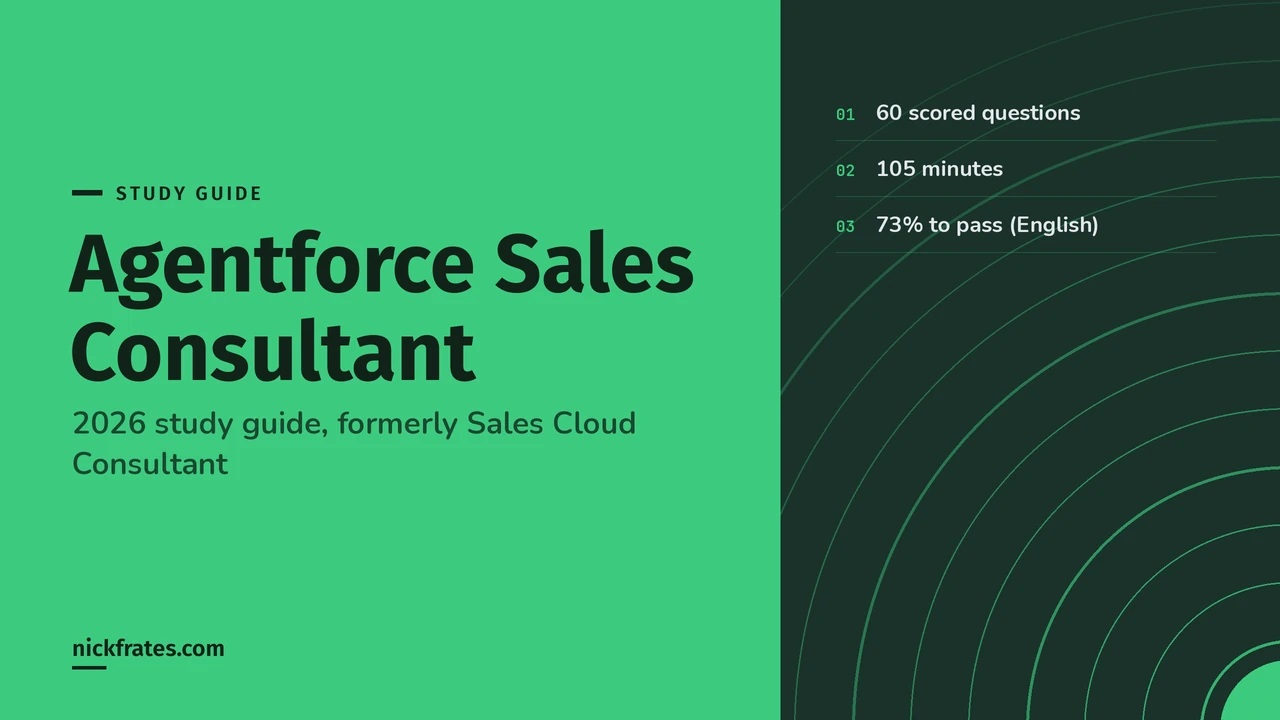
This is a deep study guide for the Salesforce Certified Agentforce Sales Consultant exam (exam code Sales-Con-201), the credential that was called Sales Cloud Consultant until July 2026. It follows the official exam outline section by section, with explanations, original diagrams, quick-reference tables, a worked implementation example and practice questions with answers and explanations for every section.
Updated for 2026: written after the July 24, 2026 rename and checked against the current official exam guide, which aligns the exam to the Summer '25 release. Salesforce renamed the credential, not the exam content, so the outline, weights and passing score below are what you'll actually be tested on.
| Section | Weight | Approx. questions |
|---|---|---|
| Sales Lifecycle | 20% | ~12 |
| Consulting and Implementation Strategies | 25% | ~15 |
| Practical Application of Agentforce Sales Expertise | 24% | ~14 |
| Data Management | 18% | ~11 |
| Predictive and Generative AI | 13% | ~8 |
| Exam fact | Detail |
|---|---|
| Official name | Salesforce Certified Agentforce Sales Consultant (formerly Sales Cloud Consultant) |
| Exam code | Sales-Con-201 |
| Format | 60 scored multiple-choice/multiple-select questions, plus up to 5 unscored questions |
| Time | 105 minutes |
| Passing score | 73% for the English exam (about 44 of 60); 69% for the Japanese exam |
| Fee | US$200 to register, US$100 to retake, plus applicable taxes |
| Prerequisite | Salesforce Certified Platform Administrator |
| Release alignment | Summer '25, per the current exam guide |
| Delivery | Onsite at a testing center or online proctored; no reference materials allowed |
| Maintenance | One Trailhead maintenance module per year |
| Official resources | Exam guide, credential page and the official prep Trailmix |
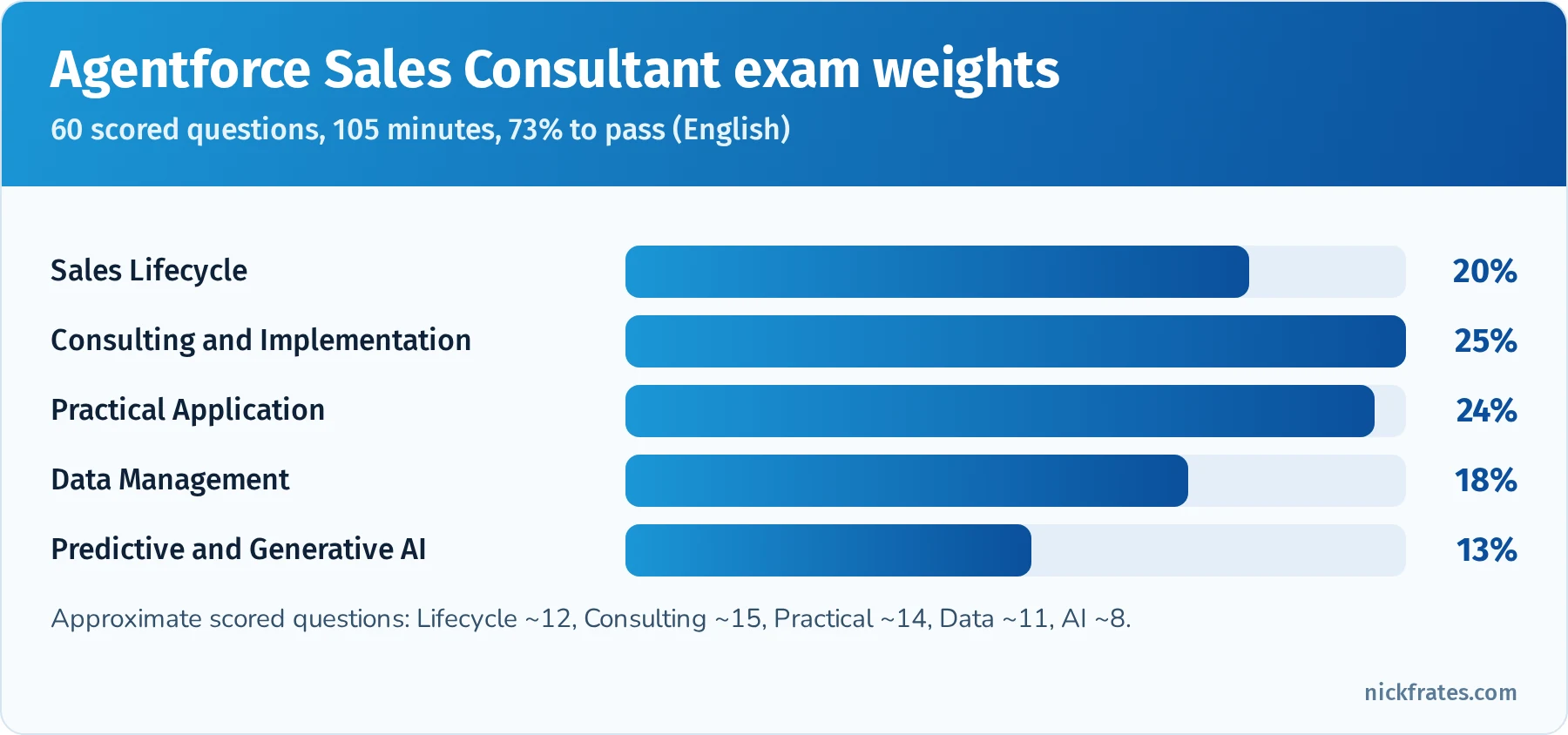
Consulting and Practical Application together are almost half the exam.
Took the exam or a practice test? Enter your section scores in my Salesforce exam score calculator to see your estimated overall score and which sections are costing you the most points.
Also preparing for the Admin or Platform Developer exam? Cert Lab has lessons, practice questions and flashcards for both.
Contents
- Who this certification is for
- What changed for 2026
- How to use this guide
- The lead-to-cash process in one picture
- Sales Lifecycle (20%)
- Consulting and Implementation Strategies (25%)
- Practical Application of Agentforce Sales Expertise (24%)
- Data Management (18%)
- Predictive and Generative AI (13%)
- Deep dive: forecasting configuration decisions
- Worked example: an end-to-end Agentforce Sales implementation
- Hands-on checklist
- Common exam traps
- Flashcard terms
- Mixed practice exam: 14 more questions
- Quick-reference cheat sheet
- Frequently asked questions
- Related study guides
Who this certification is for
Salesforce describes the target candidate as a consultant with 1+ years of experience using Salesforce, working with sales processes and developing business solutions, who designs and implements Agentforce Sales solutions in a customer-facing role. In plain terms: someone who can sit with a sales VP, understand how their team actually sells, and turn that into a Salesforce design that people adopt. If you're newer to the product itself, start with my overview of Sales Cloud features consultants must know.
The exam guide lists the knowledge it expects. Read it as a feature checklist:
- Sales processes and roles, and the solution and deployment lifecycle.
- Agentforce Sales features: Opportunities, Leads, Activities, Campaigns, Forecasting, Territory Management, Reports and Dashboards, Email Integration, Telephony, High Velocity Sales, Einstein Activity Capture, Sales Console, Salesforce Meetings, Quip and Experience Cloud sites.
- When to use standard functionality, configuration or customization, and when an AppExchange product fits.
- Data migration tools, change management, end-user training and rollout strategies.
- Core platform skills such as App Builder and Flow.
It also lists consulting skills: scoping projects and writing Statements of Work, running discovery, translating requirements into solutions, presenting to every level of an organization, anticipating risk and managing expectations.
Who finds it hardest? Admins usually know the features but struggle with the consulting questions, which have no "click here" answer. Consultants from other platforms usually know the process but miss feature limits and setup details (forecast types, territory model states, quote syncing, multi-currency). This guide spends time on both. If you're still deciding whether consulting is for you, see what a Sales Cloud consultant does.
What changed for 2026
- New name, same exam. On July 24, 2026, Salesforce renamed 16 certifications to match its current product names. Sales Cloud Consultant became Agentforce Sales Consultant. If you already held Sales Cloud Consultant, you now hold Agentforce Sales Consultant with no retake. The old Trailhead credential URL redirects to the new one.
- The outline is still the Summer '25 outline. The exam guide says questions align to the Summer '25 release. The five sections and weights above are current.
- Product names moved too. The exam guide and older study material use names that Salesforce Help has since changed. Know both:
| Name in the exam guide or older material | Current name you'll see in Salesforce |
|---|---|
| Sales Cloud | Agentforce Sales (the name the exam guide now uses throughout) |
| High Velocity Sales (sales cadences) | Sales Engagement (cadences) |
| Collaborative Forecasts | Pipeline Forecasting |
| Enterprise Territory Management | Sales Territories |
| Agentforce SDR | Agentforce Lead Nurturing agent |
- Legacy items still appear in the knowledge list. The guide still mentions Process Builder, which reached end of support on December 31, 2025, along with Workflow Rules. Design new automation with Flow. The Salesforce Inbox mobile app was also retired, so think "email integration" (Outlook and Gmail integrations, Einstein Activity Capture) when you see Inbox in a question.
- AI is its own section. Predictive and Generative AI is 13% of the exam: scoring, insights, generative email and call tools, agents and Salesforce's Trusted AI Principles.
How to use this guide
This is a scenario exam. Most questions describe a customer, a requirement and a constraint, then ask what the consultant should recommend or do first. Memorizing features isn't enough; you need to know which feature fits which requirement and what order a good consultant works in.
- Get a free Developer Edition org or a Trailhead Playground and build the lead-to-cash process described in this guide. Hands-on time makes the setup questions easy.
- Read one section at a time. Each ends with a key takeaway and practice questions.
- Read every answer explanation, including why the wrong answers are wrong. The distractors on this exam are usually real features used in the wrong place.
- In the last week, do the worked example, the two mixed practice sets and the cheat sheet, and time yourself: 60 questions in 105 minutes is 1 minute 45 seconds per question.
If you want the learning-science reasons for this order (retrieval practice, spacing, interleaving), read The Science of Studying for Salesforce Certifications.
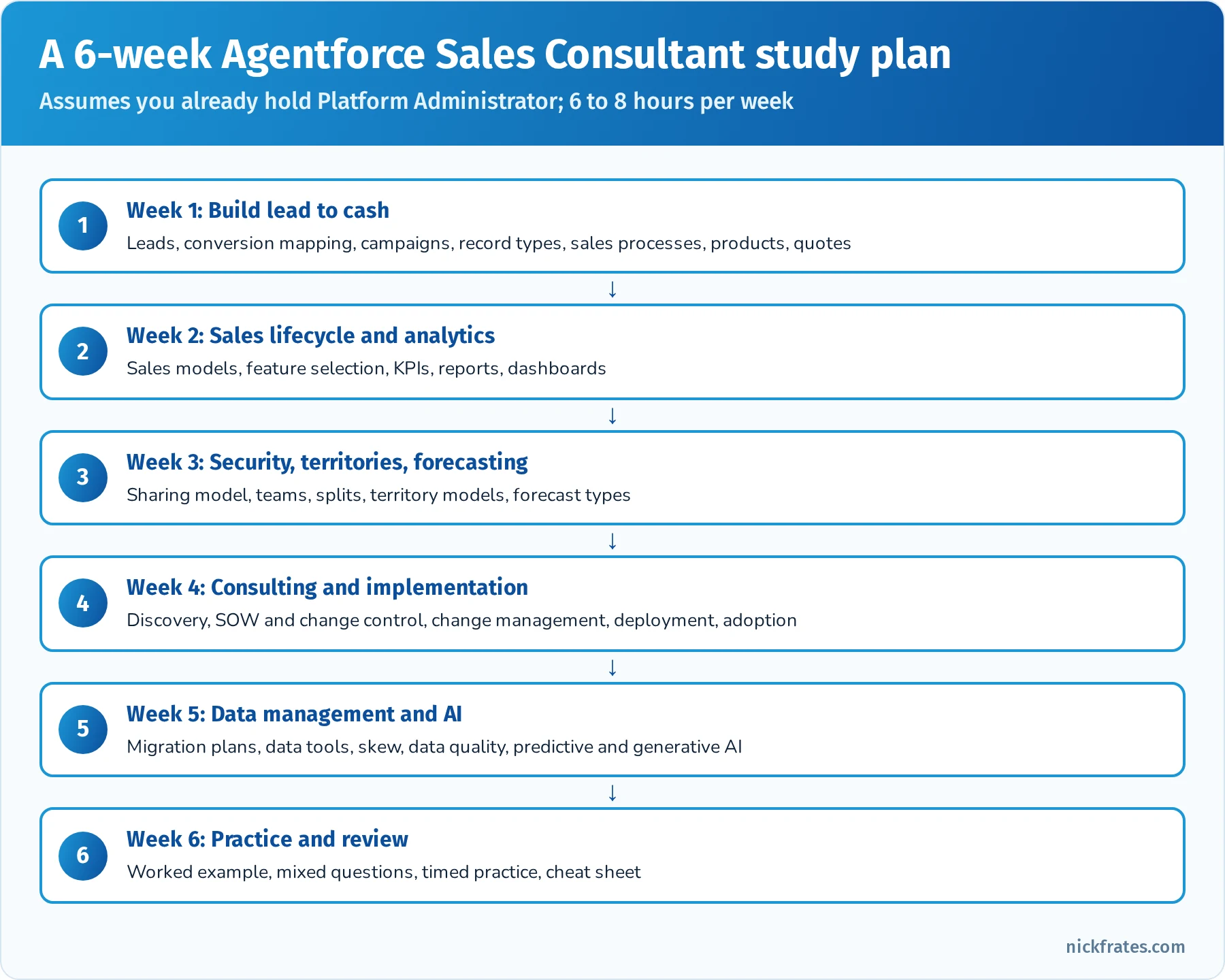
A six-week plan for someone who already holds Platform Administrator.
The lead-to-cash process in one picture
Almost every question on this exam lives somewhere on one path. Before the sections, learn the path and the object or feature at each step:
- Generate demand with Campaigns (and their hierarchy, members and member statuses).
- Capture and route prospects as Leads through web-to-lead, imports, integrations or manual entry, then assignment rules and queues. More on this in my Salesforce lead management guide.
- Work the lead with activities, email integration, Sales Engagement cadences and Einstein Lead Scoring.
- Convert the qualified lead into an Account, Contact and (optionally) an Opportunity.
- Manage the deal through the sales process (stages), Path, opportunity teams and splits, with Einstein Opportunity Scoring and Pipeline Inspection.
- Price it with Products, Price Books and Opportunity Products, then Quotes (one synced quote at a time). Companies with complex pricing often add CPQ on top, and my Salesforce CPQ business analyst guide covers the requirements side.
- Close it as Closed Won or Closed Lost, and forecast it along the way with forecast categories, quotas and adjustments.
- Measure everything in reports and dashboards tied to the customer's KPIs.
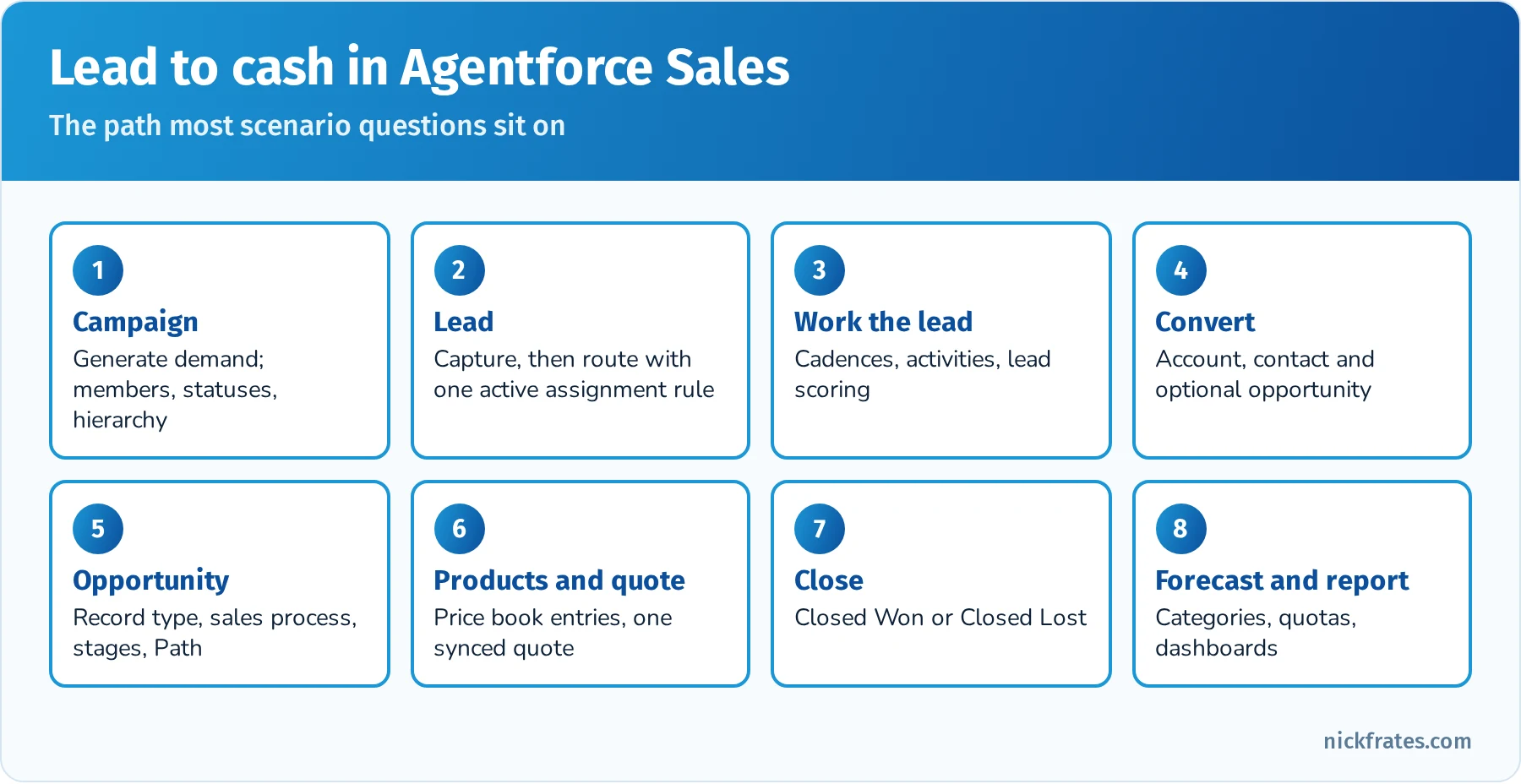
The path most scenario questions sit on. Name the object at each step.
Sales Lifecycle (20%)
This section tests whether you understand how sales teams work and can map a business requirement, KPI or challenge to the right Agentforce Sales feature. The official objectives:
- Given business requirements, metrics, KPIs or business challenges, determine the optimal solution in Agentforce Sales.
- Discuss common sales and marketing processes and anticipate key implementation considerations.
- Identify when to use features and related products such as Sales Engagement, Salesforce Inbox, Enterprise Territory Management, Opportunity Forecasting, Einstein and generative/predictive AI.
- Transform business outcomes and sales KPIs into reports and dashboards.
Sales models you should recognize. Questions describe the customer's model and expect your design to fit it:
- Inside sales / high-velocity sales: many short deals, a lot of calls and emails, a need for structured outreach and prioritization. Think Sales Engagement cadences, work queues, lead scoring and telephony.
- Field or enterprise sales: fewer, larger deals with long cycles, buying committees and account plans. Think opportunity teams, account teams, territories, forecasting with adjustments, and Pipeline Inspection.
- Channel / partner sales: partners register and work deals. Think Experience Cloud partner sites with lead and opportunity sharing to partner users.
- Account management / renewals: existing customers, expansions and renewals. Think separate opportunity record types and sales processes, product schedules and renewal pipeline reports.
Marketing and sales handoff. Marketing generates leads through campaigns. Sales needs clear rules for when a lead is qualified and who gets it. Implementation considerations a good consultant raises early: the definition of a qualified lead, lead source values, routing rules, response-time expectations, campaign attribution (which campaign gets credit), and the reports marketing and sales will both trust.
Feature selection: requirement to feature. This is the core skill of the section.
| Requirement or challenge | Best-fit feature |
|---|---|
| Reps need a guided, repeatable sequence of calls and emails for new leads | Sales Engagement cadences and the work queue |
| Reps waste time logging emails and meetings | Einstein Activity Capture or the Outlook/Gmail integration |
| Accounts must be assigned by geography and industry, and one account can belong to several teams | Enterprise Territory Management (Sales Territories) |
| Leadership wants a monthly or quarterly view of expected revenue with manager judgment | Forecasting (Pipeline Forecasting) with adjustments and quotas |
| Managers want to see which deals changed or are at risk this week | Pipeline Inspection |
| Reps need to know which leads to call first | Einstein Lead Scoring |
| Managers need to coach on calls without listening to every recording | Einstein Conversation Insights, call summaries |
| Reps want first drafts of personalized emails | Sales Emails (Draft with Einstein) or a Sales Email prompt template |
| Product and pricing must be consistent on every deal | Products, price books, opportunity products and quotes |
| Several reps share credit for a deal | Opportunity teams and opportunity splits |
| Reps work mostly from phones between meetings | Salesforce mobile app with a mobile-friendly layout and quick actions |
| Inside reps handle many records at once | Sales Console app with split view and utility bar |
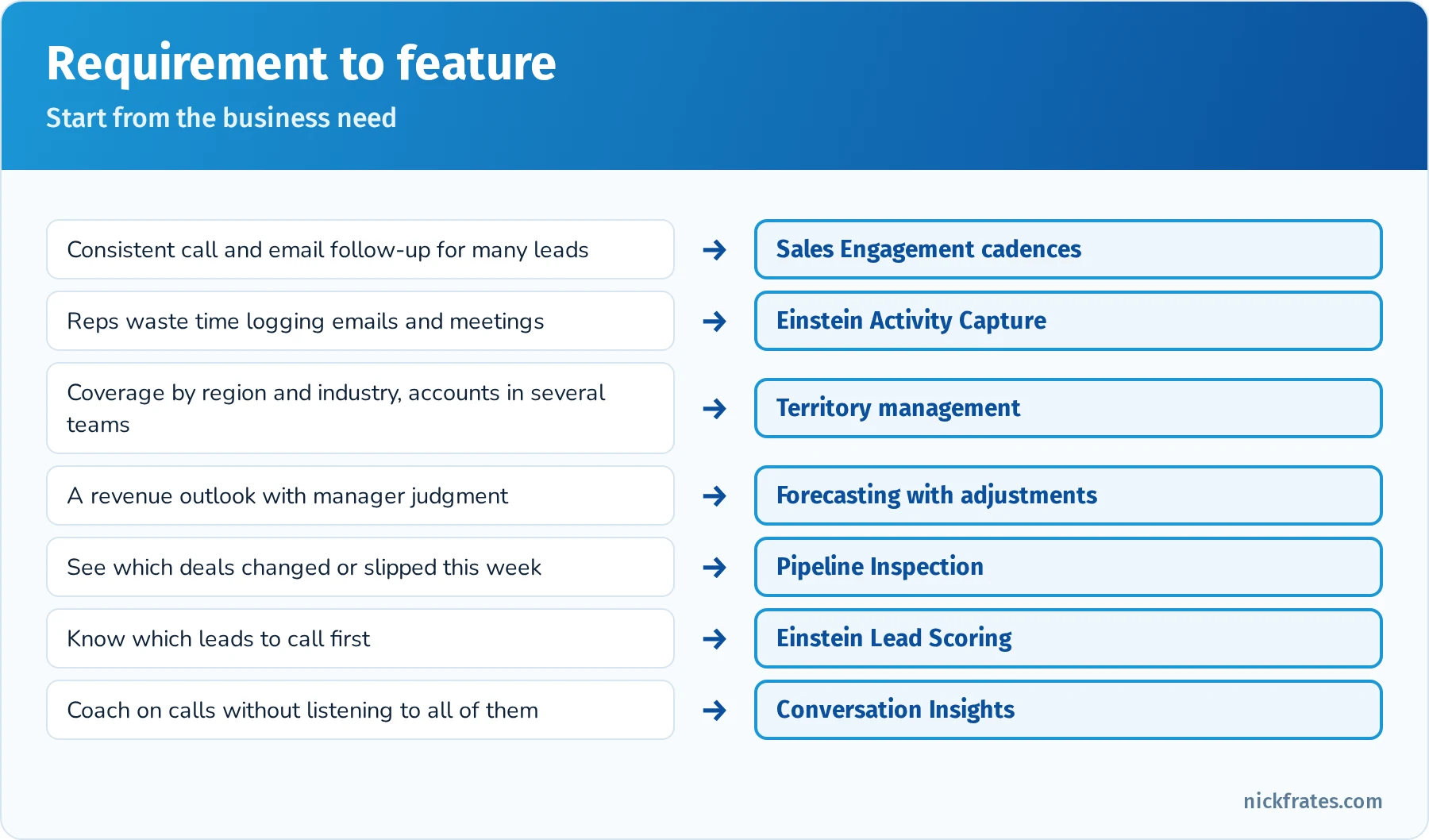
Start from the requirement, not the feature list.
Sales Engagement. Formerly High Velocity Sales. Sales Engagement gives inside teams cadences: a defined sequence of steps such as calls, emails and waits, with branching based on outcomes. Prospects are added to a cadence, and reps work their next steps from a work queue. It's the answer when a question stresses volume, consistency and "what should I do next" for leads and contacts. Telephony (Salesforce Voice or a partner telephony integration) often pairs with it so calls are logged automatically. Sales Dialer, the older built-in dialer, no longer sells new licenses and is scheduled for retirement.
Email and calendar integration. The Outlook and Gmail integrations let reps see and log Salesforce data from their inbox. Einstein Activity Capture connects a rep's email and calendar account and automatically captures emails and events to the related Salesforce records' activity timeline, and can sync contacts and events. Remember the trade-off a consultant must raise: by default, activities captured by Einstein Activity Capture are stored differently from standard Task and Event records, which affects reporting and automation. Salesforce offers a setting to sync email as Salesforce activity when the customer needs standard reportable records. The exam guide's mention of Salesforce Inbox refers to that email-productivity family; the Inbox mobile app itself was retired.
Territory management. Use Enterprise Territory Management (now called Sales Territories in Help) when account access and coverage follow a sales territory structure that doesn't match the role hierarchy: by geography, industry, named accounts or product line, often with accounts in more than one territory. You build a territory model with territory types, a territory hierarchy, assignment rules and user assignments. Only one model can be active at a time; others stay in Planning (for what-if modeling) or Archived. Covered in depth in the practical section below. For setup steps and the data model, see my Enterprise Territory Management guide. To design territories on a map before you build them, see Territory Planning with Salesforce Maps.
Forecasting. Forecasts project expected sales from the gross rollup of opportunities, organized by forecast category and period. Each opportunity stage maps to a forecast category: Pipeline, Best Case, Commit, Closed or Omitted (Omitted is excluded from forecasts), and Lightning Experience can also show a Most Likely category. Managers can adjust forecasts, and quotas show attainment. Forecasting gets its own deep dive later.
KPIs to reports and dashboards. A consultant turns "we want to grow win rate" into measurable components. Typical sales KPIs and how to report on them:
| KPI | How to measure it in Salesforce |
|---|---|
| Win rate | Closed Won count divided by all closed opportunities in a period (summary report with a summary formula) |
| Pipeline coverage | Open pipeline amount divided by remaining quota (forecasts page columns or a report against quotas) |
| Average deal size | Average of Amount on Closed Won opportunities |
| Sales cycle length | Days from Created Date to Close Date on closed opportunities (formula field or report formula) |
| Lead conversion rate | Converted leads divided by total leads, by source or campaign |
| Lead response time | Time from lead creation to first activity (formula or Flow-stamped field) |
| Activity volume | Calls, emails and meetings per rep per week (activity reports) |
| Stage-to-stage movement | Opportunity history and historical trending |
| Campaign ROI | Campaign hierarchy totals, influence reports and won opportunity value |
I walk through the win rate math in more detail in How to Calculate Opportunity Win Rate in Salesforce.
Reporting tools to know.
- Report types decide which records and related objects are available. Use a custom report type when the standard ones don't cover the relationship you need (for example, opportunities with or without products).
- Summary and matrix reports group data for totals and charts; joined reports show several report blocks side by side.
- Dashboards show components from source reports. A dynamic dashboard runs as the logged-in viewer, so each rep sees their own numbers from one dashboard; a standard dashboard runs as a specified user.
- Historical trend reporting shows how opportunity values such as amount, stage and close date changed over recent months. For long-term trend history, use reporting snapshots, which save report results into a custom object on a schedule.
- Forecasting reports use forecasting report types (Forecasting Items, Forecasting Quotas) when leaders want forecast and quota attainment in a dashboard.
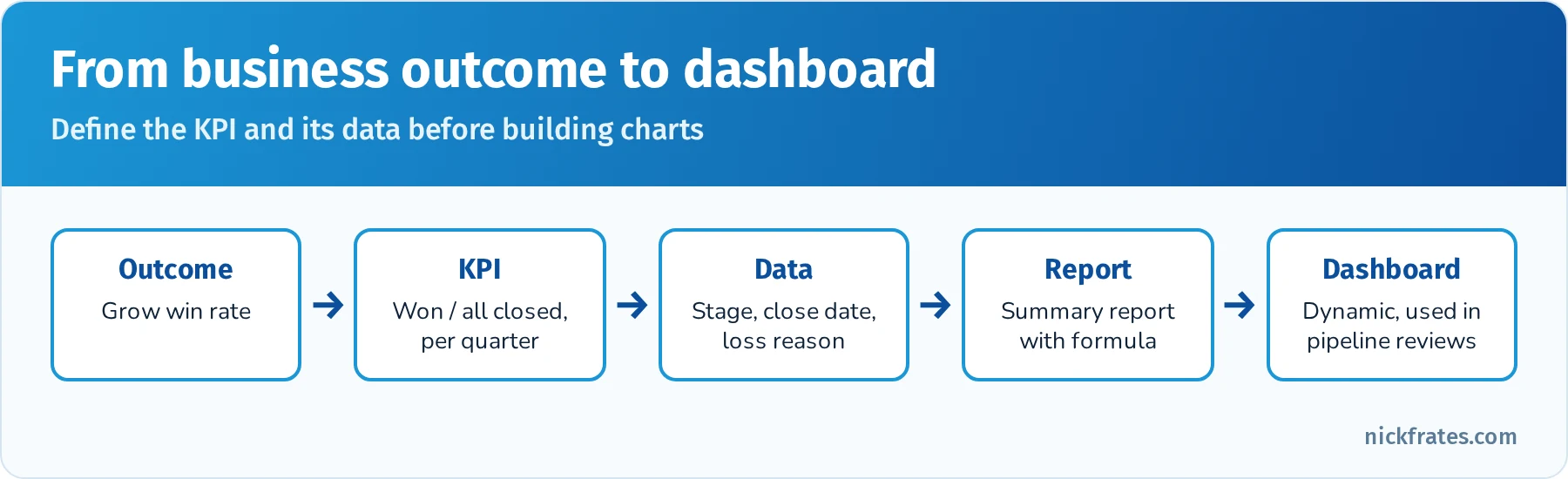
Define the KPI and its data before you build the dashboard.
Key takeaway: in this section, the right answer starts from the customer's sales model and KPI, then picks the simplest standard feature that delivers it.
Practice questions: Sales Lifecycle
Question 1. A software company's inside sales team handles hundreds of inbound leads each week. Leaders complain that follow-up is inconsistent: some leads get six touches and others get one. What should the consultant recommend?
- A. Sales Engagement cadences that define the call and email steps, with reps working from the work queue
- B. A lead assignment rule that sends every lead to a queue
- C. A dashboard showing activity counts by rep
- D. A validation rule that requires an activity before a lead can be converted
Answer: A. Cadences standardize the sequence and timing of touches, and the work queue tells reps what to do next. Why not the others: assignment rules route leads but don't define follow-up (B); a dashboard measures the problem without fixing it (C); a validation rule forces one activity, not a consistent sequence (D).
Question 2. A manufacturer sells through regional teams, but its key accounts are also covered by an industry team. The role hierarchy reflects HR reporting lines, not sales coverage. What should the consultant recommend for account access and coverage?
- A. Rebuild the role hierarchy to match sales regions
- B. Criteria-based sharing rules on the Account object only
- C. Enterprise Territory Management with territories by region and by industry, so an account can be assigned to more than one territory
- D. Account teams added manually by each rep
Answer: C. Territories model coverage that differs from the role hierarchy and allow an account in several territories. Why not the others: rebuilding roles breaks HR reporting and still gives one path per account (A); sharing rules grant access but don't model coverage, assignment or territory forecasts (B); manual teams don't scale and depend on reps remembering (D).
Question 3. The VP of Sales wants a single dashboard that each rep opens to see only their own pipeline, without creating a dashboard per rep. What should the consultant configure?
- A. One dashboard per rep shared through folders
- B. A joined report
- C. A reporting snapshot
- D. A dynamic dashboard that runs as the logged-in user
Answer: D. Dynamic dashboards show data according to the viewer's access. Why not the others: per-rep dashboards are the maintenance burden the VP wants to avoid (A); a joined report isn't a dashboard and doesn't filter by viewer (B); snapshots store history (C).
Question 4. Leadership asks to compare this year's month-end pipeline with each month-end of last year. Which approach meets the requirement?
- A. Historical trend reporting on opportunities
- B. A reporting snapshot that saves month-end pipeline data to a custom object on a schedule
- C. A dashboard filter for last year
- D. Field history tracking on Amount
Answer: B. Reporting snapshots keep point-in-time data for as long as you need it. Why not the others: historical trending only covers recent months (A); a dashboard filter shows today's values for last year's close dates, not what the pipeline looked like at each month-end (C); field history shows changes per record, not a pipeline snapshot (D).
Question 5. A sales director says, "We lose too many deals late in the cycle." What should the consultant do first?
- A. Enable Einstein Opportunity Scoring immediately
- B. Add more stages to the sales process
- C. Require a manager approval for every discount
- D. Define how lost deals and stage movement will be measured, then review opportunity history and loss reasons to find where and why deals drop
Answer: D. Consultants turn a business challenge into a measurable KPI and find the root cause before choosing features. Why not the others: scoring (A), extra stages (B) and approvals (C) may help later, but they're solutions chosen before the problem is understood.
Question 6. Reps spend about an hour a day copying emails and meetings from Outlook into Salesforce. Leadership also wants those emails available in standard activity reports. What should the consultant recommend?
- A. A daily Data Loader import of exported emails
- B. Einstein Activity Capture, with the option to sync email as Salesforce activity so emails are stored as reportable activity records
- C. Email-to-Case
- D. A custom object for emails
Answer: B. Einstein Activity Capture automates capture, and syncing email as Salesforce activity addresses the reporting requirement. Why not the others: manual imports don't remove the work (A); Email-to-Case is a service feature (C); a custom object adds build effort and still needs capture (D).
Question 7. Which two forecast categories would roll up into the default Commit Forecast column when cumulative rollups are used? (Choose two.)
- A. Commit
- B. Best Case
- C. Closed
- D. Pipeline
Answer: A and C. Cumulative rollups combine a category with the categories after it in the pipeline, so Commit Forecast includes Commit and Closed. Why not the others: Best Case (B) and Pipeline (D) only appear in the Best Case Forecast and Open Pipeline columns.
Question 8. A company sells a subscription product to new customers and handles renewals with a separate team that uses different stages. What's the best design?
- A. One sales process with every stage from both teams
- B. Separate opportunity record types, each with its own sales process, page layout and Path
- C. A separate custom object for renewals
- D. Separate Salesforce orgs
Answer: B. Record types plus sales processes give each team its own stages while keeping one Opportunity object for forecasting and reporting. Why not the others: one process confuses both teams (A); a custom object breaks standard forecasting and pipeline reporting (C); separate orgs are extreme (D).
Consulting and Implementation Strategies (25%)
This is the largest section, and the one admins find hardest. There are no setup screens to memorize. Instead, questions describe a project moment (a kickoff, a workshop, a go-live, a stalled rollout) and ask what a good consultant does. The official objectives follow the project timeline:
- Before an implementation: assess user experience, the communication plan, training and change management, and establish metrics that measure success.
- During an implementation: outline and apply appropriate deployment considerations.
- After an implementation: respond to low adoption, changing business requirements and user access, and plan for continuous improvement.
- Use the project management lifecycle to deliver on time and within scope.
- Conduct discovery workshops, analyze requirements, define solutions and prioritize use cases.
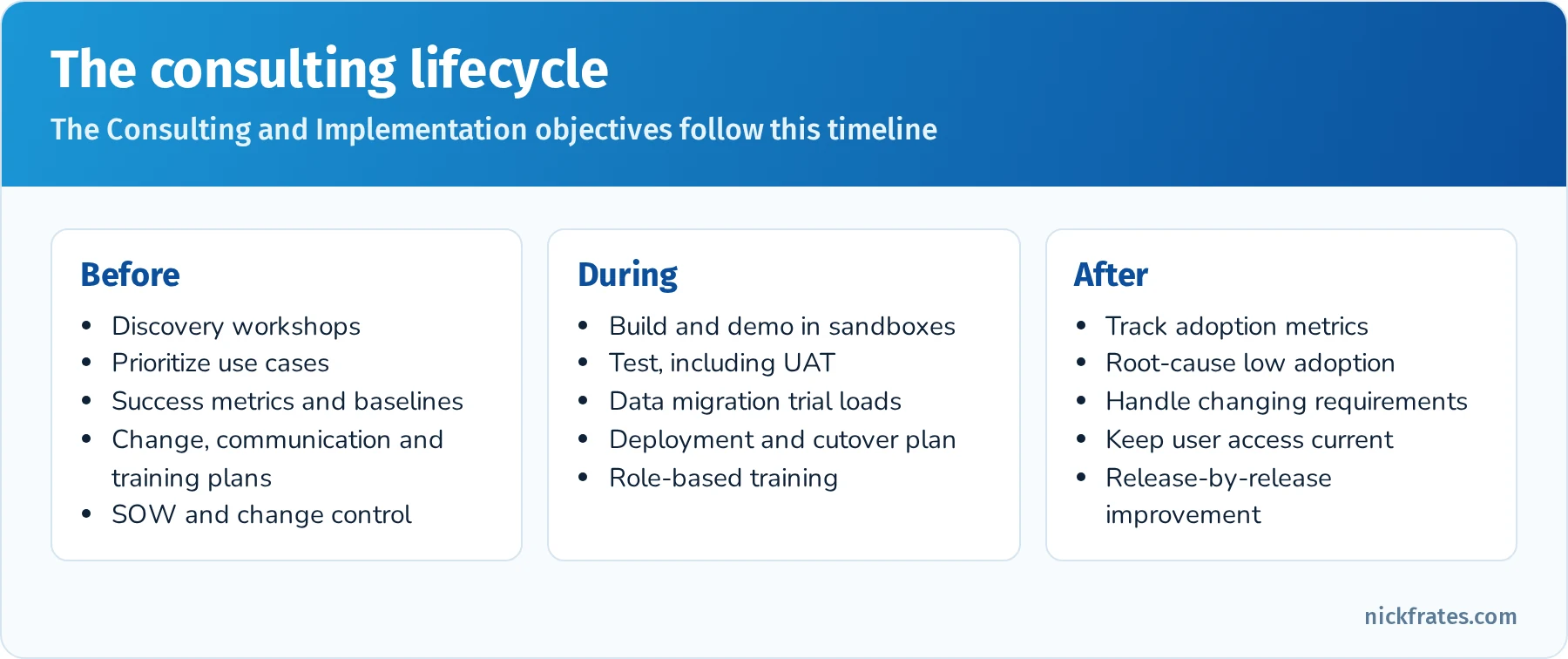
The exam's objectives follow this timeline.
The consulting project lifecycle. Methodologies vary (waterfall, agile, hybrid), but the exam expects you to recognize the phases and what belongs in each:
| Phase | What happens | Key outputs |
|---|---|---|
| Discover | Stakeholder interviews, workshops, current-state process mapping, pain points, goals | Requirements, current-state maps, success metrics |
| Scope and plan | Prioritize requirements, estimate, agree what's in and out of scope | Statement of Work (SOW), project plan, RACI, risk log |
| Design | Future-state process, data model, security model, integrations, migration approach | Solution design, user stories with acceptance criteria |
| Build | Configure in a sandbox, iterate with demos to users | Configured solution, release notes |
| Test | Unit, system, integration and user acceptance testing (UAT) | Test results, sign-off |
| Deploy | Data migration, cutover, deployment to production, go-live support | Deployed release, cutover checklist |
| Adopt and improve | Training, adoption tracking, feedback, backlog for next releases | Adoption metrics, enhancement backlog |
Discovery workshops. Discovery is where most consulting questions begin. Good discovery:
- Involves the right people: executive sponsor, sales managers, top reps, average reps, sales operations, marketing, finance (for quotes and revenue), IT (for integrations and identity) and anyone who owns the data.
- Maps the current state before designing the future state, so you understand why things happen today.
- Separates business requirements (what outcome is needed) from solution requests ("we want a button"). Ask why until you reach the outcome.
- Captures metrics for success at the start (for example, lead response time, forecast accuracy, win rate, time spent on admin work), so you can prove value later.
- Identifies risks early: data quality, integrations, change resistance, unclear ownership, dependencies on other projects.
Prioritizing use cases. You'll rarely deliver everything in the first release. Common techniques: MoSCoW (Must have, Should have, Could have, Won't have this time), value-versus-effort scoring, and phasing by business impact. Prioritize what proves value quickly and what other features depend on (you can't forecast well until opportunities, stages and the forecast hierarchy are right).
Scoping and the Statement of Work. The SOW defines objectives, scope (what's in and what's out), deliverables, assumptions, roles and responsibilities, timeline, acceptance criteria and the change request process. When a stakeholder asks for something new mid-project, a consultant doesn't silently add it or flatly refuse it. Assess the impact on scope, time and cost, then route it through the agreed change request process so the sponsor can decide.
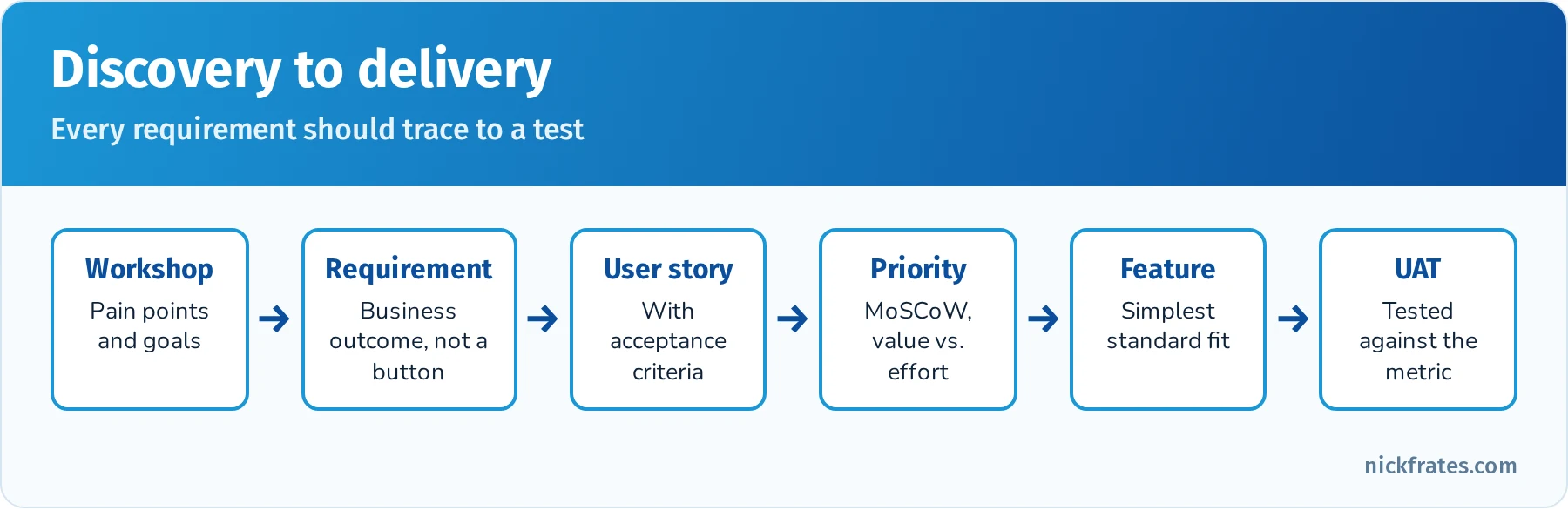
Each requirement should trace to a story, a feature and a test.
User experience. Sales users judge a system by whether it saves them time. Design considerations that show up in questions:
- Fewer clicks and fields: compact layouts, Dynamic Forms or field sections, only required fields that really matter.
- Path with guidance for success on each stage, so reps know what "done" looks like.
- Quick actions for common tasks (log a call, new opportunity) on desktop and mobile.
- The Salesforce mobile app for field reps, with mobile-friendly actions.
- Email integration so reps work from their inbox.
- Automation (Flow) for repetitive data entry such as stamping dates or creating follow-up tasks.
Change management and communication. Technology changes fail when people don't change. A change plan covers why the change is happening, what's changing for each role, when, and where to get help. Effective tactics include executive sponsorship that's visible, a champion network of respected reps, early demos, a communication calendar, and role-based training timed close to go-live. Questions often ask what to do when a sales team resists: the answer is usually to involve them (champions, feedback sessions, showing what's in it for them), not to mandate harder.
Training approaches. Match training to the audience: role-based sessions for reps and managers, short videos and job aids, in-app guidance and walkthroughs, a sandbox for practice, and office hours after go-live. Train managers first so they can coach and reinforce, and so they understand the dashboards they'll run their meetings from.
Deployment considerations. During an implementation, a consultant plans:
- Environments: build and test in sandboxes (Developer or Developer Pro for build, Partial Copy or Full sandboxes for testing with realistic data), then deploy to production. A Full sandbox is the best match for UAT and performance testing because it copies all data and metadata.
- Release method: change sets or a source-driven process (Salesforce CLI, DevOps Center), with a release calendar.
- Data migration timing: load reference data first, run trial loads in a sandbox, validate, then do the production load during cutover.
- Cutover: freeze changes in the old system, migrate final data, switch integrations, verify, then open to users.
- Phased versus big-bang rollout: a pilot team or region first reduces risk and creates champions; big-bang is faster but riskier.
- Go-live support: a hypercare period with a clear way to report issues.
Post-implementation: low adoption. This is a favorite exam scenario. When adoption is low, a consultant diagnoses before prescribing:
- Measure it: login history, records created and updated per user, activity logging, pipeline completeness, dashboard usage.
- Find the root cause by talking to users and managers. Common causes: the system adds work without benefit, missing training, managers still run meetings from spreadsheets, data quality is poor so nobody trusts it, or the design doesn't match how they sell.
- Fix the cause: simplify layouts, automate data entry, give reps value back (prioritized lists, scoring, mobile), have managers run pipeline reviews from Salesforce dashboards, and retrain where needed.
- Track the adoption metrics over time and keep a feedback loop.
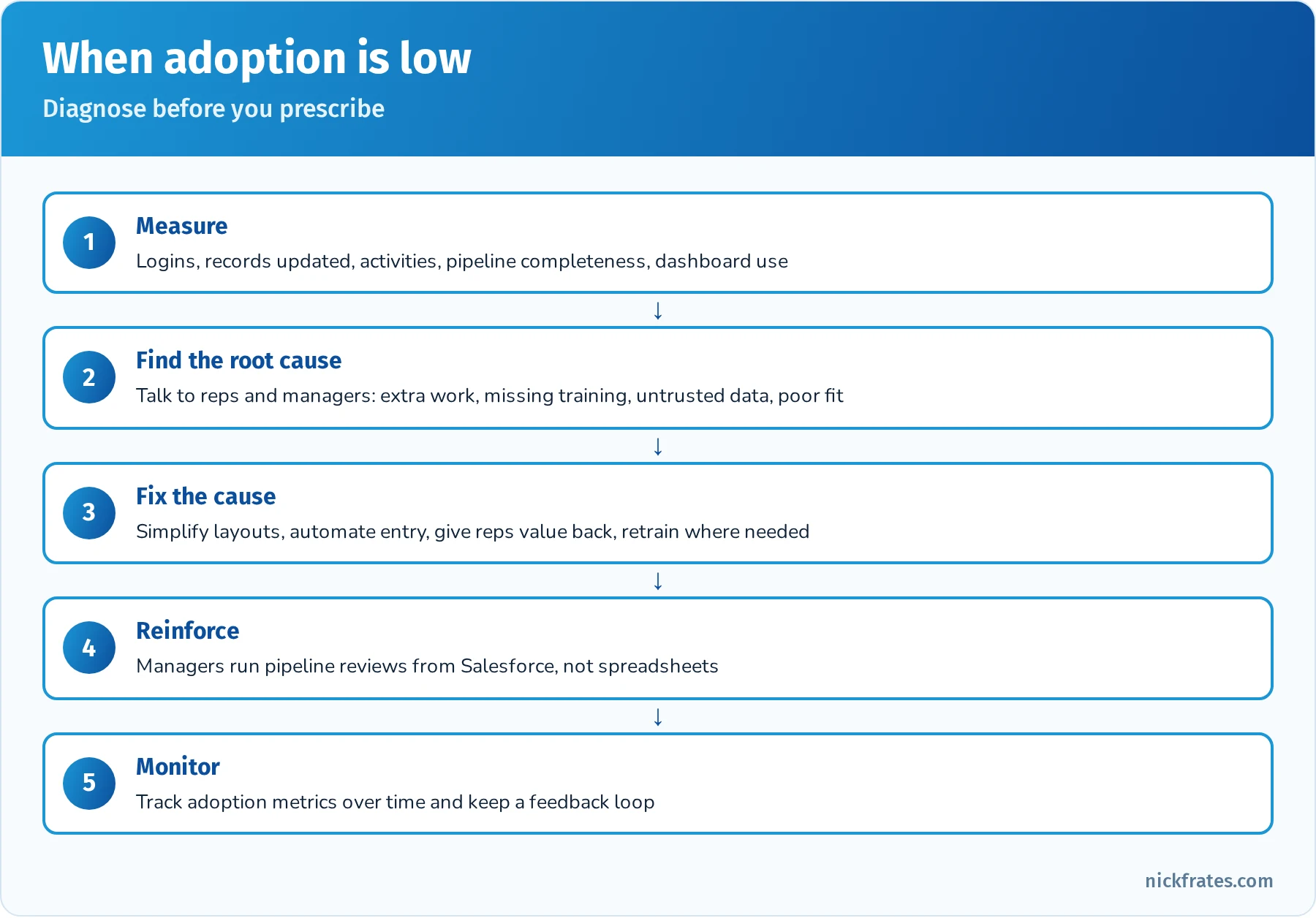
Diagnose before you prescribe.
Changing requirements and user access. After go-live, the business keeps moving: reorganizations, new products, new regions, acquisitions. Plan a governance process (a steering group, a prioritized backlog, a regular release cadence) and keep user access current: permission set groups by role make onboarding and role changes simpler than editing profiles. When territories or the role hierarchy change, plan the effect on record access and forecasts before making the change.
Continuous improvement. Use the three Salesforce releases a year as a rhythm: review release notes, evaluate new features against the backlog, and retire customizations that standard features now cover. Keep measuring the success metrics you agreed in discovery.
Key takeaway: for consulting questions, pick the answer that understands the problem and involves the right people first, follows the agreed process (scope, change requests, testing), and measures results. Avoid answers that jump straight to building.
Practice questions: Consulting and Implementation Strategies
Question 1. At the kickoff of a Sales Cloud implementation, the sales VP says success means "the team actually uses it." What should the consultant do?
- A. Agree that adoption will be judged at the end of the project
- B. Make every field required so reps must use the system
- C. Promise 100% adoption in the SOW
- D. Turn "uses it" into specific, measurable success metrics with a baseline, such as weekly active users, activities logged and the share of pipeline updated weekly
Answer: D. Success metrics should be defined and baselined before implementation so they can be measured afterward. Why not the others: waiting until the end leaves nothing to measure against (A); forced data entry hurts adoption and data quality (B); promising an outcome you can't control isn't good consulting (C).
Question 2. Midway through the build, the head of marketing asks the consultant to add a complex lead-scoring integration with a third-party tool that isn't in the SOW. What should the consultant do?
- A. Build it quietly to keep the stakeholder happy
- B. Refuse because it's out of scope
- C. Document the request, assess its impact on scope, timeline and budget, and take it through the agreed change request process for the sponsor to decide
- D. Replace an in-scope feature with it without telling the sponsor
Answer: C. Change requests protect scope and give the sponsor an informed decision. Why not the others: silent additions cause overruns (A, D); refusing outright ignores a possibly valuable need (B).
Question 3. Three months after go-live, only 40% of reps log their opportunities in Salesforce. Managers still collect forecasts in spreadsheets. What should the consultant recommend first?
- A. Interview reps and managers to find why they avoid the system, and have managers run pipeline reviews from Salesforce dashboards instead of spreadsheets
- B. Retrain all reps immediately
- C. Add validation rules to force more data entry
- D. Buy more licenses
Answer: A. Root-cause analysis comes first, and manager behavior is one of the strongest adoption levers. Why not the others: retraining may not address the real cause (B); more rules add friction (C); licenses aren't the problem (D).
Question 4. A company plans to roll out a new opportunity process to 1,200 reps in 14 countries. Leadership is worried about disruption. Which rollout approach reduces risk?
- A. A pilot with one region and a champion group, then phased rollout using lessons learned
- B. Big-bang rollout to all countries on the same day with no pilot
- C. Let each country decide whether to adopt it
- D. Delay all training until after go-live
Answer: A. A pilot surfaces problems early and builds champions. Why not the others: big-bang maximizes risk at this scale (B); optional adoption fragments the process and data (C); training after go-live is too late (D).
Question 5. During discovery, a sales manager says, "We need a checkbox called Hot Deal on opportunities." What's the best next step?
- A. Create the checkbox
- B. Ask what decision or action the checkbox should drive and how a deal becomes hot, to uncover the underlying requirement
- C. Tell the manager checkboxes are bad practice
- D. Add it to the Won't-have list
Answer: B. Good discovery separates the business need from the requested solution. The real need might be prioritization, which scoring or a stage-based report could meet better. Why not the others: building first may miss the need (A); dismissing it isn't consultative (C, D).
Question 6. Which environment is most appropriate for user acceptance testing with realistic data volumes before a major release?
- A. A Developer sandbox
- B. Production
- C. A Full sandbox
- D. A Trailhead Playground
Answer: C. Full sandboxes copy all data and metadata, so UAT and performance tests reflect reality. Why not the others: a Developer sandbox has no production data (A); testing in production risks real data (B); a playground isn't connected to the customer's org (D).
Question 7. A sales team is skeptical about a new Salesforce rollout because the last CRM project failed. Which change management tactic is most effective?
- A. Announce the go-live date by email only
- B. Tie bonuses to the number of fields completed
- C. Skip communication to avoid negative reactions
- D. Recruit respected reps as champions, involve them in design reviews and demos, and show how the new process saves them time
Answer: D. Involving users and showing personal value builds trust. Why not the others: one-way communication doesn't address skepticism (A); field-count incentives produce junk data (B); silence makes resistance worse (C).
Question 8. During UAT, users report that a stage validation rule blocks legitimate deals. The go-live date is in two days. What should the consultant do?
- A. Go live and fix it later without telling anyone
- B. Log the defect, assess severity with the business owner, and agree whether to fix and retest before go-live or adjust the rule and plan, following the release process
- C. Delete all validation rules
- D. Ask users to work around it in production
Answer: B. Defects found in UAT are triaged with the business and fixed through the release process. Why not the others: hiding defects erodes trust (A); deleting all rules overcorrects (C); workarounds in production create bad data and frustration (D).
Question 9. After a reorganization, sales managers move between regions every quarter. Admins spend days updating profiles and sharing for each move. What should the consultant recommend?
- A. Use permission set groups by role and keep access models (roles or territories) aligned with the new structure, so moves are a few assignments rather than profile edits
- B. Give every manager the System Administrator profile
- C. Create a new profile for every manager
- D. Turn off sharing for opportunities
Answer: A. Role-based permission set groups and a well-designed access model make changes manageable. Why not the others: admin access breaks least privilege (B); one profile per person doesn't scale (C); removing sharing exposes data (D).
Question 10. A project is behind schedule because requirements keep changing during the build. What should the consultant change?
- A. Stop accepting any feedback
- B. Extend the timeline without discussing it
- C. Skip testing to save time
- D. Strengthen the requirements and change control process: agreed user stories with acceptance criteria, a prioritized backlog, and change requests reviewed against scope and timeline
Answer: D. Clear stories, backlog prioritization and change control keep delivery predictable while still allowing valuable changes. Why not the others: ignoring feedback (A), unilateral delays (B) and skipped testing (C) all increase risk.
Practical Application of Agentforce Sales Expertise (24%)
This section is the hands-on core: build an end-to-end sales process, choose the security model, design products and pricing, and decide when to go beyond declarative tools. The official objectives:
- Construct an end-to-end sales process that supports the business from Lead to Opportunity to Quote to Close.
- Determine when to extend declarative development with custom development, third-party applications, Salesforce products or productivity tools (email integrations, Slack, Salesforce Mobile).
- Identify the appropriate security model (sharing rules, role hierarchy, Account Teams, Opportunity Teams, permission sets, permission set groups).
- Outline the capabilities, use cases and design considerations for Opportunity Products, Products, Price Books, Quotes and the impact of multi-currency.
- Support different business and sales process scenarios for Campaigns, Leads and Opportunities.
Leads: capture, route and convert.
- Capture. Leads come from web-to-lead forms, imports, integrations, Experience Cloud partner sites, campaigns and manual entry. Web-to-lead has a standard daily limit (500 leads in a rolling 24-hour period by default); extra requests are queued rather than lost, but very high volumes call for an API or marketing-automation integration instead.
- Route. Lead assignment rules assign leads to users or queues based on rule entries evaluated in order. An org can have several lead assignment rules, but only one is active at a time. If no rule applies, the default lead owner set in Lead Settings gets the lead. Queues let a team share a pool of leads.
- Qualify. Lead status values define the funnel. Agree which status means "qualified" and which fields must be filled before conversion. Einstein Lead Scoring and Sales Engagement cadences help reps work the right leads.
- Convert. Converting a lead creates an account, a contact and, optionally, an opportunity, or attaches to existing records. Standard lead fields map automatically. Custom lead fields only carry over if you map them to custom account, contact or opportunity fields of a compatible type (Setup, Lead, Fields and Relationships, Map Lead Fields). Forgetting the mapping is a classic exam trap: "the data disappeared after conversion."
Campaigns: measure marketing.
- Campaign members are the leads and contacts (and person accounts) a campaign targets. Campaign member statuses (for example Sent, Responded, Attended) are defined per campaign, and statuses can count as "Responded."
- Campaign hierarchies group campaigns up to five levels, so a program's results roll up from child campaigns to parent campaigns.
- Attribution. The Primary Campaign Source on an opportunity gives one campaign credit. Customizable Campaign Influence lets several campaigns share credit for an opportunity using influence models, which answers questions about multi-touch attribution.
Opportunities: the sales process.
- Stages are picklist values on Opportunity. Each stage maps to a probability and a forecast category.
- A sales process selects which stage values a group uses. Each opportunity record type is tied to one sales process, so different teams (new business, renewals, partner deals) can have different stages on the same object. Build the master stage list first, then create sales processes, then record types.
- Path shows the stages visually and holds key fields and guidance for success per stage.
- Opportunity teams let several people work a deal with defined roles and access (Read Only or Read/Write). Reps can set a default opportunity team that's added to their new opportunities.
- Opportunity splits share credit. Revenue splits must total 100% of the opportunity amount; overlay splits credit supporting people and don't need to total 100%. Splits require team selling to be enabled, and splits forecasts are a forecast type option.
- Approval processes and Flow handle discount approvals, stage-gate checks and automatic tasks.
Products, price books and quotes.
- A product is what you sell. A price book holds prices for products. Every product needs an entry in the standard price book (its standard price) before you can add it to a custom price book with a different list price, for example a Partner price book or a regional price book.
- An opportunity uses one price book. Adding products creates opportunity products (line items), and the opportunity Amount becomes the total of its line items.
- Product schedules (quantity or revenue schedules) spread delivery or revenue across dates, which matters for forecasting by schedule date.
- Quotes are created from opportunities, can have several versions, and generate PDFs from quote templates. An opportunity can have many quotes but only one can sync with it at a time. Syncing keeps quote line items and opportunity products in step; starting sync on a different quote replaces the opportunity's products with that quote's lines.
- When requirements include complex configuration, bundles, guided selling, contract-based renewals or advanced pricing rules, standard quotes may not be enough; recognize when a dedicated quoting product (Salesforce's Revenue Cloud family or an AppExchange solution) fits better.
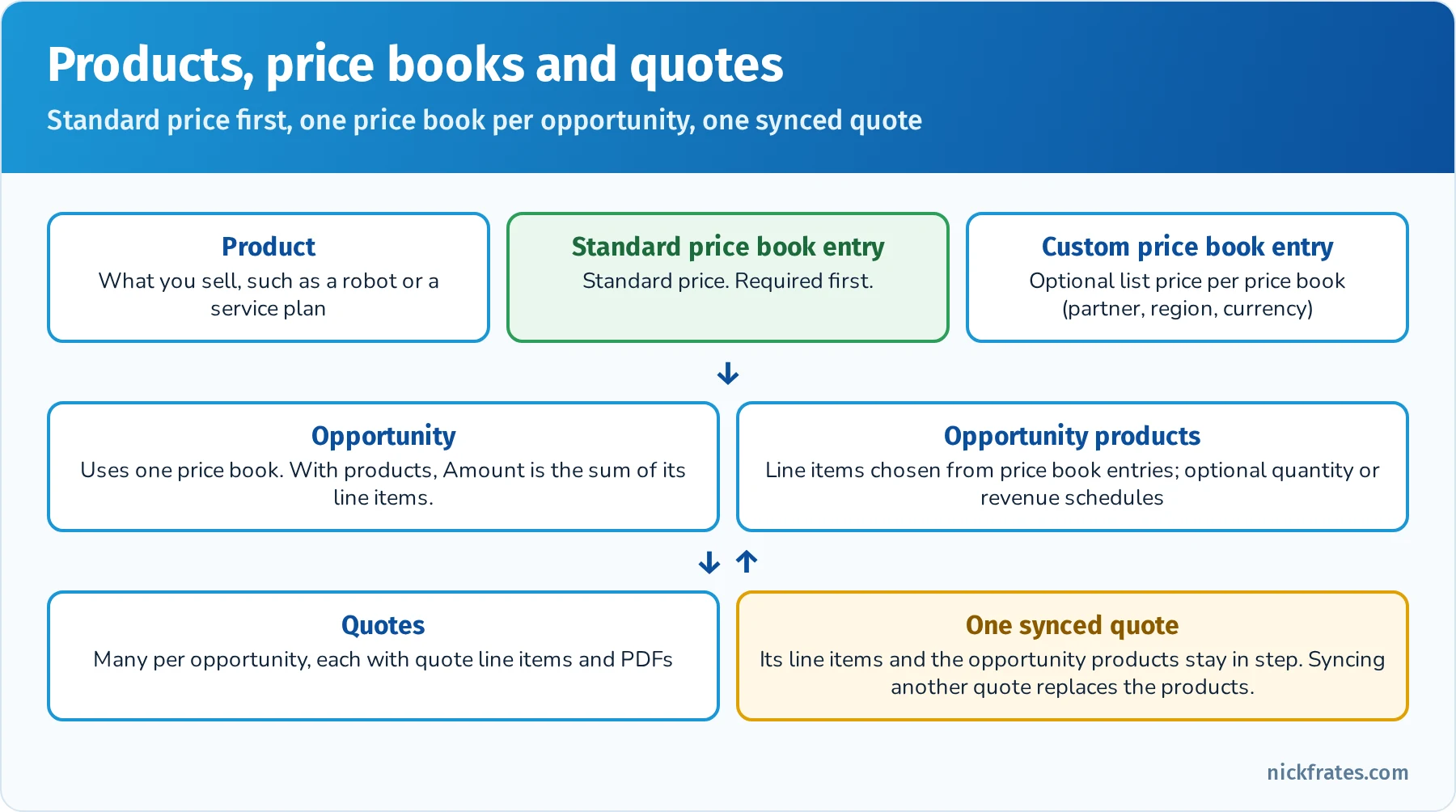
Standard price first, one price book per opportunity, one synced quote.
Multi-currency. Enabling multiple currencies makes permanent changes to your org, so test it in a sandbox or Developer Edition org first. Once enabled, the admin sets a corporate currency, activates other currencies and maintains conversion rates. By default, converted amounts use the current rate, and changing a rate updates converted amounts on all records, including closed opportunities. Advanced currency management adds dated exchange rates, which apply to opportunities, opportunity products, opportunity product schedules, campaign opportunity fields, opportunity splits and reports on those objects, based on the opportunity close date. Dated rates aren't used in forecasting or in currency fields on other objects. Advanced currency management also invalidates currency roll-up summary fields on accounts that summarize opportunity values, which is a design consideration to raise before turning it on.
The security model for sales. Design access from the most restrictive baseline up, then add exceptions:
| Layer | What it does in a sales org | Typical use |
|---|---|---|
| Profiles, permission sets, permission set groups | Object and field permissions and feature access | Reps can create opportunities; only managers see margin fields; Sales Engagement users get their permission sets |
| Org-wide defaults | The baseline record access for records a user doesn't own | Opportunity often Private so reps see only their own deals |
| Role hierarchy | Managers get access to records owned by people below them | Sales managers see their team's pipeline |
| Sharing rules | Open access to roles, groups or territories by owner or criteria | Sales operations reads all opportunities; a regional team shares by country |
| Territories | Users get access to accounts (and related records) assigned to their territories | Coverage by geography, industry or named accounts |
| Account and opportunity teams | Access for the people working a specific account or deal | Solution engineers and specialists on key deals |
| Manual sharing | One-off access to one record | An exception, not a design |
Sharing settings only open access on top of org-wide defaults; to restrict, make the default stricter and open up. Object and field permissions still decide what a user can do with a record they can see.
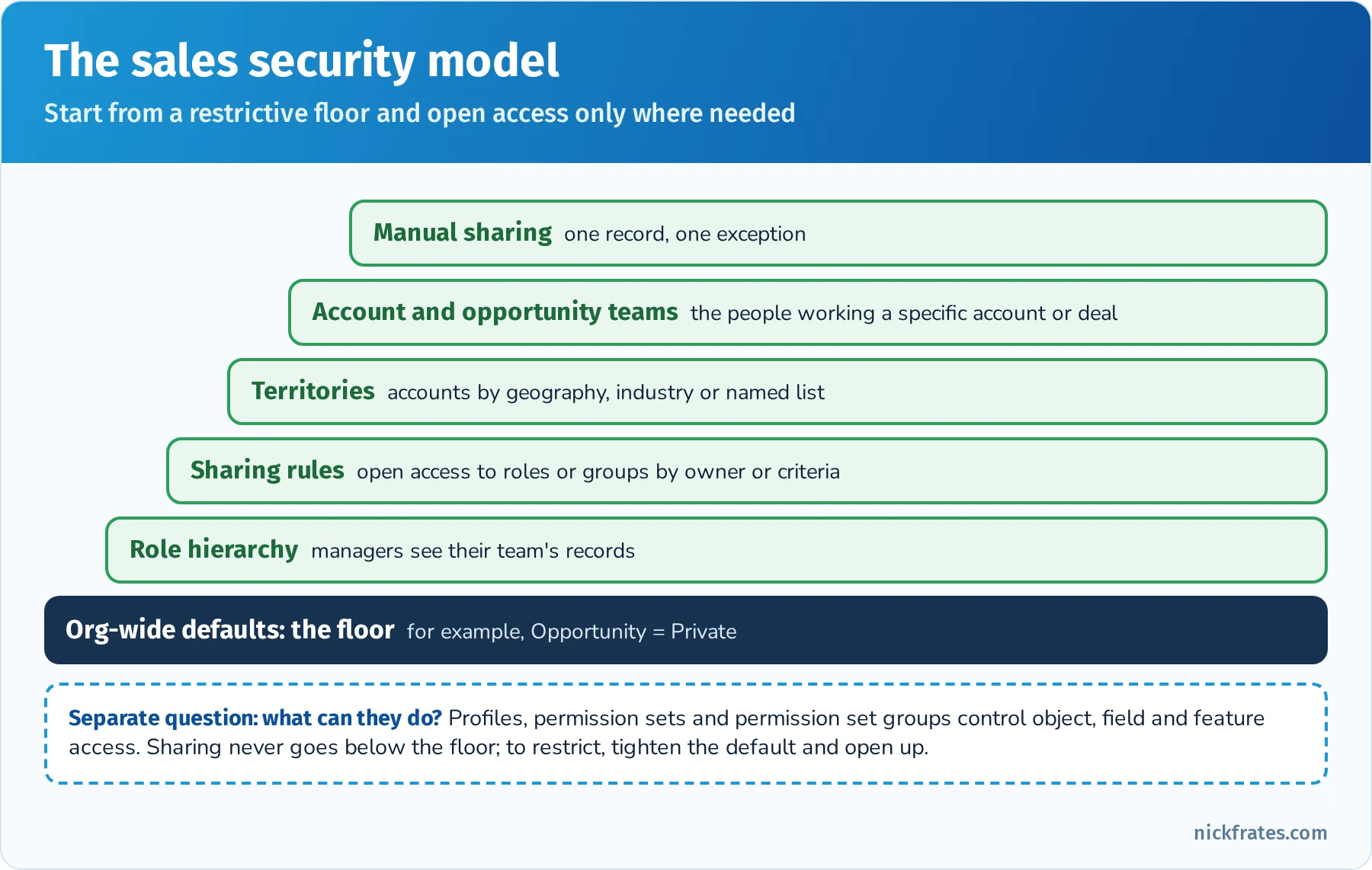
Build from a restrictive floor and open access only where needed.
Territories in practice. In Enterprise Territory Management (Sales Territories):
- A territory model is the whole structure. Models are in Planning, Active or Archived state. Only one model can be active. You can archive only the active model, and archived models can't be reactivated. Archiving a model deletes its territory forecasts, quotas and adjustments.
- Territory types categorize territories (for example Named Account, Geographic) and carry a priority used when assigning opportunities.
- Account assignment rules assign accounts to territories by account field criteria; accounts can also be assigned manually. An account can belong to several territories, and users can be assigned to several territories.
- Access levels on the territory define what assigned users can do with the territory's accounts and their opportunities and cases.
- Opportunity territory assignment sets one territory on each opportunity, manually or through the filter-based assignment Apex class Salesforce provides (which by default assigns the account's territory, using territory type priority when there are several).
- Territory forecasts roll up by the territory hierarchy rather than the role hierarchy.
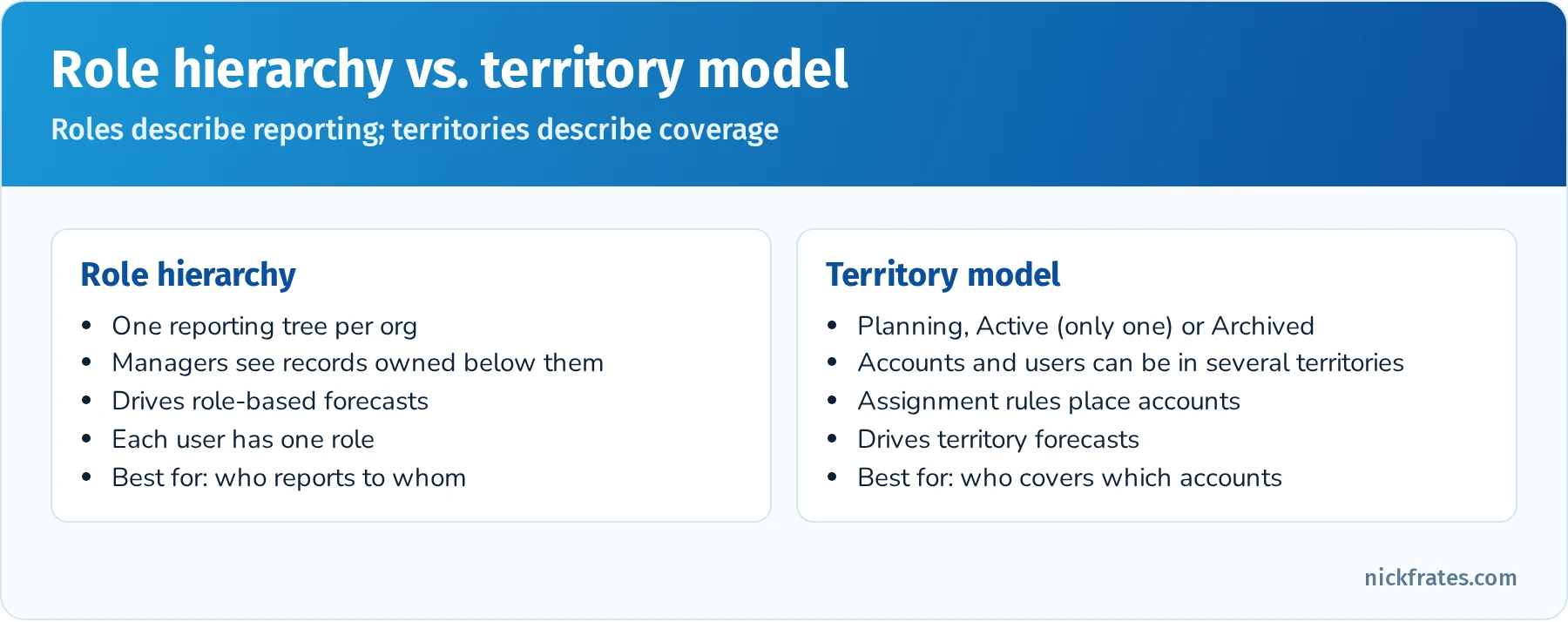
Roles describe who reports to whom. Territories describe who covers which accounts.
Extending the platform: when declarative isn't enough. The exam rewards "clicks before code," but also knowing when to stop:
| Need | Best fit |
|---|---|
| Field updates, tasks, notifications, approvals, guided screens | Flow and approval processes (declarative) |
| Complex logic, high-volume processing or integrations the platform can't do declaratively | Custom development (Apex, Lightning Web Components, APIs) |
| A mature, common capability (e-signature, data enrichment, advanced quoting, dialers) | An AppExchange product, evaluated for security, fit, support and cost |
| Another Salesforce capability the customer may already own | Salesforce products such as Experience Cloud for partners, Marketing Cloud for nurture, Revenue Cloud for advanced quoting |
| Collaboration on deals, alerts in the flow of work | Slack: deal channels, record alerts and sharing Salesforce records in Slack |
| Reps in the field | The Salesforce mobile app with quick actions and offline-friendly design |
| Reps living in email | Outlook or Gmail integration, Einstein Activity Capture |
Key takeaway: know the standard objects and limits on the lead-to-cash path cold (mapping, one active assignment rule, one synced quote, standard price first, one active territory model), and design security from a restrictive floor upward.
Practice questions: Practical Application
Question 1. After lead conversion, values in a custom lead field called Budget Range don't appear anywhere on the new opportunity. What's the most likely cause?
- A. Lead conversion can't carry custom fields
- B. The opportunity page layout is read-only
- C. The custom lead field isn't mapped to a custom opportunity field in Map Lead Fields
- D. The lead was converted by an administrator
Answer: C. Custom lead fields only carry over when mapped to compatible custom fields. Why not the others: conversion does support custom fields through mapping (A); layout doesn't stop values being saved (B); who converts doesn't matter (D).
Question 2. A company wants different discounting stages for its partner deals and its direct deals, but one forecast that includes both. What should the consultant configure?
- A. Two custom objects
- B. One sales process and a checkbox for partner deals
- C. Two opportunity record types, each with its own sales process, mapping stages to the same forecast categories
- D. Two orgs connected by an integration
Answer: C. Record types and sales processes give separate stages while forecast categories keep a single forecast. Why not the others: custom objects break standard forecasting (A); one process can't show different stages (B); two orgs are unnecessary (D).
Question 3. An admin tries to add a new product to the Partner price book but can't. What's missing?
- A. The product needs a product family
- B. The product needs an active entry in the standard price book first
- C. Quotes must be enabled
- D. Opportunity splits must be enabled
Answer: B. A product needs a standard price before it can be added to custom price books. Why not the others: product family (A), quotes (C) and splits (D) aren't prerequisites for price book entries.
Question 4. A sales rep created three quotes for one opportunity and wants the opportunity products to reflect the second quote. What should the rep do?
- A. Sync the second quote with the opportunity, which replaces the opportunity products with that quote's line items
- B. Sync all three quotes
- C. Manually re-enter the products
- D. Delete the other quotes
Answer: A. Only one quote syncs at a time, and syncing copies its lines to the opportunity. Why not the others: multiple syncs aren't possible (B); manual re-entry is error prone (C); deleting quotes isn't required (D).
Question 5. A global company wants opportunity amounts converted using the exchange rate in effect on each opportunity's close date, not today's rate. What should the consultant recommend?
- A. Update the conversion rate every day
- B. A custom formula field per currency
- C. One price book per currency only
- D. Advanced currency management with dated exchange rates
Answer: D. Dated exchange rates apply to opportunities based on close date. Why not the others: updating the single rate changes converted amounts on all records, including closed deals (A); formula fields duplicate a standard capability (B); price books don't convert amounts (C).
Question 6. Opportunities are Private. A solution engineer needs edit access to the specific deals she supports, which belong to reps in different branches of the role hierarchy. What's the best approach?
- A. Make the org-wide default Public Read/Write
- B. Move her role above all sales roles
- C. Add her to the opportunity team on those deals with Read/Write access
- D. Give her the Modify All Data permission
Answer: C. Opportunity teams grant access to specific deals. Why not the others: public defaults expose all deals (A); moving her role grants access to everything below it (B); Modify All Data breaks least privilege (D).
Question 7. A territory model has been tested in the Planning state and leadership approves it. The current model is active. What happens when the consultant activates the new model and archives the old one?
- A. The new model becomes the single active model; the archived model can't be reactivated, and its territory forecasts, quotas and adjustments are deleted
- B. Both models stay active
- C. The archived model can be set back to Planning at any time
- D. Archiving has no effect on forecasts
Answer: A. Only one model can be active, archived models can't be reactivated, and archiving deletes territory forecast data. Why not the others: A, C and D contradict how model states work. Plan forecast and quota data before archiving (for example, report on it first).
Question 8. A company's field reps work from phones between customer visits and want to log a visit and next steps in under a minute. What should the consultant recommend?
- A. Train reps on the full desktop page layout
- B. A custom native mobile app built from scratch
- C. Ask reps to log visits at the end of the week
- D. The Salesforce mobile app with quick actions that prefill fields, and a compact, mobile-friendly layout
Answer: D. Mobile quick actions and focused layouts make fast logging possible with standard tools. Why not the others: desktop layouts are slow on phones (A); a custom app is unnecessary (B); delayed logging hurts data quality (C).
Question 9. Marketing wants credit for every campaign that touched an opportunity, not just the primary campaign. What should the consultant recommend?
- A. A campaign hierarchy with five levels
- B. Customizable Campaign Influence with an influence model that distributes credit across campaigns
- C. Change the Primary Campaign Source every week
- D. Lead assignment rules
Answer: B. Campaign influence attributes opportunities to multiple campaigns. Why not the others: hierarchies roll up results but don't attribute one opportunity across several campaigns (A); changing the primary source loses history (C); assignment rules route leads (D).
Question 10. A customer requires guided product bundles, configuration rules and automated renewal quotes from contracts. Standard quotes can't enforce the configuration rules. What should the consultant recommend?
- A. Build complex validation rules on quote line items
- B. Use spreadsheets for quotes
- C. Evaluate a dedicated quoting and revenue solution (Salesforce's Revenue Cloud family or an AppExchange product) against the requirements
- D. Remove the requirement
Answer: C. When requirements exceed standard quotes, a consultant evaluates purpose-built products. Why not the others: complex validation rules are brittle (A); spreadsheets move work off-platform (B); removing a business requirement isn't the consultant's call (D).
Data Management (18%)
Sales data is only useful if people trust it. This section covers getting data in (migrations and integrations), keeping the design fast at scale, and keeping data clean. The official objectives:
- Explain the use cases and considerations for data migrations and integrations.
- Given a scenario, outline the scalability implications of a solution.
- Discuss approaches for managing sales data quality in Salesforce.
Data migration: plan before you load. A sales migration usually moves users, accounts, contacts, leads, opportunities, products, price books, activities and campaign history from a legacy CRM or spreadsheets. A consultant's migration plan covers:
- Scope: which objects and how much history. Old closed deals and activities may not be worth migrating, or may go to an archive.
- Mapping: legacy fields to Salesforce fields, picklist value mapping, and record type mapping.
- Cleansing: deduplicate and standardize before loading. Bad data migrated is bad data forever.
- Load order: parents before children so relationships resolve.
- Keys: store each legacy ID in an external ID field on the target object. External IDs let you upsert (insert or update in one pass) and link child records to parents without looking up Salesforce IDs.
- Owners: load or activate users first so records get the right owners.
- Trial loads: run full test loads in a sandbox, validate counts and spot-check records with business users.
- Automation: consider temporarily bypassing validation rules, flows and assignment rules that would fire on historical data, and turn them back on after.
- Cutover: final delta load, validation and sign-off.
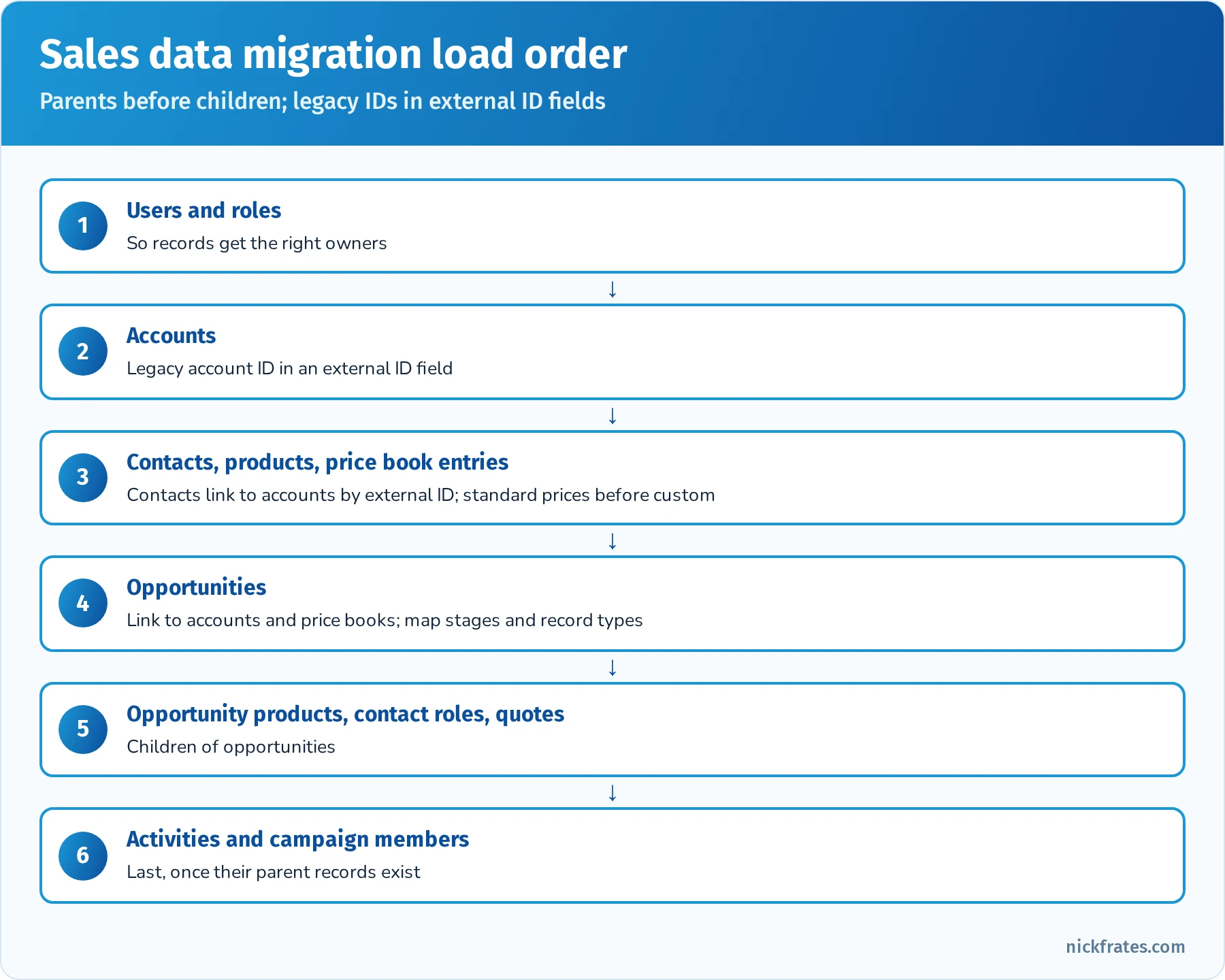
Parents before children, with legacy IDs in external ID fields.
Choosing the tool.
| Tool | Use it when |
|---|---|
| Data Import Wizard | Fewer than 50,000 records, an object the wizard supports (accounts, contacts, leads, solutions, person accounts, articles and custom objects), simple mappings, and you want its built-in duplicate matching (account name and site, contact email, lead email). It doesn't import opportunities. |
| Data Loader | Up to 150 million records in CSV files, any object (including opportunities and opportunity products), complex mappings, upsert with external IDs, exports for backup and scheduled loads from the command line |
| Integration (APIs or middleware) | Ongoing data exchange with ERP, billing, marketing or product systems |
| AppExchange or ETL tools | Complex transformations, scheduling and monitoring beyond Data Loader |
Integrations: consultant-level considerations. You won't design APIs on this exam, but you'll be asked what to consider:
- System of record: which system owns each piece of data (for example, ERP owns invoices and order status; Salesforce owns opportunities).
- Direction and timing: one-way or two-way, real time or batch. Real time when users act on the data immediately (credit check before quoting); batch for large nightly syncs (invoice history).
- Volumes and limits: API call limits and data volumes drive the choice between REST, Bulk API and middleware.
- Error handling and monitoring: who fixes failed records and how they find out.
- Security: integration users with least privilege.
- Data 360 when the requirement is unifying customer data from many sources into profiles and insights for sales, rather than point-to-point syncs. My Data 360 Consultant study guide covers that in depth.
Scalability. Designs that work for 50 reps can fail at 5,000. Know these implications:
- Account data skew: when a very large number of child records (contacts, opportunities, cases) sit under one account, updates can cause record locking and slow sharing recalculation. Salesforce's guidance is to keep any single account below about 10,000 child records. A classic cause is parking all unassigned contacts under one "Unknown" account.
- Ownership skew: when one user owns a very large number of records of one object (Salesforce's guidance is about 10,000), for example an integration user or a "lead dump" owner. Distribute ownership, and if one owner is unavoidable, keep that user out of the role hierarchy or place them in a separate top-level role.
- Sharing complexity: deep role hierarchies, many sharing rules and frequent territory realignments increase sharing recalculation time. Simplify where possible and schedule large realignments outside working hours.
- Large data volumes: selective report filters, archiving old records, and skinny or indexed fields (with Salesforce support) keep reports and list views fast.
- Automation at scale: bulk-safe flows and triggers, and avoiding a flow that updates thousands of related records on every edit.
Data quality. A data quality strategy combines prevention, detection and ownership:
| Approach | Tools |
|---|---|
| Prevent bad data at entry | Required fields (sparingly), validation rules, picklists instead of free text, dependent picklists, lookup filters, Path key fields |
| Prevent duplicates | Matching rules plus duplicate rules (alert or block) for accounts, contacts and leads; standard rules exist for each |
| Find and fix existing problems | Duplicate reports and jobs, merge tools, data quality reports and dashboards (for example, opportunities with no next step or past close dates) |
| Enrich | Data enrichment and AppExchange data providers |
| Automate hygiene | Flows that standardize values, stamp dates or create follow-up tasks; scheduled flows that flag stale opportunities |
| Own it | A data steward or sales operations owner, and data quality KPIs reviewed in pipeline meetings |
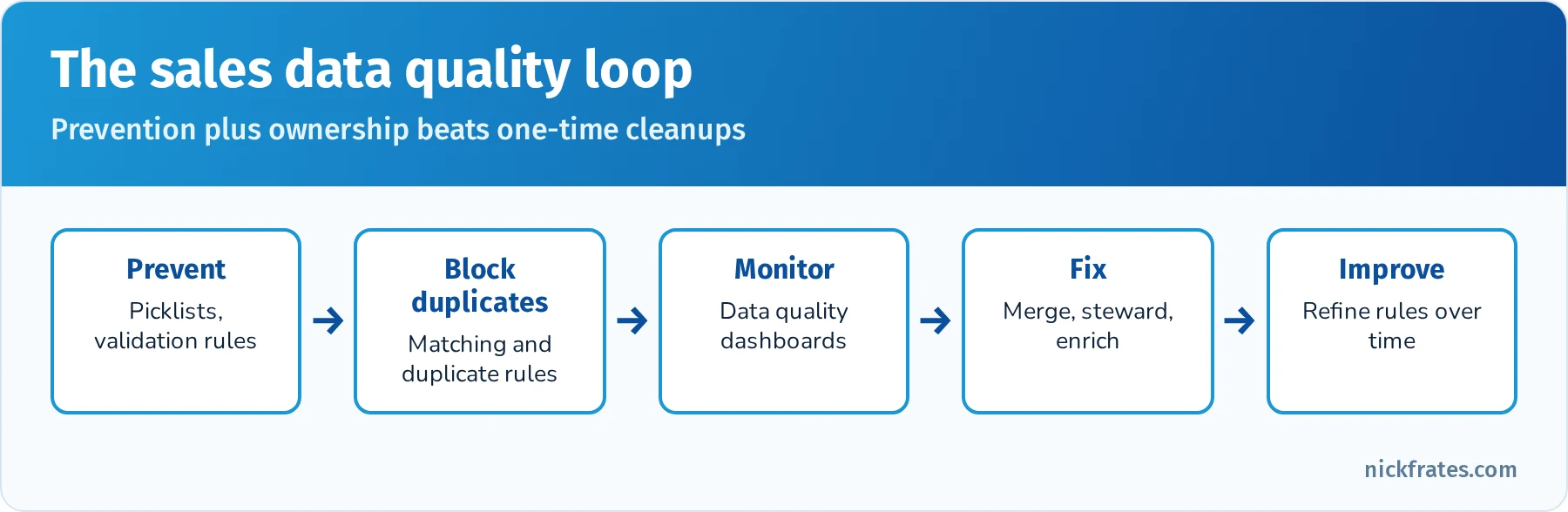
Data quality is a loop with an owner, not a one-time cleanup.
Key takeaway: for migrations, think scope, mapping, cleansing, load order and external IDs; for scale, think skew and sharing; for quality, think prevention plus ownership.
Practice questions: Data Management
Question 1. A company is migrating 2 million opportunities from a legacy CRM and needs to link each one to its migrated account. What's the best approach?
- A. Data Loader upserts that use an external ID field holding the legacy account ID to relate opportunities to accounts
- B. Data Import Wizard
- C. Manual entry by reps
- D. Load opportunities before accounts
Answer: A. Data Loader handles the volume and object, and external IDs link children to parents without looking up Salesforce IDs. Why not the others: the wizard doesn't import opportunities and is limited to 50,000 records (B); manual entry is impossible at this scale (C); children must load after parents (D).
Question 2. During a trial migration load, thousands of historical opportunities fail because of a validation rule that requires a Next Step for open deals, and an assignment flow sends notifications for every record. What should the consultant recommend?
- A. Delete the validation rule permanently
- B. Plan a controlled bypass (for example, a custom permission or setting checked by the rule and flow) for the migration user during the load, then re-enable normal behavior
- C. Ask business users to fix each record by hand
- D. Load the records without owners
Answer: B. A controlled bypass protects historical loads without removing the rule for users. Why not the others: deleting the rule harms data quality later (A); manual fixes don't scale (C); ownerless loads aren't possible and break access (D).
Question 3. An integration creates all web leads under one integration user, which now owns 3 million leads. Users report slow saves and sharing delays. What's the main issue?
- A. Too many page layouts
- B. Missing price books
- C. Too few record types
- D. Ownership data skew
Answer: D. One owner with a very large number of records causes ownership skew. Use assignment rules or queues to distribute ownership. Why not the others: layouts (A), price books (B) and record types (C) don't cause sharing performance problems.
Question 4. Sales operations reports many duplicate accounts created by reps. They want reps warned but still able to save when they're sure. What should the consultant configure?
- A. A matching rule and a duplicate rule set to Alert on create
- B. A duplicate rule set to Block
- C. A validation rule on Account Name
- D. A nightly Data Loader delete job
Answer: A. Duplicate rules with Alert warn users but allow the save. Why not the others: Block prevents the save (B); a validation rule can't compare records for duplicates (C); deleting data nightly is risky (D).
Question 5. A company wants Salesforce to show real-time order status from its ERP on the opportunity, and the ERP remains the system of record. What's the key design consideration?
- A. Copy all ERP tables into Salesforce custom objects nightly
- B. Ask reps to type order status into Salesforce
- C. Make Salesforce the system of record for orders
- D. Define the ERP as the system of record and choose an integration pattern that retrieves or displays order status when needed, with error handling and least-privilege integration access
Answer: D. Consultants define data ownership, direction and timing first. Why not the others: full nightly copies aren't real time and duplicate data (A); manual entry is unreliable (B); changing the system of record isn't the requirement (C).
Question 6. All contacts without a known company are stored under one account named "Unassigned." The account now has 400,000 contacts, and updates are slow. What should the consultant recommend?
- A. Add more fields to the account
- B. Make the account private
- C. Redistribute those contacts across many placeholder accounts or link them to real accounts, to keep any single account below the recommended child-record level
- D. Delete the account
Answer: C. This is account data skew. Spread child records out. Why not the others: fields don't affect skew (A); privacy settings don't fix locking (B); deleting the account would cascade problems (D).
Question 7. Which two practices most directly prevent poor-quality opportunity data at the point of entry? (Choose two.)
- A. Picklists instead of free-text fields for values like loss reason
- B. Validation rules for critical conditions, such as requiring a loss reason when a deal is Closed Lost
- C. A quarterly cleanup project
- D. Removing the Close Date field
Answer: A and B. Picklists and targeted validation rules stop bad data before it's saved. Why not the others: cleanups are reactive (C); Close Date is required for forecasting (D).
Question 8. A company plans to load 30,000 leads from a trade show list and wants to avoid creating leads that already exist with the same email. What's the simplest approach?
- A. Custom Apex
- B. Load them into a custom object first
- C. Data Import Wizard, matching leads by email
- D. Bulk API with no matching
Answer: C. Under 50,000 records, a supported object and built-in email matching make the wizard the simplest fit. Why not the others: code is unnecessary (A); a staging object adds work (B); loading without matching creates duplicates (D).
Predictive and Generative AI (13%)
This section checks that you know which AI tools exist in Agentforce Sales, when each helps, and how to apply Salesforce's Trusted AI Principles. The official objectives:
- Understand what generative AI tools are available in Agentforce Sales.
- Understand what predictive AI tools are available in Agentforce Sales.
- Identify ethical challenges of AI and apply Salesforce's Trusted AI Principles to sales scenarios.
Predictive versus generative. Predictive AI analyzes historical data to score or forecast an outcome (how likely is this lead to convert?). Generative AI creates new content (draft this email, summarize this call). Agents combine generative reasoning with actions to carry out multi-step work. Questions often hinge on picking the right kind.
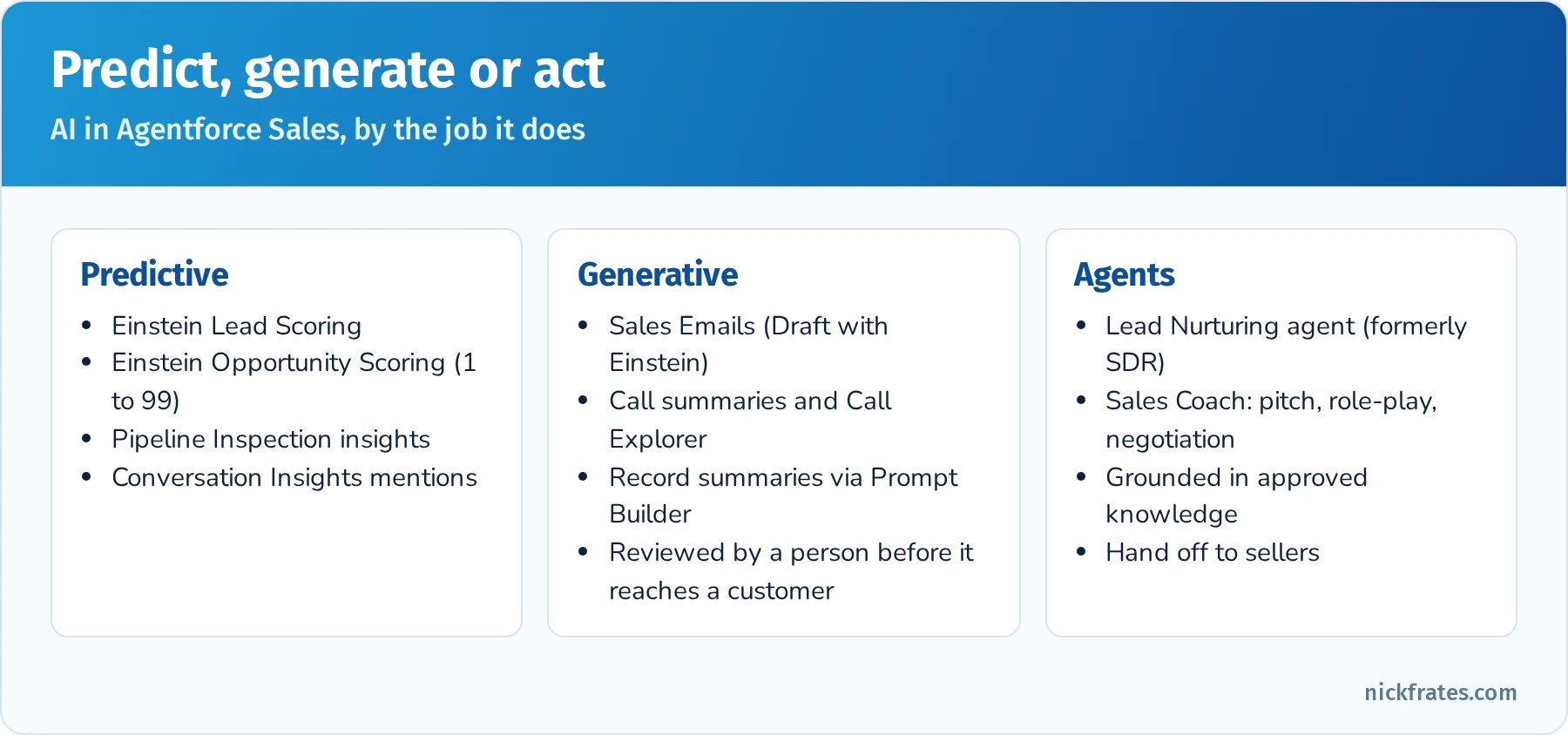
Predict, generate, or act: pick the tool by the job.
Predictive AI tools.
| Tool | What it does | When to recommend it |
|---|---|---|
| Einstein Lead Scoring | Scores leads on how likely they are to convert, based on your org's conversion history, and shows the factors that drive each score | Reps need to prioritize a large lead volume |
| Einstein Opportunity Scoring | Gives each opportunity a score from 1 to 99 for its likelihood to be won, with positive and negative factors | Managers and reps need to focus on deals most likely to close or most at risk |
| Pipeline Inspection | A pipeline view with metrics, filters and highlights of recent changes (amount, close date, stage), with AI-driven deal insights where enabled | Weekly pipeline reviews and spotting slipped or changed deals |
| Einstein Conversation Insights | Analyzes call recordings from supported voice and video providers for mentions such as competitors, pricing and next steps | Coaching and understanding what happens on calls at scale |
Note how the models learn: scoring uses your org's historical data, and when an org doesn't have enough data, Salesforce can use a global model until there's enough history for one tailored to the org. Garbage in, garbage out: poor stage and conversion data produces weak predictions, which is a data quality conversation for the consultant.
Generative AI tools.
| Tool | What it does | When to recommend it |
|---|---|---|
| Sales Emails (Draft with Einstein) | Drafts personalized emails for leads, contacts and person accounts from CRM data, which the rep reviews before sending; custom versions use Sales Email prompt templates in Prompt Builder | Reps spend time writing outreach and follow-ups |
| Call summaries and Call Explorer | Summarize recorded calls (customer feedback, next steps) and answer questions about a call transcript; part of Einstein Conversation Insights | Reps and managers need quick call recaps and coaching |
| Record summaries and prompt templates | Summarize accounts or opportunities, or generate field values, using Prompt Builder grounded in Salesforce data | Reps prep for meetings or managers review deals faster |
| Agentforce Lead Nurturing agent (formerly SDR) | An autonomous agent that sends personalized outreach and follow-ups to assigned prospects, answers questions from approved knowledge, and hands qualified prospects to sellers | High lead volume with limited rep capacity |
| Agentforce Sales Coach | Lets reps practice a pitch, role-play with a simulated buyer and practice negotiation on an opportunity, with personalized feedback | Onboarding and deal-specific coaching |
For how agents, prompt templates and grounding work under the hood, see my Agentforce Specialist study guide. For subagents and actions specifically, see Agentforce topics and actions.
Trust and the Einstein Trust Layer. Generative features in Salesforce run through the Einstein Trust Layer, which provides protections such as data masking, zero data retention with model providers, toxicity detection and an audit trail. Generative output should be grounded in the customer's own data and reviewed by a human before it reaches a customer, especially early in a rollout. My Einstein Trust Layer guide explains each protection.
Salesforce's Trusted AI Principles. Salesforce publishes five Trusted AI Principles:
- Responsible: safeguard human rights and protect the data entrusted to Salesforce.
- Accountable: seek and use feedback, and take responsibility for outcomes.
- Transparent: explain how AI makes recommendations so people understand and can question them.
- Empowering: augment human abilities and make AI accessible.
- Inclusive: respect the societal values of everyone affected and work to avoid bias.
For generative AI, Salesforce added five guidelines: accuracy, safety, honesty, empowerment and sustainability.
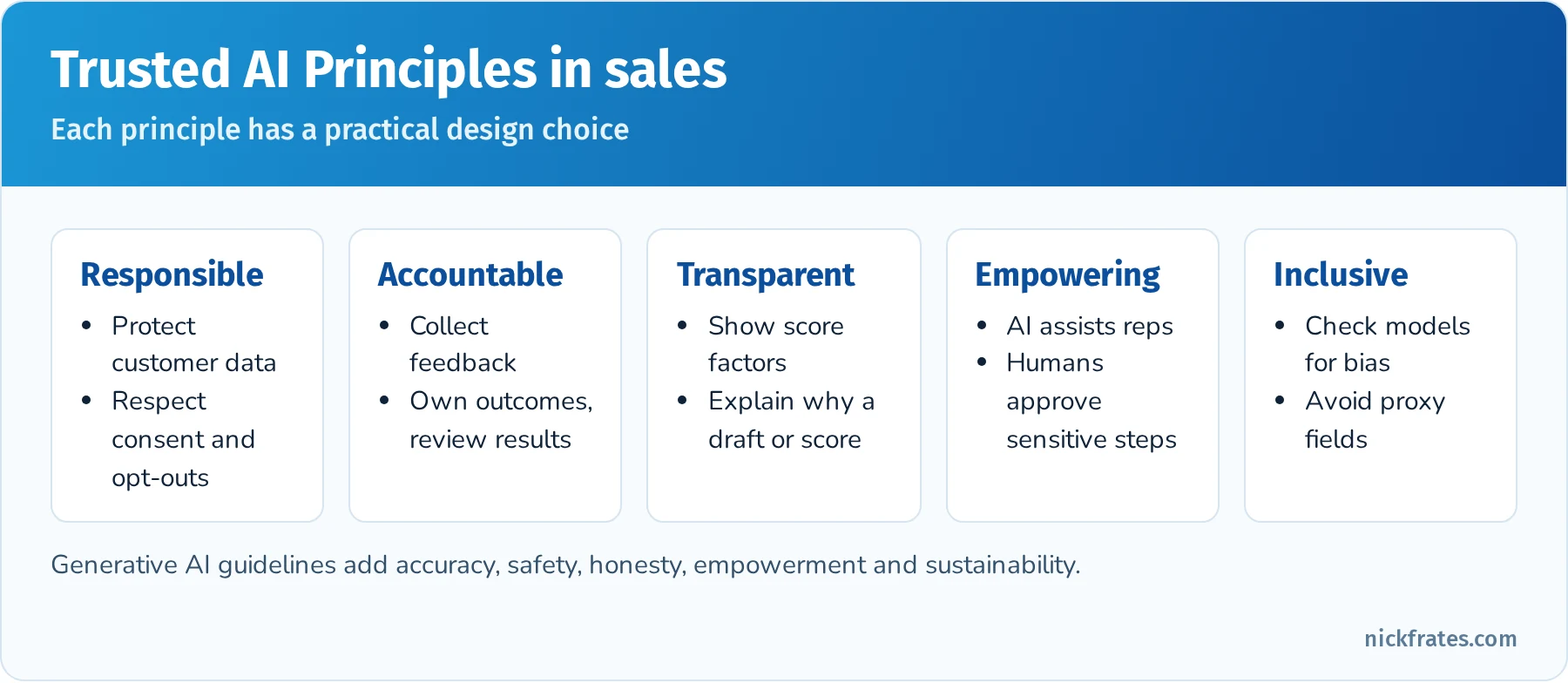
Each principle has a practical sales design choice.
Ethical challenges in sales scenarios. Expect questions like these, and think about which principle applies:
- Bias in scoring. If historical deals favored certain regions or company sizes, a lead score can reinforce that. Review which fields feed the model and exclude fields that act as proxies for protected characteristics (Inclusive, Accountable).
- Transparency. Reps and managers should see why a score is high or low (score factors) before acting on it (Transparent).
- Human in the loop. Generated emails should be reviewed before sending, and agents should hand off to people for sensitive decisions such as pricing exceptions (Empowering, Accuracy).
- Disclosure. When an agent emails prospects, it should be clear the message is AI-generated (Honesty).
- Data protection and consent. Use only data the customer is allowed to use for outreach, and respect contact preferences and opt-outs (Responsible).
Key takeaway: predictive tools score and prioritize, generative tools draft and summarize, agents act; and every recommendation should include data quality, human review and the matching Trusted AI Principle.
Practice questions: Predictive and Generative AI
Question 1. A sales manager wants reps to focus each morning on the open deals most likely to close this quarter. Which tool fits best?
- A. Sales Emails
- B. Einstein Opportunity Scoring
- C. Agentforce Sales Coach
- D. Data Import Wizard
Answer: B. Opportunity Scoring predicts win likelihood. Why not the others: Sales Emails drafts content (A); Sales Coach is for practice (C); the wizard imports data (D).
Question 2. Reps spend 20 minutes writing each follow-up email after discovery calls. The company wants drafts that use the opportunity's data while reps stay in control. What should the consultant recommend?
- A. An agent that sends emails automatically with no review
- B. A predictive lead score
- C. An email template with only static text
- D. Sales Emails, with a custom Sales Email prompt template grounded in opportunity fields, and reps reviewing each draft before sending
Answer: D. Generative drafts grounded in CRM data save time, and human review keeps quality and accountability. Why not the others: unreviewed automatic sending removes control (A); scoring doesn't write emails (B); static templates aren't personalized (C).
Question 3. A company enables Einstein Lead Scoring and notices the top-scored leads come almost entirely from one region, mirroring which regions historically received the most sales attention. What should the consultant do?
- A. Ignore it; the model is always right
- B. Review the fields and history feeding the model for bias, adjust what's included, and make score factors visible so reps understand the drivers
- C. Turn off all AI permanently
- D. Hide the scores from managers
Answer: B. This applies the Inclusive, Accountable and Transparent principles. Why not the others: blind trust ignores bias (A); turning everything off loses value without investigating (C); hiding scores reduces transparency (D).
Question 4. A company has more inbound leads than its reps can follow up within a day. It wants every lead to get a timely, personalized response and qualified leads passed to sellers. What should the consultant recommend?
- A. Einstein Opportunity Scoring
- B. Historical trend reporting
- C. A campaign hierarchy
- D. Agentforce Lead Nurturing agent with approved knowledge, clear handoff rules to sellers and AI disclosure in its messages
Answer: D. The Lead Nurturing agent handles outreach and follow-up at scale and hands qualified prospects to sellers. Why not the others: opportunity scoring works on deals, not lead outreach (A); reporting (B) and hierarchies (C) don't respond to leads.
Question 5. Which statement correctly describes Einstein Conversation Insights?
- A. It records calls on its own without any voice provider
- B. It's a data migration tool
- C. It analyzes recordings from supported voice and video providers to surface insights such as mentions and next steps, and supports generative call summaries
- D. It only works on leads
Answer: C. Conversation Insights processes recordings from connected providers. Why not the others: it relies on a recording provider (A); it isn't a migration tool (B); it isn't limited to leads (D).
Question 6. New reps take months to become confident in negotiations. The sales enablement team wants deal-specific practice without taking managers' time. What fits best?
- A. Agentforce Sales Coach for pitch practice, buyer role-play and negotiation practice on the opportunity
- B. Einstein Lead Scoring
- C. A dynamic dashboard
- D. Pipeline Inspection
Answer: A. Sales Coach provides AI role-play and feedback in the context of the deal. Why not the others: B, C and D measure or prioritize; they don't coach.
Question 7. A predictive score shows a 92 on an opportunity, and the rep asks why. Which Trusted AI Principle is served by showing the top factors behind the score?
- A. Sustainable
- B. Responsible only
- C. Transparent
- D. None; scores shouldn't be explained
Answer: C. Explaining recommendations is transparency. Why not the others: sustainability is a generative AI guideline about efficient models (A); responsibility is about rights and data protection (B); unexplained scores reduce trust (D).
Cert Lab by Nick Frates
Practice each section with the Agentforce Sales Consultant Cert Lab
Short lessons, flashcards and a practice quiz for all 5 exam sections, from Sales Lifecycle to Predictive and Generative AI.
Start the Agentforce Sales Consultant Cert Lab for $9.99 →Deep dive: forecasting configuration decisions
Forecasting shows up in the Sales Lifecycle and Practical Application sections, and the questions are usually about configuration choices and their side effects. Here's what to know, using the current Help name Pipeline Forecasting (formerly Collaborative Forecasts).
The building blocks.
- Forecast types define what you forecast: the object (Opportunity, Opportunity Product, Opportunity Split, Opportunity Product Split or Line Item Schedule), the measure (revenue, quantity or a custom currency or number field), the date (close date, a custom date, product date or schedule date) and the hierarchy (user role or territory). Up to four forecast types can be active at a time; Salesforce Support can raise that limit.
- Forecast categories come from opportunity stages: Pipeline, Best Case, Commit, Closed and Omitted, with an optional Most Likely category in Lightning Experience.
- Rollups: cumulative rollups (the default) show Closed Only (Closed), Commit Forecast (Commit plus Closed), Best Case Forecast (Best Case, Commit and Closed) and Open Pipeline (all open categories: Pipeline, Best Case and Commit). Single category rollups show each category on its own.
- The forecast hierarchy is generated from the role hierarchy for role-based forecasts. Users need Allow Forecasting enabled, and each manager level needs a forecast manager assigned, or the manager won't see subordinates' forecasts. Territory forecasts use the territory hierarchy instead.
- Adjustments let managers (and optionally owners) apply judgment without changing the underlying opportunities. Each forecast type keeps its own adjustments. Users need the Override Forecasts permission to adjust.
- Quotas show attainment on the forecasts page and are managed in Setup or loaded with Data Loader.
- Date range: forecasts are monthly or quarterly, with a default range up to 15 months or 8 quarters.
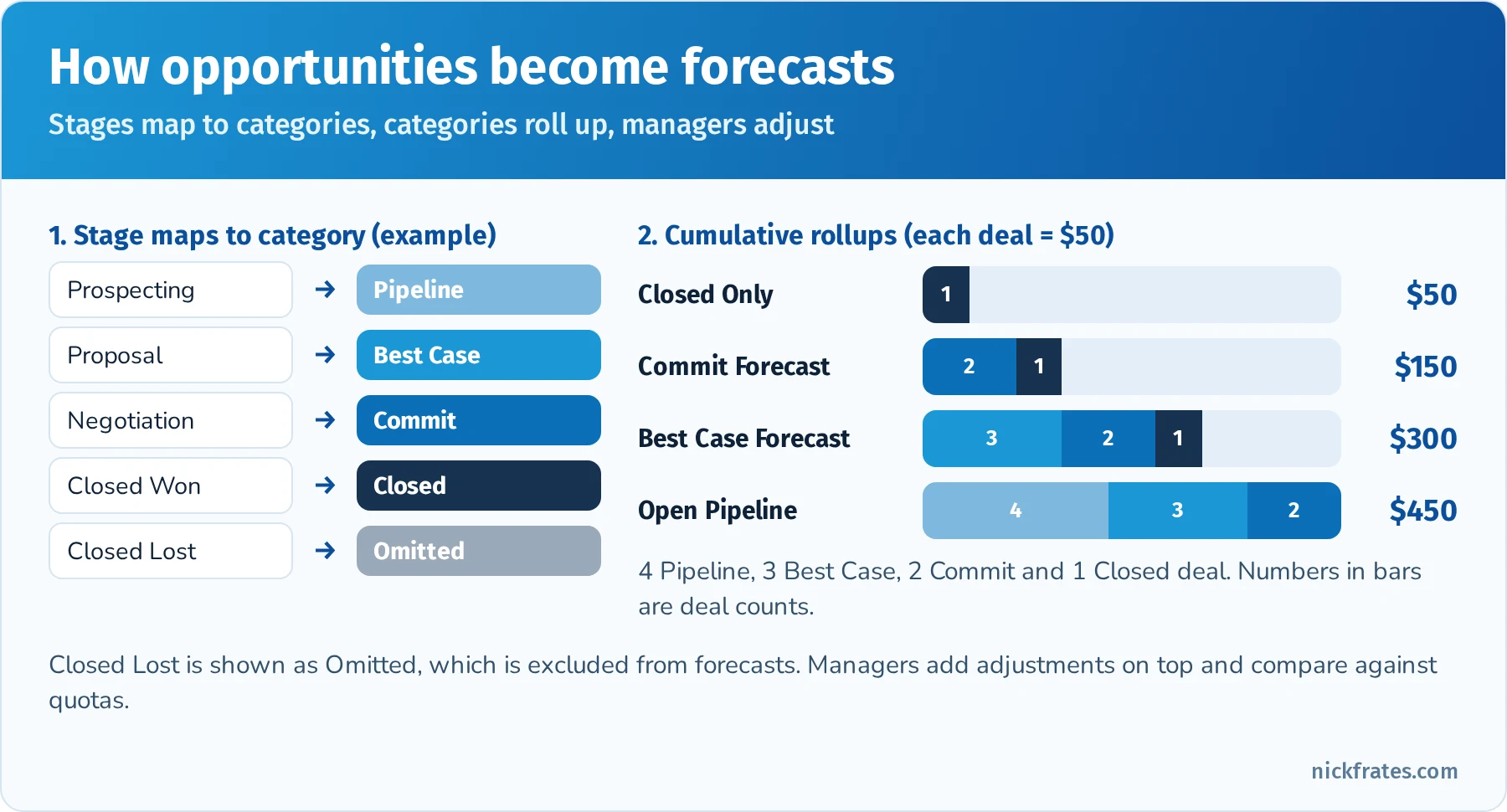
Stages map to categories, categories roll up, managers adjust.
Side effects the exam likes.
| Change | Side effect to warn the customer about |
|---|---|
| Switch between cumulative and single category rollups | Deletes adjustments for all active forecast types |
| Switch the forecast period between monthly and quarterly, or change the standard fiscal year | Purges adjustments, manager judgments and quotas |
| Create the first custom fiscal year | Deletes quotas and adjustments in the matching and later standard fiscal years |
| Deactivate a forecast type | Deletes that type's forecast data |
| Archive a territory model | Deletes territory forecasts, forecast types, quotas and adjustments for that model |
Choosing a forecast type from a requirement.
| Requirement | Forecast type |
|---|---|
| Revenue by rep and manager | Opportunity revenue by close date, role hierarchy (the default type) |
| Forecast by product line | Opportunity Product revenue grouped by product family |
| Credit for several sellers on a deal | Opportunity Splits revenue (team selling and splits enabled) |
| Revenue recognized over months of delivery | Line Item Schedule revenue by schedule date |
| Coverage-based forecasting by territory | A territory-based forecast type with an active territory model |
| Forecast on a custom value such as margin | A custom currency field as the measure |
Worked example: an end-to-end Agentforce Sales implementation
Let's put the whole outline together with a fictional customer.
The customer. Ridgeline Robotics sells warehouse robots and service contracts in North America and Europe. 180 reps work in three teams: inside sales for small customers, field sales for enterprise accounts, and a renewals team. Today they use spreadsheets and an old CRM. Leadership's complaints: slow lead follow-up, no trusted forecast, no visibility into which marketing programs work, and quotes built in spreadsheets with inconsistent pricing.
Discovery and success metrics (Consulting). The consultant runs workshops with each team, sales operations, marketing and finance. They agree four success metrics with baselines: median lead response time, forecast accuracy versus actuals, the share of opportunities with products and a quote, and weekly active users. Requirements are prioritized with MoSCoW. Phase 1 covers leads, opportunities, products, quotes and forecasting. Phase 2 adds territories, AI and Slack. Everything is written into the SOW with a change request process.
Lead to opportunity (Practical Application). Web-to-lead and a marketing-automation integration capture leads. One active lead assignment rule routes small-company leads to an inside sales queue and enterprise leads by region. Inside reps work leads in Sales Engagement cadences. Custom lead fields (robot fleet size, warehouse count) are mapped to opportunity fields for conversion. Campaigns use a hierarchy (annual program, quarterly campaigns, individual events) and Customizable Campaign Influence for attribution.
Opportunities, products and quotes. Three opportunity record types (New Business, Enterprise, Renewal) each have a sales process and Path with guidance for success. Products include robots and service plans; all have standard prices, and a Europe price book holds euro prices. Multi-currency with advanced currency management uses dated exchange rates for opportunities. Quotes generate PDFs, and the rep syncs the final quote to the opportunity. Discounts over 15% go through an approval process.
Security. Opportunity org-wide default is Private. The role hierarchy gives managers their team's deals. Sales operations gets read access to all opportunities through a sharing rule. Solution engineers join opportunity teams. Permission set groups bundle access by role.
Forecasting. Phase 1 activates the default opportunity revenue forecast type with cumulative rollups, quarterly periods, manager adjustments and quotas. Forecast managers are assigned at each level. A product family forecast type follows for the robots versus services split.
Data migration (Data Management). Accounts, contacts and open opportunities from the last two years are migrated with Data Loader using external IDs; older closed deals go to an archive. Duplicate rules alert reps when they create a likely duplicate account or contact. A data quality dashboard tracks opportunities with past close dates or no next step.
Phase 2: territories and AI (Sales Lifecycle, AI). Enterprise Territory Management models regions and a named-account territory in the Planning state, previews assignments, then activates. Einstein Opportunity Scoring and Pipeline Inspection support weekly reviews. Sales Emails with a custom prompt template speeds follow-ups, with reps reviewing every draft. The team reviews score factors for bias and documents the Trusted AI principles they apply.
Adoption. Champions in each team, manager-first training, and pipeline meetings run from Salesforce dashboards. After go-live, the consultant tracks the four success metrics monthly and feeds a backlog for the next release.
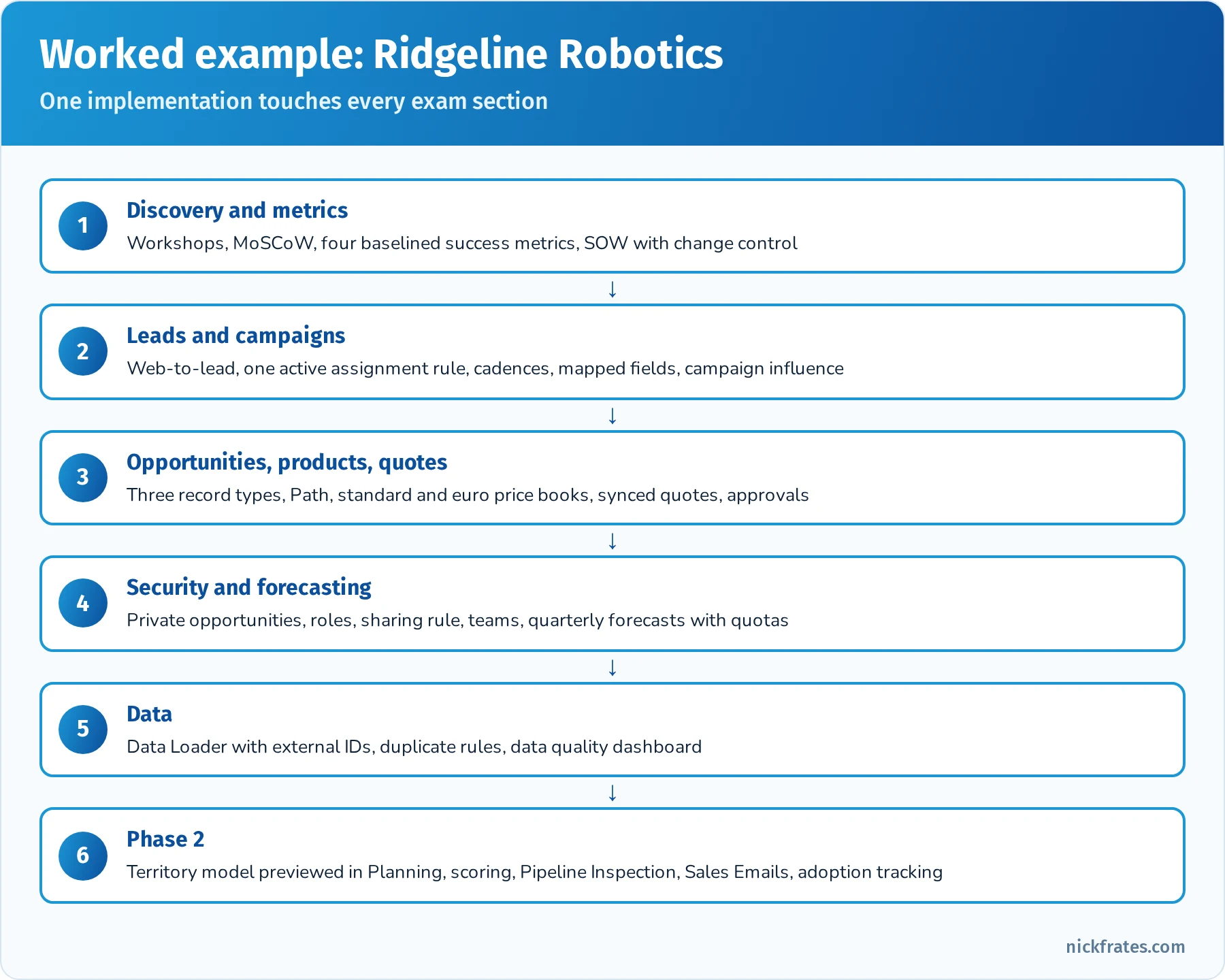
Every exam section shows up in one implementation.
Practice questions: worked example
Question 1. Ridgeline's European reps say opportunity amounts in corporate currency look wrong for deals that closed last year. The company uses one conversion rate that sales operations updates monthly. What should the consultant recommend?
- A. Ask reps to update closed deals manually
- B. Enable advanced currency management so opportunities use dated exchange rates based on close date
- C. Create a custom currency field for every month
- D. Stop using multi-currency
Answer: B. With a single rate, every rate change updates converted amounts on all records, including closed deals. Dated exchange rates fix that for opportunities. Why not the others: manual updates (A) and custom fields (C) are workarounds; disabling multi-currency isn't possible once it's enabled and wouldn't meet the requirement (D).
Question 2. Ridgeline's VP of Sales opens the forecasts page but can't see her managers' forecasts, even though she's at the top of the role hierarchy. What's the most likely cause?
- A. Opportunities are Private
- B. Quotas aren't enabled
- C. The forecast period is quarterly
- D. She isn't assigned as the forecast manager for her level in the forecast hierarchy
Answer: D. Forecast managers must be assigned for each level; being high in the role hierarchy isn't enough. Why not the others: forecast visibility comes from the forecast hierarchy (A); quotas (B) and the period setting (C) don't control who sees forecasts.
Question 3. Before activating the new territory model, Ridgeline's sales ops lead wants to confirm which accounts each territory will get. What should they do?
- A. Run the assignment rules while the model is in Planning and review the account assignments for each territory
- B. Activate the model and check afterward
- C. Archive the current model first
- D. Use criteria-based sharing rules instead
Answer: A. Planning state lets you run rules and preview assignments before activation. Why not the others: activating first defeats the purpose (B); archiving the current model first would delete its territory forecast data and leave no active model (C); sharing rules don't model territories (D).
Hands-on checklist
Build these in a free Developer Edition org or Trailhead Playground. Each one maps to likely exam questions.
- Create two opportunity record types with different sales processes and Paths, and map stages to forecast categories.
- Build a web-to-lead form, a queue and one active lead assignment rule with two entries; submit test leads.
- Add a custom lead field, map it in Map Lead Fields, convert a lead and confirm the value carried over.
- Create a campaign hierarchy with a parent and two children, add members, and set member statuses.
- Create products, add standard prices, create a custom price book, add products to an opportunity, then create two quotes and sync one.
- Enable team selling and opportunity splits; add a team and split a deal 60/40.
- Turn on forecasting in Forecasts Settings, enable a user for forecasting, assign a forecast manager, add a quota and make an adjustment.
- In a sandbox or Developer Edition org only, enable Enterprise Territory Management (Sales Territories), build a small model in Planning, add an assignment rule, run rules and preview assignments.
- Create a matching rule and a duplicate rule set to Alert; create a duplicate contact to see it fire.
- Build a summary report with a win rate summary formula and a dynamic dashboard.
- Open Prompt Builder and review the Sales Email template type, if your org has generative AI features. My Prompt Builder tutorial walks through it.
Common exam traps
- Building before discovering. If one answer gathers requirements or finds the root cause and another jumps to configuration, the discovery answer is usually right.
- Custom lead fields need mapping. Unmapped custom fields don't carry over on conversion.
- One active lead assignment rule. You can have many rules, but only one is active.
- Standard price first. A product needs a standard price book entry before a custom price book entry.
- One synced quote. Many quotes per opportunity, one synced at a time.
- One active territory model. Planning models are for what-if analysis; archived models can't come back.
- Forecast managers must be assigned. A role at the top of the hierarchy doesn't automatically see subordinates' forecasts.
- Rollup and period changes delete forecast data. Warn before switching.
- Dated exchange rates are opportunity-focused. They don't apply to forecasting or currency fields on other objects.
- Sharing only opens access. To restrict, tighten the org-wide default.
- Data Import Wizard limits. Under 50,000 records and no opportunities; use Data Loader beyond that.
- Predictive versus generative. Scoring predicts; Sales Emails and summaries generate; agents act.
- Old names in answer choices. Sales Cloud, High Velocity Sales, Collaborative Forecasts and Enterprise Territory Management still appear in study material and possibly in questions.
Flashcard terms
- Sales process: the set of opportunity stages available to an opportunity record type.
- Forecast category: the forecast bucket a stage maps to: Pipeline, Best Case, Commit, Closed or Omitted.
- Cumulative rollup: forecast columns that combine categories, such as Commit Forecast (Commit plus Closed).
- Forecast type: the object, measure, date and hierarchy a forecast is based on; up to four active.
- Adjustment: a manager's or owner's judgment on a forecast that doesn't change the opportunities.
- Territory model: the full territory structure; Planning, Active (only one) or Archived.
- Territory type priority: used to pick a territory for an opportunity when an account is in several.
- Lead assignment rule: routes leads to users or queues; one active rule at a time.
- Map Lead Fields: where custom lead fields are mapped for conversion.
- Campaign hierarchy: up to five levels of parent and child campaigns that roll up results.
- Customizable Campaign Influence: attributes an opportunity to several campaigns.
- Standard price book: holds every product's standard price; required before custom price books.
- Quote sync: links one quote's line items to the opportunity's products.
- Opportunity split: credit sharing; revenue splits total 100%, overlay splits don't have to.
- Advanced currency management: dated exchange rates for opportunities and related objects.
- External ID: a field holding a legacy or external key for upserts and relationships.
- Ownership skew: one user owning a very large number of records of one object.
- Account data skew: one account with a very large number of child records.
- Sales Engagement: cadences and work queues for structured outreach (formerly High Velocity Sales).
- Einstein Activity Capture: automatic email and calendar capture to Salesforce.
- Einstein Opportunity Scoring: a 1 to 99 score for the likelihood an opportunity is won.
- Pipeline Inspection: pipeline view with metrics, changes and insights for deal reviews.
- Lead Nurturing agent: autonomous outreach agent for prospects (formerly Agentforce SDR).
- Trusted AI Principles: Responsible, Accountable, Transparent, Empowering, Inclusive.
Mixed practice exam: 14 more questions
Question 1. A company's sales managers want to forecast robots and service contracts separately, while still seeing the total. What should the consultant configure?
- A. An Opportunity Product forecast type grouped by product family
- B. Two separate orgs
- C. Two opportunity record types only
- D. A dashboard without forecasting
Answer: A. Product family forecasts split the forecast by family. Why not the others: separate orgs are excessive (B); record types alone don't create family forecasts (C); a dashboard lacks adjustments and quotas (D).
Question 2. Sales operations wants to change forecasts from monthly to quarterly in the middle of the year. What should the consultant tell them first?
- A. Nothing changes
- B. Switching the period purges existing adjustments, manager judgments and quotas, so plan the timing and reload quotas
- C. It deletes all opportunities
- D. It requires custom code
Answer: B. Period changes purge forecast judgment data. Why not the others: there is a side effect (A); opportunities aren't deleted (C); it's a setting (D).
Question 3. A new rep can see accounts in his territory but not the opportunities on them. What should the consultant check?
- A. The price book
- B. The campaign hierarchy
- C. The quote template
- D. The territory's opportunity access level and the rep's object permissions on Opportunity
Answer: D. Territory access levels and object permissions together decide opportunity access. Why not the others: B, C and D don't control record access.
Question 4. A company acquires a competitor and must merge 400,000 accounts, many of which already exist in Salesforce. Which first step reduces duplicate risk?
- A. Load everything and clean up later
- B. Use the Data Import Wizard for all records
- C. Cleanse and match the incoming data against existing accounts before loading, using external IDs and agreed matching criteria, then upsert
- D. Turn off duplicate rules permanently
Answer: C. Matching before loading prevents duplicates. Why not the others: cleanup later is harder (A); the wizard is limited to 50,000 records (B); permanently disabling rules invites new duplicates (D).
Question 5. Which statement about Opportunity Amount is correct once products are added to an opportunity?
- A. Amount must always be entered manually
- B. Amount is calculated from the opportunity products, so reps don't edit it directly
- C. Amount is copied from the account
- D. Amount equals the quote's tax
Answer: B. With products, Amount reflects the sum of the line items. Why not the others: B, C and D misdescribe the field.
Question 6. A company's partners sell its products. Leadership wants partners to register deals and see only their own leads and opportunities. What should the consultant recommend?
- A. Give partners full Salesforce licenses and the sales rep profile
- B. Email spreadsheets to partners
- C. An Experience Cloud partner site with partner users, sharing set up so each partner sees its own leads and opportunities
- D. Public read access to all opportunities
Answer: C. Partner sites are the standard pattern for channel sales. Why not the others: internal licenses are costly and overexpose data (A); spreadsheets lose visibility (B); public access exposes every deal (D).
Question 7. An executive asks for an AI tool that writes a summary of an account before each meeting. Which category of AI is this?
- A. Predictive AI
- B. Data migration
- C. Duplicate management
- D. Generative AI
Answer: D. Summaries are generated content. Why not the others: predictive AI scores outcomes (A); C and D aren't AI.
Question 8. During design, a stakeholder asks for 40 required fields on the opportunity "for better data." What should the consultant do?
- A. Work with the stakeholder to identify which fields drive decisions and when they're known, require only critical ones at the right stage (for example, through Path key fields and stage validation), and explain the adoption impact
- B. Make all 40 required
- C. Refuse all required fields
- D. Hide the fields
Answer: A. Balance data needs with user experience by requiring the right fields at the right time. Why not the others: 40 required fields hurt adoption and quality (B); some required fields are reasonable (C); hiding fields doesn't meet the need (D).
Question 9. A sales leader wants to see deals whose close date pushed out or amount dropped since last week. Which feature is designed for this?
- A. Data Loader
- B. Web-to-lead
- C. Campaign influence
- D. Pipeline Inspection
Answer: D. Pipeline Inspection highlights recent changes to key opportunity fields. Why not the others: B, C and D don't track deal changes.
Question 10. A project team wants to deploy configuration from a sandbox to production. Which two methods are standard options? (Choose two.)
- A. Change sets
- B. Re-creating everything manually in production on go-live day
- C. A source-driven process with the Salesforce CLI or DevOps Center
- D. Exporting data with the Data Import Wizard
Answer: A and C. Both move metadata between orgs. Why not the others: manual re-creation is error prone (B); the wizard imports data, not metadata (D).
Question 11. A company with Private opportunities wants every member of the Sales Operations public group to read all opportunities. What's the simplest approach?
- A. Manual sharing on every record
- B. An owner-based or criteria-based sharing rule granting Read Only to the Sales Operations group
- C. Change the org-wide default to Public Read/Write
- D. Add Sales Operations users to every opportunity team
Answer: B. Sharing rules open access to groups at scale. Why not the others: manual sharing doesn't scale (A); public read/write overexposes and allows edits (C); teams per deal are unmanageable here (D).
Question 12. A company wants its Lead Nurturing agent to answer product questions accurately. What should the consultant make sure of?
- A. The agent is allowed to invent answers to keep conversations going
- B. The agent never discloses it's AI
- C. The agent has the System Administrator profile
- D. The agent is grounded in approved, current product and policy knowledge, with handoff to a person for questions it can't answer
Answer: D. Grounding and handoff support accuracy and honesty. Why not the others: invented answers break accuracy (A); hiding AI involvement breaks honesty (B); admin access breaks least privilege (C).
Question 13. A rep added US-dollar products to an opportunity, then learns the customer will be billed in euros. The rep can't change the opportunity currency. Why, and what's the fix?
- A. Currency can never change after an opportunity is created
- B. For opportunities with products, the currency is tied to the price book entries' currency, so the rep removes the products, changes the currency, and adds products from euro price book entries
- C. The rep needs the Modify All Data permission
- D. Advanced currency management must be disabled first
Answer: B. An opportunity with products uses the currency of its price book entries; delete the products to change it. Why not the others: currency can change on opportunities without products (A); permissions aren't the blocker (C); dated exchange rates don't control the record currency (D).
Question 14. A trade-show campaign drives about 2,000 web-to-lead submissions in one day. What happens, and what should the consultant recommend if this volume becomes normal?
- A. Submissions over the 24-hour limit go to a pending request queue and are created when the limit refreshes; for sustained high volume, capture leads through an API or marketing-automation integration instead
- B. Every lead over 500 is lost; nothing can be done
- C. Salesforce creates all 2,000 leads instantly with no limit
- D. Web-to-lead converts the extra leads to contacts
Answer: A. The default limit is 500 leads in 24 hours, with extra requests queued (up to a pending-queue limit) and submitted later. Why not the others: requests are queued rather than lost until the pending queue fills (B); there is a limit (C); web-to-lead doesn't convert leads (D).
Quick-reference cheat sheet
| Topic | Remember |
|---|---|
| Format | 60 scored + up to 5 unscored, 105 min, 73% to pass (English), US$200, retake US$100 |
| Prerequisite | Platform Administrator |
| Largest sections | Consulting 25%, Practical Application 24% |
| Consulting pattern | Discover, measure, involve people, follow change control, then build |
| Low adoption | Measure, find root cause, fix it, manager pipeline reviews in Salesforce |
| Leads | One active assignment rule; map custom fields before conversion; web-to-lead daily limit |
| Campaigns | Hierarchy up to five levels; Customizable Campaign Influence for multi-touch |
| Opportunities | Record type to sales process to stages to forecast categories; Path guidance |
| Products | Standard price first; one price book per opportunity; one synced quote |
| Multi-currency | Permanent once enabled; dated rates for opportunities only (not forecasts) |
| Splits | Revenue 100%; overlay any amount |
| Territories | One active model; Planning to preview; archived can't return; archive deletes territory forecasts |
| Forecasting | Up to 4 active types; cumulative default; assign forecast managers; period changes purge data |
| Data tools | Wizard under 50,000 and no opportunities; Data Loader up to 150 million; external IDs |
| Scale | Keep accounts and owners under about 10,000 child or owned records |
| AI | Predictive scores, generative drafts, agents act; Trust Layer; five Trusted AI Principles |
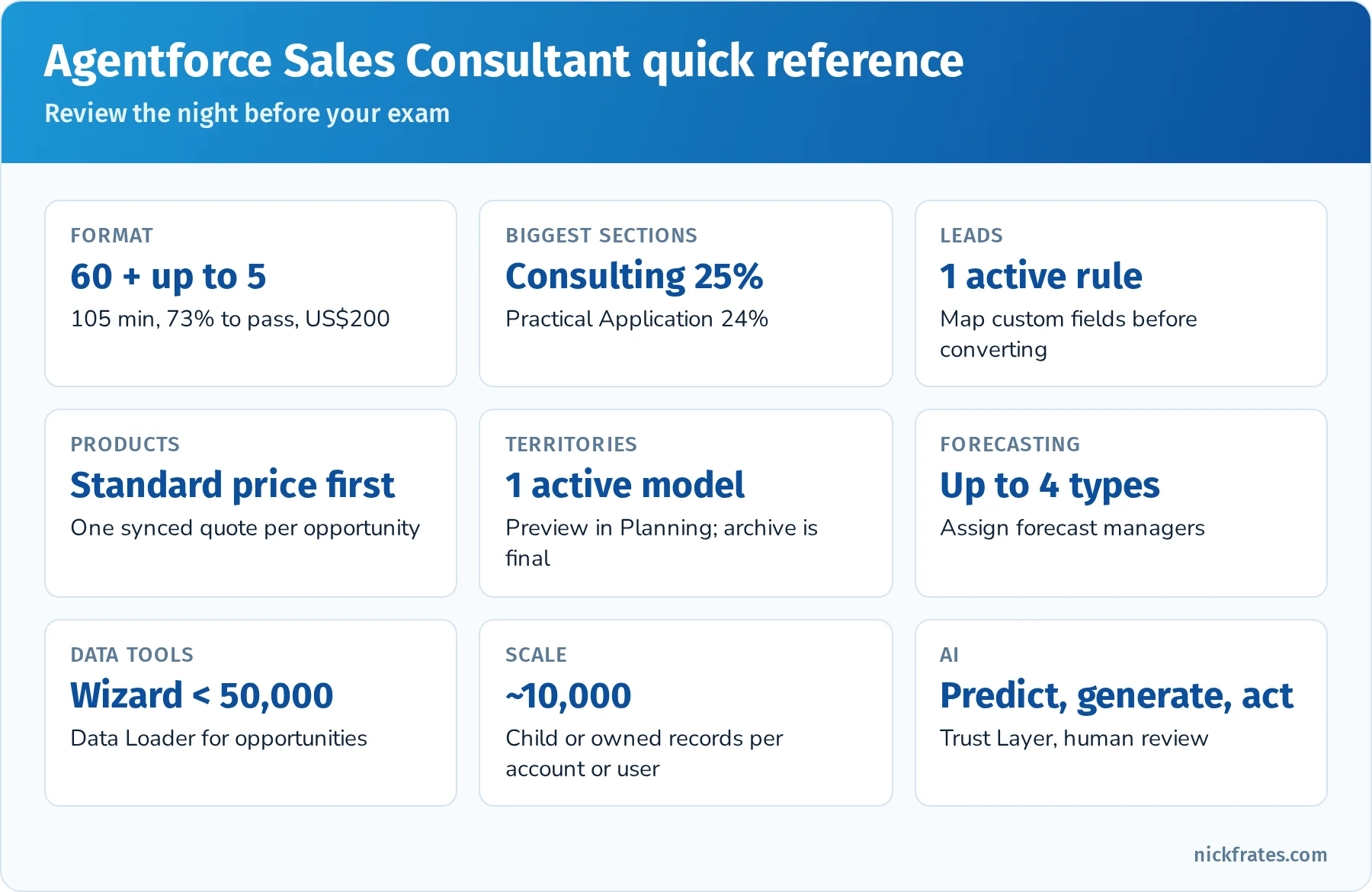
Review this the night before the exam.
Frequently asked questions
Is Agentforce Sales Consultant the same as Sales Cloud Consultant? Yes. Salesforce renamed Sales Cloud Consultant to Agentforce Sales Consultant on July 24, 2026. The exam content and maintenance requirements didn't change with the name, and existing credential holders kept the certification under the new name.
How hard is the exam? It's harder than Platform Administrator because a quarter of it is consulting judgment, and the passing score is 73%. People with real implementation experience find it fair; admins without client-facing experience should spend extra time on the consulting section and practice questions.
What's the prerequisite? You need the Salesforce Certified Platform Administrator credential before you can register. My Platform Administrator study guide covers it.
How many questions and how long? 60 scored questions plus up to 5 unscored questions in 105 minutes.
How much does it cost? US$200 to register and US$100 to retake, plus applicable taxes.
Does the exam cover Agentforce agents? The Predictive and Generative AI section (13%) covers the AI tools in Agentforce Sales and Salesforce's Trusted AI Principles. The deeper agent-building skills (subagents, actions, prompt grounding) belong to the Agentforce Specialist exam.
How do I keep the certification? Complete the annual Agentforce Sales Consultant maintenance module on Trailhead before the due date.
Should I take this or Agentforce Specialist next? If you implement sales processes for clients or your company, take Agentforce Sales Consultant. If you build agents and prompts, take Agentforce Specialist. Many consultants will want both. The certification study guides hub can help you pick. For the other AI options, see my guide to Salesforce AI certifications.
Related study guides
- Salesforce Administrator (Platform Administrator) study guide for the required prerequisite.
- Agentforce Specialist study guide for agents, prompts and grounding.
- Agentforce Specialist practice questions for 18 exam scenarios with explanations.
- Agentforce pricing, for the licensing and credit questions clients ask.
- Agentforce Service Consultant (formerly Service Cloud Consultant) study guide for the service side of the consultant track.
- Salesforce Advanced Administrator study guide for deeper security, data and automation.
- Salesforce Business Analyst study guide for discovery, requirements and user stories.
- Salesforce Data 360 Consultant study guide for unified customer data.
- Sales Cloud Trailhead modules that map to this exam.
- The Science of Studying for Salesforce Certifications for how to study.
- All Salesforce certification study guides.
Want to go deeper on automation? Flow is how consultants automate the sales process: stamping dates, creating follow-up tasks, routing approvals and powering agent actions, and it's the only supported declarative automation tool now that Workflow Rules and Process Builder are past end of support. My Salesforce Flows course walks through record-triggered, screen, scheduled and platform event flows with real-world challenges.
Hope this helps!
Best,
Nick
Cert Lab by Nick Frates
Ready to test yourself?
The Agentforce Sales Consultant Cert Lab ends with 4 full 60-question practice exams with the real 105-minute limit and 73% pass mark, and every answer is explained.
Start the Agentforce Sales Consultant Cert Lab for $9.99 →