This certification is retired. Salesforce retired the Salesforce Certified AI Associate exam in February 2026 (the exam was withdrawn on February 2, 2026). You can no longer register for it. Salesforce now recognizes AI skills through Agentblazer Status on Trailhead and validates them with the Agentforce Specialist certification.
Updated for 2026: this page used to be a short note about passing the AI Associate exam. It's now a guide to what replaced it, what to study instead, and the AI fundamentals from the old exam that are still worth knowing, with practice questions for each topic.
| Quick facts | Detail |
|---|---|
| Status | Retired in February 2026; registration closed |
| Announced | Spring 2025 |
| Replaced by | Agentblazer Status (Champion, Innovator, Legend) and the Agentforce Specialist certification |
| Old exam format | 40 questions, 70 minutes, $75 with free retakes |
| Old exam weights | Data for AI 36%, Ethical Considerations of AI 39%, AI Fundamentals 17%, AI Capabilities in CRM 8% |
| Official sources | AI Associate credential page (with a retirement FAQ) and Salesforce Ben's coverage |
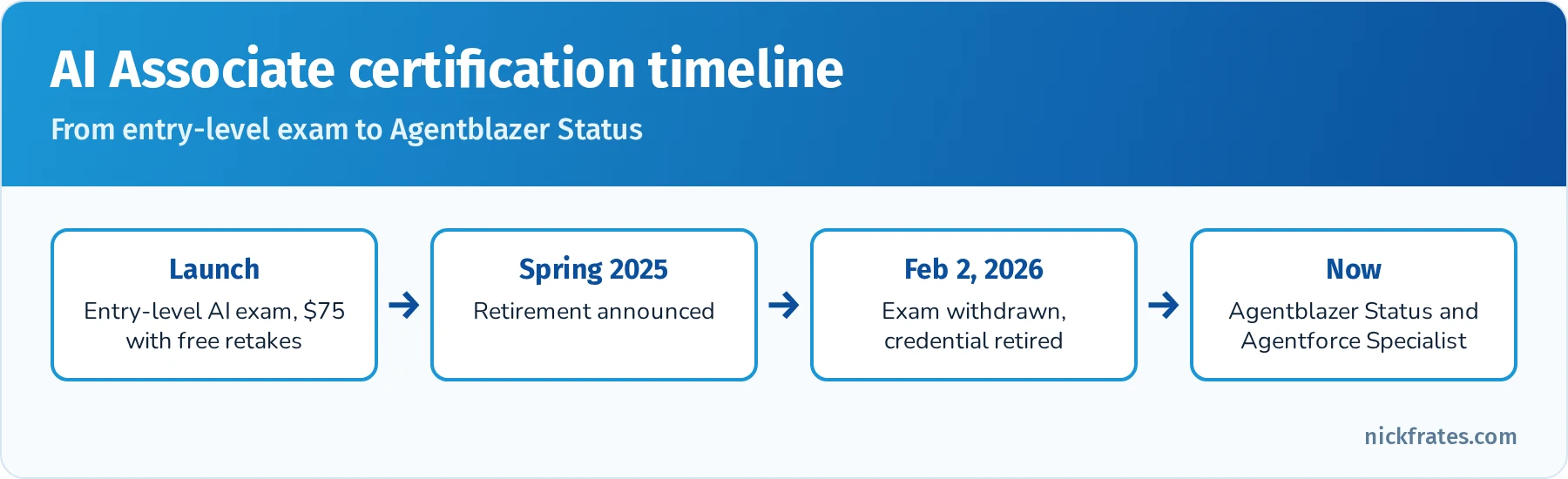
From entry-level exam to Agentblazer Status.
A light personal note: I passed the AI Associate exam in April 2024 after one pass through the official Trailmix and one round of practice exams. It was one of the most relaxed Salesforce exams I've taken, and at $75 with free retakes it was a great first certification for a lot of people. That door is closed now, but the concepts it covered are more useful than ever.
Contents
- What happened to the AI Associate certification
- What replaces it: Agentblazer Status
- What replaces it: the Agentforce Specialist certification
- AI fundamentals that still matter
- AI capabilities in CRM
- Ethical considerations of AI
- Data for AI
- How to study for Agentforce Specialist now
- Frequently asked questions
- Related study guides
What happened to the AI Associate certification
Salesforce launched the AI Associate certification as a low-cost, entry-level exam on AI concepts: what AI is, how it shows up in CRM, how to use it ethically and why data quality matters. As Agentforce and autonomous agents became central to Salesforce's strategy, the company decided a short theory exam no longer represented real AI skills.
In spring 2025 Salesforce announced the retirement, and in February 2026 the exam was withdrawn. The credential page now says Salesforce "retired the AI Associate certification in February 2026" and points to Agentblazer Status. In its retirement FAQ, Salesforce describes the replacement this way: as you advance from Champion to Innovator to Legend, an Agentblazer badge displays on your Trailblazer profile, and you can validate your skills with the Agentforce Specialist certification, which Salesforce offered for free as part of its "AI for All" initiative. Offers like that change, so check the current price before you register.
The community reaction was mixed. Many people agreed that the exam was lightweight. Others, including writers at Salesforce Ben, pointed out that cheap entry-level exams with free retakes were a valuable on-ramp for newcomers nervous about their first certification. If you want that low-cost first-exam experience today, the Platform Foundations certification (formerly Associate) is the closest remaining option, at $75 with free retakes.
If you already hold the AI Associate certification: it no longer needs maintenance, and you can't earn it anymore. Check the retirement FAQ linked from the credential page for exactly how retired credentials display on your Trailblazer profile, and consider adding Agentblazer Status or the Agentforce Specialist certification to show current AI skills.
What replaces it: Agentblazer Status
Agentblazer Status is a Trailhead learning program with three levels. Each level is a curated set of trails and hands-on badges; there's no proctored exam. When you complete a level, an Agentblazer badge shows on your Trailblazer profile.
| Level | Focus | Typical activities |
|---|---|---|
| Agentblazer Champion | Understand AI agents and Agentforce basics | Learn what agents are, explore Agentforce use cases, build and test a simple agent in a Trailhead Playground |
| Agentblazer Innovator | Build and customize agents | Create topics (now called subagents in the new builder), instructions and actions, use Prompt Builder, ground agents in data |
| Agentblazer Legend | Advanced agent design and deployment | Multi-agent scenarios, testing and monitoring, advanced data and integration patterns |
Salesforce updates the Agentblazer curriculum as Agentforce changes, so the exact trails differ year to year. Start from the Agentblazer page on Trailhead and follow the current Champion path.
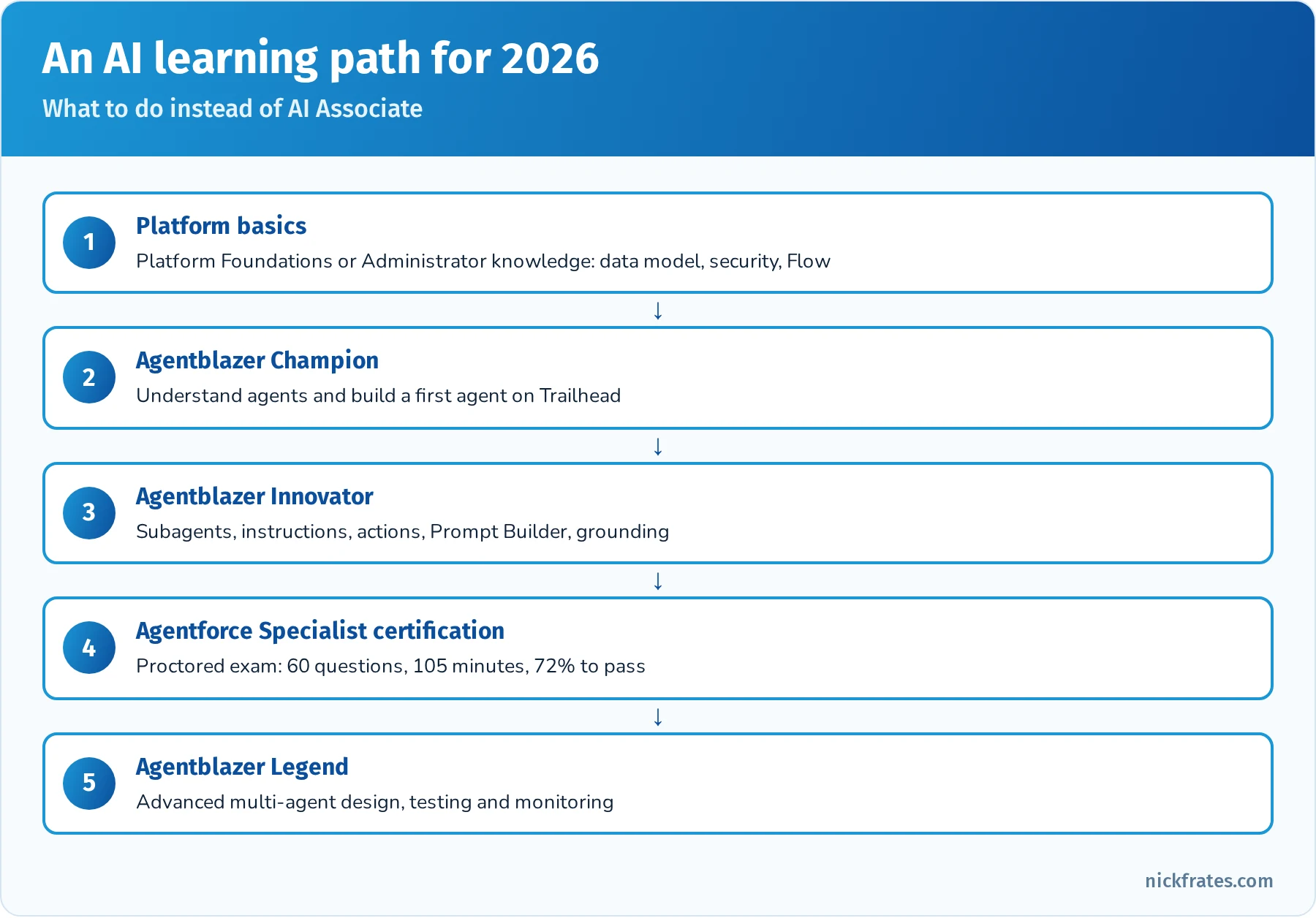
A practical order for building AI skills on Salesforce in 2026.
What replaces it: the Agentforce Specialist certification
The Agentforce Specialist certification (exam code AI-201, formerly AI Specialist) is now Salesforce's main AI credential. It's much deeper than AI Associate: it tests building, testing and governing agents, not just understanding AI concepts.
| Exam fact | Detail |
|---|---|
| Format | 60 scored multiple-choice/multiple-select questions, plus up to 5 unscored |
| Time | 105 minutes |
| Passing score | 72% |
| Fee | $200 USD, retake $100 USD (check for free-voucher programs such as "AI for All") |
| Prerequisites | None; Administrator and Platform App Builder knowledge recommended |
| Official resources | Credential page and exam guide |
| Section (Spring '26 outline) | Weight |
|---|---|
| AI Agents | 35% |
| Prompt Engineering | 20% |
| Data 360 Fundamentals | 20% |
| Testing, Deployment, and Maintenance | 10% |
| Governance and Observability | 10% |
| Multi-Agent Orchestration | 5% |
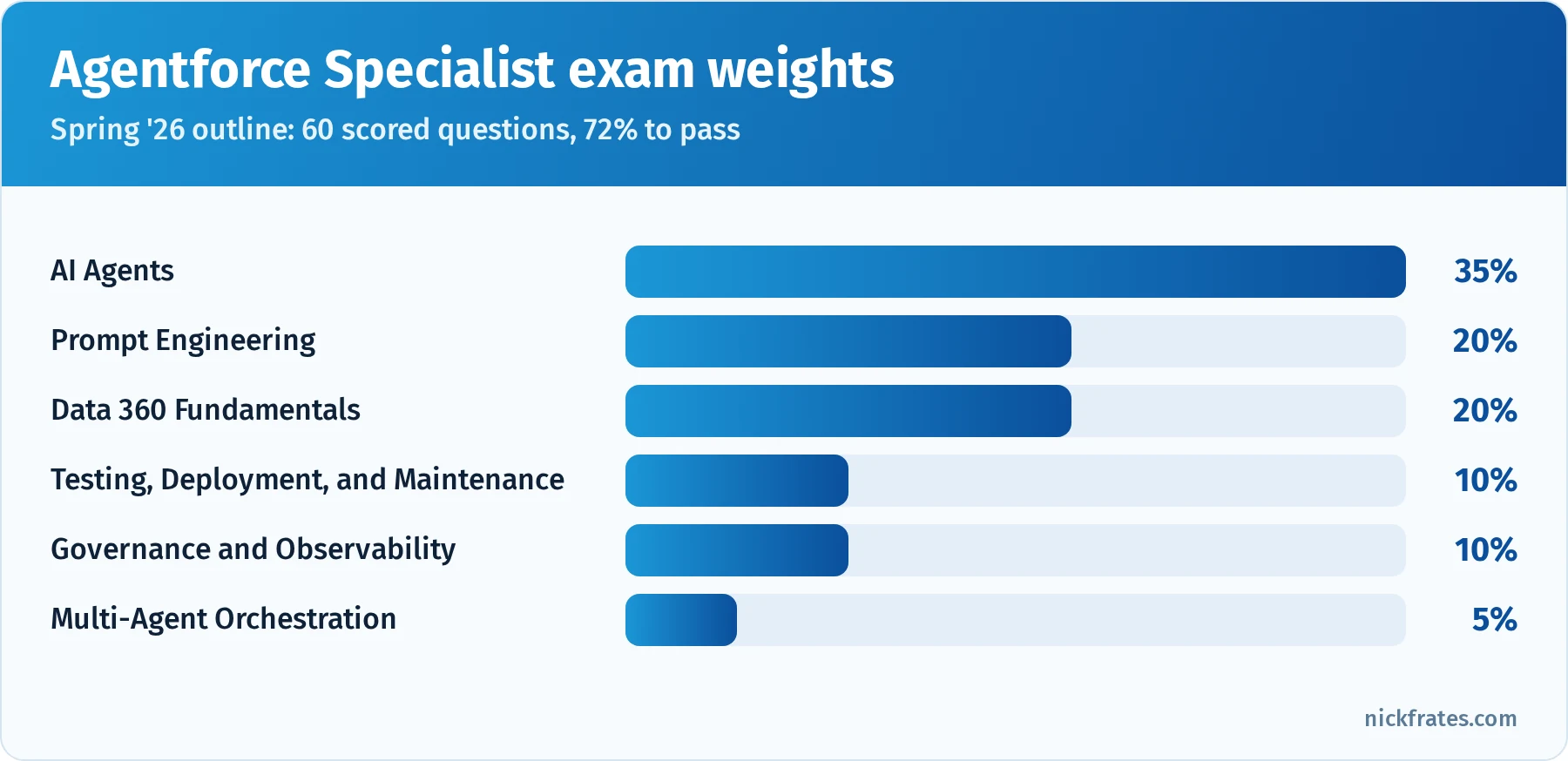
The Agentforce Specialist exam is heavily weighted toward building agents.
Expect questions on the new Agentforce Builder (with canvas and script views and Agent Script), subagents (the exam guide still calls them topics), instructions and actions (flows, Apex, prompt templates), Prompt Builder template types and grounding, the Einstein Trust Layer, Data 360 data libraries and retrievers, the Testing Center, agent analytics and observability, and multi-agent patterns like the Agent API, MCP and agent-to-agent handoffs. You won't be asked to fine-tune models or write code.
How AI Associate topics map to Agentforce Specialist. Most of the old exam's "Data for AI" content now lives inside Data 360 Fundamentals, "Ethical Considerations" became Governance and Observability plus the Einstein Trust Layer, "AI Capabilities in CRM" grew into the whole AI Agents section, and "AI Fundamentals" is assumed background knowledge for Prompt Engineering.
| Old AI Associate section | Where it lives now |
|---|---|
| AI Fundamentals (17%) | Background knowledge for Prompt Engineering and AI Agents |
| AI Capabilities in CRM (8%) | AI Agents (35%), Prompt Builder and Agentforce features |
| Ethical Considerations of AI (39%) | Governance and Observability (10%), Einstein Trust Layer |
| Data for AI (36%) | Data 360 Fundamentals (20%), grounding and retrieval |
AI fundamentals that still matter
The rest of this guide keeps the useful content from the AI Associate outline, updated for 2026. It's a solid foundation for Agentblazer Champion and for the background knowledge the Agentforce Specialist exam assumes.
Types of AI. Predictive AI uses historical data to predict outcomes, for example a lead score, the likelihood a case will escalate, or a forecast. Generative AI creates new content such as emails, summaries, code or images from a prompt. Agentic AI combines a language model with instructions, data and actions so it can reason about a request and take steps on a user's behalf, which is what Agentforce agents do.
Key terms. Machine learning finds patterns in data instead of following hand-written rules. Supervised learning trains on labeled examples (emails labeled spam or not spam); unsupervised learning finds structure in unlabeled data (customer segments). Deep learning uses neural networks with many layers. Natural language processing (NLP) lets computers understand and generate human language. A large language model (LLM) is a deep learning model trained on huge amounts of text to predict the next word, which is what powers generative AI. Hallucination is when a model produces confident but false output. Grounding adds trusted data to a prompt so the model answers from facts. Retrieval augmented generation (RAG) retrieves relevant documents or records at run time and includes them in the prompt.
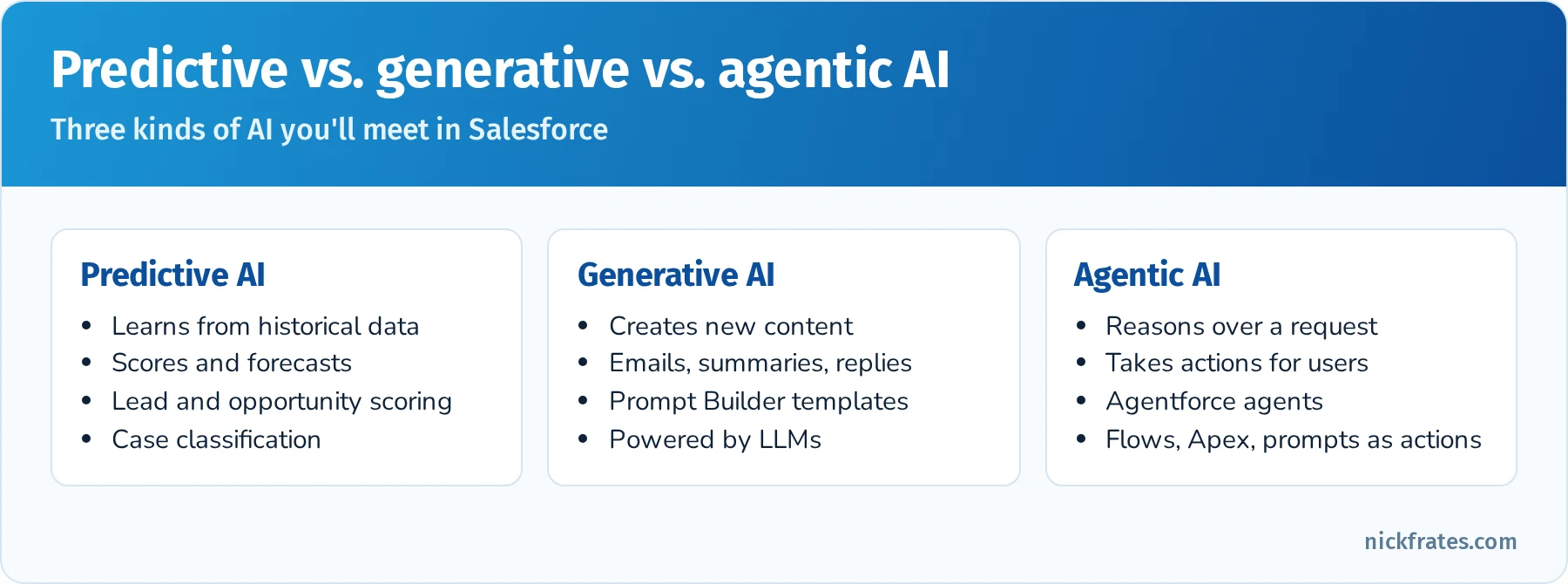
Predictive AI scores, generative AI writes, agentic AI acts.
Quick reference: AI terms
| Term | Plain-English meaning |
|---|---|
| Model | A program trained on data to make predictions or generate content |
| Training data | The examples a model learns from |
| Prompt | The instructions and context you give a generative model |
| Token | A chunk of text a language model reads or writes |
| Grounding | Adding trusted, relevant data to a prompt |
| Hallucination | Confident but incorrect output |
| Bias | Systematic unfairness that comes from data, design or use |
| Agent | AI that reasons over a request, then uses actions to complete tasks |
Practice questions: AI fundamentals
Question 1. A model predicts which open opportunities are most likely to close this quarter based on past deals. What type of AI is this?
- A. Generative AI
- B. Predictive AI
- C. Robotic process automation
- D. Rules-based automation
Answer: B. Predicting an outcome from historical data is predictive AI. Generative AI creates new content.
Question 2. A service rep asks AI to draft a reply to a customer email. What type of AI is being used?
- A. Predictive AI
- B. Generative AI
- C. Unsupervised clustering
- D. A validation rule
Answer: B. Drafting new text is generative AI, usually powered by a large language model.
Question 3. What's the main difference between supervised and unsupervised learning?
- A. Supervised learning needs a human to approve every prediction
- B. Supervised learning trains on labeled examples; unsupervised learning finds patterns in unlabeled data
- C. Unsupervised learning is always more accurate
- D. There is no difference
Answer: B. Labels (known correct answers) define supervised learning. Clustering customers into segments without labels is unsupervised.
Question 4. An LLM invents a return policy that doesn't exist. What is this called, and what helps prevent it?
- A. Overfitting; add more training epochs
- B. Hallucination; ground the prompt in trusted company data
- C. Tokenization; shorten the prompt
- D. Bias; remove all data
Answer: B. Grounding the model in real policy documents or records reduces hallucinations.
Question 5. Which statement best describes an AI agent?
- A. A static report
- B. AI that interprets a request, reasons about it and uses actions such as flows or Apex to complete tasks
- C. A spreadsheet macro
- D. A human support agent
Answer: B. Agents combine a language model with instructions, data and actions to take steps on a user's behalf.
AI capabilities in CRM
Salesforce AI shows up in three broad ways: predictions built into apps, generative features that help users write and summarize, and agents that can complete tasks.
Predictive features. Examples include lead and opportunity scoring, case classification and routing suggestions, forecasting and next best action recommendations. They help users prioritize work, and they're only as good as the historical data behind them.
Generative features. Prompt Builder lets admins create reusable prompt templates (for example, field generation templates that fill a field with a summary, sales email templates and flex templates) grounded with record fields, related lists, flows, Apex or retrievers. Generative features also power email drafting, call summaries, knowledge article drafting and service replies.
Agents. Agentforce agents (built in Agentforce Builder) handle conversations with employees or customers. Each agent has subagents (topics) that define jobs to be done, instructions that guide reasoning, and actions such as flows, Apex, prompt templates and API calls. Agents can be deployed in Salesforce, on websites, in messaging channels and through APIs.
The Einstein Trust Layer. Salesforce's security architecture for generative AI. It includes secure data retrieval that respects user permissions, dynamic grounding, data masking of sensitive fields before prompts reach an external model, prompt defense, zero data retention agreements with model providers, toxicity detection and an audit trail. Expect it on the Agentforce Specialist exam.
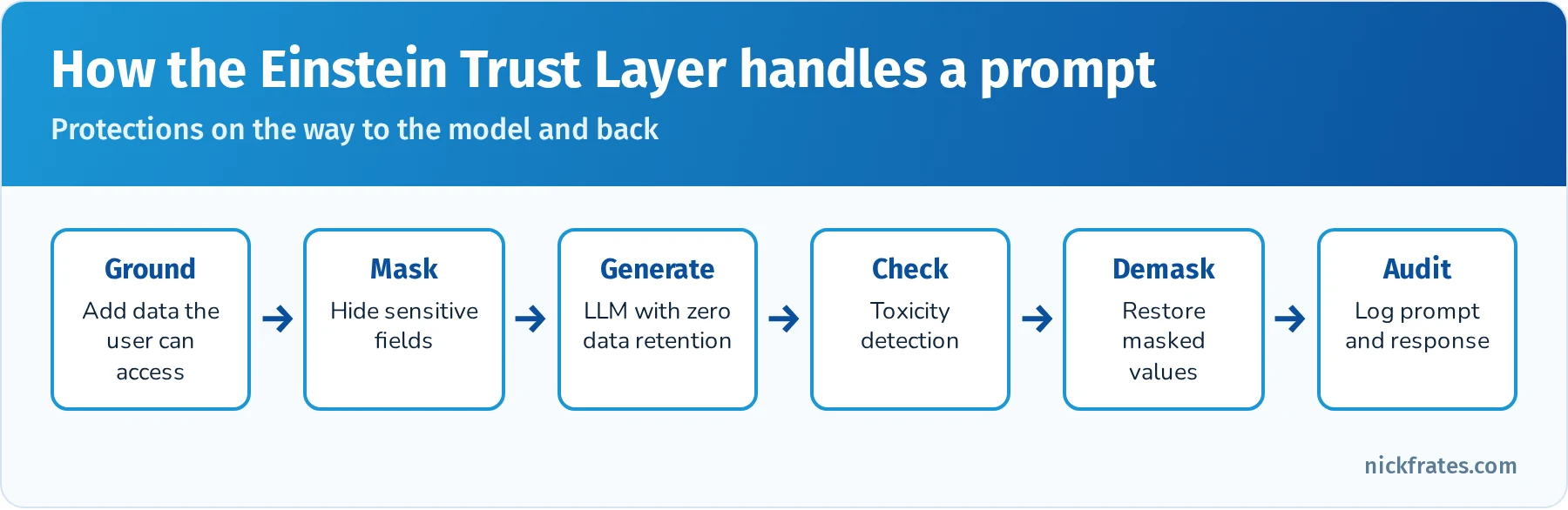
The Einstein Trust Layer wraps every generative request.
Quick reference: picking the right AI feature
| Need | Feature |
|---|---|
| Prioritize leads by likelihood to convert | Predictive scoring |
| Fill a summary field automatically from a record | Prompt Builder field generation template |
| Draft a personalized sales email | Sales email prompt template |
| Answer customer questions 24/7 and take actions | Agentforce service agent |
| Help employees complete tasks in Salesforce | Agentforce employee agent |
| Protect sensitive data in prompts | Einstein Trust Layer data masking |
Practice questions: AI capabilities in CRM
Question 1. A sales manager wants each opportunity to show a short AI-generated summary of recent activity in a field. Which feature fits?
- A. A validation rule
- B. A Prompt Builder field generation template
- C. A roll-up summary
- D. A report
Answer: B. Field generation templates write generated content into a field, grounded in record data.
Question 2. Which component of an Agentforce agent defines what the agent can actually do, like look up an order or create a case?
- A. Actions
- B. Page layouts
- C. Reports
- D. Roles
Answer: A. Actions (flows, Apex, prompt templates, APIs) are the steps an agent can take. Subagents and instructions guide when to use them.
Question 3. How does the Einstein Trust Layer protect customer data sent to an external LLM?
- A. It sends all data unchanged
- B. It masks sensitive data, relies on zero data retention agreements and logs interactions in an audit trail
- C. It disables AI features
- D. It deletes the customer record
Answer: B. Masking, zero data retention and auditing are core Trust Layer protections.
Question 4. A company wants customers on its website to get answers about order status at any time, with the ability to start a return. What should it consider?
- A. A dashboard
- B. An Agentforce service agent with order lookup and return actions
- C. A list view
- D. A static FAQ page only
Answer: B. A service agent can answer questions and take actions such as starting a return.
Question 5. Predictive lead scores are poor at a new company with only 20 historical leads. What's the most likely reason?
- A. The model is too big
- B. There isn't enough historical data for the model to learn reliable patterns
- C. Leads can't be scored
- D. The org needs more page layouts
Answer: B. Predictive AI depends on enough quality historical data. Small or skewed data sets produce unreliable predictions.
Ethical considerations of AI
This was the largest section on the old exam, and it's still essential. Salesforce frames responsible AI with two sets of principles.
Salesforce's Trusted AI principles: Responsible, Accountable, Transparent, Empowering and Inclusive.
Salesforce's guidelines for trusted generative AI: Accuracy (verifiable, grounded results and clear uncertainty), Safety (mitigating bias, toxicity and harmful output, and protecting privacy), Honesty (respecting data provenance and being transparent that content is AI-generated), Empowerment (keeping humans in the loop where it matters) and Sustainability (using right-sized models to limit environmental cost).
Types of bias. Bias can enter at many points:
| Bias | Example |
|---|---|
| Measurement or dataset bias | Training data over-represents one region, so predictions are worse elsewhere |
| Association bias | A model links certain jobs with one gender because of historical data |
| Confirmation bias | Designers only test cases that confirm what they expect |
| Automation bias | Users trust AI output without checking it |
| Societal bias | Historical inequities in data are reproduced by the model |
| Survivorship bias | Only successful cases are in the data, so failures are invisible |
| Interaction bias | Users teach a system biased behavior through their inputs |
Practical safeguards. Use diverse, representative data; remove or carefully handle sensitive attributes and their proxies (such as postal code standing in for ethnicity); test outcomes across groups; keep humans in the loop for consequential decisions; tell people when they're interacting with AI; give users ways to give feedback; and monitor models after launch.
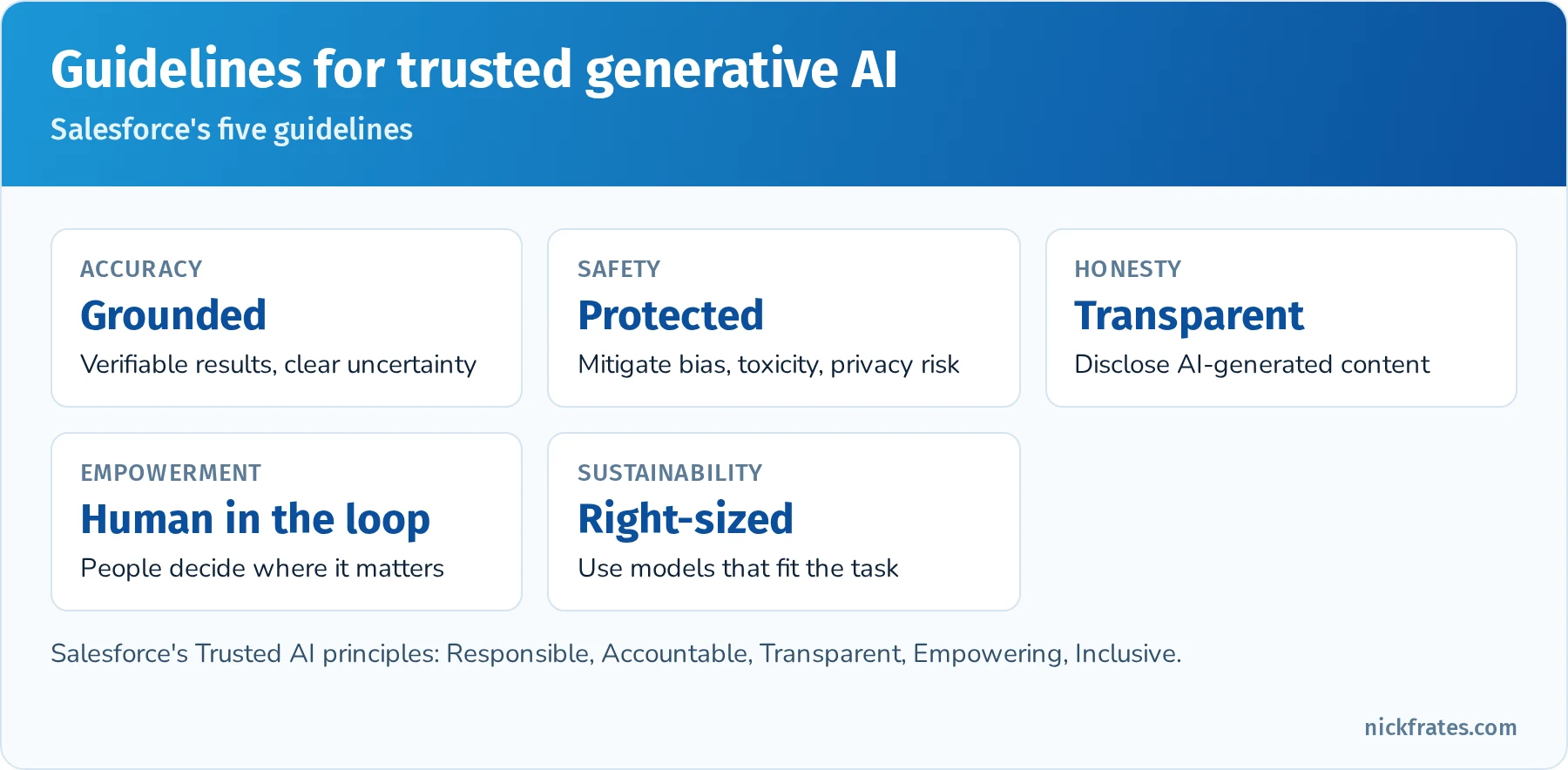
Five guidelines for trusted generative AI.
Practice questions: Ethical considerations of AI
Question 1. A loan pre-approval model rejects applicants from certain postal codes at much higher rates even though postal code isn't supposed to matter. What's the most likely problem?
- A. The model is too accurate
- B. Postal code is acting as a proxy for a protected attribute, introducing bias
- C. There's no problem
- D. The model needs more page layouts
Answer: B. Seemingly neutral fields can act as proxies for sensitive attributes. Test outcomes across groups and remove or adjust proxy features.
Question 2. Which Salesforce generative AI guideline is about telling users that content was AI-generated?
- A. Sustainability
- B. Honesty
- C. Safety
- D. Accuracy
Answer: B. Honesty covers transparency about AI-generated content and respecting data provenance.
Question 3. Service reps accept every AI-suggested reply without reading it. What bias is this?
- A. Survivorship bias
- B. Automation bias
- C. Association bias
- D. Measurement bias
Answer: B. Automation bias is over-trusting automated output. Keep humans meaningfully in the loop.
Question 4. What is a good practice when deploying an AI feature that affects important decisions about people?
- A. Hide that AI is being used
- B. Keep a human in the loop, explain how the AI is used and monitor outcomes for bias
- C. Never collect feedback
- D. Use as much personal data as possible
Answer: B. Transparency, human oversight and monitoring are central to responsible AI.
Question 5. Which choice best supports the Sustainability guideline?
- A. Always use the largest available model
- B. Use an appropriately sized model for the task
- C. Run every prompt twice
- D. Disable caching
Answer: B. Right-sizing models reduces energy use and cost without hurting quality for the task.
Data for AI
AI is only as good as its data. This was over a third of the old exam and it maps directly to Data 360 Fundamentals on the Agentforce Specialist exam.
Data quality dimensions.
| Dimension | Question it answers | Salesforce tools that help |
|---|---|---|
| Completeness | Are required values filled in? | Required fields, validation rules, Flow |
| Accuracy | Do values reflect reality? | Validation rules, data enrichment, verification |
| Consistency | Is the same thing recorded the same way everywhere? | Picklists, global value sets, standard formats |
| Timeliness | Is the data current? | Integrations, scheduled updates, data freshness checks |
| Uniqueness | Are there duplicates? | Duplicate rules and matching rules, identity resolution in Data 360 |
| Validity | Does data follow formats and rules? | Field types, validation rules, input masks |
Why it matters for AI. Incomplete or duplicated customer data leads to bad predictions and badly grounded answers. Agents grounded in stale knowledge articles give stale answers. Data 360 (formerly Data Cloud) unifies data from many sources into unified profiles, and its data libraries, search indexes and retrievers let agents and prompts find the right content at run time.
Data privacy and governance. Collect only what you need, respect consent and regional privacy laws, classify sensitive fields, control access with permissions, and use masking for sensitive data in prompts. Remember that agents act with permissions, so least-privilege access matters.
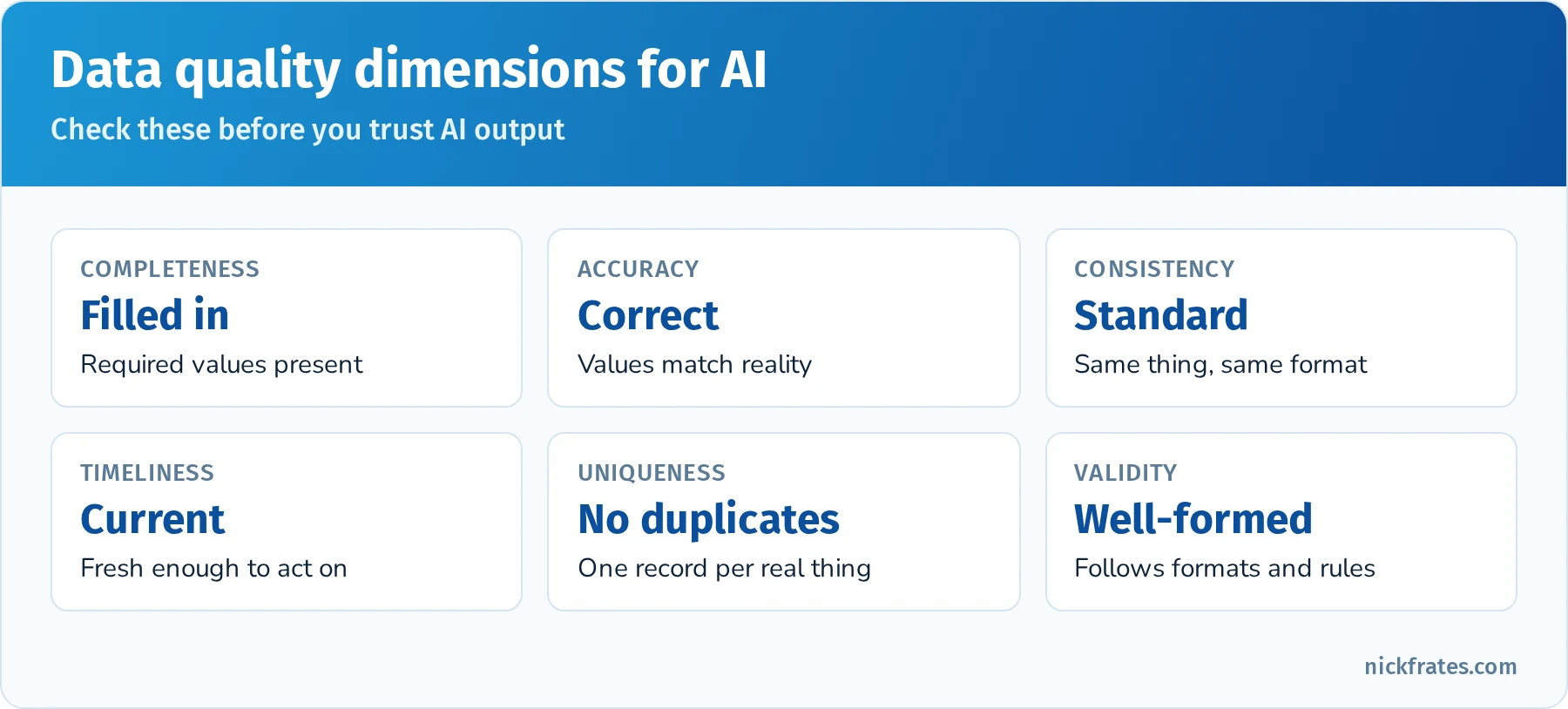
Six data quality dimensions to check before you trust AI output.
Practice questions: Data for AI
Question 1. An AI model trained on CRM data gives poor predictions because 40% of opportunity records have no Close Reason. Which data quality dimension is the issue?
- A. Timeliness
- B. Completeness
- C. Uniqueness
- D. Sustainability
Answer: B. Missing values are a completeness problem. Validation rules or required fields can help going forward.
Question 2. The same customer appears three times with slightly different names, splitting their history. What should be addressed first?
- A. Uniqueness, with duplicate and matching rules or identity resolution
- B. Timeliness
- C. Model size
- D. Prompt length
Answer: A. Duplicates hurt both predictions and grounding. Duplicate management and identity resolution create a single view of the customer.
Question 3. An agent answers questions using knowledge articles that haven't been updated in two years. Which dimension is the risk?
- A. Validity
- B. Timeliness
- C. Consistency
- D. Inclusivity
Answer: B. Outdated content produces outdated answers even if the AI works perfectly.
Question 4. Which approach best protects sensitive data when using generative AI in Salesforce?
- A. Paste records into public chatbots
- B. Use the Einstein Trust Layer's masking and permission-aware grounding, and limit what data templates include
- C. Give agents System Administrator access
- D. Turn off field-level security
Answer: B. Masking, permission-aware retrieval and minimal data in prompts protect sensitive information.
Question 5. What does Data 360 add for AI use cases?
- A. Page layouts
- B. Unified customer profiles from many sources plus retrieval of structured and unstructured content for grounding
- C. Apex compilation
- D. Email deliverability settings
Answer: B. Data 360 harmonizes and unifies data, and its search indexes and retrievers ground prompts and agents.
How to study for Agentforce Specialist now
If you were planning to take AI Associate, here's a simple path forward:
- Week 1: Agentblazer Champion. Complete the current Champion trails and build your first agent in a Trailhead Playground or a Developer Edition org with Agentforce enabled.
- Week 2: Prompt Builder and grounding. Build a field generation template and a flex template, ground them with record data and a flow, and test them in the preview panel.
- Week 3: Agents in depth. Create subagents, instructions and actions (a flow action and a prompt template action). Test conversations in the builder, then use the Testing Center to run batch tests.
- Week 4: Data 360, governance and multi-agent topics. Learn data libraries, retrievers, the Einstein Trust Layer, agent analytics and how agents hand off to each other or connect through the Agent API and MCP.
- Week 5: Practice exams and review. Take timed practice tests and turn every miss into a flashcard.
Flows are the most common agent action, so strong Flow skills pay off on this exam. Want to go deeper on automation? My Salesforce Flows course walks through record-triggered, screen, scheduled and platform event flows with real-world challenges.
Frequently asked questions
Can I still take the AI Associate exam? No. Salesforce retired it in February 2026, and registration is closed.
Is my AI Associate certification still valid? Salesforce's retirement FAQ, linked from the credential page, explains how retired credentials appear on your profile. The best way to show current AI skills is to add Agentblazer Status or the Agentforce Specialist certification.
Is Agentblazer Status a certification? No. It's a Trailhead recognition program with badges for completing learning paths. Agentforce Specialist is the proctored certification.
Is the Agentforce Specialist exam hard? It's much harder than AI Associate was. The passing score is 72%, and questions are scenario-based. Hands-on experience building agents makes the biggest difference.
What's the cheapest Salesforce certification now? Platform Foundations (formerly Associate) is $75 with free retakes. Salesforce has also offered free Agentforce Specialist vouchers through programs like AI for All, so check current offers.
Related study guides
- Salesforce Platform App Builder study guide, the declarative foundation recommended before Agentforce Specialist.
- Salesforce Platform Developer I study guide, including invocable Apex for Flow and agent actions.
- Development Lifecycle and Deployment Architect study guide for testing and releasing changes safely.
- The Future of Salesforce Careers (2025 to 2027) for how AI is changing Salesforce roles.
Hope this helps!
Best,
Nick