Hey friends,
These are 18 original Agentforce Specialist (AI-201) practice questions, spread across the six exam sections the same way the real exam is, each with the reasoning and a link to the Salesforce Help page it comes from. They're not exam dumps. I wrote them from the official exam guide and the Help articles I used to build my AI-201 course.
If you want the full outline first, start with my Agentforce Specialist study guide. Come back here when you want to test yourself.
The exam in one minute
- 60 scored questions plus up to five unscored ones, in 105 minutes.
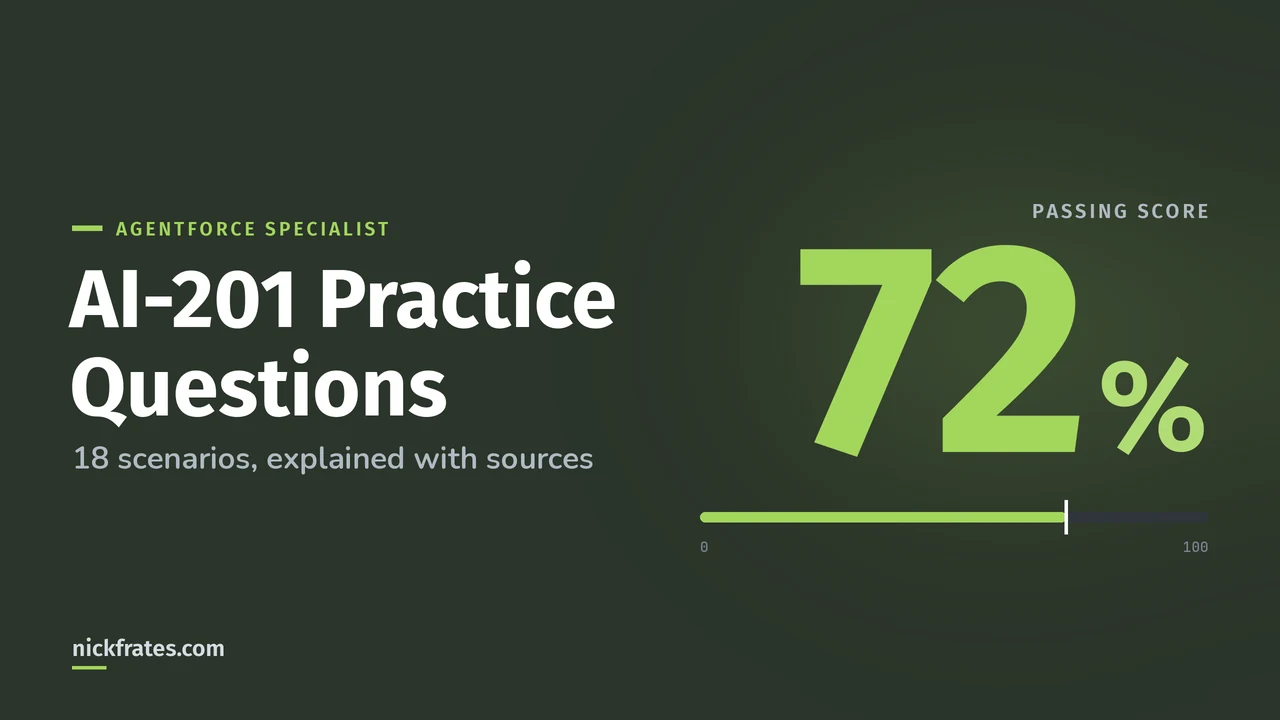
- Passing score: 72%. Registration is USD 200, retakes USD 100, plus taxes.
- No prerequisite, though the guide recommends Platform Administrator knowledge.
- Aligned to the Spring '26 release. Agentforce changes every release, so check the guide before you book.
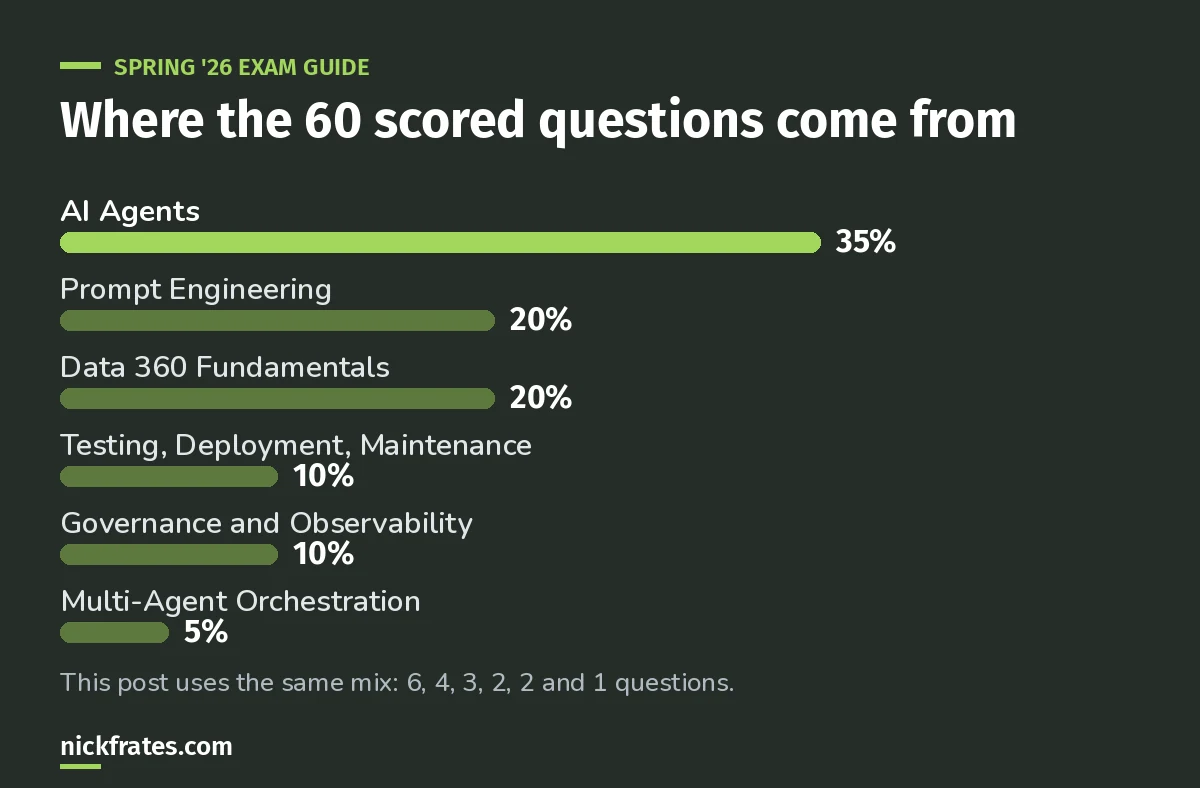
AI Agents alone is more than a third of the exam.
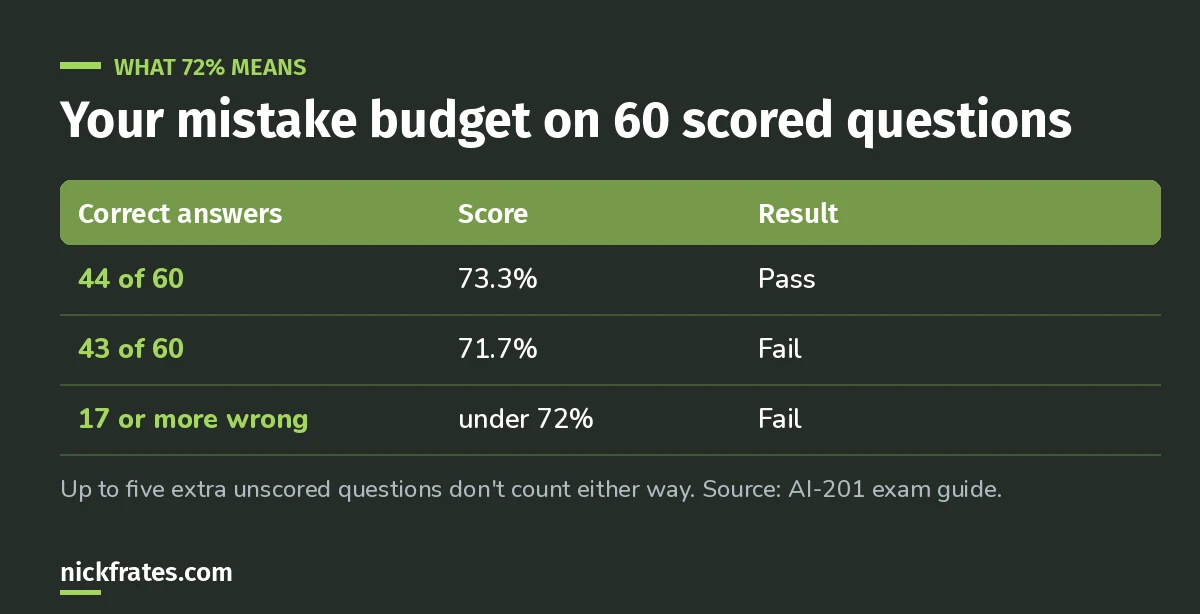
Seventeen misses is the line.
How to use these: cover the answer, commit to a letter, then read the explanation even when you got it right. The explanation is where the points are.
AI Agents (35%)
1. An agent tracks which step of an intake interview it's on. The value starts at "gatheringInfo" and the agent must be able to change it as the conversation moves on. How do you define it in Agent Script?
- A. A linked variable with a default value
- B. A custom variable marked mutable, with a default value
- C. A system variable
- D. A custom variable without mutable
Answer: B. Custom variables can have a default value, and mutable is what lets the agent change it. Leave mutable off when the value must never change. Linked variables can't have a default at all. (Source: Agentforce Developer Guide)
2. A variable should always hold whatever an order lookup action returned. Which kind of variable is that?
- A. Custom
- B. Linked
- C. System
- D. External
Answer: B. A linked variable's value is tied to an output, such as an action's output, and it can't have a default value. (Source: Agentforce Developer Guide)
3. Your mobile app calls the agent through an API and needs to pass in the customer's tier before the conversation starts. What do you set on the variable?
- A. mutable
- B. A description so the LLM fills it
- C. visibility: External
- D. Nothing; API callers can set any variable
Answer: C. Visibility defaults to Internal. External lets an API set the value (and lets you change it in simulate mode while testing). (Source: Agentforce Developer Guide)
4. New Help articles talk about "subagents" where your notes say "topics". What changed?
- A. Subagents replaced topics and work differently
- B. Only the name: topics are called subagents since April 2026
- C. Subagents are only for multi-agent orchestration
- D. Subagents are a paid add-on
Answer: B. Salesforce renamed agent topics to subagents beginning in April 2026, with no change in functionality. Expect both terms in study material for a while. (Source: Salesforce Help)
5. A loyalty member must always be offered the members-only return policy. The team doesn't want the LLM deciding this. What's the right approach in Agent Script?
- A. Add "please always offer it" to the instructions
- B. A conditional expression on an is_member variable, so the path is deterministic
- C. A longer system prompt
- D. A second agent
Answer: B. Agent Script mixes LLM reasoning with deterministic logic. Conditional expressions on variables decide the path the same way every time, which is the point of hybrid reasoning. (Source: Agentforce Developer Guide)
6. An admin wants to review an agent as readable blocks and expand them when needed. A developer wants syntax highlighting, autocompletion and validation. Which views?
- A. Both use Canvas view
- B. Admin: Canvas view. Developer: Script view
- C. Admin: Script view. Developer: Canvas view
- D. Both use Setup
Answer: B. Canvas view summarizes Agent Script into blocks you can expand. Script view is for writing script directly with developer aids. (Source: Agentforce Developer Guide)
Prompt Engineering (20%)
7. You built a Field Generation prompt template that summarizes open cases. Users can't see the AI button on the Account page. What's the most likely missing step?
- A. The template isn't a Flex template
- B. The Account page doesn't use Dynamic Forms
- C. Toxicity detection is off
- D. The LLM provider is disabled
Answer: B. To add a Field Generation template to a Lightning record page, the page must use Dynamic Forms. (Source: Salesforce Help)
8. You need a template that takes a Campaign and a Product as inputs to draft a newsletter. Which type?
- A. Sales Email
- B. Field Generation
- C. Flex
- D. Record Summary
Answer: C. Flex templates are for use cases the other types don't cover. You define your own inputs (resources), up to 5. (Source: Salesforce Help)
9. Version 2 of a prompt template was active last week and is now deactivated. You want to fix a typo in it. What happens?
- A. Edit and save version 2
- B. Version 2 is immutable; save your change as a new version
- C. Delete version 2 first
- D. Reactivate it, then edit
Answer: B. Activating a version makes it immutable, even after it's deactivated. Only one version can be active at a time. (Source: Salesforce Help)
10. Compliance asks you to block one LLM provider's models org-wide. Where and what's the catch?
- A. Prompt Builder settings; no catch
- B. Einstein Setup, Configure Model Providers; agents and templates using those models can stop working, and it can take up to 10 minutes
- C. Data 360 setup; it only affects new templates
- D. It can't be done
Answer: B. Turning off a provider blocks its models in the org. Salesforce warns this can stop agents, actions, prompt templates and Testing Center runs that use them, so test in a sandbox first. (Source: Salesforce Help)
Cert Lab by Nick Frates
Want 6 full sections of this?
The AI-201 Cert Lab has lessons, practice questions and flashcards for every section of the Spring '26 guide, with each answer explained.
Start the AI-201 Cert Lab, $9.99 →Data 360 Fundamentals (20%)
11. You created a data library from uploaded files. Now the team wants it to use Knowledge articles instead. What do you do?
- A. Edit the library's data source
- B. Create a new data library with Knowledge as the source
- C. Add Knowledge as a second source
- D. Re-run chunking
Answer: B. A data library supports one data source, and you can't change it after you choose it. Each feature can use one library at a time. (Source: Salesforce Help)
12. Customers search for exact model numbers like "TX 400" vs "TX 440", and vector search keeps mixing them up. What fixes it?
- A. Larger chunks
- B. A hybrid search index
- C. Turning off citations
- D. Conversation-based chunking
Answer: B. Vector search handles meaning but not specific numbers or domain terms well. Hybrid search adds a keyword index and fuses the results. (Source: Salesforce Help)
13. In Prompt Builder you want the retriever to return only articles for the customer's country, but there's no Pre-filter field. Why?
- A. Prefilters only work in Flex templates
- B. The retriever has no filter condition marked Dynamic
- C. Prefilters need Apex
- D. The search index isn't hybrid
Answer: B. The retriever must be configured in AI Models (formerly Einstein Studio) with at least one filter condition that has Dynamic selected. (Source: Salesforce Help)
Testing, Deployment, and Maintenance (10%)
14. You want to iterate on instructions quickly without touching real records or external services. Which Testing Center setting?
- A. Live data
- B. Mocked data
- C. Conversation-level scope
- D. Text and voice output
Answer: B. Mocked data runs in an isolated environment with no external calls and no side effects. Note that conversation-level tests don't support mocked data. (Source: Salesforce Help)
15. Your test CSV has an Expected Response of "The agent should mention the order number and be polite." Scores look wrong. Why?
- A. The column must be blank
- B. Expected Response should be the response you expect, not instructions about it
- C. CSVs can't include Expected Response
- D. You need a custom scorer
Answer: B. Salesforce calls this out as a common mistake: write the answer you expect, not a description of it. (Source: Salesforce Help)
Governance and Observability (10%)
16. Service leaders assume customer names are masked before the LLM sees them in agent conversations. Are they?
- A. Yes, always
- B. Only with field-based masking
- C. No: Trust Layer data masking is disabled for agents
- D. Only in sandboxes
Answer: C. Help is explicit that LLM data masking is disabled for agents. It's available for features like Service Replies and work summaries. (Source: Salesforce Help)
17. Where do toxicity scores end up, and which detection is on by default?
- A. Debug logs; prompt detection on
- B. The audit trail in Data 360; response detection on and can't be turned off, prompt detection (beta) off
- C. Setup Audit Trail; both off
- D. Nowhere; scores aren't stored
Answer: B. Scores run from 0 to 1 and are logged in the audit trail in Data 360. Response detection is always on; prompt detection is a beta you turn on. (Source: Salesforce Help)
Multi-Agent Orchestration (5%)
18. An agent needs a loan risk score from a third-party banking service without custom point-to-point integration code. Which open standard fits?
- A. MCP (Model Context Protocol)
- B. Change sets
- C. Platform Events
- D. Agent Script variables
Answer: A. MCP is an open standard for how AI models connect to external systems and their tools. MCP for Agentforce lets you register and use third-party tools. (Source: Salesforce Help)
Scoring yourself
- 15 or more right: you're in good shape. Spend your time on whatever section you missed.
- 11 to 14: close. Re-read the Help pages linked in the answers you missed, then try again in a few days.
- 10 or fewer: go back to the study guide, especially AI Agents and Prompt Engineering, which together are 55% of the exam.
That cut-off is my rule of thumb for this set, not an official number. Eighteen questions is a spot check, not a prediction.
Patterns behind the wrong answers
- "Just add it to the instructions." When the scenario says the behavior must be predictable, the answer is deterministic logic (variables, conditions, filters), not a stronger prompt.
- Assuming masking covers agents. It doesn't. Know where Trust Layer features apply.
- Edit-in-place thinking. Activated prompt template versions are immutable, data library sources can't be changed, and only one retriever version is active at a time.
- Old names. Data Cloud is now Data 360, Einstein Studio is now AI Models, topics are now subagents. Questions may use either name.
Keep studying
- Agentforce Specialist study guide: every objective, section by section.
- Salesforce AI certifications: how AI-201 fits with the other AI credentials.
- Agentforce Trailhead modules: the free hands-on modules worth doing.
- AI Associate is retired: what replaced it and the AI basics still worth knowing.
- Exam score calculator: turn section results into an estimated score.
- Agentforce Service Consultant guide if you're heading toward implementation work next.
Cert Lab by Nick Frates
Get the Agentforce Specialist Cert Lab
Lessons, practice questions and flashcards for all 6 AI-201 exam sections, built from Salesforce Help.
Start the AI-201 Cert Lab, $9.99 →Hope this helps!
Best,
Nick


