Hey friends,
To pass the Salesforce Certified Platform Development Lifecycle and Deployment Architect exam you need 65% on 60 multiple-choice questions in 105 minutes, and no section is safe to skip: System Design (15%), Building (14%) and Deploying (14%) are the biggest, but the other five sit between 8% and 13%. I built this plan from the official exam guide and the Salesforce docs behind it. It tells you what to study first, what each section is really asking and how to spend your weeks.
This is the short plan. There is also a much longer Development Lifecycle and Deployment Architect study guide that walks through every section in depth. Use this page to decide what to do each week, and that one when you want the detail.
What is on the Salesforce Development Lifecycle and Deployment Architect exam?
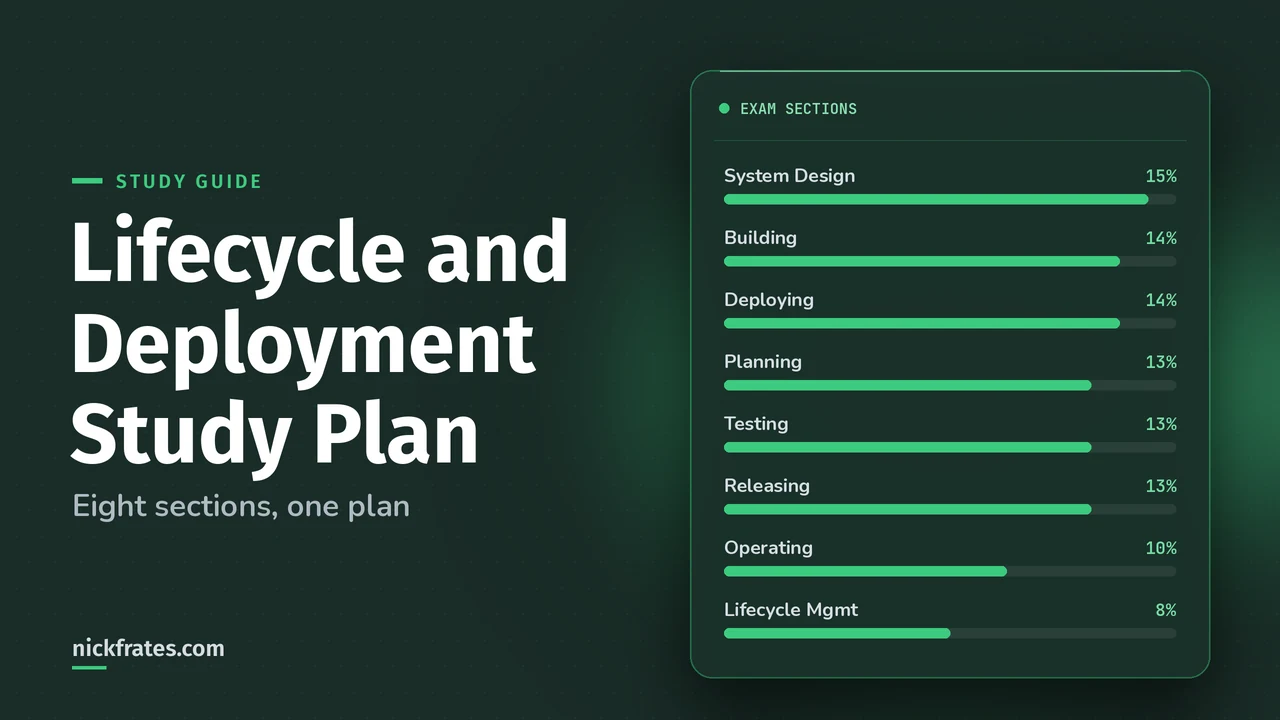
Eight sections, weighted like this in the exam guide:
| Section | Weight | What it tests |
|---|---|---|
| Application Lifecycle Management | 8% | Comparing development methodologies (agile, waterfall, hybrid), their benefits and risks, and recommending governance that fits the customer's maturity |
| Planning | 13% | Assessing ALM maturity (people, technology and process), environment risks and how to reduce them, governance frameworks and planning for the Summer, Winter and Spring releases |
| System Design | 15% | Agile tools, org strategy, an environment strategy built on the right sandbox types, and comparing the components and tools of a deployment strategy |
| Building | 14% | Source control branching, versioning and merging, test data and unit test approaches, org-based versus package-based development, and code quality practices |
| Deploying | 14% | What the Metadata API and Tooling API can and can't do for deployment, pre and post deployment steps, and managing configuration that is stored as data |
| Testing | 13% | Choosing a testing methodology, test execution and coverage requirements, and a test data strategy that uses representative data securely |
| Releasing | 13% | Managed, unmanaged and unlocked packages, mapping sandboxes to a release plan with streams, training, staging and hotfixes, and release management |
| Operating | 10% | What happens when changes are made directly in production and how to bring those changes back into the lifecycle, plus sharing release artifacts across multiple orgs |
The guide wording is scenario-based throughout: "given a customer scenario, recommend...". That tells you what the questions look like. You pick the best approach for a described situation, not a definition.
How many questions, how long and how much does it cost?
| Detail | What the exam guide says |
|---|---|
| Questions | 60 multiple-choice questions, plus up to five unscored ones (the Trailhead Academy page says multiple-choice/multiple-select, so prepare for both) |
| Time | 105 minutes |
| Passing score | 65%, which is 39 of the 60 scored questions |
| Registration fee | US$400 plus applicable taxes |
| Retake fee | US$200 plus applicable taxes |
| Delivery | Proctored, at a testing center or online |
| During the exam | No hard-copy or online materials |
| Prerequisite | None |
| Release alignment | Questions align to the Spring '23 release |
The unscored questions are mixed in at random, so treat every question as if it counts. The guide also says you complete a maintenance badge on Trailhead once a year to keep the certification. For the money side, I break down fees and retakes in how much Salesforce certifications cost. The Trailhead credential page has the official listing.
What has changed since the exam guide?
The guide says the questions align to the Spring '23 release, and the platform has moved since. The exam tests the concepts, but you will see newer names in the docs and in real projects, so it helps to know both:
| In the exam guide era | What you will see now |
|---|---|
| DevOps Center | Salesforce's Trailhead module says Lifecycle Center was previously known as DevOps Center. Same idea: work items, a source control repository as the source of truth and a release pipeline you move changes through with clicks |
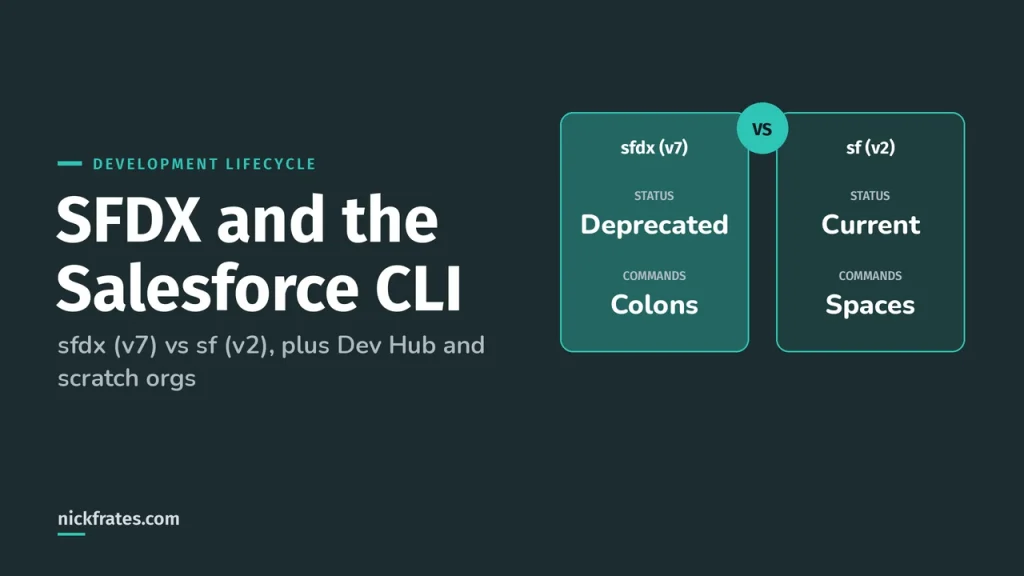
| sfdx commands (v7) | The Salesforce CLI is now the sf command (v2), and Salesforce says sfdx is aliased to it after you upgrade |
| AppExchange | Salesforce now calls its marketplace AgentExchange. Managed packages for ISVs are still how apps get listed there |
None of this changes what the exam wants from you: pick the right environment, source control approach, deployment tool and release path for the scenario.
Who should take the Platform Development Lifecycle and Deployment Architect exam?
The guide describes someone with a degree in computer science or equivalent, 2 to 3 years on the Salesforce platform, 1 to 2 years on Salesforce DevOps topics, and 1 to 2 years each with governance committees and application lifecycle management. Typical roles are Technical Lead, Delivery Lead, Release Manager, Environment Manager, Ops Manager, Test Manager and Technical Architect.
The guide is just as clear about what you are not expected to do: write Ant or CLI migration scripts, set up the source control environment or set up continuous integration tools. Read that as a signal. You need to know what these tools are for and when to pick each one, not how to configure them from scratch.
Is the Salesforce Development Lifecycle and Deployment Architect exam hard?
It's a judgment exam. A question describes a company, its sandboxes, its team and its release pressure, and you choose the best approach from options that all sound reasonable. People with a lot of development experience tend to miss the governance and planning questions. People from an admin background tend to miss the questions on source control, packages and the limits of the Metadata API.
The same handful of ideas keep winning: keep the source of truth outside the org, give people isolated environments, test with the right level of data and coverage, validate before you deploy and always have a path for hotfixes.
How should I study for the Platform Development Lifecycle and Deployment Architect exam?
Here's the order I'd use, weighted by the exam. It's my plan, not an official one. Read the exam guide once first so you know the objectives. Salesforce also recommends the Architect Journey: Development Lifecycle and Deployment Trailmix, which is a good source list to work through alongside this.
- Week 1, lifecycle and planning (8% and 13%). Learn how agile, waterfall and hybrid trade off, and how governance changes with customer maturity. Brush up on Salesforce agile basics, then write down how you would assess a team on people, technology and process.
- Week 2, system design (15%). Sandbox types and what each is for, then an environment map for a team with several project streams. Read Salesforce sandbox types and memorize the refresh intervals. Then compare deployment tools in Salesforce DevOps.
- Week 3, building (14%). Source control branching, org-based versus package-based development, scratch orgs versus sandboxes and code quality. SFDX and the Salesforce CLI covers the tooling side.
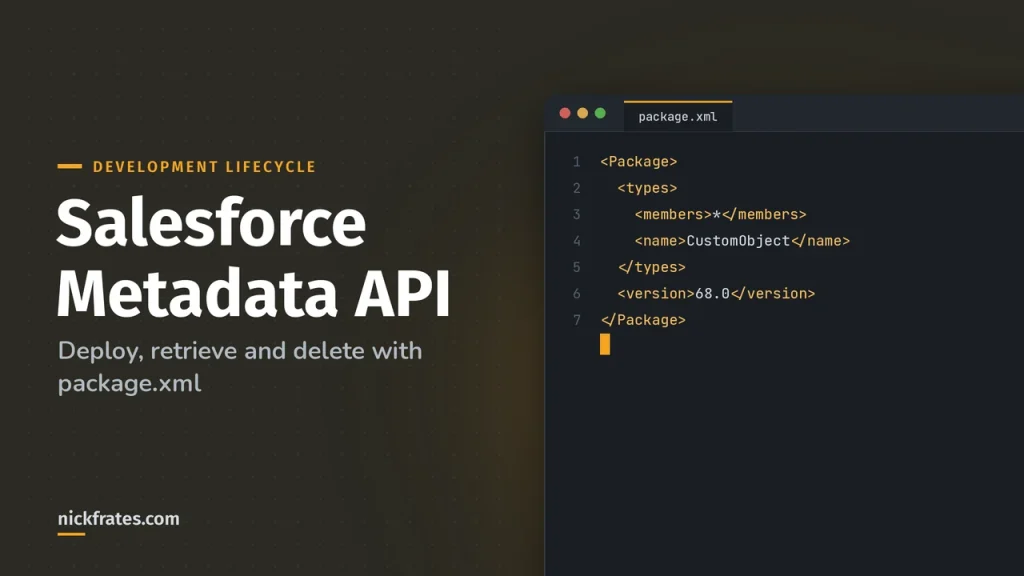
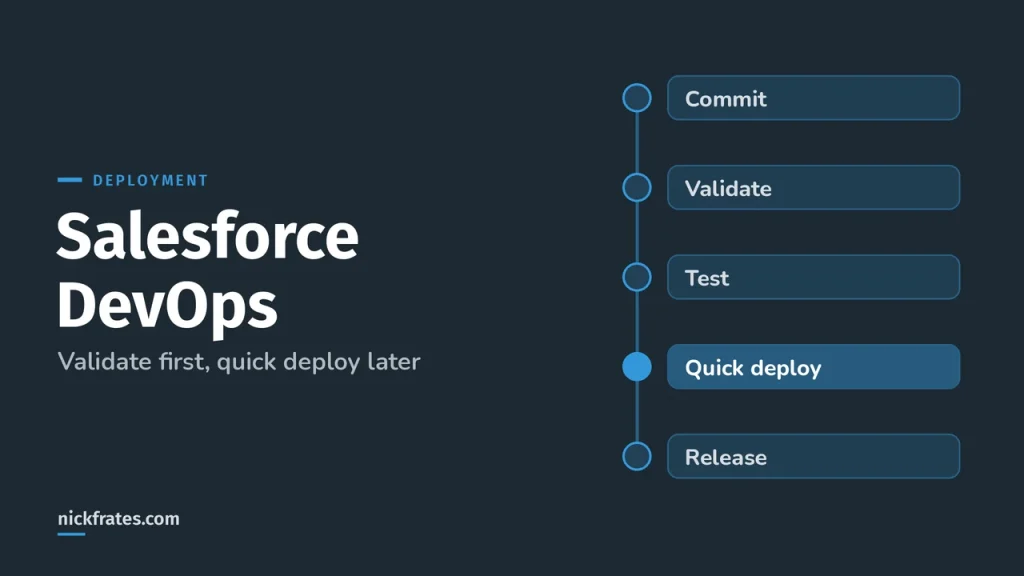
- Week 4, deploying (14%). What the Metadata API can and can't do, test levels, validation and quick deploy, pre and post deployment steps and destructive changes. Start with Salesforce Metadata API, then compare with change sets.
- Week 5, testing and releasing (13% and 13%). Test methods, coverage rules, test data that is representative but secure, then managed, unmanaged and unlocked packages and how sandboxes map to a release plan with hotfixes.
- Week 6, operating and practice (10% plus review). Changes made directly in production and how to bring them back, then multi-org release artifacts. Take timed practice questions every day. The ones further down this page are a good first set.
If you have less time, keep the order and give weeks 2 to 4 the most hours, since they cover 43% of the score. For how I learn faster in general, I wrote about it in the science of studying for Salesforce certifications.
Cert Lab by Nick Frates
Let the Platform Development Lifecycle and Deployment Architect Cert Lab test you to success
Lessons, flashcards, a quiz for each of the eight exam sections and full practice exams, every answer explained.
Start the Platform Development Lifecycle and Deployment Architect Cert Lab for $9.99 →Not ready to buy? Try a free lesson and see how fast you learn.
What does each section really ask?
Reading the objectives, each section has one question it keeps asking in different clothes.
| Section | The question underneath |
|---|---|
| Application Lifecycle Management | What process fits this team and this level of risk? |
| Planning | How mature is this team, and what could go wrong before we start? |
| System Design | Which environments, which sandbox types and which tools? |
| Building | Where does the source live, and how do we keep quality high as many people build? |
| Deploying | How do we move change safely, and what can't the API move for us? |
| Testing | Which tests, how much coverage and what data, without exposing real customer data? |
| Releasing | What do we package, and how does a release or a hotfix travel through the environments? |
| Operating | What happens when someone changes production directly, and how do we recover the process? |
Platform Development Lifecycle and Deployment Architect practice questions
Fifteen scenario questions, weighted like the real exam: 1 on lifecycle management, 2 on planning, 3 on system design, 2 on building, 2 on deploying, 2 on testing, 2 on releasing and 1 on operating. I wrote them myself from the Salesforce docs. Tap a question to see the answer and why. Time yourself at about 1.5 minutes each, since the real exam gives you 105 minutes for 60 questions.
Application Lifecycle Management
Question 1. A client is building a new onboarding app. Business stakeholders say the requirements will shift every few weeks as they see working screens, and the budget allows regular releases. Which delivery approach should the architect recommend?
- A. A hybrid plan that freezes the design for six months, then switches to short sprints
- B. No formal method, since Salesforce is configuration and changes are quick
- C. A waterfall plan with a signed-off specification and a single release at the end of the project
- D. An agile approach with short iterations and a backlog the business can reprioritize
Show the answer and explanation
Answer: D. Requirements that keep changing, plus stakeholders who learn by seeing working software, are the textbook case for an iterative, agile approach. Waterfall fits fixed scope with stage gates, and the architect should still match governance to how mature the customer is.
A six-month design freeze would lock in assumptions that the client has already said will change. Skipping a methodology doesn't remove the need for planning, testing and release control.
Planning
Question 2. An architect is asked to assess a customer's ALM maturity before proposing a release process. Which set of areas should the assessment cover?
- A. People, technology and process
- B. Sandbox names, branch names and package names
- C. Apex coverage, Flow count and object count
- D. Org edition, license counts and storage
Show the answer and explanation
Answer: A. The exam guide asks you to assess ALM maturity and identify the people, technology and processes required. Maturity is about who does the work, which tools support it and how changes move, not just a count of what is in the org.
Question 3. A Summer release is coming. The customer runs a large Apex codebase, a managed package and several integrations. What is the best way to reduce the risk of a surprise on upgrade day?
- A. Move every customization into one change set so it can be rolled back quickly
- B. Wait and watch for problems once production is upgraded, then raise cases for anything that breaks
- C. Test in a sandbox that gets the release early, using the release notes to focus on risky areas
- D. Disable all integrations for a week around the upgrade and re-enable them afterward
Show the answer and explanation
Answer: C. Salesforce lets sandboxes be on the preview release ahead of production, so you can run regression tests and fix issues before upgrade day. The exam objective is to recommend a strategy that mitigates seasonal release risk, and early testing against the release notes is the core of it.
Waiting turns production users into your test team. Switching off integrations is a blunt step that doesn't test anything, and a change set has no bearing on release readiness.
System Design
Question 4. A team needs a sandbox for user acceptance testing and a final regression run with production-sized data volumes. Which sandbox type fits best?
- A. Full sandbox
- B. Developer sandbox
- C. Developer Pro sandbox
- D. Partial Copy sandbox
Show the answer and explanation
Answer: A. A Full sandbox holds a full copy of production data and is typically used for QA and user acceptance testing at the end of the development cycle. Salesforce's own sandbox guidance puts performance testing and production-like staging here, and also says to restrict access and mask sensitive data.
Developer and Developer Pro sandboxes copy configuration, not data. Developer allows 200 MB and Developer Pro 1 GB of data to load. A Partial Copy sandbox holds a sample of production data, up to 10,000 parent records and their related child records or 5 GB in total, and it requires a sandbox template.
Question 5. Which statement about sandbox refresh intervals is correct?
- A. Every 5 days for all sandbox types, as long as a sandbox template is attached to each
- B. Full sandboxes can be refreshed every day, but only if a sandbox template is used
- C. Partial Copy sandboxes can only be refreshed once a quarter, and Developer ones once a year
- D. Daily for Developer and Developer Pro, every 5 days for Partial Copy, 29 days for Full
Show the answer and explanation
Answer: D. Developer and Developer Pro sandboxes refresh daily, Partial Copy every 5 days and Full every 29 days, per Salesforce Help. The long Full interval is why a Full sandbox is a poor choice for day-to-day development.
Question 6. Fifteen developers share one Developer sandbox and keep overwriting each other's work, then use change sets to move changes. The team wants repeatable, reviewable releases. What should the architect recommend first?
- A. Move everyone to one shared Full sandbox with extra storage so there is room for all of the changes
- B. Give each developer their own environment, keep source in version control and automate deployment
- C. Ask developers to message each other before saving anything, and keep a shared spreadsheet of who edited what
- D. Create one change set per developer and upload them every Friday afternoon after a team review
Show the answer and explanation
Answer: B. Salesforce's Well-Architected guidance lists a shared development sandbox and an org treated as the source of truth as anti-patterns. The fix is isolated development environments, version control as the source of truth and an automated pipeline with validation at each stage.
A bigger shared sandbox keeps the collisions. Asking people to coordinate by chat and weekly change sets doesn't give you history, review or repeatability.
Building
Question 7. A team keeps one long-lived Git branch per sandbox (integration, qa and uat) and promotes by merging between them. Merges are painful and the branches no longer match each other. What is the better pattern?
- A. Keep all work on a single shared branch and skip merging so nothing can conflict
- B. Delete the branches and move the whole team back to change sets for every deployment
- C. Add more environment branches so that each sandbox gets closer to the production configuration
- D. Short-lived feature branches merging to main, with release tags deployed to each environment
Show the answer and explanation
Answer: D. Salesforce's guidance is to pick one documented Git model, such as trunk-based, GitHub Flow or GitFlow, that suits the team's size and release frequency. Short-lived feature branches, a protected main branch and promotion of the same tagged commit avoid the drift that comes from long-lived environment branches.
More environment branches multiply the drift. Working on a single branch without merging removes review, and change sets give you no version history.
Question 8. A company builds internal Salesforce apps only and wants modular, versioned units it can install in sandboxes and production, with version control as the source of truth. Which development model fits?
- A. Unmanaged packages emailed to each admin
- B. Org development model with all changes made directly in production
- C. Package development model using unlocked packages
- D. Second-generation managed packages submitted for security review
Show the answer and explanation
Answer: C. The Salesforce DX Developer Guide says an unlocked package is the right package type for most internal business apps and follows a source-driven model. Managed 2GP is for ISV partners who distribute through AppExchange, which Salesforce now calls AgentExchange.
Changing production directly is the opposite of a controlled model. An unmanaged package is a one-time drop that the publisher can't upgrade.
Deploying
Question 9. A developer deploys a package that contains Apex classes to production with the Metadata API and sets no test level. What happens?
- A. All local tests run, except those from managed packages
- B. Only the tests for the classes in the package run, picked automatically
- C. Tests from managed packages run too, and no other tests are required
- D. No tests run, because the package contains only metadata and no data
Show the answer and explanation
Answer: A. When no test level is set and the target is production, all local tests are run if the package contains Apex classes or triggers. The Metadata API documentation says tests from managed packages are excluded. If the package has no Apex components, no tests run by default.
RunLocalTests is the default for production deployments that include Apex, and the CLI's validate command also defaults to it. Running only the tests for the deployed classes needs RunSpecifiedTests, and that test level has its own coverage rule.
Question 10. A production deployment takes several hours because of the number of Apex tests, and the release window is short. What should the team do ahead of time?
- A. Deploy a smaller package every few minutes so each one finishes before the window closes
- B. Run the tests in a sandbox only and deploy to production without any validation step
- C. Use NoTestRun on production so that the deployment skips the long test run completely
- D. Validate with tests ahead of the window, then quick deploy the validated deployment
Show the answer and explanation
Answer: D. A deployment validated with checkOnly, with passing tests and met coverage, can be quick deployed without rerunning tests. The validation must be for the same target environment and no older than 10 days. In the CLI that is sf project deploy validate followed by sf project deploy quick.
NoTestRun applies only to development environments such as sandboxes, not production. Salesforce also recommends running all local tests in the development environment, but production still enforces its own test rules.
Testing
Question 11. A deployment to production uses the RunSpecifiedTests test level. What code coverage rule applies?
- A. The overall org coverage must be at least 75%, calculated across all Apex in the org
- B. Each class and trigger in the package must reach at least 75% from the tests that run
- C. Only triggers need coverage, and classes are exempt when specific tests are named
- D. Coverage is not checked at this level because the tests are named explicitly by the person deploying
Show the answer and explanation
Answer: B. For RunSpecifiedTests, each class and trigger in the deployment package must be covered by the tests that run for at least 75%. This is computed per class and trigger, not as the overall org percentage.
The overall 75% rule applies when all tests or all local tests are run. That difference is why the exam likes this level as a trick.
Question 12. QA needs realistic records in a Full sandbox, but production holds personal data and the team is large. Which approach is best?
- A. Export the records to a spreadsheet and share it with testers by email
- B. Give everyone production-level access, because the data is only used for testing purposes
- C. Use a Full sandbox, mask sensitive data with Data Mask and limit who can access it
- D. Use only invented sample data from now on and drop the Full sandbox altogether
Show the answer and explanation
Answer: C. Salesforce documents Data Mask as a way to mask sensitive data such as personally identifiable information in sandboxes. Combined with access limits, it gives representative data without exposing real values to everyone.
Open access to a copy of production is the anti-pattern here. A spreadsheet adds another uncontrolled copy of the data.
Releasing
Question 13. Which statement about unmanaged packages is correct?
- A. Components stay editable in the subscriber org, and the publisher can't upgrade them
- B. They are the preferred package type for commercial distribution of apps to many customers
- C. They can only be installed into a Developer Edition org, not into sandboxes or production
- D. The publisher can push upgrades to every installed org without asking the admins
Show the answer and explanation
Answer: A. The Apex Developer Guide says unmanaged packages are best for one-time drops of apps that need customization after install. The components are editable in the installed org, and the publisher has no control over them and can't upgrade them.
Upgrades and commercial distribution belong to managed packages. Unlocked packages are also upgradeable and suit internal business apps.
Question 14. A critical bug is found in production while the Full staging sandbox holds the next release's unfinished changes. What is the best way to handle the hotfix?
- A. Fix it directly in production and tell the team about it after the next release goes out
- B. Wait for the next scheduled release and tell users to work around the bug until then
- C. Push the whole staging sandbox to production now, since it will include the fix as well
- D. Build the fix on a production mirror, deploy only that change, then merge it back
Show the answer and explanation
Answer: D. Hotfixes need a path that is separate from the in-flight release. Build the fix against what is in production, validate and deploy only that change, then merge it back into the release branch so the next deployment doesn't undo it.
Sending the staging sandbox would release unfinished work. A silent change in production is exactly what the Operating section warns about.
Operating
Question 15. An admin fixed a validation rule directly in production during an incident. The team deploys from version control. What is the main lifecycle risk?
- A. None, because production is the source of truth and its configuration always wins over version control
- B. The change isn't in source, so the next deployment can overwrite it and sandboxes drift
- C. Production will refuse further deployments until the change is formally approved
- D. The validation rule becomes a managed component that nobody can edit afterwards
Show the answer and explanation
Answer: B. A deployment overwrites matching metadata in the target org, per the CLI documentation for deploy and quick deploy. A change made only in production isn't in source, so the next release can undo it. Retrieve the change, commit it and merge it into the ALM process.
Production does keep working, but treating it as the source of truth is what Salesforce's guidance calls an anti-pattern because the org and version control drift apart.
If you learn best by testing yourself, the Platform Development Lifecycle and Deployment Architect Cert Lab has quick practice questions on all eight sections, with every option explained.
What mistakes do candidates make?
- Memorizing tool names. The questions ask you to choose between change sets, the CLI, packages and a pipeline for a given team, not to name them.
- Treating production as the source of truth. Salesforce's own guidance calls that an anti-pattern when the org and version control drift apart.
- Using the wrong sandbox for the job. A Developer sandbox has no production data, a Partial Copy needs a template and a Full sandbox only refreshes every 29 days.
- Mixing up test levels. RunLocalTests is the production default for Apex, RunSpecifiedTests has its own per-class 75% rule and NoTestRun is only for development environments.
- Forgetting the hotfix path. The release plan has to include a way to ship a fix without releasing unfinished work.
- Skipping governance and planning because they feel soft. They are 21% of the exam together with lifecycle management.
Here's why I care about practice questions so much. I earned 17 Salesforce certifications, and Focus on Force was a big part of that. My early approach was study guide first, tests later. Flipping it, taking practice tests fast and often, cut my study time way down. Cert Lab is my version of that: fast testing with explanations that link to current docs.
FAQ
How hard is the Salesforce Platform Development Lifecycle and Deployment Architect exam?
It's an intermediate-level architect exam made of scenarios. You pick the best approach from several reasonable options, so you need to know the trade-offs, not just the definitions.
What is the passing score?
65%, which works out to 39 of the 60 scored questions. The exam has 60 questions plus up to five unscored ones, and you get 105 minutes.
How much does the exam cost?
US$400 plus applicable taxes, and US$200 to retake it.
Which section is the biggest?
System Design at 15%, followed by Building and Deploying at 14% each.
Do I need to write deployment scripts?
The exam guide says candidates aren't expected to write Ant or CLI migration scripts, set up source control or set up continuous integration tools. You should know what they do and when to choose them.
Is there a prerequisite?
No. Salesforce lists none for this exam.
Do I have to renew it?
Yes. The guide says you complete the Platform Development Lifecycle and Deployment Architect maintenance badge on Trailhead once a year.
Where should you go next?
- Salesforce DevOps to compare deployment tools and pipelines.
- SFDX and the Salesforce CLI for scratch orgs, packages and the CLI.
- Salesforce Metadata API for deploy, retrieve and test levels.
- The practice questions on this page to test yourself.
- The long study guide when you want every section in depth.
Nick Frates, a senior Salesforce developer with 17 certifications, built the Platform Development Lifecycle and Deployment Architect Cert Lab at nickfrates.com: rapid-fire practice questions for every exam section, each answer explained.
Cert Lab by Nick Frates
Let the Platform Development Lifecycle and Deployment Architect Cert Lab test you to success
Lessons, flashcards, a quiz for each of the eight exam sections and full practice exams, every answer explained.
Start the Platform Development Lifecycle and Deployment Architect Cert Lab for $9.99 →Not ready to buy? Try a free lesson and see how fast you learn.
Hope this helps!
Best,
Nick