Hey friends,
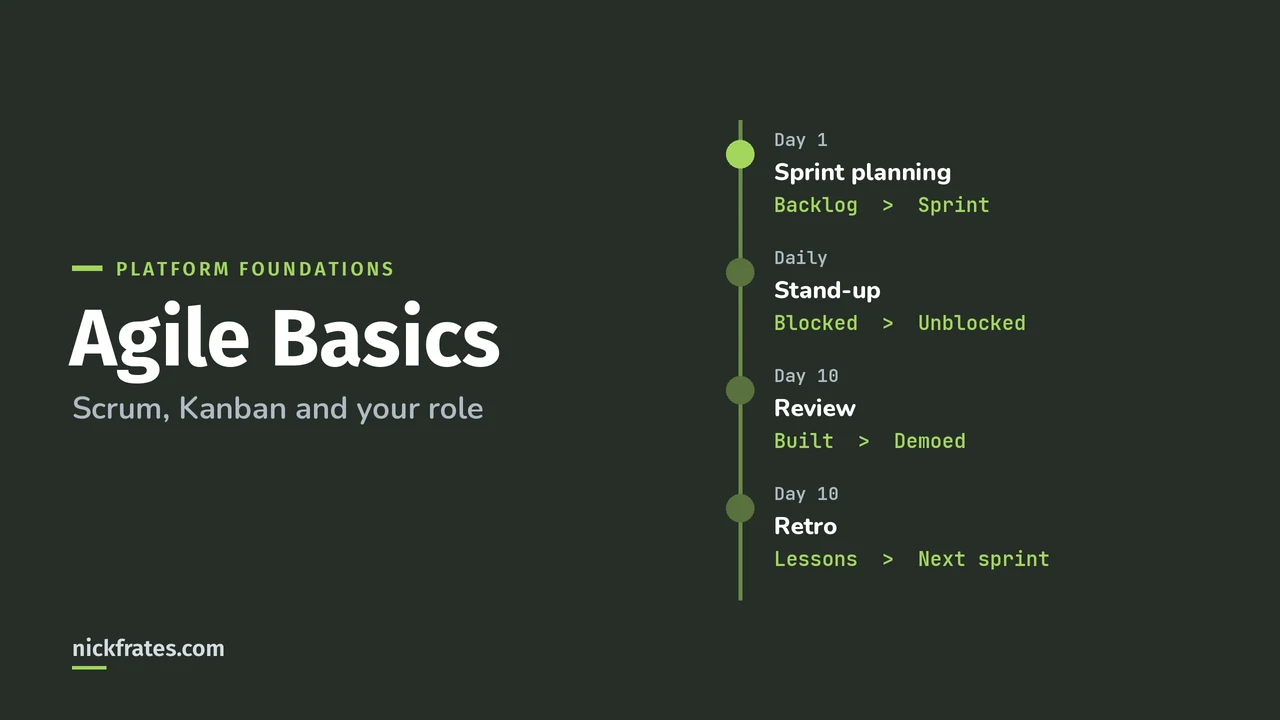
Agile is a way of delivering work in small, frequent pieces with constant feedback, instead of designing everything up front. Most Salesforce projects run on Scrum (two-week sprints with a prioritized backlog) or Kanban (a continuous flow with work-in-progress limits). If you're new to Salesforce, you'll hear these words in your first week on any team.
This post covers the basics from Trailhead's Salesforce Agile Basics and Scrum and Kanban at Salesforce modules, plus where admins and business analysts fit.
The four Agile values
In 2001, 17 software engineers wrote the Agile Manifesto. It values:
- Individuals and interactions over processes and tools
- Working software over comprehensive documentation
- Customer collaboration over contract negotiation
- Responding to change over following a plan
The items on the right still matter; the ones on the left matter more. Trailhead adds a nice gut check: are we focused on people, continuously improving, and frequently delivering value to the customer?
How Scrum works
Scrum organizes people into small, cross-functional teams that work in short iterations called sprints. Salesforce adopted it in 2006, and Trailhead says it's the go-to framework for 70% of Salesforce's own teams.
- Product backlog: the ordered list of everything that might be needed, owned and prioritized by the product owner. Higher-priority items get more detail so they're ready to work (Trailhead).
- Sprint backlog: the items the team commits to for the next two weeks.
- Potentially shippable work: something of value delivered every sprint. Finish before starting something new.
- Values: focus, courage, openness, commitment and respect.
A typical Salesforce example: the backlog has "add a Loss Reason field required when Closed Lost." In sprint planning the team picks it up, the admin builds it in a sandbox, the BA confirms it meets the acceptance criteria, and it ships in the next release.
Here's why I care about practice questions so much. I earned 17 Salesforce certifications, and Focus on Force was a big part of that. Then I found I learned fastest by taking practice tests fast and often instead of rereading. Cert Lab is my version of that: fast testing, with explanations that link to current Salesforce docs and screenshots.
Cert Lab by Nick Frates
Let the Platform Foundations Cert Lab test you to success
Rapid quizzes on the ecosystem, job roles, navigation, the data model and reports, with every answer explained so the basics stick for good.
Start the Platform Foundations Cert Lab for $9.99 →How Kanban works
Kanban is less prescriptive, which makes it easier to start. At Salesforce it's used mostly by infrastructure and operations teams that handle production and customer issues (Trailhead). Its key traits:
- Visualize the workflow on a board with a column per stage.
- Limit work in progress (WIP) in each stage, and swarm to unblock.
- Change incrementally instead of big process shifts.
- Measure flow with cycle time (days to finish one item) and throughput (work done per period).
Many Salesforce teams mix the two. Trailhead calls Kanban with Scrum's roles and meetings "Scrumban."
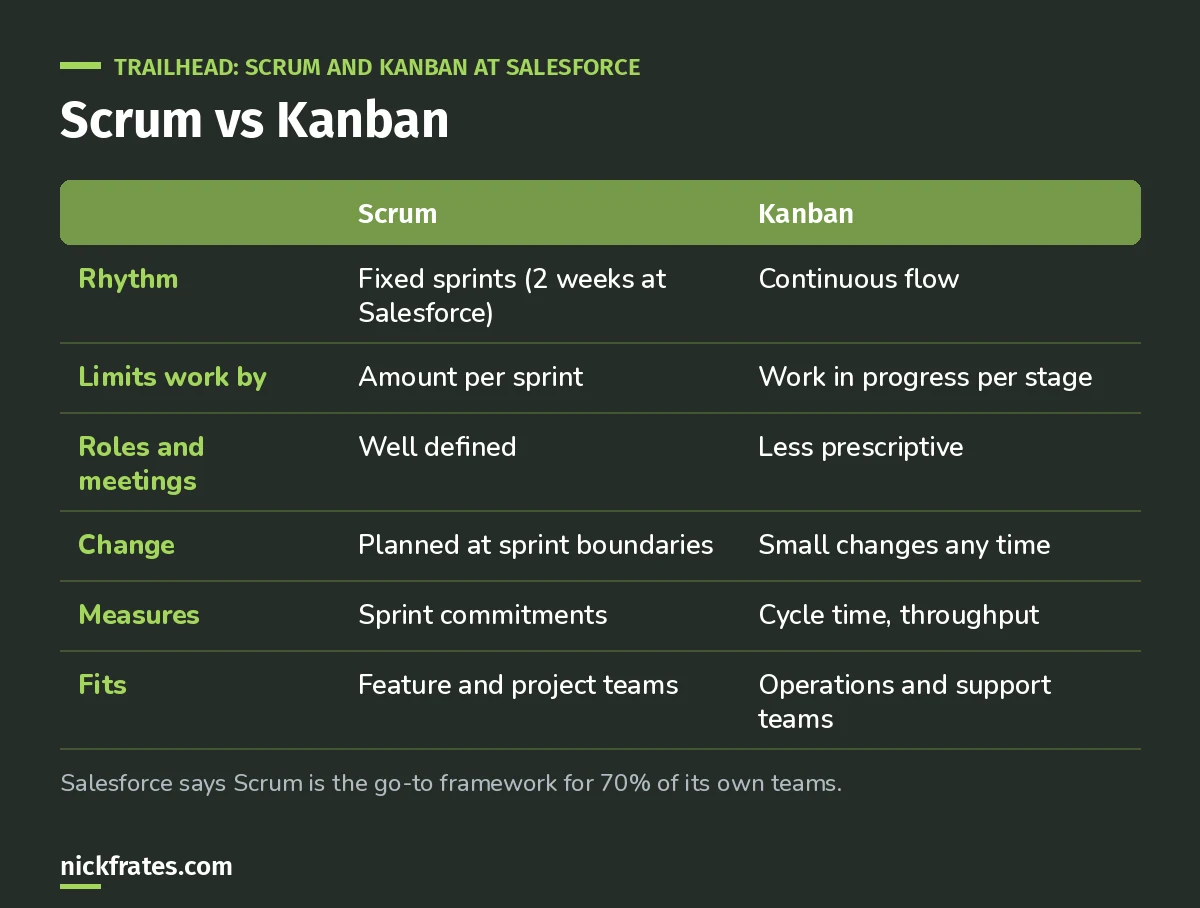
Scrum for planned feature work, Kanban for a steady stream of requests.
Where you fit on an agile Salesforce team
| Role | Typical agile responsibility |
|---|---|
| Product owner | Owns and prioritizes the backlog |
| Business analyst | Writes user stories and acceptance criteria; supports testing |
| Admin | Builds declarative changes in a sandbox each sprint |
| Developer | Builds code where declarative tools can't |
| Scrum master | Runs the process and removes blockers |
An admin handling a steady stream of small requests often works Kanban style, even inside a Scrum organization. My Salesforce for business analysts post covers how sandboxes and releases fit around sprints.
Why this matters for certification
Agile isn't a named section of the Platform Foundations exam, but the Salesforce Ecosystem section (32%) asks you to differentiate job roles and career paths, and agile vocabulary shows up in how those roles work together. On the Business Analyst exam, it goes further: candidates need to understand the implications of different development lifecycle methodologies.
FAQ
How long is a Salesforce sprint?
Trailhead says Salesforce's own teams use 2-week sprints. Your team may differ.
Is Agile the same as Scrum?
No. Agile is the mindset and values. Scrum and Kanban are frameworks that put it into practice.
Where should you go next?
Cert Lab by Nick Frates
Let the Platform Foundations Cert Lab test you to success
Lessons, flashcards, a quiz for each of the four exam sections and full practice exams, every answer explained.
Start the Platform Foundations Cert Lab for $9.99 →Hope this helps!
Best,
Nick