Hey friends,
Here are 25 free Salesforce Associate practice questions for the Platform Foundations exam. Salesforce renamed the Salesforce Certified Associate certification to Salesforce Certified Platform Foundations, but most people still call it the Associate exam. I wrote every question myself from the official exam outline, weighted them like the real exam, and put the answer and a full explanation under each one.
Each question has three answer options, which is the format people who've taken this exam describe. Answer each question before you open its toggle, then score yourself at the end. Question 1 is right below.
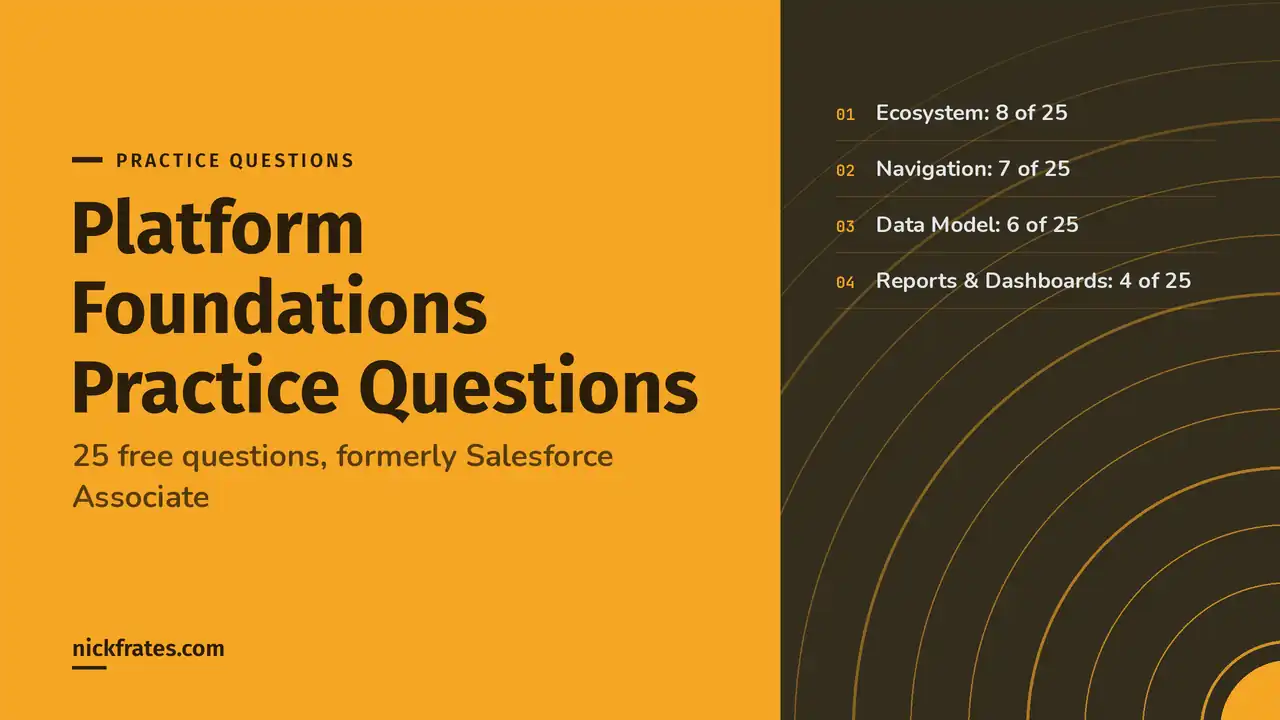
How the 25 questions are split: Salesforce Ecosystem 8, Navigation 7, Data Model 6 and Reports & Dashboards 4. That's the official weighting from the Platform Foundations exam guide (32, 28, 25 and 15%) scaled to 25 and rounded.
Salesforce Ecosystem (32%): 8 questions
Question 1. Dana is switching careers into Salesforce. She wants to click through real Salesforce features and complete hands-on Trailhead challenges, with no risk of breaking anyone's real data. What should she use?
- A. A Trailhead Playground, the free practice org that comes with her Trailhead account
- B. A login to her friend's company production org
- C. AgentExchange (formerly AppExchange)
Show the answer and explanation
Answer: A. A Trailhead Playground is a free Salesforce org connected to your Trailhead account. It's built for practice, Trailhead checks your hands-on challenges in it, and nothing you do there touches a real company's data.
A production org holds a company's real customer data, so it's the last place to experiment, and logging in with someone else's access is a security problem anyway. AgentExchange is Salesforce's marketplace for apps, agents and consultants, not a practice environment.
Exam section: Salesforce Ecosystem (32%). Source: Trailhead: Trailhead Playground Management.
Question 2. An admin wants to know which new features and changes are coming in the next major Salesforce release, before they reach her production org. Where should she look first?
- A. The Setup Audit Trail
- B. A dashboard built on her org's opportunities
- C. The release notes for the upcoming release
Show the answer and explanation
Answer: C. Salesforce publishes release notes for each major release (Spring, Summer and Winter), describing new features and changes. Reading them ahead of time is how admins plan for what's coming.
The Setup Audit Trail lists configuration changes people in your own org have already made, so it can't tell you about future features. A dashboard shows your org's business data.
Exam section: Salesforce Ecosystem (32%). Source: Salesforce Release Notes.
Question 3. A company's support team gets customer questions by phone, email and web form. It wants to track each issue from the first contact until it's resolved, and give agents a knowledge base to search. Which Salesforce product fits best?
- A. Commerce Cloud
- B. Service Cloud
- C. Tableau
Show the answer and explanation
Answer: B. Service Cloud is Salesforce's customer service product. It's built around cases (a case is a customer's question, feedback or issue), with channels such as Email-to-Case and Web-to-Case feeding cases in, and knowledge articles to help agents resolve them.
Commerce Cloud runs online stores. Tableau is for analytics and data visualization. Neither one is built to manage support issues.
Exam section: Salesforce Ecosystem (32%). Source: What's a Case?, Service Cloud.
Question 4. A retailer wants to launch an online store where shoppers browse products, add them to a cart and check out. Which Salesforce product is built for this?
- A. Commerce Cloud
- B. Sales Cloud
- C. MuleSoft
Show the answer and explanation
Answer: A. Commerce Cloud is Salesforce's ecommerce product, with B2C and B2B storefronts, checkout and order management.
Sales Cloud helps a sales team manage leads, opportunities and forecasts. It isn't a store for shoppers. MuleSoft connects systems to each other through APIs, but it doesn't give customers a place to shop.
Exam section: Salesforce Ecosystem (32%). Source: Commerce Cloud.
Question 5. A manufacturer's orders live in an older ERP system. The company wants that order data available in Salesforce and kept in sync, using reusable APIs. Which Salesforce offering is designed for connecting systems like this?
- A. Slack
- B. MuleSoft
- C. Trailhead
Show the answer and explanation
Answer: B. MuleSoft is Salesforce's integration platform. It connects applications and data through APIs, so information from a system like an ERP can flow into Salesforce.
Slack is for messaging and collaboration. Trailhead is Salesforce's free learning platform. Neither one moves data between systems.
Exam section: Salesforce Ecosystem (32%). Source: MuleSoft.
Question 6. A company's IT director asks how Salesforce upgrades work. She's used to installing new software versions on the company's own servers. Which statement is accurate?
- A. Each company downloads new Salesforce versions and installs them on its own servers
- B. Customers only get a new release if they buy a new license for it
- C. Salesforce is a multitenant cloud service, so Salesforce upgrades customers' orgs automatically and there's nothing to install
Show the answer and explanation
Answer: C. In Salesforce's multitenant cloud, many customers share the same infrastructure while each org's data stays separate. That's what lets Salesforce deliver automatic, seamless upgrades throughout the year, with no new features to install and no hardware for customers to manage.
There are no Salesforce servers for a customer to install anything on. And upgrades aren't something you buy: releases reach orgs automatically, even though some separate products and add-ons are licensed on their own.
Exam section: Salesforce Ecosystem (32%). Source: Trailhead: Understand the Salesforce Architecture.
Question 7. A sales team wants an e-signature tool that works inside Salesforce. The admin would rather install a ready-made solution than build one. Where should the admin look first?
- A. Schema Builder
- B. The admin's own Trailhead Playground
- C. AgentExchange (formerly AppExchange), Salesforce's marketplace
Show the answer and explanation
Answer: C. AgentExchange is Salesforce's marketplace for apps, agents and consulting partners, and it's the first place to look for a ready-made add-on like e-signature. Salesforce renamed AppExchange to AgentExchange, and because the exam questions align to the Winter '25 release, you may still see the old name on the exam.
Schema Builder shows your objects, fields and relationships as a diagram, and it doesn't add new features. A Trailhead Playground is a practice org for learning, not where you find a production solution.
Exam section: Salesforce Ecosystem (32%). Source: AgentExchange, Trailhead: AgentExchange Basics.
Question 8. On a Salesforce rollout, one team member interviews department heads, documents how work gets done today, and writes user stories describing what the new system must do. She doesn't configure Salesforce or write code. Which role is she playing?
- A. Developer
- B. Business analyst
- C. Salesforce administrator
Show the answer and explanation
Answer: B. Salesforce describes certified business analysts as people who understand business needs, capture requirements and work with stakeholders to shape Salesforce solutions. Interviews, process documentation and user stories are that job.
A developer writes code, such as Apex and Lightning Web Components. An administrator configures and maintains the org: users, security, fields, automation and reports. She's doing neither.
Exam section: Salesforce Ecosystem (32%). Source: Trailhead: Salesforce Certified Business Analyst.
Navigation (28%): 7 questions
Question 9. A support agent gets a call from a customer who gives only her email address. The agent doesn't know which account the customer belongs to. What's the fastest way to find her contact record?
- A. Open the App Launcher
- B. Type the email address into the global search box at the top of the page
- C. Open Setup and use Quick Find
Show the answer and explanation
Answer: B. Global search sits at the top of every page in Lightning Experience and searches across the records you have access to, so the agent doesn't need to know the account first.
The App Launcher finds apps and items, such as the Contacts tab, not a specific person's record. Quick Find in Setup finds setup pages for admins, not customer records.
Exam section: Navigation (28%). Source: Trailhead: Optimize Salesforce Navigation and Setup.
Question 10. A rep working in the Sales app needs to open the list of cases, but Cases isn't a tab in the Sales app's navigation bar. What should she do?
- A. Open the App Launcher and search for Cases
- B. Ask the admin to create a new Cases object
- C. Change her time zone in her personal settings
Show the answer and explanation
Answer: A. The App Launcher lists every app and every item you have permission to use, and you can search it by name. Cases is a standard object that's already there. It just isn't one of the Sales app's tabs.
Salesforce already has a Case object, so building a new one would duplicate it. Personal settings such as time zone don't change what you can open.
Exam section: Navigation (28%). Source: Trailhead: Navigate Around.
Question 11. A company wants to record each account's preferred contact method. Where does an admin create a new custom field on the Account object?
- A. In the App Launcher
- B. In the admin's personal settings
- C. In Setup, under Object Manager
Show the answer and explanation
Answer: C. Setup is where admins customize the org. Object Manager lists every object, and from an object's Fields & Relationships page you create custom fields. (Schema Builder can create fields too.)
The App Launcher opens apps and items, and it doesn't change their structure. Personal settings are for your own preferences, such as language, time zone and password.
Exam section: Navigation (28%). Source: Create a Custom Field.
Question 12. A rep wants to move the Opportunities tab to the front of her navigation bar and add Dashboards to it. She doesn't want to change anything for her teammates. What should she do?
- A. Ask the admin to change the Sales app's navigation items for everyone
- B. Personalize her own navigation bar using the pencil icon
- C. Open Lightning App Builder and edit the Home page
Show the answer and explanation
Answer: B. Users can personalize an app's navigation bar themselves: add items, reorder them, and rename or remove the items they added. The change is just for her. She can't rename or remove the default items her admin set for the app, but she doesn't need to here.
Changing the app's navigation items in Setup changes them for everyone who uses the app, which is the opposite of what she wants. Lightning App Builder builds pages, not her personal tab order.
Exam section: Navigation (28%). Source: Personalize the Navigation Bar in Lightning Experience.
Question 13. An admin wants to rearrange the Opportunity record page: put Path at the top and move related lists into their own tab. Which tool should she use?
- A. Lightning App Builder
- B. Schema Builder
- C. Data Import Wizard
Show the answer and explanation
Answer: A. Lightning App Builder is the point-and-click tool for building Lightning pages, including record pages, app pages and Home pages, by dragging components into place.
Schema Builder works with the data model (objects, fields and relationships), not page layouts. The Data Import Wizard loads records from a file.
Exam section: Navigation (28%). Source: Get Help for Lightning App Builder.
Question 14. A service manager wants a one-click list of all open, high-priority cases on the Cases tab, which her team can sort and work through. What should she create?
- A. A dashboard
- B. A new record type for high-priority cases
- C. A list view filtered to open cases with Priority equal to High
Show the answer and explanation
Answer: C. A list view shows the records that meet your filter criteria, right on the object's tab. Users can sort it, and where they have access they can edit fields inline without opening each record.
A dashboard shows charts and metrics from reports, so it's for monitoring, not for working through records one by one. Record types control business processes, picklist values and page layouts. They don't filter a list.
Exam section: Navigation (28%). Source: Create a Custom List View in Lightning Experience.
Question 15. Before a call, a rep opens an account and wants to see recent calls and emails, plus upcoming tasks and meetings, for that account. Where on the record page should she look?
- A. The activity timeline
- B. The highlights panel
- C. The Setup Audit Trail
Show the answer and explanation
Answer: A. The activity timeline shows a record's past and upcoming activities, including tasks, events, logged calls and emails, in one place.
The highlights panel at the top of the page shows a few key fields and actions. The Setup Audit Trail tracks admin configuration changes, not customer activity.
Exam section: Navigation (28%). Source: Activity Timeline.
Data Model (25%): 6 questions
Question 16. A rep qualifies a lead, Marta Ruiz of Acme Corp. Acme Corp already exists as an account in Salesforce. When the rep converts the lead, what can happen?
- A. Salesforce must create a second Acme Corp account, because conversion always creates a new account
- B. Marta becomes a contact related to the existing Acme Corp account, and the rep can create an opportunity at the same time
- C. The lead becomes a case on the Acme Corp account
Show the answer and explanation
Answer: B. Converting a lead turns it into a contact. During conversion you either relate that contact to an existing account or create a new account, and you can create an opportunity at the same time if there's a promising deal.
Picking the existing account is exactly how you avoid a duplicate Acme Corp. Cases are customer support issues, and lead conversion never creates one.
Exam section: Data Model (25%). Source: Convert Qualified Leads.
Question 17. A support manager looks at a customer company's account record and wants to see every case that company has opened. Why can she do that from the account?
- A. Cases are stored inside the Opportunity object
- B. She can't: cases only appear in reports, never on account records
- C. Cases are related to the account (and to the contact who raised them), so the account page can list them in a related list
Show the answer and explanation
Answer: C. A case records a customer's question, feedback or issue, and it's linked to the customer it belongs to. Because of that relationship, the account's record page can show a Cases related list with all of them.
Opportunities track potential deals, and cases are a separate object. Related lists on a record page are exactly how you see child records such as cases, so reports aren't the only way.
Exam section: Data Model (25%). Source: What's a Case?, Trailhead: Data Modeling.
Question 18. Everyone at a company should be able to see account records, but only the finance team should see each account's Credit Limit field, including in reports, list views and search results. What should the admin use?
- A. Field-level security (field permissions), so only finance can read Credit Limit
- B. Remove Credit Limit from the Account page layout
- C. Change the Account org-wide default to Private
Show the answer and explanation
Answer: A. Field-level security, also called field permissions, controls whether each user can see or edit a field, and it applies everywhere the field could show up: record pages, list views, reports and search.
Taking a field off a page layout only hides it on that layout, so people could still see it in a report or list view. An org-wide default controls access to whole records, so Private would hide entire accounts rather than one field.
Exam section: Data Model (25%). Source: Field Permissions.
Question 19. Sales reps should see only the opportunities they own, and each sales manager should see the opportunities owned by the reps who report to them. Which setup does this?
- A. Remove the Opportunities tab from the reps' navigation bars
- B. Add a validation rule to Opportunity
- C. Set the Opportunity org-wide default to Private and put users in a role hierarchy
Show the answer and explanation
Answer: C. The org-wide default sets the baseline. With Private, users can see only the records they own unless something else opens up access. The role hierarchy does that upward, so users in higher roles can see records owned by people below them.
Hiding a tab isn't security, because reps could still reach opportunities through search, reports or related lists. Validation rules check data when a record is saved, and they don't control who can see it.
Exam section: Data Model (25%). Source: Controlling Access Using the Role Hierarchy, Set Your Internal Organization-Wide Sharing Defaults.
Question 20. Reps type a customer's region into a text field, and reports now show “West”, “west” and “Western US” as three separate groups. What's the best way to keep the data consistent going forward?
- A. Make the text field longer
- B. Change the field to a picklist with a defined list of values
- C. Hide the field from reports
Show the answer and explanation
Answer: B. A picklist lets users choose from a predefined list of values, so everyone picks the same “West”. You can also restrict the picklist so values outside the list can't be saved at all.
A longer text field still accepts anything people type. Hiding the field from reports hides the problem without fixing the data.
Exam section: Data Model (25%). Source: Trailhead: Picklist Administration.
Question 21. Reps sometimes create a new account for a company that's already in Salesforce. The admin wants Salesforce to warn reps, or stop them, when they're about to save a likely duplicate. What should the admin set up?
- A. A duplicate rule that uses a matching rule to spot likely duplicates
- B. A report subscription
- C. Field history tracking
Show the answer and explanation
Answer: A. A matching rule defines what counts as a likely duplicate (for example, a similar account name and website). The duplicate rule decides what happens when someone saves one: let them save with an alert, or block the save.
A report subscription emails report results on a schedule, after the fact. Field history tracking records changes to field values and does nothing about duplicates.
Exam section: Data Model (25%). Source: Things to Know About Duplicate Rules, Trailhead: Data Quality.
Reports & Dashboards (15%): 4 questions
Question 22. A user starts a new report to list accounts along with their contacts' names and email addresses, but she can't find any contact fields in the report builder. What most likely needs to change?
- A. She needs to add the report to a dashboard first
- B. She needs to start from a report type that includes both accounts and contacts
- C. She needs to group the report by rows and columns
Show the answer and explanation
Answer: B. The report type decides which records and fields a report can use. If she started from a report type that only covers accounts, contact fields won't be in the list, so she needs one that includes both objects.
Dashboards display reports that already exist, so they can't add fields to one. Grouping changes how rows are organized, not which fields are available.
Exam section: Reports & Dashboards (15%). Source: Build a Report in Lightning Experience, Trailhead: Create Reports with the Report Builder.
Question 23. A sales manager wants a report of opportunity amounts grouped by stage down the side and by close month across the top, with subtotals for each. Which report format is this?
- A. Tabular
- B. Summary, grouped by stage only
- C. Matrix
Show the answer and explanation
Answer: C. A report grouped by both rows and columns is a matrix report. In Lightning Experience you get one by adding a row grouping and a column grouping in the report builder.
A tabular report is a simple list with no groupings. A summary report groups rows only, so it can't also break the amounts out by month across the top.
Exam section: Reports & Dashboards (15%). Source: Trailhead: Create Reports with the Report Builder.
Question 24. A sales VP wants one dashboard that every rep can open, where each rep sees only the pipeline data they have access to. What should the admin build?
- A. A dynamic dashboard, which shows each viewer the data they have access to
- B. A dashboard that runs as the VP, so everyone sees the VP's data
- C. A separate dashboard and folder for every rep
Show the answer and explanation
Answer: A. A dynamic dashboard shows each user only the data they have access to, so one dashboard works for every rep, without separate dashboards and folders.
A dashboard that runs as one specific user shows that user's data to everyone who opens it, so every rep would see the VP's view. Building one dashboard per rep is exactly the maintenance work a dynamic dashboard avoids.
Exam section: Reports & Dashboards (15%). Source: Dynamic Dashboards.
Question 25. A manager opens a dashboard on Monday morning, and the numbers match what she saw last Friday, even though the team closed deals over the weekend. What's the most likely explanation?
- A. Dashboards only update when Salesforce delivers a new release
- B. The dashboard's source reports have to be rebuilt every week
- C. The dashboard shows data as of its last refresh, so she should refresh it
Show the answer and explanation
Answer: C. A dashboard shows its data as of the last refresh, and the time is shown under Last Refreshed. Refreshing it pulls current data, and the refresh updates the results for everyone who has access to the dashboard.
Releases change Salesforce features, not your dashboard's data. Source reports don't need rebuilding, because a refresh runs them again.
Exam section: Reports & Dashboards (15%). Source: Refresh Dashboard Data.
Score yourself
Count your correct answers, then enter your number in my Salesforce exam score calculator. That link opens it set to Platform Foundations in questions-correct mode with the total already set to 25, so you only type your number.
The real exam's passing score is 62%, which works out to 16 of these 25 (15 is 60%). Treat that as a rough signal, not a prediction. 25 questions is a small sample, and the real exam has 40 scored questions. If you miss more than one in a section, that's the section to study next.
The real exam at a glance
- Name: Salesforce Certified Platform Foundations, formerly Salesforce Certified Associate
- Questions: 40 scored multiple-choice questions, plus up to 5 unscored ones that don't count
- Time: 70 minutes
- Passing score: 62%
- Cost: US$75 (¥10,000 in Japan), plus applicable taxes. Retakes are free.
- Prerequisite: none. Salesforce aims it at people with up to 6 months of Salesforce user experience.
- Delivery: proctored, at a test center or online, registered through Trailhead Academy (exam code Plat-101)
- Languages: English, Japanese, French and Spanish
- Version: the questions align to the Winter '25 release
- Maintenance: none required at this time
Last verified October 7, 2026 against the official exam guide on Salesforce Help and the Trailhead Academy exam page. Salesforce updates exams, so check the guide before you book.
Where to go next
- Salesforce Platform Foundations certification study guide: every exam section in depth, with a worked lead-to-dashboard scenario, a cheat sheet and more practice questions.
- Prepare for your Salesforce Platform Foundations Certification: the free Trailhead trail the exam guide recommends, plus the Platform Foundations Certification Prep module.
- Admin Cert Lab: when you're ready for Platform Administrator, the usual next certification, this is my free course for it. Configuration and Setup is live with 9 short lessons, a practice quiz and flashcards. Object Manager and Lightning App Builder has its quiz and flashcards live, and the other sections are rolling out. You need a free account to save your progress. There's no card and no paid tier. (What's in Cert Lab?)
- Salesforce Admin practice test: 25 questions for the Platform Administrator exam, with the same answer-and-explanation toggles.
- All my Salesforce certification study guides, with exam codes, passing scores and fees for each one.
About these questions
I'm Nick Frates, a senior Salesforce developer with 17 Salesforce certifications. This site is independent and isn't affiliated with, sponsored by or endorsed by Salesforce. Every question here is original, written from the public exam outline and checked against Salesforce's own documentation. None of them are real exam questions, and no practice set can guarantee a passing score. Salesforce, Trailhead, AgentExchange and the other Salesforce product names used here are trademarks of Salesforce, Inc.
If you spot something that's changed in a recent release, let me know and I'll update it.
Hope this helps, and good luck on the exam!
Best,
Nick