This is a deep study guide for the Salesforce Certified Data 360 Consultant exam, the credential formerly called Data Cloud Consultant. It covers every section of the current outline with explanations, architecture diagrams, quick-reference tables, a worked implementation example and practice questions with answers and explanations.
Updated for 2026: Salesforce renamed Data Cloud to Data 360, and the exam and credential followed. The outline now has six sections, with Data Activations and Utilization the largest at 20%. Older study material that uses the Data Cloud name is still mostly valid for concepts, but check the current product names and features.
| Section | Weight | Approx. questions |
|---|---|---|
| Solution Positioning | 14% | ~8 |
| Data 360 Setup and Administration | 13% | ~8 |
| Data Source Connection and Ingestion | 18% | ~11 |
| Harmonization and Unification | 17% | ~10 |
| Data Enhancements, Sharing, and Analysis | 18% | ~11 |
| Data Activations and Utilization | 20% | ~12 |
| Exam fact | Detail |
|---|---|
| Official name | Salesforce Certified Data 360 Consultant (formerly Data Cloud Consultant) |
| Format | 60 scored multiple-choice and multiple-select questions, plus up to 5 unscored |
| Time | 105 minutes |
| Passing score | 70% (42 of 60) |
| Fee | $200, retake $100, plus applicable taxes |
| Prerequisites | None required; hands-on Data 360 implementation experience strongly recommended |
| Delivery | Onsite or online proctored through Trailhead Academy and Pearson VUE |
| Official resources | Exam guide, prep trail, credential page |
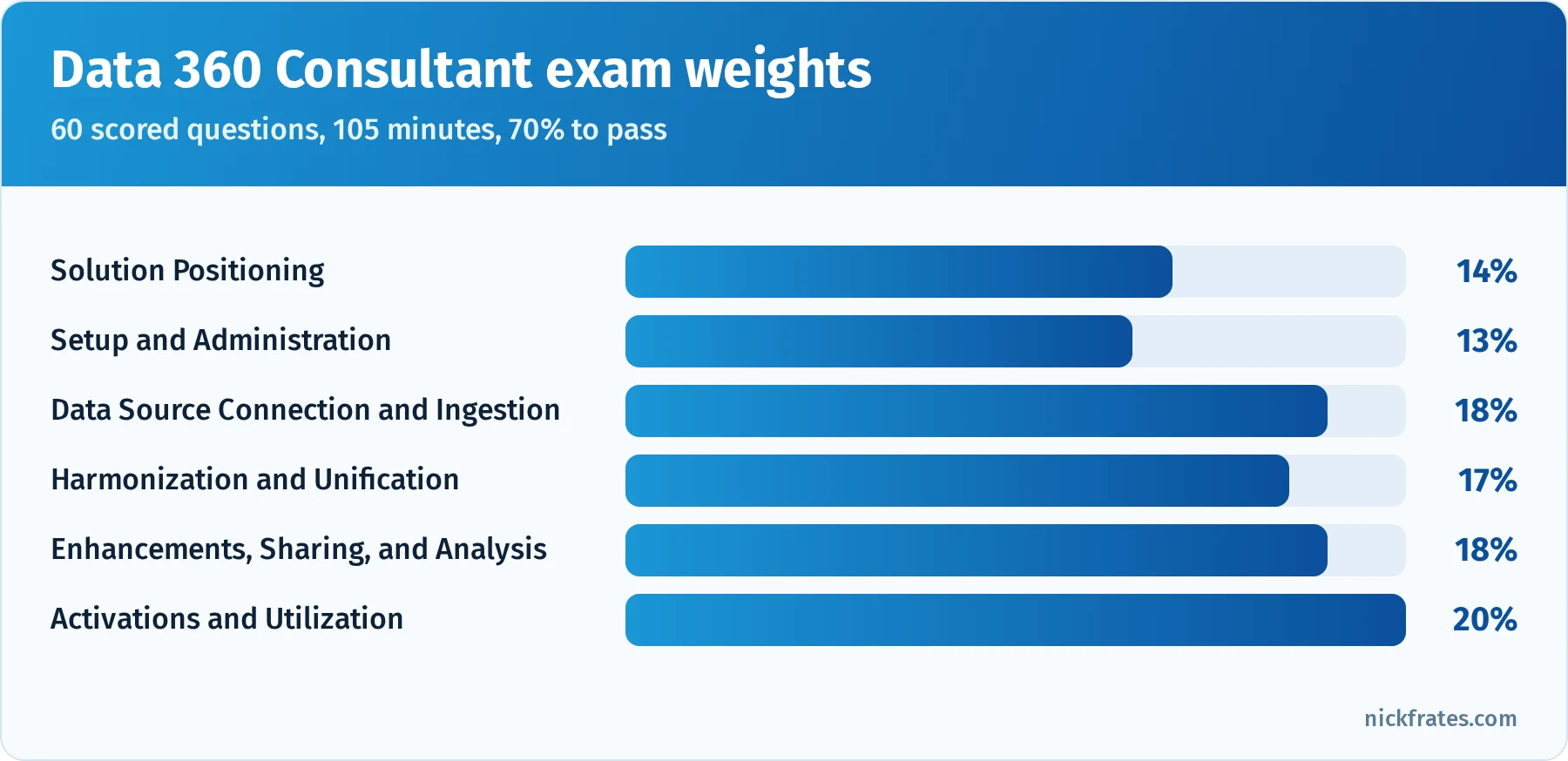
Ingestion, unification, enhancements and activation make up 73% of the exam.
Took the exam or a practice test? Enter your section scores in my Salesforce exam score calculator to see your estimated overall score and which sections are costing you the most points.
Also preparing for the Admin or Platform Developer exam? Cert Lab has lessons, practice questions and flashcards for both.
Contents
- Who this certification is for
- What changed for 2026
- How to use this guide
- The Data 360 architecture in one picture
- Solution Positioning (14%)
- Data 360 Setup and Administration (13%)
- Data Source Connection and Ingestion (18%)
- Harmonization and Unification (17%)
- Data Enhancements, Sharing, and Analysis (18%)
- Data Activations and Utilization (20%)
- Worked example: an end-to-end Data 360 implementation
- Deep dive: consultant design decisions
- Hands-on checklist
- Common exam traps
- Flashcard terms
- Mixed practice exam: 10 more questions
- Quick-reference cheat sheet
- Frequently asked questions
- Related study guides
Who this certification is for
The Data 360 Consultant exam is for consultants, architects, admins and marketing technologists who design and implement Data 360 solutions. Salesforce describes the target candidate as someone with experience in data management, data modeling, identity resolution and activation who can explain Data 360 to business stakeholders and configure it end to end.
You don't need to be a developer, but you need to be comfortable with data concepts: primary keys, relationships, data types, SQL-style aggregations, batch vs. streaming, and the difference between profile data and event data. If you're coming from an admin background, the hardest parts are usually the data model mapping and identity resolution. If you're coming from marketing, the hardest parts are usually setup, permissions and the platform plumbing.
What changed for 2026
- Data Cloud became Data 360. Product, exam and credential names changed. The Trailhead credential is now Data 360 Consultant, and Setup screens use the Data 360 name.
- Six-section outline. The current guide groups topics into Solution Positioning, Setup and Administration, Data Source Connection and Ingestion, Harmonization and Unification, Data Enhancements, Sharing, and Analysis, and Data Activations and Utilization.
- More emphasis on zero copy. Zero Copy data federation (querying data in Snowflake, Databricks, Google BigQuery, Amazon Redshift and other lakes without copying it) and data sharing back out to those platforms are core topics.
- Agentforce and unstructured data. Data 360 is the data foundation for Agentforce, so grounding agents with unified profiles, search indexes and retrievers over unstructured data now appears alongside traditional marketing use cases.
- Consumption-based pricing. Data 360 usage is metered in credits, and the exam expects you to know that ingestion, unification, segmentation, activation and queries consume credits, so design choices have cost implications.
How to use this guide
- Get hands-on access. A Data 360-enabled Developer Edition org (available through Trailhead) or a customer sandbox is far better than reading alone.
- Study the sections in the order data flows: setup, ingestion, harmonization, unification, enhancement, segmentation and activation.
- Answer the practice questions for each section and read every explanation.
- Finish with the worked example and the mixed questions, then take a timed practice exam: 60 questions in 105 minutes is 1 minute 45 seconds per question.
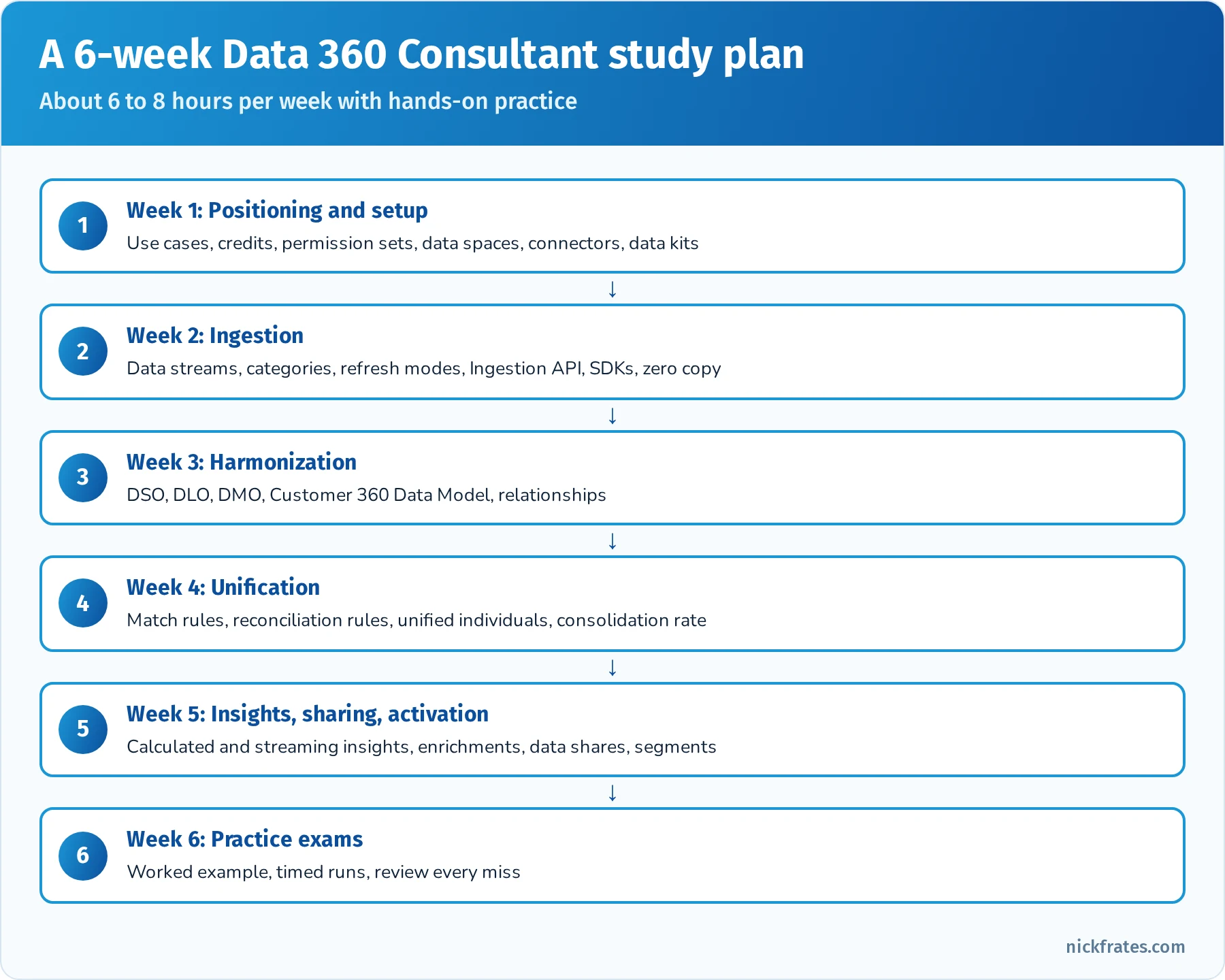
A six-week plan for someone with Salesforce experience but limited Data 360 time.
The Data 360 architecture in one picture
Before the sections, it helps to see the whole flow. Almost every exam scenario fits somewhere on this path:
- Connect a data source (Salesforce CRM, Marketing Cloud Engagement, Commerce Cloud, cloud storage, the Ingestion API, the Web and Mobile SDK, or a zero copy source).
- Ingest data through a data stream. Raw data lands in a data source object (DSO), then in a data lake object (DLO), optionally with formula fields and transforms.
- Map DLO fields to data model objects (DMOs) in the Customer 360 Data Model. This is harmonization.
- Unify profiles with identity resolution rulesets: match rules decide which records belong to the same person, and reconciliation rules decide which values win. The result is unified individuals (and unified accounts for B2B).
- Enhance with calculated insights, streaming insights, data graphs and enrichments.
- Analyze and share with Tableau, CRM Analytics, the Query API, Data Explorer, and data shares out to external lakes.
- Act with segments and activations to marketing and advertising targets, data actions and Data 360-triggered flows, and Agentforce grounding.
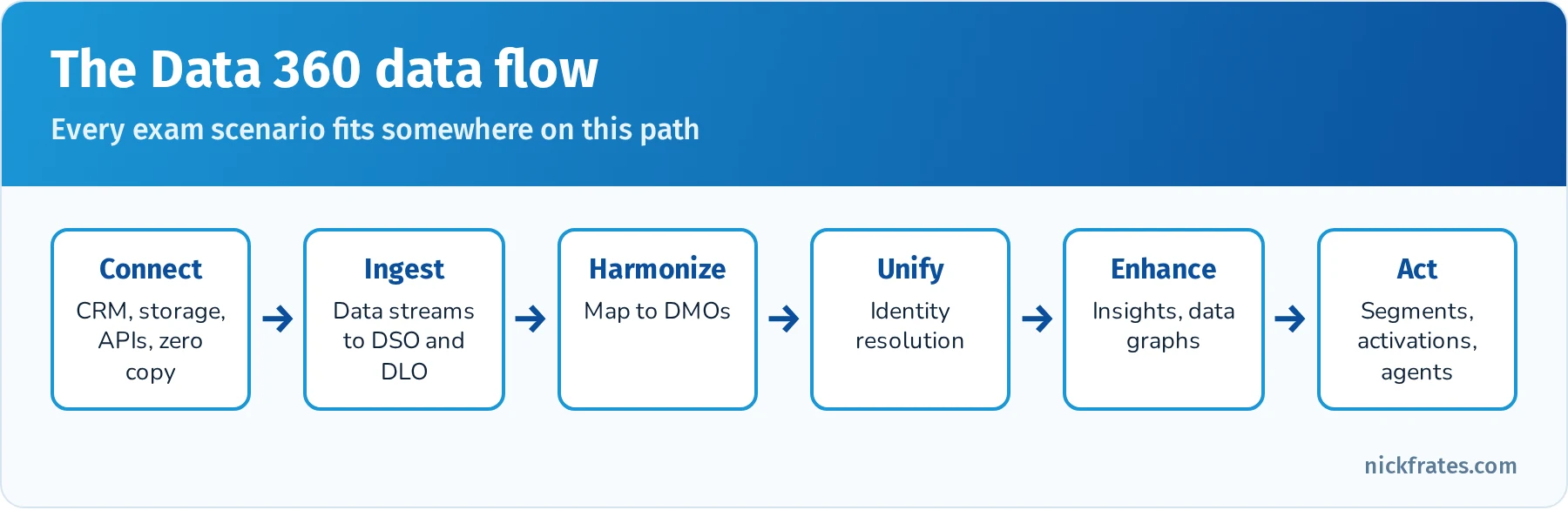
The Data 360 data flow from source to action.
Solution Positioning (14%)
This section checks that you can explain what Data 360 is, what business problems it solves and when it's the right fit.
The problem. Customer data is spread across CRM, marketing platforms, commerce, service, websites, mobile apps, point-of-sale systems, data warehouses and partner feeds. Each system has its own identifiers and its own partial view of the customer. Teams can't personalize consistently, measure accurately or give AI agents a trustworthy picture of the customer.
What Data 360 does. It's Salesforce's real-time data platform, built into the Salesforce platform. It ingests and federates data at scale, harmonizes it into a common data model, resolves identities into unified profiles, calculates insights, and makes that data available across Salesforce apps (Sales, Service, Marketing, Commerce, Agentforce, Tableau) and outside systems.
Key value statements to recognize:
- A single, unified customer profile across sources, updated in near real time.
- Native to Salesforce, so unified data appears in CRM records, flows, reports and Agentforce without custom integration.
- Zero copy access to data already in external lakes and warehouses, which avoids duplicate pipelines and storage.
- Segmentation and activation at scale for marketing and advertising.
- Trusted AI grounding for Agentforce and generative AI with governed data.
- Governance: data spaces, permissions, consent and data deletion support.
Common use cases.
| Use case | How Data 360 helps |
|---|---|
| Personalized marketing | Unified profiles and calculated insights drive segments activated to Marketing Cloud and ad platforms |
| Service with full context | Agents see purchases, web behavior and engagement on the contact or case through related lists and enrichments |
| Sales prioritization | Account and contact insights (product usage, engagement scores) appear on CRM records |
| Real-time actions | Streaming insights and data actions trigger flows or alerts when behavior happens |
| AI agents | Agentforce uses unified profiles and unstructured data to ground responses |
| Analytics | Tableau and CRM Analytics query harmonized data without separate warehouse work |
When Data 360 may not be the answer. A consultant should also recognize simpler needs. If a customer only needs to sync a few fields between two Salesforce orgs, or a one-time data migration, Data 360 is overkill. If they need a system of record for transactions, Data 360 is not a transactional database. Questions sometimes test whether you can push back on an over-engineered design.
Discovery questions. Expect scenarios where a consultant gathers requirements. Good discovery covers: data sources and volumes, identifiers in each source, latency requirements (batch vs. real time), the business outcomes (segments, insights, agent use cases), consent and privacy requirements, regions and brands (which affect data spaces), and existing data platforms (which affect zero copy).
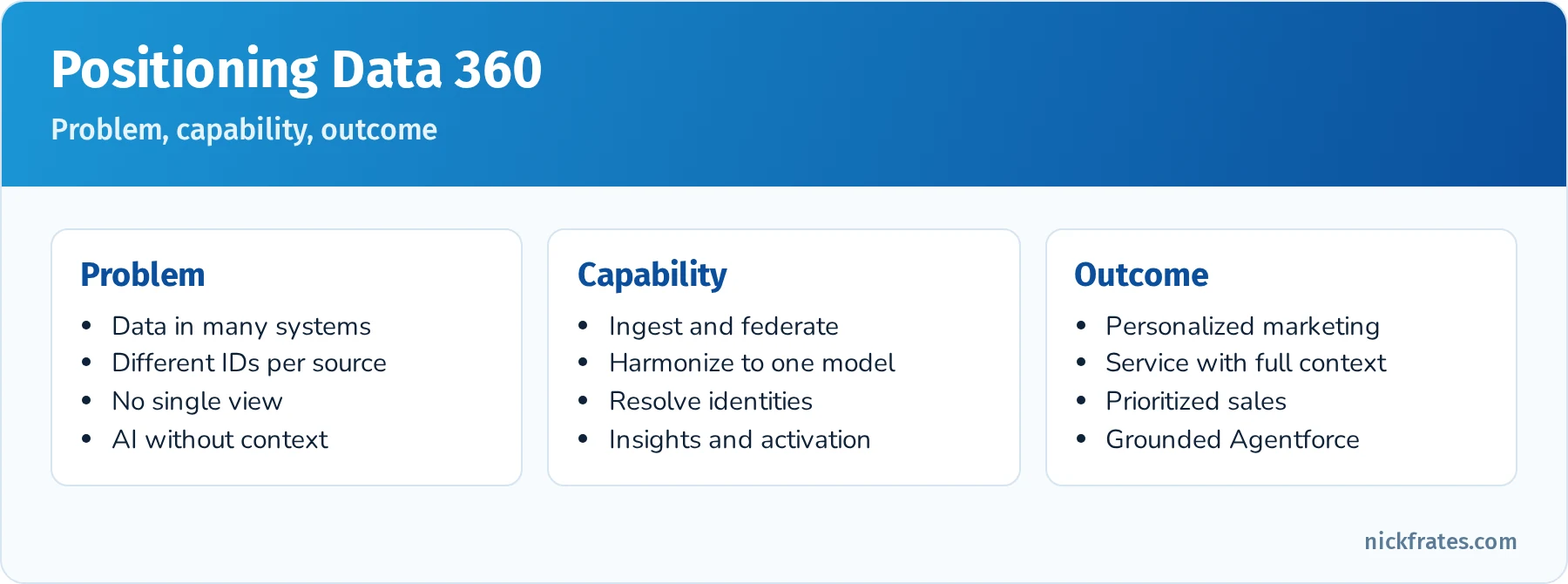
Connect the problem, the capability and the outcome.
Practice questions: Solution Positioning
Question 1. A retailer has customer data in Salesforce CRM, an e-commerce platform and a point-of-sale system, each with different customer IDs. Marketing wants one view of each customer to personalize campaigns. What is the primary Data 360 capability that addresses this?
- A. Identity resolution to create unified profiles
- B. Validation rules on the Contact object
- C. Report subscriptions
- D. Field history tracking
Answer: A. Identity resolution links records from multiple sources into unified individual profiles.
Question 2. A customer already stores years of transaction data in Snowflake and doesn't want to copy it into another platform. Which Data 360 capability fits? (Choose the best answer.)
- A. Zero Copy data federation
- B. Data Import Wizard
- C. Bulk API export
- D. Change Data Capture to Snowflake
Answer: A. Zero copy federation lets Data 360 query external data in place.
Question 3. Which statement best describes how Data 360 relates to Salesforce CRM?
- A. It's a separate product that requires middleware to connect to CRM
- B. It's built on the Salesforce platform, so unified data can be used natively in CRM, flows and Agentforce
- C. It replaces the Account and Contact objects
- D. It only works with Marketing Cloud
Answer: B. Data 360 is native to the Salesforce platform.
Question 4. A stakeholder asks why Data 360 usage needs monitoring. What's the best explanation?
- A. Data 360 is consumption-based, and activities such as ingestion, unification, segmentation and queries use credits
- B. Data 360 has no cost after licensing
- C. Monitoring is only required for Marketing Cloud
- D. Usage only matters for API calls from CRM
Answer: A. Credit consumption makes design choices (refresh frequency, data volume) cost decisions.
Question 5. A company needs to migrate legacy contacts into a new Sales Cloud org once. What should a consultant recommend?
- A. Implement Data 360 identity resolution
- B. Use a data migration tool such as Data Loader; Data 360 isn't needed for a one-time migration
- C. Create calculated insights
- D. Activate a segment to CRM
Answer: B. Data 360 isn't a migration tool for one-time loads.
Question 6. Which two discovery topics most directly affect the identity resolution design? (Choose two.)
- A. Identifiers available in each source, such as email, phone and loyalty ID
- B. Data quality and consistency of those identifiers
- C. The color scheme of the Lightning app
- D. The number of report folders
Answer: A and B. Match rules depend on which identifiers exist and how reliable they are.
Data 360 Setup and Administration (13%)
Provisioning and setup. Data 360 is provisioned in a Salesforce org (often the customer's main CRM org, sometimes a dedicated org). Admins complete setup in Data 360 Setup, then configure connectors, data spaces and permissions. Know that the choice of home org matters, because Data 360 lives alongside that org's CRM data and users.
Permission sets. Access is granted with Data 360 permission sets. Names have changed over time, so focus on the roles they represent:
| Role | Typical capabilities |
|---|---|
| Data 360 admin | Full setup, connectors, data streams, identity resolution, permissions |
| Data 360 user | View data and use features without configuring the platform |
| Marketing manager | Segments, activations and related marketing configuration |
| Marketing specialist | Build segments and work with activations with less setup access |
| Data-aware specialist | Data streams, mappings and identity resolution without full admin rights |
Least privilege applies: give users the narrowest permission set that lets them do their job.
Data spaces. A data space is a logical partition of data, metadata and processes inside one Data 360 instance. Organizations use data spaces to separate brands, regions or business units. Each has its own data model mappings, identity resolution, segments and activations, and access is controlled per data space. Every org has a default data space. DLOs can be shared into data spaces with filters, so a brand sees only its records.
Connectors. Admins configure connectors before data streams can use them:
| Connector type | Examples |
|---|---|
| Salesforce apps | Salesforce CRM (Sales, Service, other orgs), Marketing Cloud Engagement, Marketing Cloud Account Engagement, B2C Commerce, Marketing Cloud Personalization |
| Cloud storage | Amazon S3, Google Cloud Storage, Microsoft Azure Storage, SFTP |
| APIs and SDKs | Ingestion API (streaming and bulk), Web SDK, Mobile SDK |
| Zero copy | Snowflake, Databricks, Google BigQuery, Amazon Redshift and other supported lakehouses |
| Other | MuleSoft and additional partner connectors |
Packaging and environments. Data 360 configuration can be packaged with data kits, which bundle data stream definitions, mappings and other metadata for deployment to other orgs. Data 360 sandbox support lets teams build and test configuration before production. Know that you move metadata, not ingested data, between environments.
Monitoring and consumption. Admins monitor data stream status, identity resolution job results, segment publish history and activation status. Consumption is tracked in the Digital Wallet, which shows credit usage by feature so teams can catch expensive refresh schedules or oversized segments.
Consent and privacy. Data 360 supports consent data models (contact point consent, data use purpose) and data subject requests such as deletion. Consultants should design segments and activations to respect consent.
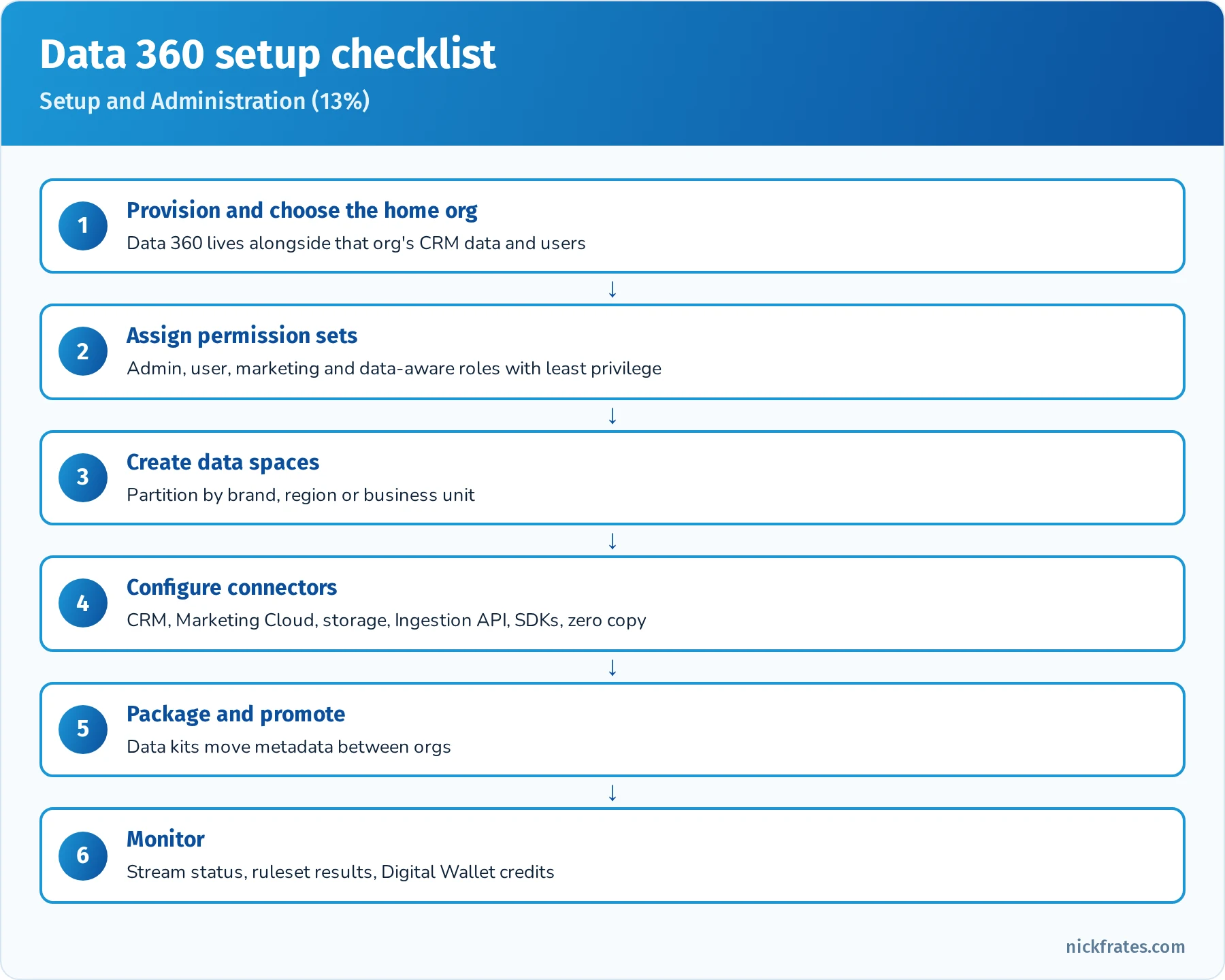
Setup and administration tasks in the order you usually do them.
Practice questions: Setup and Administration
Question 1. A company has two brands that must keep customer data, segments and activations separate within one Data 360 instance. What should the consultant configure?
- A. Two data spaces
- B. Two report folders
- C. Two record types on Contact
- D. Two page layouts
Answer: A. Data spaces partition data, metadata and processes by brand, region or business unit.
Question 2. A marketing user needs to build segments but shouldn't configure connectors or identity resolution. What's the best approach?
- A. Assign the Data 360 admin permission set
- B. Assign a marketing-focused permission set with segment access only
- C. Make the user a system administrator
- D. Share the admin's login
Answer: B. Least privilege: give the role-specific permission set.
Question 3. Which tool helps a team move Data 360 data stream definitions and mappings from a sandbox to production?
- A. Data kits
- B. Data Import Wizard
- C. Report types
- D. Schema Builder
Answer: A. Data kits package Data 360 metadata for deployment.
Question 4. Where would an admin check which features are consuming the most Data 360 credits?
- A. Digital Wallet
- B. Setup Audit Trail
- C. Login History
- D. The App Launcher
Answer: A. Digital Wallet shows consumption by usage type.
Question 5. Before creating a data stream from Amazon S3, what must the admin do first?
- A. Configure the Amazon S3 connector with credentials and bucket details
- B. Create a calculated insight
- C. Build a segment
- D. Run identity resolution
Answer: A. Data streams use connectors that must already be configured.
Data Source Connection and Ingestion (18%)
Data streams. A data stream brings data from a source into Data 360. When you create one, you pick the source and object or file, choose fields, set the primary key, choose a category and set a refresh mode and schedule.
DSO, DLO and DMO. Know the three object layers:
| Layer | What it is |
|---|---|
| Data source object (DSO) | Raw data as ingested, in its original format |
| Data lake object (DLO) | Stored, typed data in the lake; you can add formula fields and transforms here |
| Data model object (DMO) | A harmonized view mapped to the Customer 360 Data Model; segments, insights and identity resolution use DMOs |
Categories. Each data stream has a category that controls how Data 360 treats the data:
- Profile: data about people or accounts, such as customers, contacts and loyalty members. Profile data is used for identity resolution.
- Engagement: time-stamped behavior and events, such as email opens, web page views, purchases and app events. Engagement data requires an event time field and is typically immutable.
- Other: reference or other data that isn't profile or engagement, such as products, stores or campaigns.
Choosing the wrong category is a classic exam trap. Purchases with timestamps are engagement; a product catalog is other; a loyalty member list is profile.
Refresh modes. Full refresh replaces all data each time. Upsert (incremental) inserts new records and updates existing ones by primary key. Upsert is more efficient for large, growing data sets; full refresh fits small reference files or sources that can't provide changes.
Formula fields and transforms. You can add formula fields to a data stream to derive values (for example, building a composite primary key or normalizing a field). Batch data transforms combine, filter, aggregate and reshape DLOs on a schedule into new DLOs. Streaming data transforms process records continuously as they arrive.
Ingestion API. For custom sources, the Ingestion API supports streaming (small payloads in near real time) and bulk (large CSV jobs) patterns. You define a schema (OpenAPI YAML) for the connector, then create data streams from its objects.
Web and Mobile SDK. The SDKs capture website and app behavior (page views, product views, cart events) as engagement data, using a sitemap or event schema to map events.
Salesforce CRM connector. Ingests standard and custom objects from connected Salesforce orgs. Data bundles for common clouds (Sales, Service) create the data streams and mappings for standard objects automatically.
Marketing Cloud Engagement connector. Brings in email and mobile engagement data and data extensions through starter data bundles.
Zero copy (data federation). Instead of ingesting, Data 360 can federate data from supported lakes and warehouses. Federated data appears as DLOs that query the source in place. Some designs use acceleration (caching) to improve performance. Zero copy reduces duplication and keeps a single source of truth, but query performance and the source platform's costs still matter.
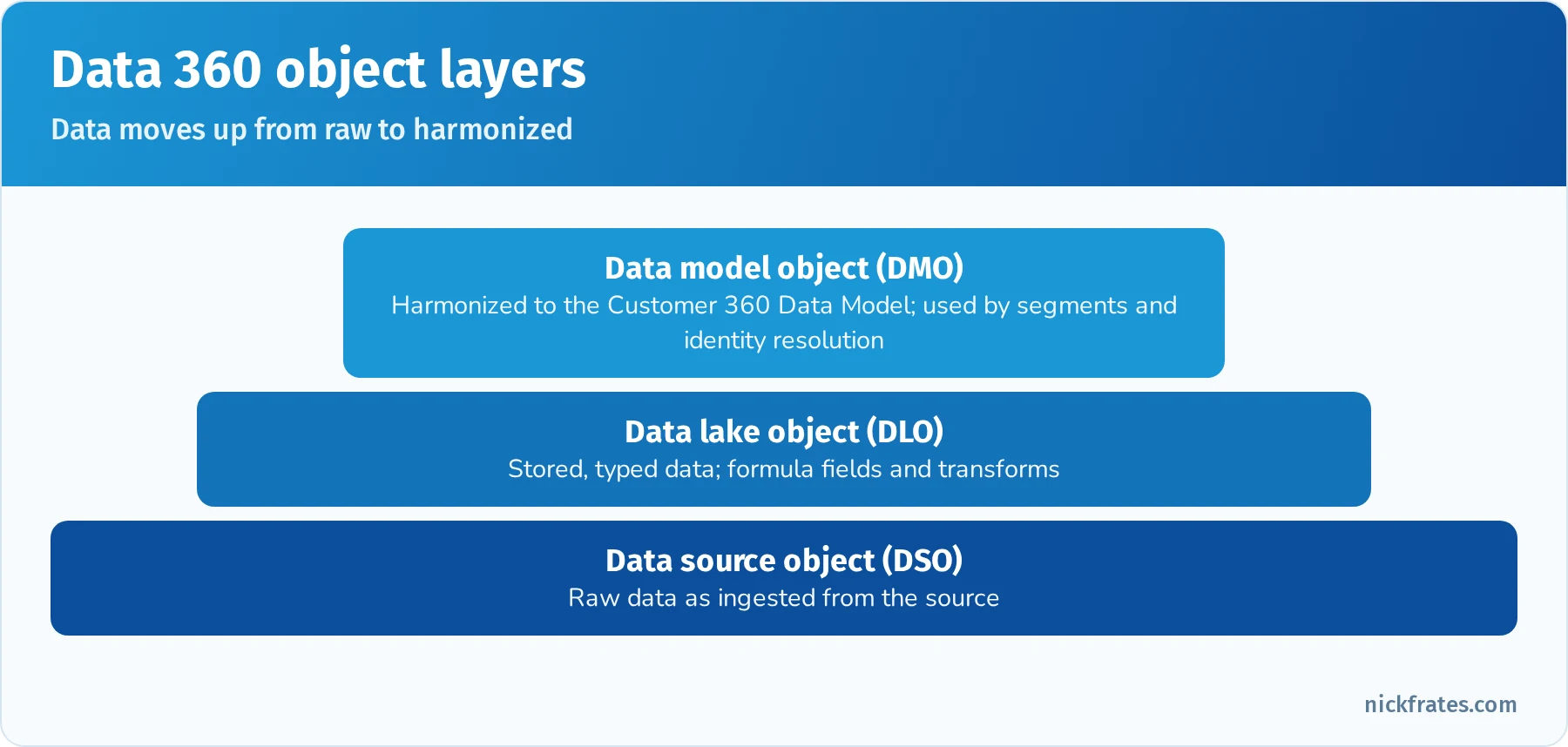
DSO to DLO to DMO.
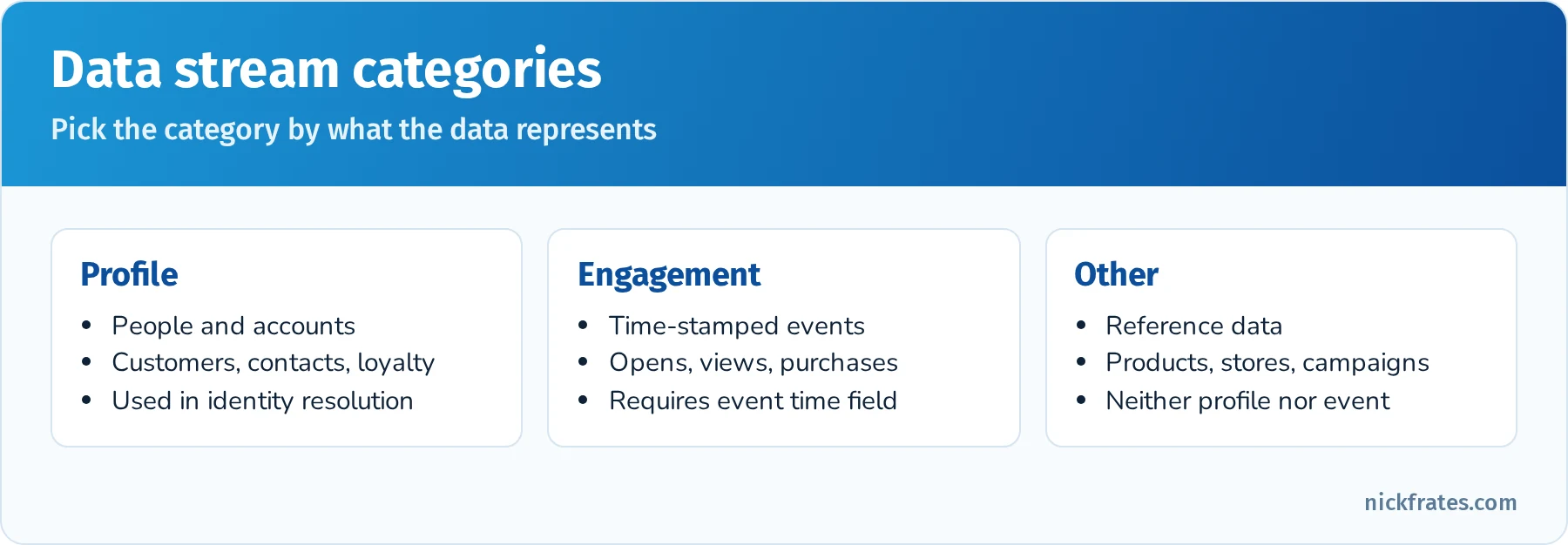
Pick the category based on what the data represents.
Practice questions: Ingestion
Question 1. A company ingests online order lines, each with an order timestamp. Which category should the data stream use?
- A. Profile
- B. Engagement
- C. Other
- D. Consent
Answer: B. Time-stamped events such as purchases are engagement data and need an event time field.
Question 2. A product catalog file of 5,000 SKUs is replaced completely each night. Which refresh mode fits?
- A. Full refresh
- B. Upsert
- C. Streaming
- D. Rapid publish
Answer: A. A small reference file replaced nightly fits full refresh.
Question 3. A source file has no single unique field, but the combination of store ID and transaction number is unique. How can the consultant create a primary key?
- A. Add a formula field that concatenates store ID and transaction number and use it as the primary key
- B. Leave the primary key blank
- C. Use the event time field as the primary key
- D. Use a random number
Answer: A. Formula fields can build composite keys during ingestion.
Question 4. A custom loyalty app needs to send profile updates to Data 360 within seconds. Which option fits?
- A. Ingestion API streaming pattern
- B. A weekly SFTP file
- C. Data Import Wizard
- D. A report subscription
Answer: A. The streaming Ingestion API handles small, near-real-time payloads.
Question 5. Which object layer do segments and identity resolution use directly?
- A. Data source objects
- B. Data model objects
- C. Report types
- D. Big objects
Answer: B. Segments, insights and identity resolution work on harmonized DMOs.
Question 6. A company wants Data 360 to use web browsing behavior from its website. What should it implement?
- A. The Web SDK to capture engagement events
- B. Validation rules
- C. A data kit
- D. Field history tracking
Answer: A. The Web SDK captures web engagement as data streams.
Question 7. What is a key benefit and a key consideration of zero copy federation? (Choose two.)
- A. Benefit: data stays in the external platform without duplicating pipelines
- B. Consideration: query performance and source platform costs still need planning
- C. Benefit: no data is ever available to Data 360
- D. Consideration: zero copy requires Data Import Wizard
Answer: A and B. Federation avoids copies but doesn't remove performance and cost planning.
Harmonization and Unification (17%)
Harmonization: mapping to the data model. After ingestion, you map DLO fields to DMOs in the Customer 360 Data Model. Standard DMOs include:
| DMO | Holds |
|---|---|
| Individual | A person's core attributes (name, birth date) |
| Contact Point Email, Phone, Address, App | Ways to reach the person |
| Party Identification | External identifiers such as loyalty ID or driver's license |
| Account and Account Contact | B2B organizations and their people |
| Sales Order, Sales Order Product | Orders and line items |
| Engagement DMOs (Email Engagement, Web Engagement) | Behavioral events |
You can create custom DMOs when the standard model doesn't fit. Profile data used for identity resolution must map to Individual plus contact point and party identification DMOs, with relationships connecting them. Mapping data to the wrong DMO or skipping contact points breaks identity resolution later.
Relationships. DMOs have relationships (for example, Contact Point Email to Individual through the party field). Correct relationships matter for segmentation on related attributes and for identity resolution.
Identity resolution. An identity resolution ruleset defines how profiles are unified in a data space:
- Match rules decide which source profiles represent the same person. Criteria include exact matching, normalized matching (for email, phone and address) and limited fuzzy matching (such as first name). A match rule might be "exact normalized email" or "fuzzy first name + exact last name + normalized phone." Party identification matching uses an identifier type and value, such as a loyalty number.
- Reconciliation rules decide which value wins when sources disagree: last updated, most frequent or source priority. Contact points can keep multiple values rather than picking one.
- The result is a unified individual (or unified account) with unified link objects connecting it to the source profiles.
Rulesets run on a schedule, and you can review results (number of profiles, consolidation rate) to tune rules. Rules that are too loose over-merge different people; rules that are too strict leave duplicates. Consolidation rate is a useful sanity check.
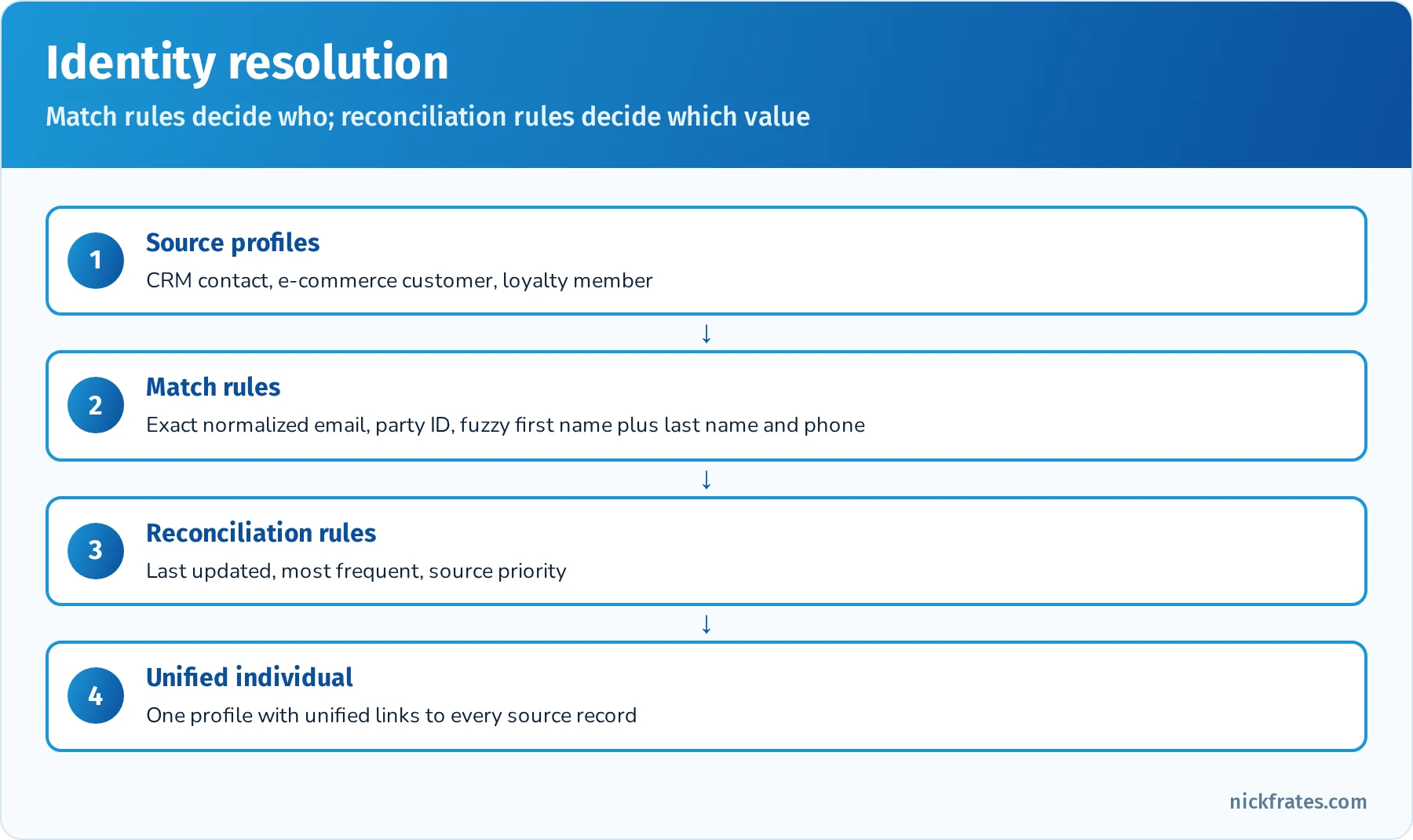
Match rules group profiles; reconciliation rules pick the winning values.
Quick reference: harmonization and unification
| Question | Answer |
|---|---|
| Where do you map fields? | DLO to DMO in the data stream mapping |
| Which DMOs must profile data map to for identity resolution? | Individual plus contact point and party identification DMOs |
| What decides that two profiles are the same person? | Match rules |
| What decides which first name to keep? | Reconciliation rules |
| What links unified profiles back to sources? | Unified link objects |
| How do you check unification quality? | Ruleset results and consolidation rate |
Practice questions: Harmonization and Unification
Question 1. Identity resolution isn't matching any profiles from a new loyalty source. The data stream is ingesting correctly. What should the consultant check first?
- A. Whether the loyalty data is mapped to Individual and contact point or party identification DMOs with correct relationships
- B. Whether a dashboard exists
- C. Whether the user has a Kanban view
- D. Whether the data kit is installed
Answer: A. Unmapped or incorrectly related profile data can't participate in identity resolution.
Question 2. Two sources have different phone numbers for the same unified customer. Which configuration controls which value appears on the unified profile?
- A. Match rules
- B. Reconciliation rules
- C. Activation filters
- D. Data stream category
Answer: B. Reconciliation rules choose winning values.
Question 3. A company wants CRM data to win over e-commerce data when names conflict. Which reconciliation rule fits?
- A. Source priority
- B. Most frequent
- C. Last updated
- D. Fuzzy match
Answer: A. Source priority ranks data sources.
Question 4. After a ruleset runs, many different people are merged into one unified profile. What's the likely cause?
- A. Match rules are too loose, such as matching on first name only
- B. Reconciliation rules are too strict
- C. The data space is too small
- D. Too many segments exist
Answer: A. Overly broad match criteria cause over-merging.
Question 5. A customer's loyalty number should match profiles across sources. Where should it be mapped?
- A. Party Identification DMO
- B. Sales Order DMO
- C. Web Engagement DMO
- D. A custom report type
Answer: A. Party identification stores external identifiers used for matching.
Question 6. Which object connects a unified individual to its source profiles?
- A. Unified link object
- B. Data stream
- C. Calculated insight
- D. Activation target
Answer: A. Unified link objects map source records to unified profiles.
Data Enhancements, Sharing, and Analysis (18%)
Calculated insights. Calculated insights are SQL-based, multi-dimensional metrics built on DMOs, refreshed on a schedule. They have measures (aggregated values, such as lifetime value or order count) and dimensions (what you group by, such as unified individual ID or product category). Use them for metrics like customer lifetime value, recency/frequency/monetary (RFM) scores, average order value or churn indicators. They can be used in segments, activations, CRM enrichments and analytics.
Streaming insights. Streaming insights compute metrics over a time window on streaming engagement data, in near real time, such as "three failed logins in 10 minutes" or "added to cart but didn't buy in 30 minutes." They often pair with data actions.
Data graphs. Data graphs precompute a denormalized view of a profile and related objects (for example, a unified individual with orders and cases), so applications and Agentforce can retrieve the full profile quickly.
Enriching CRM records. Unified data and insights can appear in Salesforce CRM:
- Related list enrichment shows Data 360 records (such as purchases) as related lists on contacts, leads or accounts.
- Copy field enrichment copies Data 360 values (such as lifetime value) into CRM fields, so they can be used in reports, list views and automation.
- Data 360-related lists and Profile Explorer show unified data for service and sales users.
Analysis. Harmonized data can be queried with Data Explorer, the Query API, Tableau and CRM Analytics. Reports on Data 360 objects are possible in Salesforce reports for some use cases.
Sharing data out. Data shares expose Data 360 data to external platforms such as Snowflake, Databricks, BigQuery and Redshift with zero copy, so data science teams can use unified profiles in their own tools.
Unstructured data and AI. Data 360 can ingest unstructured content (PDFs, knowledge articles, transcripts) and build search indexes (vector, keyword or hybrid). Retrievers use those indexes to ground Agentforce and prompt templates with relevant content.
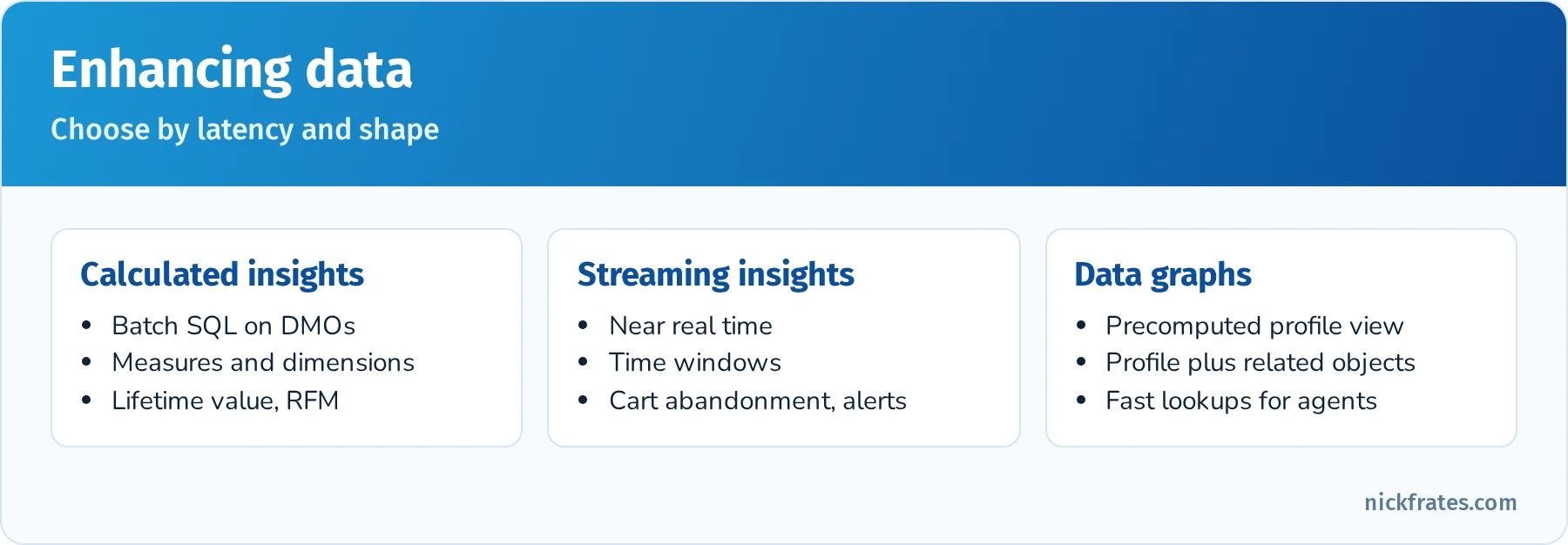
Choose the enhancement that fits the latency and shape you need.
| Need | Feature |
|---|---|
| Lifetime value per customer, refreshed daily | Calculated insight |
| Alert when a customer abandons a cart within 30 minutes | Streaming insight plus data action |
| Show purchases on the contact record | Related list enrichment |
| Use lifetime value in a CRM list view and flow | Copy field enrichment |
| Give the data science team unified profiles in Snowflake | Data share |
| Fast full-profile lookups for an agent | Data graph |
| Ground an agent in product manuals | Search index and retriever |
Practice questions: Enhancements, Sharing, and Analysis
Question 1. Marketing wants a customer lifetime value metric for each unified individual, updated daily, to use in segments. What should the consultant build?
- A. Calculated insight
- B. Streaming insight
- C. Validation rule
- D. Data kit
Answer: A. Calculated insights aggregate measures by dimensions on a schedule.
Question 2. Sales reps need lifetime value on the Contact record so they can filter list views by it. Which feature fits?
- A. Copy field enrichment
- B. Related list enrichment
- C. A data share
- D. Rapid publish
Answer: A. Copy field enrichment writes Data 360 values into CRM fields.
Question 3. In a calculated insight, which element is the value being aggregated, such as total spend?
- A. Measure
- B. Dimension
- C. Primary key
- D. Event time
Answer: A. Measures are aggregated values; dimensions are the grouping attributes.
Question 4. The data science team wants unified profiles available in their Databricks environment without building an export pipeline. What fits?
- A. Data share
- B. Data Loader export
- C. Report subscription
- D. Email activation
Answer: A. Data shares expose Data 360 data to external platforms with zero copy.
Question 5. A bank wants to flag three failed logins within 10 minutes and notify security in near real time. Which combination fits?
- A. Streaming insight and data action
- B. Calculated insight and a weekly report
- C. Data kit and a sandbox
- D. Segment and an ad activation
Answer: A. Streaming insights detect windowed patterns; data actions send events to targets.
Question 6. An Agentforce service agent must answer questions using the company's product manuals. What does Data 360 provide?
- A. A search index and retriever over the ingested unstructured content
- B. A related list on Account
- C. A matrix report
- D. A permission set group
Answer: A. Search indexes and retrievers ground agents in unstructured data.
Data Activations and Utilization (20%)
Segments. A segment is a group of entities (usually unified individuals) that meet filter criteria. Segments are built on a segment on entity, with filters on direct attributes, related attributes (such as purchases) and calculated insights. Segments can be nested (one segment used inside another) and use exclusions. Publish options include standard scheduled publishing, rapid publish for more frequent refreshes with a shorter engagement lookback, and real-time segments for supported use cases. You can see segment population counts before publishing.
Activation targets. An activation target defines where a segment goes:
| Target type | Examples |
|---|---|
| Marketing | Marketing Cloud Engagement, Marketing Cloud Account Engagement, Marketing Cloud Personalization |
| Advertising | Meta, Google, Amazon and other ad platforms |
| Storage | Amazon S3, Google Cloud Storage, Azure, SFTP |
| Data 360 | Use segment membership inside Data 360 and Salesforce |
Activations. An activation sends a segment to a target with chosen contact points (email, phone, mobile app), direct attributes and related attributes. Consent and contact point selection rules determine which email or phone number is used when a unified profile has several. Activation membership tells you which profiles were sent.
Data actions. Data actions send events to targets such as Platform Events, webhooks or Marketing Cloud when conditions are met on DMO changes or streaming insights.
Data 360-triggered flows. Flows can start when Data 360 data changes, such as when a calculated insight crosses a threshold, so Salesforce automation can create tasks, update records or alert teams.
Agentforce and apps. Unified profiles, data graphs and retrievers give Agentforce agents and prompt templates customer context. Data 360 data can also appear in Lightning pages, Experience Cloud sites and Tableau. For how retrievers ground agents step by step, see my guide to Data 360 for Agentforce.
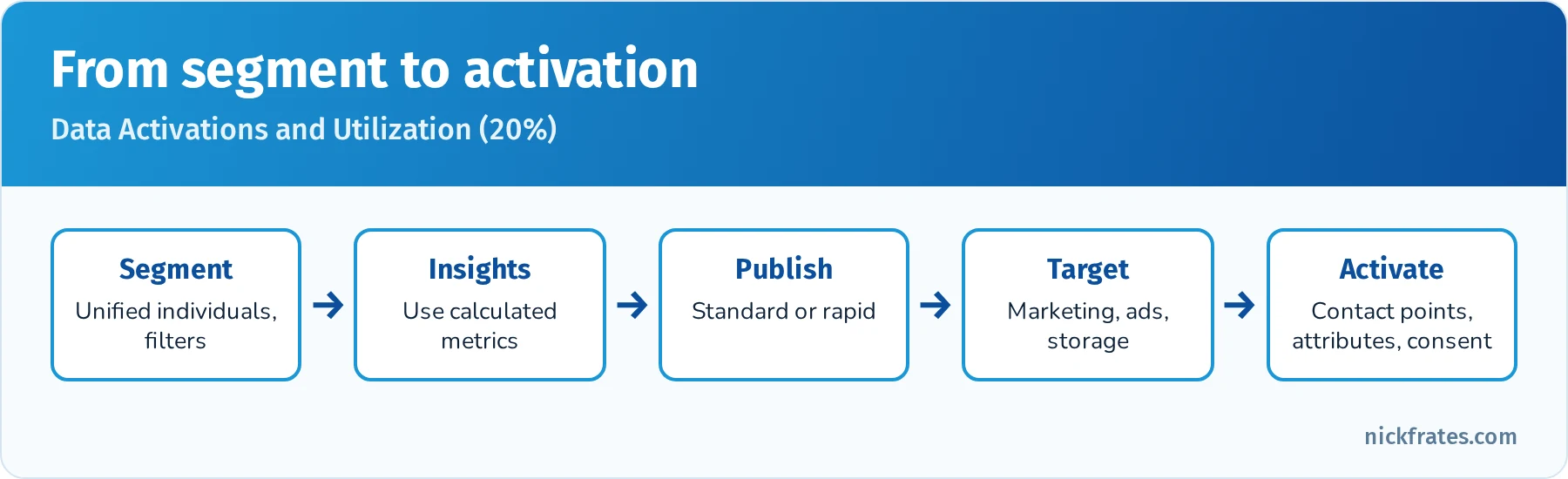
From segment to target.
Practice questions: Activations and Utilization
Question 1. Marketing wants to send high-value customers who haven't purchased in 90 days to Marketing Cloud Engagement for a win-back journey. What's the correct sequence?
- A. Build a segment using a lifetime value insight and last purchase date, then activate to the Marketing Cloud Engagement target
- B. Create a dashboard, then email it
- C. Create a data kit, then deploy it
- D. Run identity resolution, then create a report folder
Answer: A. Segments with insights feed activations to marketing targets.
Question 2. A unified profile has three email addresses. How does Data 360 decide which one to send in an activation?
- A. Contact point selection and consent configuration in the activation
- B. Randomly
- C. The first email alphabetically
- D. The data stream's refresh mode
Answer: A. Activations choose contact points based on configuration and consent.
Question 3. A segment must update more frequently than the standard schedule for a time-sensitive campaign. Which option fits?
- A. Rapid publish
- B. Full refresh on the data stream
- C. A larger data space
- D. A joined report
Answer: A. Rapid publish refreshes segments more often, with a shorter engagement lookback.
Question 4. When a customer's churn score insight exceeds a threshold, sales should get a task in Salesforce. What fits?
- A. A Data 360-triggered flow
- B. A report subscription
- C. A data share
- D. A Web SDK sitemap
Answer: A. Data 360-triggered flows run Salesforce automation from Data 360 changes.
Question 5. A company wants to suppress existing customers from paid social ads. What should it do?
- A. Build a segment of existing customers and activate it to the ad platform as a suppression audience
- B. Delete customers from CRM
- C. Turn off identity resolution
- D. Create a validation rule
Answer: A. Segments activated to ad platforms can serve as suppression lists.
Question 6. Which two items are chosen when configuring an activation? (Choose two.)
- A. Contact points to send
- B. Attributes to include
- C. The org's fiscal year
- D. The page layout
Answer: A and B. Activations specify contact points and attributes.
Worked example: an end-to-end Data 360 implementation
The company. Northwind Outdoor sells gear online, in 40 stores and through a loyalty program. It uses Sales Cloud for B2B wholesale, Service Cloud for support, Marketing Cloud Engagement for email, and Snowflake for store transaction history.
Goals.
- One profile per customer across online, store, loyalty and support.
- A lifetime value and "days since last purchase" metric for every customer.
- Win-back journeys for lapsed high-value customers.
- Service agents see purchases and loyalty tier on the contact.
- An Agentforce service agent that answers order questions with customer context.
Design.
- Setup. One data space, because there's one brand. Permission sets: admin for the implementation team, marketing manager for campaign leads, user for service supervisors.
- Ingestion. Salesforce CRM connector with the Service and Sales data bundles (contacts, accounts, cases). Marketing Cloud Engagement connector for email engagement. Web SDK for site behavior. Zero copy federation from Snowflake for store transactions (they're huge and already governed there). Loyalty members via S3 nightly upsert as profile data.
- Harmonization. Map contacts and loyalty members to Individual, Contact Point Email and Phone, and Party Identification (loyalty number). Map online and store orders to Sales Order and Sales Order Product, with relationships to Individual.
- Unification. Match rules: exact normalized email; party identification on loyalty number; fuzzy first name + exact last name + normalized phone. Reconciliation: source priority with CRM over loyalty for names, last updated for addresses. Check consolidation rate after the first run.
- Enhancement. Calculated insights for lifetime value, order count and days since last purchase. Copy field enrichment of lifetime value and loyalty tier to Contact. Related list enrichment for recent orders on Contact.
- Activation. Segment: lifetime value above the top quartile and days since last purchase above 120, excluding customers with open cases. Activate to Marketing Cloud Engagement with email contact point and first name, respecting email consent.
- Agentforce. A data graph of unified individual + orders + cases grounds the service agent; a search index over return policy documents grounds policy answers.
- Governance. Monitor credits in Digital Wallet; set the win-back segment to daily rather than rapid publish because the campaign isn't time-sensitive.
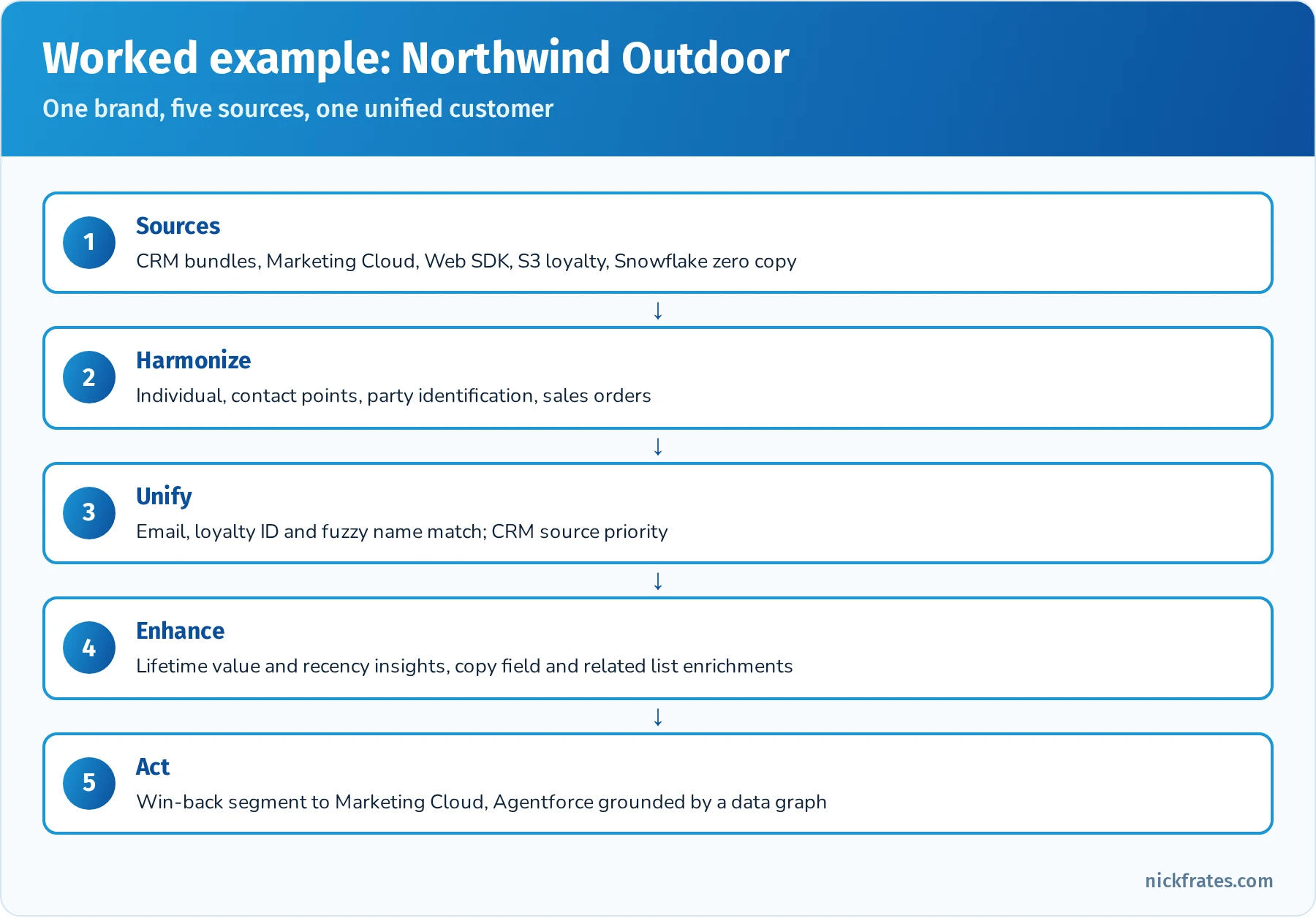
The worked example as a single diagram.
Deep dive: consultant design decisions
Scenario questions often hinge on one design choice. This table collects the most common ones.
| Decision | Choose this when | Choose the alternative when |
|---|---|---|
| Ingest vs. zero copy federation | Data needs heavy processing, frequent use in segments, or the source can't be queried efficiently | Data already lives in a supported lakehouse, is large and governed there, and duplication is a concern |
| Full refresh vs. upsert | Small reference data or sources with no change tracking | Large, growing data with a reliable primary key |
| Streaming vs. bulk Ingestion API | Small, frequent updates needed within minutes | Large periodic loads as files |
| One data space vs. several | One brand or a shared customer view | Separate brands, regions or legal entities that must not mix data |
| Calculated vs. streaming insight | Historical metrics such as lifetime value | Windowed, near-real-time patterns such as cart abandonment |
| Copy field vs. related list enrichment | Users need to filter, report or automate on a value | Users need to see a list of related Data 360 records |
| Standard vs. rapid publish | Campaigns that tolerate daily refresh | Time-sensitive audiences that need more frequent refresh |
| Strict vs. loose match rules | Over-merging is costly (financial services, healthcare) | Duplicates are costly and identifiers are reliable |
Cost awareness. Every "more often" choice (more frequent refreshes, rapid publish, streaming) usually uses more credits. Good answers balance business need and consumption.
Hands-on checklist
Complete these in a Data 360-enabled Developer Edition org or sandbox:
- Open Data 360 Setup, review permission sets and assign yourself the admin role.
- Connect the Salesforce CRM connector and deploy the Sales or Service data bundle.
- Create a data stream from a CSV in cloud storage (or the sample data) as profile data, with a formula field as a composite primary key.
- Create an engagement data stream with an event time field.
- Map the profile stream to Individual, Contact Point Email and Party Identification.
- Create an identity resolution ruleset with an exact normalized email match and a source priority reconciliation rule. Review the results and consolidation rate.
- Build a calculated insight for order count and total spend per unified individual.
- Create a segment of unified individuals with more than three orders and view the population count.
- Create an activation target (cloud storage is easiest in a dev org) and activate the segment with email and first name.
- Add a related list enrichment to Contact and view it on a record.
- Explore data in Data Explorer and check usage in Digital Wallet.
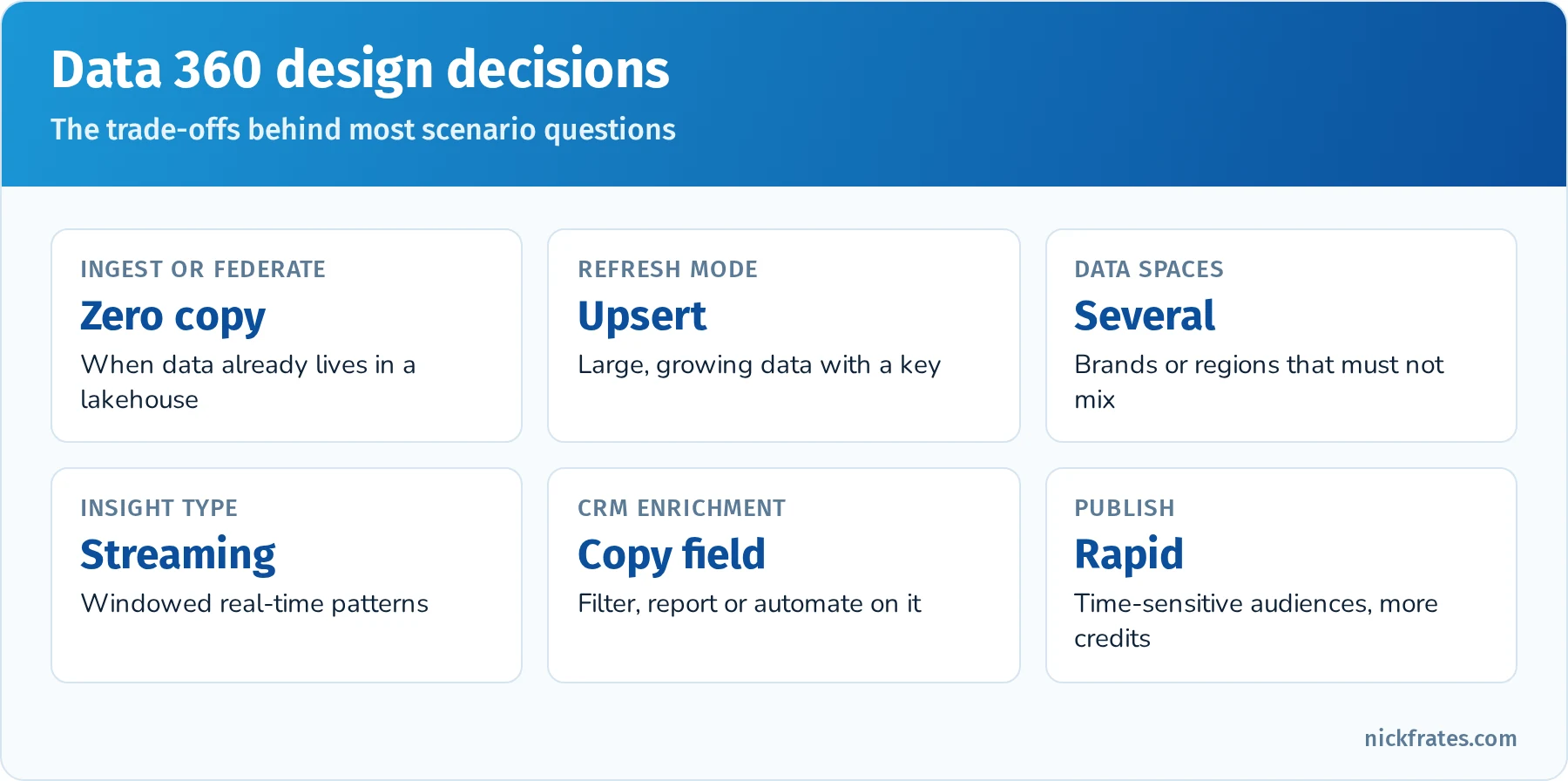
The trade-offs behind most scenario questions.
Common exam traps
- Category confusion. Time-stamped events are engagement, even when they look like transactions. Reference data is other.
- Match vs. reconciliation. Match rules decide who is the same; reconciliation decides which value wins.
- DLO vs. DMO. Segments and identity resolution use DMOs, not DLOs.
- Calculated vs. streaming insights. Batch metrics over history vs. near-real-time windowed metrics.
- Copy field vs. related list enrichment. Copy field writes to a CRM field you can filter and automate on; related lists show records.
- Federation isn't free. Zero copy saves duplication but still has performance and cost implications.
- Over-engineering. Not every data problem needs Data 360. One-time migrations and simple syncs don't.
- Multiple-select questions. Read "Choose two" carefully; partial answers score zero.
Flashcard terms
- Data stream: the ingestion definition for a source object or file.
- DSO / DLO / DMO: raw source, stored lake object, harmonized model object.
- Profile / Engagement / Other: data stream categories.
- Event time field: required timestamp for engagement data.
- Full refresh / upsert: replace all vs. insert and update by primary key.
- Batch / streaming data transform: scheduled vs. continuous reshaping of DLOs.
- Customer 360 Data Model: Salesforce's standard DMO set.
- Party Identification: DMO for external IDs such as loyalty numbers.
- Identity resolution ruleset: match and reconciliation rules for a data space.
- Unified individual: the resolved profile.
- Calculated insight: SQL metrics with measures and dimensions.
- Streaming insight: windowed real-time metric.
- Data graph: precomputed denormalized profile view.
- Data share: zero copy sharing out to external platforms.
- Segment / activation / activation target: audience, delivery, destination.
- Data action: event sent to a target when conditions are met.
- Data space: logical partition of data and metadata.
- Data kit: package of Data 360 metadata.
- Digital Wallet: credit consumption tracking.
Mixed practice exam: 10 more questions
Question 1. Which data stream setting is required for engagement data but not for profile data?
- A. Event time field
- B. Data space name
- C. Activation target
- D. Reconciliation rule
Answer: A. Engagement data must have an event time field.
Question 2. A consultant needs to combine two DLOs and aggregate them nightly into a new DLO before mapping. What should they use?
- A. Batch data transform
- B. Copy field enrichment
- C. Rapid publish
- D. A data share
Answer: A. Batch data transforms reshape DLOs on a schedule.
Question 3. Which statement about data spaces is correct?
- A. Each data space has its own mappings, identity resolution, segments and activations
- B. Data spaces are only used for sandboxes
- C. Data spaces replace permission sets
- D. Data spaces can't share DLOs
Answer: A. Data spaces partition configuration and data.
Question 4. A unified profile shows an outdated address even though a newer one exists in e-commerce. Which change helps?
- A. Use a last updated reconciliation rule for address
- B. Add a fuzzy first name match rule
- C. Change the data stream category to Other
- D. Create a new data space
Answer: A. Last updated reconciliation keeps the most recent value.
Question 5. What's the main purpose of the Customer 360 Data Model?
- A. Provide standard objects so data from different sources is harmonized consistently
- B. Store dashboards
- C. Replace the CRM data model
- D. Hold Apex classes
Answer: A. Harmonization maps different sources into common DMOs.
Question 6. Which two activities consume Data 360 credits? (Choose two.)
- A. Data ingestion and processing
- B. Segmentation and activation
- C. Viewing a Lightning page layout in Setup
- D. Changing a user's time zone
Answer: A and B. Data processing, segmentation and activation are metered.
Question 7. Which feature lets service agents see a customer's recent purchases from Data 360 on the Contact record?
- A. Related list enrichment
- B. Data kit
- C. Data share
- D. Activation membership
Answer: A. Related list enrichment shows Data 360 records in CRM.
Question 8. A marketing team wants to exclude anyone in the "Open support case" segment from a promotional segment. What's the best approach?
- A. Use the open-case segment as an exclusion (nested segment) in the promotional segment
- B. Delete open cases
- C. Turn off identity resolution
- D. Create a separate data space
Answer: A. Nested segments and exclusions reuse audiences.
Question 9. Which connector is most appropriate for a mobile app that needs to capture in-app behavior?
- A. Mobile SDK
- B. Data Import Wizard
- C. Data Loader
- D. Change sets
Answer: A. The Mobile SDK captures app engagement.
Question 10. A company's legal team requires that segments only include customers who consented to marketing email. Where is this enforced?
- A. In segment filters and activation consent settings using consent data
- B. In report folder sharing
- C. In the Web SDK sitemap only
- D. It can't be enforced
Answer: A. Consent data and activation settings ensure only consented contact points are used.
Quick-reference cheat sheet
| Topic | Remember |
|---|---|
| Format | 60 + 5 questions, 105 minutes, 70% to pass |
| Largest section | Activations and Utilization 20% |
| Object layers | DSO, then DLO, then DMO |
| Categories | Profile, Engagement (needs event time), Other |
| Refresh | Full refresh or upsert |
| Unification | Match rules (who), reconciliation rules (which value) |
| Insights | Calculated (batch SQL), streaming (windowed real time) |
| CRM enrichment | Copy field (filterable field), related list (records) |
| Zero copy | Federation in, data shares out |
| Governance | Data spaces, permission sets, consent, Digital Wallet |
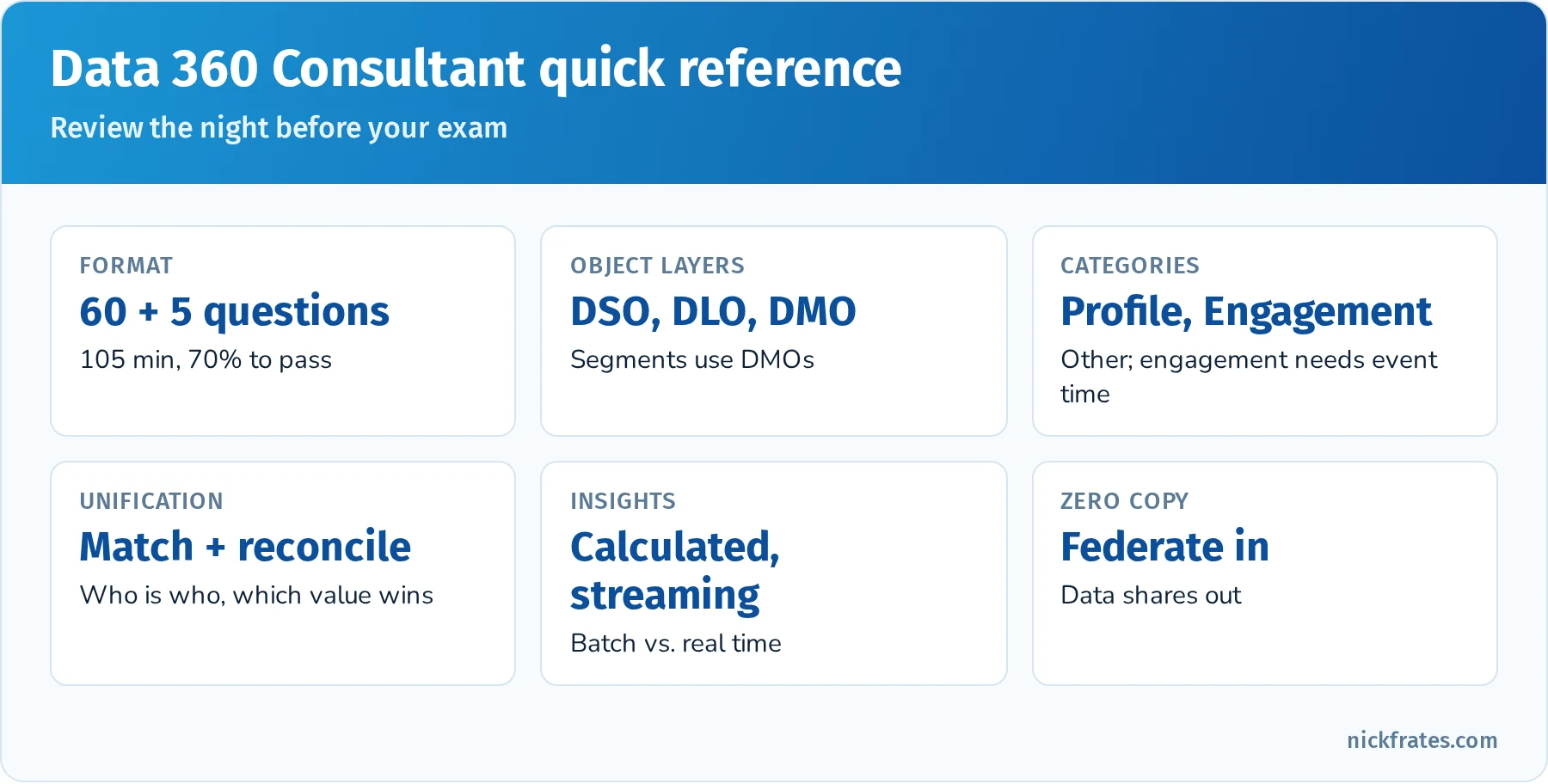
Review this card the night before.
Frequently asked questions
Is the Data 360 Consultant exam the same as Data Cloud Consultant? It's the same credential with the new product name. Content has been updated as the product evolved.
How hard is it? It's one of the harder consultant exams for people without hands-on Data 360 time, because questions are scenario-based and the data concepts are unfamiliar to many admins. Hands-on practice makes a big difference.
Do I need to know SQL? You should understand basic SQL concepts (aggregations, group by, joins) for calculated insights. You won't write long queries on the exam.
Do I need Marketing Cloud experience? It helps for activation questions, but you can learn the concepts without it.
What should I study alongside it? The Agentforce Specialist study guide pairs well, since Data 360 is the data foundation for Agentforce.
Related study guides
- Agentforce Specialist study guide.
- Salesforce Administrator study guide.
- Salesforce Business Analyst study guide.
- Salesforce AI Associate retirement guide.
- All Salesforce certification study guides.
- The science of studying for Salesforce certifications for active recall, spaced repetition and an Anki workflow.
- Agentforce Sales Consultant (formerly Sales Cloud Consultant) study guide for another consultant-track exam.
- Agentforce Service Consultant (formerly Service Cloud Consultant) study guide for another consultant-track exam, focused on contact center design.
Want to go deeper on automation? Data 360-triggered flows turn insights into action in Salesforce, and Flow is the only supported declarative automation tool now that Workflow Rules and Process Builder are past end of support. My Salesforce Flows course walks through record-triggered, screen, scheduled and platform event flows with real-world challenges.
Hope this helps!
Best,
Nick