Hey friends,
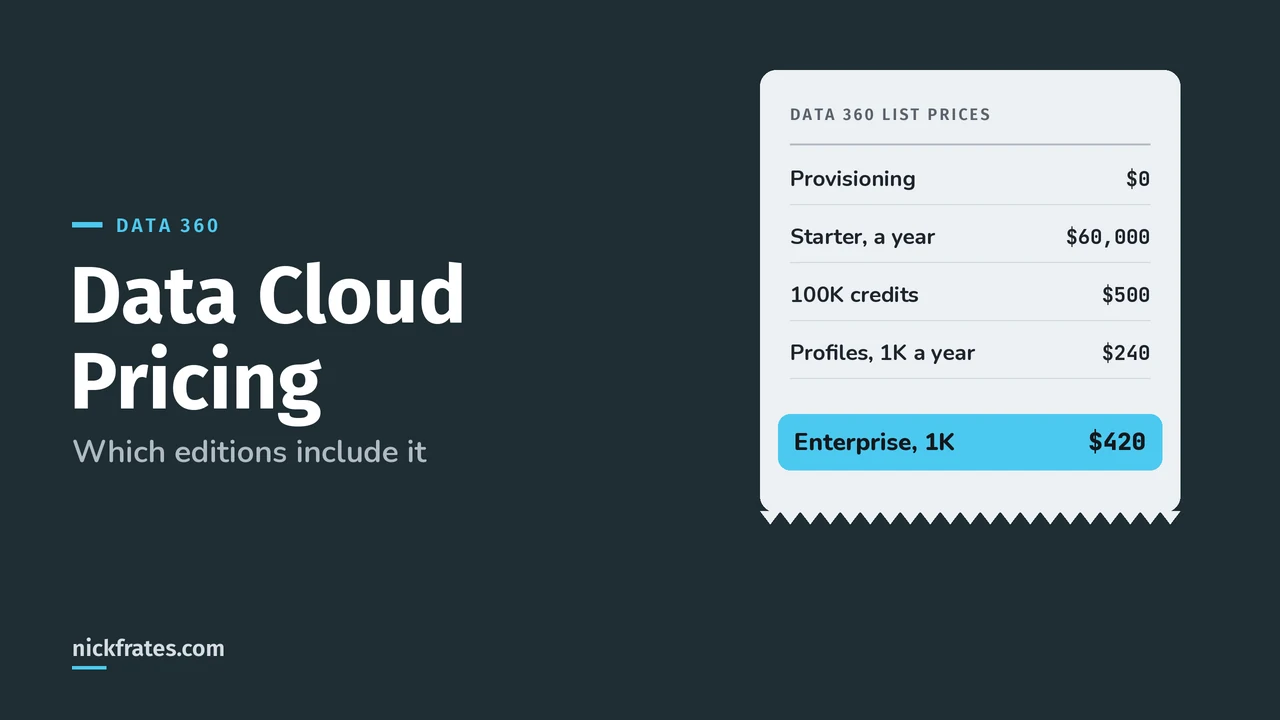
Salesforce doesn't list one fixed price for Data Cloud, which it now calls Data 360. It's usage-based: $500 per 100,000 Flex Credits, or a flat $240 or $420 per 1,000 profiles a year, and orgs on Enterprise Edition and above can switch it on for $0 with 250,000 credits a year included. Which one you pay depends on your edition, your data volume and what you run on it.
Everything below comes from Salesforce's own pages: its Data 360 pricing page, pricing calculator, pricing guide and Help, as they read on Oct 28, 2026. These are list prices in US dollars. Your contract can differ, so treat this as a way to understand the model, not a quote.
Data 360 pricing at a glance
| Option | List price | What Salesforce says it includes |
|---|---|---|
| Developer Edition | $0 | Data 360 in a new Developer Edition org, with limits (see below) |
| Data 360 Provisioning | $0 | 250,000 Flex Credits a year, 1 TB of storage, 1 Data 360 admin and 100 internal identity users. Enterprise Edition and above |
| Data 360 Starter | $60,000 a year | 10 million Flex Credits, 5 TB of storage, 1 admin and 100 internal identity users |
| Flex Credits | $500 per 100,000 credits | One credit you spend on any Data 360 action, and on Agentforce |
| Data 360 Profiles | $240 per 1,000 profiles a year | Profile-building actions included, up to 100 segments, 25 calculated insights and 25 transforms |
| Enterprise Profiles | $420 per 1,000 profiles a year | Everything in Profiles with up to 500 segments, 100 calculated insights and 100 transforms |
Data Cloud and Data 360 are the same product. Salesforce's Data 360 page says Data 360 is the official new name for what was previously called Data Cloud, and that existing Data Cloud agreements and pricing are honored through the end of the current term. You'll still see "Data Cloud" in license and permission set names. Older contracts may use Data Services credits, and the pricing page says there's no forced move to Flex Credits.
Which editions include Data 360?
Data 360 runs in Developer, Enterprise, Performance and Unlimited Editions, in Lightning Experience only, and the free Provisioning offer is for Enterprise Edition and above. That comes from Salesforce's Data 360 Editions and Licenses and Free Data Cloud Account articles. Here's how it breaks down:
| Edition | Data 360 access |
|---|---|
| Developer | Supported. A new Developer Edition org includes Data 360 and Agentforce, with usage limits |
| Professional | Not a supported edition, and Salesforce says Professional Edition customers can't get Data 360 Provisioning |
| Enterprise, Performance, Unlimited | Supported. Enterprise Edition and above can add Data 360 Provisioning for $0 through the Your Account app |
| Unlimited Edition Plus Bundle | Already includes a Data 360 license, so Provisioning isn't offered. The article lists 2,500,000 credits for Unlimited Plus instead of 250,000 |
| Government Cloud | Data 360 is available, but Provisioning isn't |
A few more rules from the same Help article:
- Each org can have only one Data 360 license of any kind. If you have several orgs, Salesforce suggests looking at Data 360 One, which connects them to the same Data 360.
- Nonprofit customers are eligible. Industry Cloud customers are eligible on Enterprise Edition and above.
- AppExchange partners with an ISV Enterprise Edition org can't use Your Account. They log a Salesforce Partner Program Support case instead.
- Data 360 doesn't turn itself on in a sandbox, even one copied from an org that has it. In a sandbox with a Data 360 license, open Data 360 Setup and click Enable.
What about Core, Advanced and Max? Salesforce's Sales Cloud pricing page now lists Free Suite, Starter Suite, Pro Suite, Core, Advanced and Max, while the Data 360 Help articles I read still use Enterprise, Performance and Unlimited. I couldn't find a Salesforce page that maps one list to the other for Data 360, so I won't guess. What the Sales page does say: Pro Suite has "Limited Data Cloud features" under data synchronization, and Core, Advanced and Max include 500,000, 1 million and 2.75 million Flex Credits per org per year. Salesforce says Flex Credits move between Data 360 and Agentforce, but that page doesn't split them, so ask your account executive how much you can spend on Data 360. To see what you own, open Setup > Company Information and read Organization Edition. I wrote about the newer names in Sales Cloud pricing and editions and Service Cloud editions.
Salesforce Foundations is a third route. It's a $0 add-on for your existing org, and it has nothing to do with the Platform Foundations exam. Salesforce's Foundations page says Data 360 is provisioned automatically once you add the required products, and lists unified profiles, 1 TB of storage and starter Flex Credits shared with Agentforce. Eligibility depends on your edition and region.
What free Provisioning gives you
- 250,000 credits a year, prorated against your core contract. With 3 years left, you'd get 750,000 over the 3 years. It's renewable.
- 1 TB of storage, 1 Data 360 admin, 100 internal identity users and 5 integration users.
- Nothing gets switched off at the limit. Salesforce says it won't turn off access if you reach or exceed your credits, and you'll be billed for overages. Track usage in Digital Wallet and set threshold alerts.
- More credits come through your account executive, not through Your Account.
Salesforce says Provisioning has the same features as Starter with fewer credits. Its calculator page describes Provisioning as the SKU for customers who use other Salesforce products built on Data 360, and Starter as the one for customers with their own Data 360 use cases. Setup is in Data 360: Access and Provisioning: in some orgs an admin first opens Data 360 Setup and clicks Get Started, then assigns the Data 360 permission sets to users. For Digital Wallet, see my post on monitoring usage and setting credit alerts.
How Flex Credits are charged
Bringing data in is free. You spend credits when you do something with it. Salesforce's pricing guide lists a meter for each action, and the base rates are below (1M means 1 million). A credit is $0.005 at the list price of $500 per 100,000, so I've added the dollar cost.
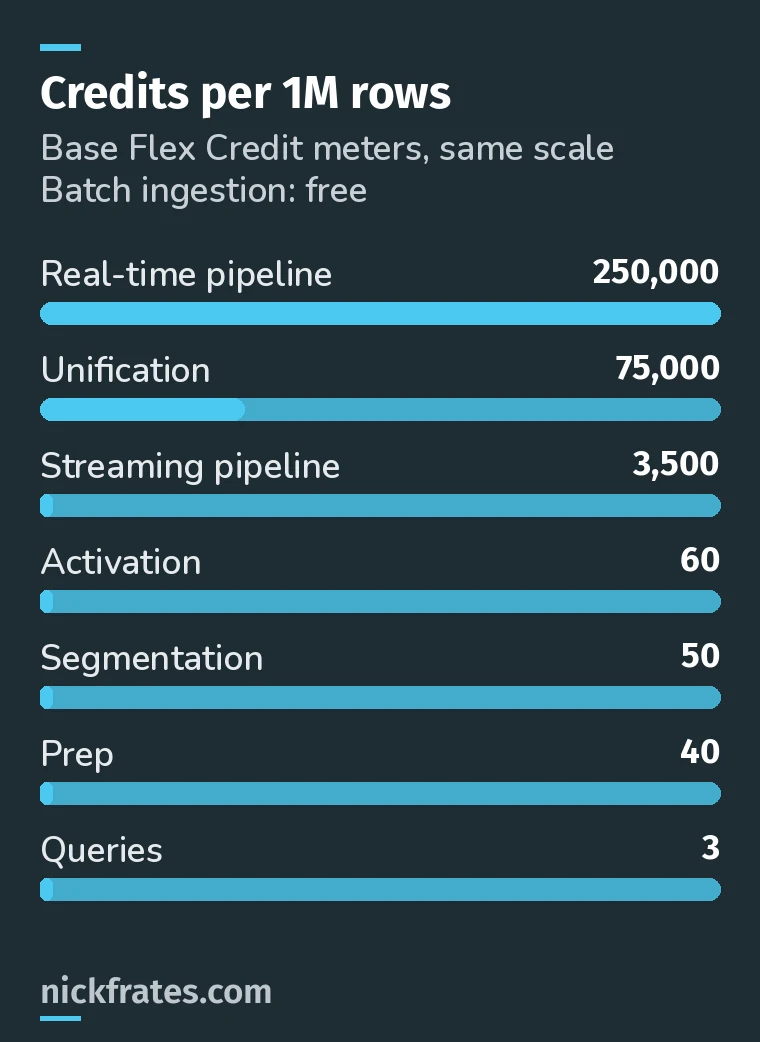
One scale for every meter. Unification and real-time processing dwarf the rest.
| Meter | Base credits | Per | List cost |
|---|---|---|---|
| Batch ingestion | Free | $0 | |
| Prep | 40 | 1M rows | $0.20 |
| Unification | 75,000 | 1M rows | $375 |
| Segmentation | 50 | 1M rows | $0.25 |
| Queries | 3 | 1M rows | $0.015 |
| Activation | 60 | 1M rows | $0.30 |
| Zero-copy sharing out | 60 | 1M rows | $0.30 |
| Unstructured processing | 150 | 1 MB | $0.75 |
| Intelligent processing | 600 | 1 MB | $3 |
| Streaming pipeline | 3,500 | 1M rows | $17.50 |
| Real-time pipeline | 250,000 | 1M rows | $1,250 |
Three things stand out:
- Unification is the big one. Matching and merging a million rows takes 75,000 credits. At the base rate, the free 250,000 credits cover about 3.3 million rows of unification, before any discounts.
- Volume and frequency matter. Salesforce names three levers: how many rows, how often you run, and which usage type. Its example only unifies the roughly 3% of records that change each day.
- Rates drop as you scale. The guide shows the Prep rate falling from 40 to 32 credits per million rows once you've used 300,000 credits in a month, and lower again at higher volumes. These tiers apply per meter, reset every month and only apply to Flex Credits.
Here's a small test. Say you ingest 2 million customer rows, prep them and unify them once. Ingestion is free, prep is 80 credits and unification is 150,000 credits. That's about 150,000 credits, roughly $750 at list, which fits inside the free 250,000. The same rows unified every day is a different bill, so run frequency belongs in every estimate.
For a full-size picture, Salesforce's guide walks an example that ingests profile, purchase and product data, unifies it, processes knowledge articles, runs queries and adds Agentforce actions. It lands at about 22 million credits a year, roughly $110,000 at list. Agentforce actions cost 20 credits each, which I broke down in Agentforce pricing and Agentforce billing.
Flex Credits or Profiles?
| Flex Credits | Profiles | Enterprise Profiles | |
|---|---|---|---|
| List price | $500 per 100K credits | $240 per 1K profiles a year | $420 per 1K profiles a year |
| Ingestion | Free | Free | Free |
| Prep and unify | Tied to usage | 25 insights, 25 transforms | 100 insights, 100 transforms |
| Segment, activate | Tied to usage | 100 segments | 500 segments |
| Query, share | Tied to usage | Tied to usage | Tied to usage |
| Streaming, real-time | Tied to usage | Tied to usage | Tied to usage |
| Credits included | None | 1 per profile a year | 2 per profile a year |
Salesforce's own guidance: Flex Credits give the most flexibility and scale across any use case, and Profiles give flat, predictable billing for profile-based work like personalized marketing journeys or proactive service. With Profiles you still spend Flex Credits on things like queries and unstructured data processing.
- Profiles is an add-on. It sits on top of a Data Cloud license, and Salesforce says you can't combine Profiles with Enterprise Profiles.
- You can't buy it in Your Account. The Help article lists both Profiles licenses as not available there, so it's a conversation with your account executive.
- Scale it before you decide. Salesforce's bank example has 2 million profiles on Data 360 Profiles: 2,000 × $240 is $480,000 a year at list, with the 2 million included credits covering part of the queries and zero-copy sharing.
How to estimate what you'd pay
- Write down the use case. Salesforce's guide starts with four questions: the problem, the role of AI, the data you need and the business value.
- Estimate rows, run frequency and usage type for each step, then multiply by the meter.
- Add Agentforce actions if agents will use the data, at 20 credits each.
- Try Salesforce's Data 360 Pricing Calculator. It asks for your industry and company size, then sets defaults.
- Check the current rate card with your account executive, since the calculator page says pricing can be customized for each customer.
Data 360 in a Developer Edition org
If you're learning rather than buying, a Developer Edition org is the cheap way in. Salesforce launched a new Developer Edition with Agentforce and Data 360 in March 2026, as its developer blog says. Here are the limits from the Developer Edition limits article:
- 1 data space, 10 GB of total data, 100 data streams and 300 data models.
- 25 active segments, 10 calculated insights and 2 identity resolution rulesets.
- 1,000 queries a day, with 2 at a time.
- No scheduled runs. Refresh Now, Publish Now and Run Ruleset start jobs by hand.
My post on the Developer Edition sign-up covers getting the org.
Pricing traps worth knowing
- Treating the free credits as unlimited. They're 250,000 a year, and going over means an overage bill, not a shutoff.
- Forgetting Agentforce draws on Data 360. Salesforce's license and billing article says features powered by Data 360, including Agentforce, are billed for Data 360 services based on your license type. My post on the Data 360 grounding pipeline shows where Agentforce uses it.
- Assuming a sandbox is covered. Data 360 doesn't turn itself on there, and every org in the cluster has to use the same license type. The production home org is billed for the processing its sandboxes generate.
- Assuming Professional Edition can use it. Salesforce says it can't get Provisioning.
- Quoting a price you read elsewhere. Salesforce says a fixed price is hard to give upfront because usage varies. Use the calculator and your own rate card.
If you're reading this for the Agentforce Specialist exam, Data 360 Fundamentals is 20% of the exam guide, and its Data 360 objectives name chunking, indexing and retrievers. My Agentforce Specialist study guide covers the whole exam, and the Data 360 Consultant study guide goes deeper on the product. The Agentforce guide is the place to start if agents are new to you.
Cert Lab by Nick Frates
Heading for the Agentforce Specialist exam?
Lessons, a section check, quiz and flashcards for every section, including Data 360 Fundamentals, with each fact linked to the Salesforce Help page behind it.
Start the Agentforce Specialist Cert Lab, $9.99 →FAQ
How much does Salesforce Data Cloud cost? There's no single price. Salesforce lists $500 per 100,000 Flex Credits, $240 or $420 per 1,000 profiles a year, and a $60,000-a-year Starter SKU with 10 million credits. Enterprise Edition and above can add Provisioning for $0.
Is Data Cloud free? Partly. Provisioning is $0 and includes 250,000 credits a year, and a new Developer Edition org includes Data 360 with limits. Using it beyond the included credits is billed.
Which Salesforce editions include Data Cloud? Data 360 is supported in Developer, Enterprise, Performance and Unlimited Editions. Free Provisioning needs Enterprise Edition or above, and Professional Edition customers can't get it.
Did Data Cloud change its name? Yes. Salesforce renamed it Data 360 and says existing Data Cloud agreements are honored through the current term. Some license and permission set names still say Data Cloud.
What are Flex Credits? A single credit you spend on Data 360 actions and Agentforce actions, priced at $500 per 100,000. Older contracts may still use Data Services credits.
What happens if I use more than the free credits? Salesforce doesn't turn access off. It bills the overage, and you can ask your account executive to add credits.
Can I try Data 360 for free? Salesforce customers can provision it for free with limited storage and credits, and a new Developer Edition org includes it with limits.
Where can I check my usage? In Digital Wallet, which shows near real-time consumption and lets you set threshold alerts.
Hope this helps!
Best,
Nick