Hey friends,
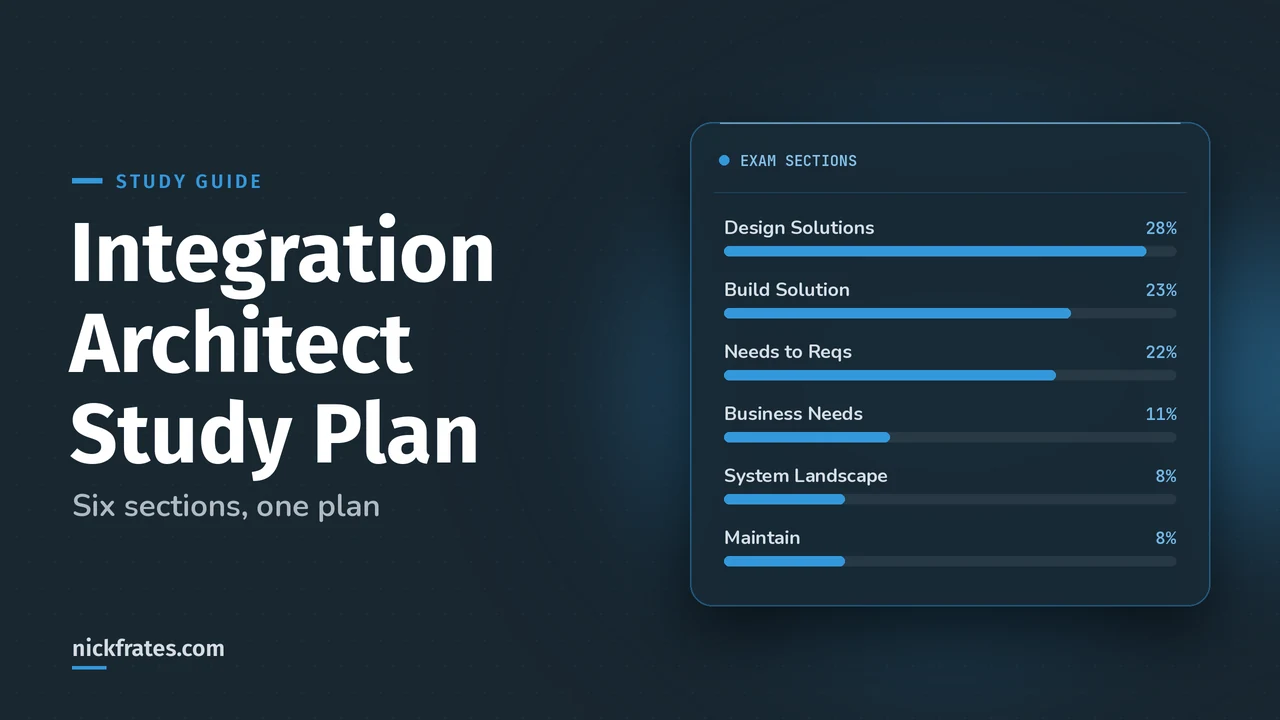
To pass the Salesforce Certified Platform Integration Architect exam you need 67% on 60 multiple-choice questions in 105 minutes, and three sections carry 73% of the score: Design Integration Solutions (28%), Build Solution (23%) and Translate Needs to Integration Requirements (22%). I built this plan from the official exam guide and the Salesforce docs behind it. It tells you what to study first, what each section is really asking and how to spend your weeks.
This is the short plan. I also wrote a much longer Platform Integration Architect certification study guide that walks through the topics one by one. Use this page to decide what to do each week, and that one when you want depth.
What is on the Salesforce Platform Integration Architect exam?
Six sections, weighted like this in the exam guide:
| Section | Weight | What it tests |
|---|---|---|
| Evaluate the Current System Landscape | 8% | Spotting the standards, limits and protocols of the systems already in place, finding constraints and pain points, and what authentication and authorization the landscape needs |
| Evaluate Business Needs | 11% | Functional and non-functional requirements, classifying data as confidential, secure or public, and the growth and regulatory factors that change your choice of solution |
| Translate Needs to Integration Requirements | 22% | Inventorying systems and patterns from a landscape diagram, process constraints, security requirements, and performance needs such as volumes, response times and latency |
| Design Integration Solutions | 28% | Choosing the integration pattern, defining the components, naming the trade-offs, and picking the right Salesforce API and security mechanism |
| Build Solution | 23% | Salesforce as an API provider and as an API consumer, outbound calls, scalability, error handling, security and resilience during system updates |
| Maintain Integration | 8% | Performance monitoring, error handling and escalation for a failed integration, and reporting |
The top three sections are 73% of the exam. Design is the biggest single block, so the pattern and API choices are where I'd spend the most time.
How many questions, how long and how much does it cost?
| Detail | What the exam guide says |
|---|---|
| Questions | 60 multiple-choice questions, plus up to five unscored ones |
| Time | 105 minutes |
| Passing score | 67%, which is about 40 of the 60 scored questions |
| Registration fee | US$400 plus applicable taxes |
| Retake fee | US$200 plus applicable taxes |
| Delivery | Proctored, at a testing center or online |
| During the exam | No hard-copy or online materials |
| Prerequisite | None |
| Release alignment | Questions align to the Summer '23 release |
The unscored questions are mixed in at random, so treat every question as if it counts. The Trailhead credential page also lists a separate MuleSoft Platform Integration Architect credential. That is a different exam, so make sure you register for the right one. For the money side, I break down fees and retakes in how much Salesforce certifications cost.
Who should take the Platform Integration Architect exam?
The guide describes someone with 1 to 2 years of experience with Salesforce integration architecture, 2 to 3 years of hands-on admin or developer experience and at least a year supporting or implementing data-centric enterprise integrations. Typical roles are Technical Architect, Integration Architect, Solution Architect, Programmer Analyst and Application Manager.
The guide is just as clear about what you don't need: non-Salesforce technology or database concepts, configuring integration tools, MDM tool experience, Lightning development or a programming language. It also says candidates will likely need help choosing the best middleware tool in a scenario. Read that as a signal. The questions are about picking designs on Salesforce, not writing syntax.
Is the Salesforce Integration Architect exam hard?
It's a scenario exam. A question describes a company, a legacy system, a volume or a latency target, and you choose the best design from options that all sound plausible. People with deep API experience tend to miss the requirements-gathering sections. People from a business background tend to miss the details of which API handles which job.
The same handful of ideas keep winning: match the pattern to the timing and the data volume, use the API built for the job, authenticate server to server without a person in the loop, and plan for failure from day one.
How should I study for the Platform Integration Architect exam?
Here's the order I'd use, weighted by the exam. It's my plan, not an official one. Read the exam guide once first so you know the objectives. Salesforce also recommends the Architect Journey: Integration Architecture Trailmix, which is a good source list to work through alongside this.
- Week 1, patterns and landscape (8% plus part of 28%). Read the Integration Patterns and Practices guide and learn the pattern names: Remote Process Invocation (Request and Reply, Fire and Forget), Batch Data Synchronization, Remote Call-In, UI Update Based on Data Changes and Data Virtualization. My Salesforce integration patterns post has the breakdown.
- Week 2, which API for which job (28%). Learn what REST, SOAP, Bulk API 2.0, Composite and Pub/Sub API are each for. Start with Salesforce API types, then go deeper on the REST API, SOAP API, Bulk API 2.0 and Composite API.
- Week 3, events (part of Design and Build). Platform events, change data capture, delivery allocations and replay. Read Salesforce platform events and compare it with the request and reply pattern.
- Week 4, requirements (22% and 11%). Practice turning a paragraph of business needs into volumes, response times, data classification and authentication needs. Write a one-line requirement for each: how many records, how fast, how secure, who calls whom.
- Week 5, build (23%). Salesforce as a provider (Apex REST, the standard APIs) and as a consumer (callouts, Named Credentials, remote site settings, timeouts). Add error handling, retries, idempotency and OAuth flows. Compare it with the Salesforce security model for who gets access to what.
- Week 6, maintain and practice (8% plus review). Monitoring, escalation and reporting for failed integrations. Then take timed practice questions every day. The practice questions further down this page are a good first set.
If you have less time, keep the order and give weeks 2 and 5 the most hours. For how I learn faster in general, I wrote about it in the science of studying for Salesforce certifications.
What does each section really ask?
Reading the objectives, each section has one question it keeps asking in different clothes.
| Section | The question underneath |
|---|---|
| Evaluate the Current System Landscape | What do the systems already do, and what will break if I plug something into them? |
| Evaluate Business Needs | What must the integration do, how well must it do it, and which data is sensitive? |
| Translate Needs to Integration Requirements | How many, how fast, how secure? Put a number on every requirement. |
| Design Integration Solutions | Which pattern, which API, which security mechanism, and what do I give up? |
| Build Solution | How do I build it so it scales, fails safely and survives a system upgrade? |
| Maintain Integration | How will I know it broke, who gets told and how does it recover? |
Platform Integration Architect practice questions
Fifteen scenario questions, weighted like the real exam: 1 on the landscape, 2 on business needs, 3 on requirements, 4 on design, 4 on build and 1 on maintenance. I wrote them myself from the Salesforce docs. Tap a question to see the answer and why. Time yourself at about 1.5 minutes each, since the real exam gives you 105 minutes for 60 questions.
Evaluate the Current System Landscape
Question 1. A company's on-premises order system exposes only a SOAP web service described by a WSDL. Salesforce needs to read orders from it during a user's session. What is the most direct way to do that?
- A. Publish a platform event and let the order system subscribe
- B. Ask the order system team to rebuild the service as REST first
- C. Build a Bulk API 2.0 job that pulls the orders
- D. Generate an Apex class from the WSDL and make a SOAP callout, with the endpoint registered as a remote site or behind a named credential
Show the answer and explanation
Answer: D. Apex can define a class from a WSDL document and call the service as a SOAP callout. Salesforce blocks callouts to addresses that aren't registered, so the endpoint has to be in Remote Site Settings or defined by a named credential.
Bulk API 2.0 loads data into Salesforce, it doesn't call out of it. A platform event is fire and forget, so it can't return the order data during the session. Rebuilding the service might be nice, but the question asks for the most direct way with what exists.
Evaluate Business Needs
Question 2. An integration will send customer tax IDs and purchase totals to a partner. Which step belongs first in the requirements work?
- A. Classify each data element as confidential, secure or public, then let that drive the security and authentication requirements
- B. Choose the middleware product
- C. Set the batch size
- D. Pick between REST and SOAP
Show the answer and explanation
Answer: A. The exam guide asks you to classify data as confidential, secure or public from the integration requirement. The classification decides what encryption, authentication and access controls the design needs, so it comes before technology choices.
Question 3. Which statement is a non-functional integration requirement?
- A. Sales managers can see the ERP status on the opportunity page
- B. When an opportunity is Closed Won, create an order in the ERP
- C. The ERP order number is stored on the opportunity
- D. Orders must reach the ERP within 5 seconds for 99% of closed deals
Show the answer and explanation
Answer: D. Response time and a percentage target describe how well the integration performs, not what it does. The other three describe behavior: create an order, store a number, show a status. Non-functional requirements like speed, volume, availability and security are what drive the pattern and API choice later.
Translate Needs to Integration Requirements
Question 4. An ERP sends about 4 million record updates every night, and nobody is waiting on the result. Which API fits?
- A. SOAP API with 200 records per call
- B. REST sObject Rows resource, one call per record
- C. Composite API with 25 subrequests per call
- D. Bulk API 2.0
Show the answer and explanation
Answer: D. Salesforce's guidance is that operations on more than about 2,000 records are good candidates for Bulk API 2.0, which is asynchronous. It has no completion SLA, which is fine here because nobody is waiting.
One call per record would burn through API limits. Composite and SOAP calls move tens or hundreds of records per call, which is fine for smaller, interactive work but a poor fit for millions.
Question 5. A middleware server must call Salesforce APIs every night with no user present, and security won't allow stored passwords. Which OAuth flow fits best?
- A. User-agent flow
- B. JWT bearer flow
- C. Device flow
- D. Username-password flow
Show the answer and explanation
Answer: B. The JWT bearer flow authorizes servers without interactive login. The server signs its request with a certificate, and the client app has to be approved ahead of time. Client credentials, with a named integration user, is the other server-to-server option.
Username-password and user-agent flows pass credentials around, and Salesforce recommends avoiding them. The username-password flow is blocked by default in orgs created in Summer '23 or later. The device flow is for devices with limited input, such as smart TVs.
Question 6. A rep taps an account in a mobile app and needs its current record within a second. Which choice fits the requirement?
- A. Bulk API 2.0 query job
- B. A platform event the app subscribes to
- C. A REST API call on the account record
- D. A nightly sync to a local database
Show the answer and explanation
Answer: C. A user waiting for one record is request and reply: a synchronous REST call, either the sObject Rows resource or a query, returns the record right away.
Bulk API 2.0 is asynchronous with no SLA. A platform event doesn't return a requested record. A nightly sync leaves the data stale, which fails the real-time need.
Design Integration Solutions
Question 7. When a case is closed, the billing system should hear about it. Salesforce doesn't need an answer, and billing is sometimes down for hours. Which design fits?
- A. A scheduled Bulk API job every minute
- B. An outbound email to the billing team
- C. A synchronous callout from the case trigger that retries three times
- D. Publish a platform event that billing subscribes to and replays from after an outage
Show the answer and explanation
Answer: D. This is the fire and forget pattern. Salesforce publishes an event and moves on, and a subscriber can store a replay ID and resubscribe to get events it missed. High-volume platform events are retained for 72 hours, so an outage shorter than that is recoverable.
A synchronous callout makes the user's transaction wait on billing and fails when billing is down. A minute-by-minute bulk job is the wrong tool for single events. Email isn't an integration.
Question 8. A single request must create an Account and a Contact linked to it, and if the Contact fails, the Account must not be saved. What should you use?
- A. Bulk API 2.0 with two jobs
- B. Two separate REST calls from the client
- C. Composite API with a reference ID on the Account and all-or-none turned on
- D. Composite batch with two subrequests
Show the answer and explanation
Answer: C. A composite request lets a later subrequest use an earlier one's output, for example @{refAccount.id} as the Contact's AccountId, and you can choose whether an error rolls back the whole request.
Composite batch subrequests are independent and can't pass information between them, and a successful one commits even if a later one fails. Two separate calls can't be rolled back together, and Bulk API 2.0 works on one object per job.
Question 9. An external subscriber needs to receive platform events but wants to control how many events it receives at a time, based on how fast it processes them. Which API fits?
- A. Pub/Sub API
- B. SOAP API
- C. Composite API
- D. Streaming API
Show the answer and explanation
Answer: A. Pub/Sub API is pull-based: the client says how many events it wants per Subscribe call. Streaming API is push-based, and the client can't control how many events the server delivers.
Question 10. Users must see live inventory held in an external system inside Salesforce, and the company doesn't want a copy stored in Salesforce. Which integration pattern is this?
- A. Data Virtualization
- B. Fire and Forget
- C. Batch Data Synchronization
- D. Remote Call-In
Show the answer and explanation
Answer: A. Data Virtualization is defined as Salesforce accessing external data in real time, which removes the need to store the data in Salesforce and reconcile it with the source.
Batch Data Synchronization copies data in batches. Remote Call-In is an outside system acting on Salesforce data. Fire and Forget sends a message and doesn't wait.
Build Solution
Question 11. A queueable job makes one HTTP callout for each of 250 records and fails partway through. What is the most likely cause?
- A. The default callout timeout is too short
- B. A single Apex transaction can make at most 100 callouts
- C. Remote Site Settings is missing
- D. Callouts can't run in queueable jobs
Show the answer and explanation
Answer: B. Apex limits a transaction to 100 callouts. Split the work into chunks of fewer than 100 callouts, or send records in a single request if the target accepts it. Timeouts are separate: the default is 10 seconds per callout and the cumulative maximum is 120 seconds per transaction.
A missing remote site would fail the first callout, not partway through.
Question 12. Developers hardcode an external endpoint and an API token inside Apex. What is the best fix?
- A. Put them in a static resource
- B. Move both into a custom label
- C. Use a named credential, which holds the endpoint and its authentication together
- D. Store them in a custom object
Show the answer and explanation
Answer: C. A named credential defines the callout endpoint and its required authentication in one place. When a callout uses one, you also don't need a remote site setting for that endpoint.
Question 13. A Bulk API 2.0 ingest job ends in the Failed state with some records in error. What happened to the records that succeeded?
- A. They were kept, and you use the failed and unprocessed results to decide what to resubmit
- B. They are held until you close the job again
- C. They are retried automatically
- D. They were rolled back
Show the answer and explanation
Answer: A. Salesforce states that job data that was successfully processed isn't rolled back when a job fails. Use the successful, failed and unprocessed record results to work out what to resubmit, and keep your local CSV until you've confirmed everything went through.
Question 14. A legacy integration still logs in with the SOAP login() call. What should the architect recommend?
- A. Switch to Streaming API
- B. Move to an older API version
- C. Nothing, since SOAP login() is permanent
- D. Move to an OAuth flow through an external client app before login() is retired in Summer '27
Show the answer and explanation
Answer: D. The SOAP API end-of-life page says login() is scheduled for retirement in Summer '27. Authenticate with OAuth instead, and plan the change now so the integration survives the retirement.
Maintain Integration
Question 15. You must find which integrations still call Salesforce with old or unsupported API versions. What does Salesforce suggest?
- A. Check the debug logs of each integration user
- B. Use the API Total Usage event type
- C. Count callouts in the Limits API
- D. Ask each vendor
Show the answer and explanation
Answer: B. The SOAP API end-of-life policy page says to use the API Total Usage event type to identify requests made from old or unsupported API versions. Salesforce gives at least a year of notice before it ends support for an API version.
If you learn best by testing yourself, the Platform Integration Architect Cert Lab has quick practice questions on all six sections, with every option explained.
What mistakes do candidates make?
- Treating the exam as a memorization test of API names. The questions ask you to choose between them for a given volume, timing and direction.
- Reaching for a custom Apex solution when a standard API or a declarative option already fits the requirement.
- Picking real-time request and reply when the business can wait, or batch when the user is staring at a screen.
- Skipping the security objectives. Authentication and security show up in four of the six sections.
- Forgetting the failure path. Every design needs a retry, an alert and a way to recover.
- Studying only integration products and ignoring the data classification and requirements work.
Quick backstory. I loved Focus on Force and used it on my way to 17 Salesforce certifications. At first I read the study guide cover to cover, then took the tests. What I eventually noticed: I learned way faster when I skipped ahead and took practice tests rapid-fire, reading the explanation for every miss. So I built Cert Lab around fast testing, with up-to-date doc links in every explanation. It's designed to test you to success.
FAQ
How hard is the Salesforce Platform Integration Architect exam?
It's an intermediate-level architect exam made of scenarios. You pick the best integration design from several reasonable options, so you need to know the trade-offs, not just the definitions.
What is the passing score?
67%, which works out to about 40 of the 60 scored questions. The exam has 60 questions plus up to five unscored ones, and you get 105 minutes.
How much does the exam cost?
US$400 plus applicable taxes, and US$200 to retake it.
Which section is the biggest?
Design Integration Solutions at 28%, followed by Build Solution at 23% and Translate Needs to Integration Requirements at 22%.
Do I need to know how to code?
The exam guide says programming language experience isn't expected. You should still understand what Apex REST, callouts and the standard APIs do and when each fits.
Is there a prerequisite?
No. Salesforce lists none for this exam.
Do I have to renew it?
Yes. The guide says you complete the Platform Integration Architect maintenance badge on Trailhead once a year.
Where should you go next?
- Salesforce API types to learn which API handles which job.
- Salesforce platform events for the event-driven side.
- The practice questions on this page to test yourself.
- The long study guide when you want every topic in depth.
Nick Frates, a senior Salesforce developer with 17 certifications, built the Platform Integration Architect Cert Lab at nickfrates.com: rapid-fire practice questions for every exam section, each answer explained.
Cert Lab by Nick Frates
Let the Platform Integration Architect Cert Lab test you to success
Lessons, flashcards, a quiz for each of the six exam sections and full practice exams, every answer explained.
Start the Platform Integration Architect Cert Lab for $9.99 →Not ready to buy? Try a free lesson and see how fast you learn.
Hope this helps!
Best,
Nick