Hey friends,
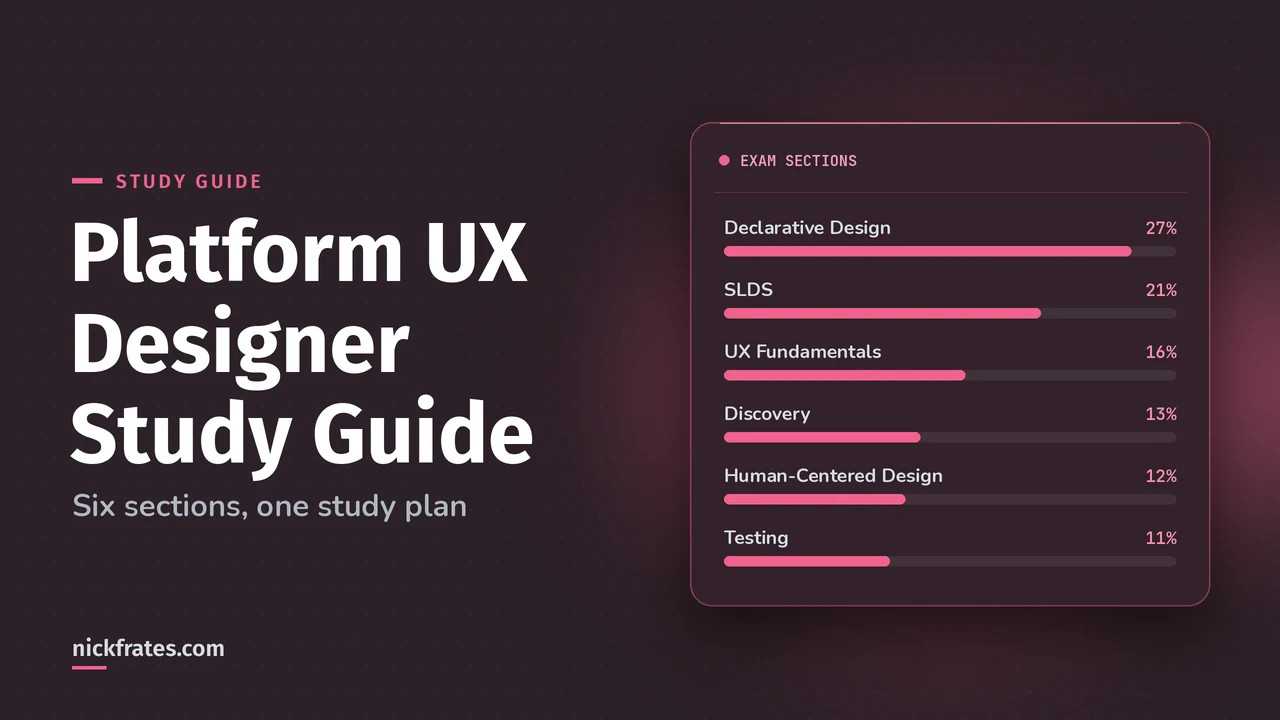
The Salesforce Platform UX Designer certification exam, officially Salesforce Certified Platform User Experience Designer, has 60 scored multiple-choice questions, a 105-minute time limit and a 65% passing score, and it covers six sections: Discovery, UX Fundamentals, Human-Centered Design, Declarative Design, Testing and the Salesforce Lightning Design System (SLDS). Declarative Design is the biggest at 27%, and SLDS is next at 21%. I built this guide from the official exam guide and Salesforce's own Trailhead prep module.
Salesforce also writes the name as Platform User Experience (UX) Designer, Platform UX Designer, or just UX Designer on Trailhead. They're all the same credential. Here's what's on it, what each section really tests, and how I'd study.
What is on the Salesforce Platform UX Designer exam?
Six sections, weighted like this in the exam guide:
| Section | Weight | What it tests |
|---|---|---|
| Discovery | 13% | Picking research methods and tools, gathering requirements, Salesforce UX personas, and how Salesforce adds value to a user experience |
| UX Fundamentals | 16% | Choosing a UX method, branding and styling, design principles and tools for accessible, engaging experiences, and mobile UX basics |
| Human-Centered Design | 12% | Using human-centered design in a customer solution, and why inclusive design matters |
| Declarative Design | 27% | Core Salesforce objects, page and layout features, features that speed up multi-step work, global configuration, onboarding and support, and branding a solution |
| Testing | 11% | Planning ways to validate a design with users, testing techniques, and evaluating and managing design changes |
| Salesforce Lightning Design System (SLDS) | 21% | What SLDS is for, out-of-the-box design that matches Lightning Experience, and using SLDS to build customized components |
Add Declarative Design and SLDS and you're at 48% of the exam. That's where I'd spend the most study time.
How many questions, how long and how much does it cost?
| Detail | What the exam guide says |
|---|---|
| Questions | 60 multiple-choice questions, plus up to five unscored ones |
| Time | 105 minutes |
| Passing score | 65%, which is about 39 of the 60 scored questions |
| Registration fee | US$200 plus applicable taxes |
| Retake fee | US$100 plus applicable taxes |
| Delivery | Proctored, at a testing center or online |
| During the exam | No hard-copy or online materials |
| Prerequisite | None |
The unscored questions are mixed in at random, so you can't tell which ones don't count. Treat every question like it does.
Who should take the UX Designer exam?
The exam guide describes candidates with at least 6 months of hands-on experience as a UX designer, engineer, administrator, stakeholder, facilitator or researcher, plus 3 to 6 months using UX design concepts on the Salesforce Platform. There's no prerequisite, so you can sit it without that, but plan on more study time if you haven't used Lightning App Builder or SLDS before. For how this compares with other certification costs, see my Salesforce certification cost post.
Is the Salesforce UX Designer exam hard?
It depends on where you start. Designers usually find Discovery, Human-Centered Design and Testing familiar, but Declarative Design asks which Salesforce feature solves a UX problem, and that's product knowledge. Admins and developers have the opposite problem: they know Path and page layouts, but terms like card sorting, tree testing and attitudinal vs behavioral research are new.
Most questions are scenarios, so memorizing definitions only gets you partway. You need to pick the best option when several sound reasonable.
What should I study in each section?
These are the key topics Salesforce lists in each unit of the Trailhead prep module, with my notes on where to go deeper.
| Section | Key topics from Trailhead | Where to study |
|---|---|---|
| Discovery | Research methodology and tools, content strategy, heuristic analysis, root cause analysis, personas for Salesforce clouds, data relationships | UX research methods, Salesforce user stories, business process mapping |
| UX Fundamentals | User flow, brand identity, visual design, contrast, eye path tracking, responsive design, mobile optimization | UX design principles, wireframe fidelity |
| Human-Centered Design | Journey mapping, development stages, service design, relationship design and its four mindsets, inclusive design | UX design principles (accessibility section) |
| Declarative Design | Standard and custom objects, reports and dashboards, page layouts, Dynamic Forms, in-app guidance, global elements, utility bar, Path, user engagement, declarative theming | Lightning App Builder, data modeling, reports and dashboards |
| Testing | User validation, task scenarios, focus groups, A/B testing, tree testing, usability benchmarking, prototyping, user stories, biases, feedback | UX research methods, sandbox types |
| SLDS | Design documentation, framework, color contrast, design tokens, grid system, icon library, Lightning components, iconography | SLDS explained |
Does the exam cover SLDS 2 and the Cosmos theme?
The exam guide says questions align to the Winter '24 release, so the SLDS section follows the original Lightning Design System, now called SLDS 1, with design tokens, the grid and the icon library. Salesforce has since released SLDS 2 and the Salesforce Cosmos theme, where design tokens are replaced by global styling hooks. Salesforce also requires a yearly Trailhead maintenance module, and the current one is Summer '26.
My advice: learn the exam's SLDS 1 vocabulary first, then spend an hour on styling hooks so SLDS 2 scenarios don't surprise you. I cover both in my SLDS post.
Cert Lab by Nick Frates
Find your weak sections before exam day
Rapid-fire questions for all six Platform UX Designer sections, with every option explained and current doc links.
Start the Platform User Experience Designer Cert Lab for $9.99 →Not ready to buy? Try a free lesson and see how fast you learn.
How should I study for the UX Designer exam?
Here's the order I'd use, weighted by the exam. It's a plan I'd follow, not an official one. First, read the exam guide once so you know the objectives. Then:
- Declarative Design first. Build something in a Developer Edition org: a record page with Dynamic Forms, a Path with key fields and guidance, and an in-app prompt. Seeing a feature work makes the scenario questions much easier.
- SLDS next. Know the four design principles (clarity, efficiency, consistency, beauty), the grid classes, icon types, and the difference between design tokens and styling hooks.
- Then the three research-heavy sections together, Discovery, Human-Centered Design and Testing. They share vocabulary: attitudinal vs behavioral, qualitative vs quantitative, card sorting vs tree testing.
- UX Fundamentals last, with extra time on accessibility: contrast, headings, keyboard use and not relying on color alone.
- Finish with timed practice questions. Take a set, read every explanation, and note which section each miss came from.
My post on the science of studying for Salesforce certifications explains why testing yourself beats rereading. You can try it now with my 20 Platform UX Designer practice questions.
What mistakes do people make on this exam?
- Treating it as a pure design exam. 27% is Declarative Design, which is Salesforce configuration.
- Mixing up methods that sound alike: card sorting builds a structure, tree testing checks one.
- Mixing up what people say (attitudinal) with what they do (behavioral) when a scenario asks for evidence.
- Relying on color alone for meaning, which is an accessibility failure.
- Studying only the older SLDS vocabulary, or only the newer one.
- Skipping hands-on practice and relying on definitions.
How do I keep the certification current?
Salesforce requires a Trailhead maintenance module once a year for this credential. If you miss the due date, the certification expires. The module changes each release, so check Trailhead for the current one.
Quick backstory. I loved Focus on Force and used it on my way to 17 Salesforce certifications. At first I read the study guide cover to cover, then took the tests. What I eventually noticed: I learned way faster when I skipped ahead and took practice tests rapid-fire, reading the explanation for every miss. So I built Cert Lab around fast testing, with up-to-date doc links in every explanation. It's designed to test you to success.
FAQ
What is the official name of the exam?
Salesforce Certified Platform User Experience Designer. Salesforce also writes Platform UX Designer or Platform User Experience (UX) Designer.
How many questions are on the exam?
60 scored multiple-choice questions plus up to five unscored ones, in 105 minutes.
What is the passing score?
65%.
How much does the exam cost?
US$200, and a retake is US$100, plus applicable taxes.
What's the biggest section?
Declarative Design, at 27%. SLDS is second at 21%.
Is there a prerequisite?
No. Salesforce recommends 6 months of UX experience and 3 to 6 months using UX concepts on the Salesforce Platform.
Can I use notes during the exam?
No. The exam guide says no hard-copy or online materials may be referenced.
Where should you go next?
- Platform UX Designer practice questions, 20 original questions weighted like the exam.
- UX research methods for Discovery and Testing.
- The Salesforce Lightning Design System for the SLDS section.
- UX design principles for UX Fundamentals and inclusive design.
Nick Frates, a senior Salesforce developer with 17 certifications, built the Platform User Experience Designer Cert Lab at nickfrates.com: rapid-fire practice questions for every exam section, each answer explained.
Cert Lab by Nick Frates
Let the Platform User Experience Designer Cert Lab test you to success
Lessons, flashcards, a quiz for each of the six exam sections and full practice exams, every answer explained.
Start the Platform User Experience Designer Cert Lab for $9.99 →Not ready to buy? Try a free lesson and see how fast you learn.
Hope this helps!
Best,
Nick