Hey friends,
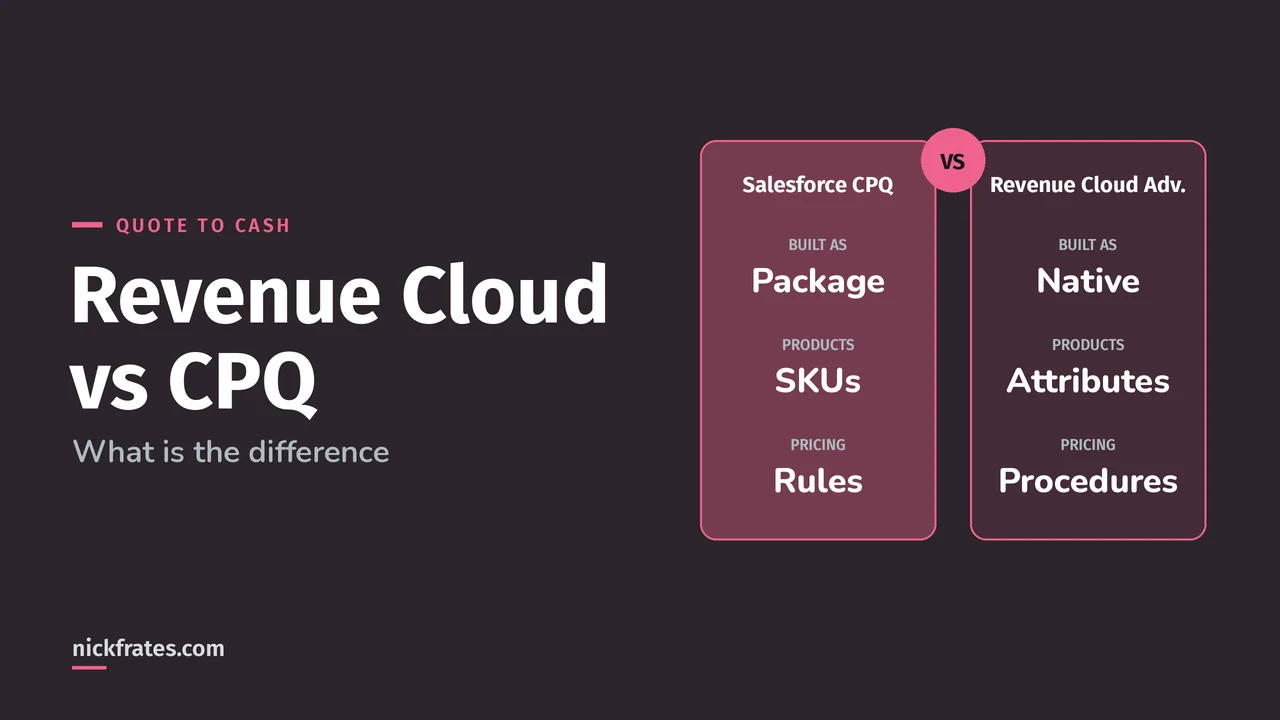
Salesforce CPQ is a managed package built around seller-led quoting. Revenue Cloud Advanced is built natively on the Salesforce platform, covers more of the quote-to-cash process, and is what Salesforce calls the successor to CPQ. Salesforce says CPQ is end of sale, not end of life: existing customers keep using it, but new customers can't buy it.
Everything below comes from Salesforce's own pages: its CPQ end of sale article, the Help article Key Differences Between Revenue Management and Salesforce CPQ, and the Revenue Cloud, pricing and Revenue Cloud Billing pages, as they read on Oct 28, 2026. Where Salesforce's pages disagree with each other, I say so instead of picking one.
What the names mean
Salesforce's pages use several names for the same area, which is the first thing that trips people up. Here's how its pages use them:
| Name | What Salesforce's pages say |
|---|---|
| Salesforce CPQ | A managed package for configuring products, pricing and quoting. End of sale, not end of life |
| Revenue Cloud | The suite: pricing, quoting, contracting, orders, assets, billing, AI agents and headless revenue workflows |
| Revenue Cloud Advanced (RCA) | The product inside the suite that Salesforce names as the successor to CPQ |
| Revenue Cloud Billing | A separate but complementary product in the suite for usage rating, invoicing, payments, collections and financial operations |
| Revenue Lifecycle Management (RLM) | An earlier product name. Salesforce says RCA is the current product |
| Revenue Management | The name the Help article uses, written as "Revenue Management (formerly Revenue Cloud)". Trailhead modules on the Revenue Cloud page say "Agentforce Revenue Management" |
A few terms first. A managed package is software installed into your org from a package. Headless means the logic can run through APIs and agents without needing the Salesforce screens. Quote-to-cash is the whole path from quote to contract, order, invoice and payment.
Salesforce also says RCA "is not simply CPQ with a new name." The two were designed on different architectures, one for seller-led quoting and the other for selling across channels and revenue models. That's why Salesforce's Help article tells customers to treat a move as a redesign, not a direct migration.
Salesforce CPQ vs Revenue Cloud Advanced, side by side
This table combines the comparison on the end of sale article with the one in the Help article. I've kept Salesforce's own wording where I could.
| Area | Salesforce CPQ | Revenue Cloud Advanced |
|---|---|---|
| Architecture | Managed package installed on top of Salesforce, with a quote-centric design | Native to the Salesforce platform, API-first, headless and composable |
| Adoption | All or nothing: all capabilities are bundled together | Modular: adopt pricing, quoting, ordering or billing independently |
| Products | SKU-based, with a bundle and option hierarchy | Attribute-based catalog, with a clear split between commercial and technical products |
| Pricing engine | Browser-side, rules-based and sequential. Price rules, custom scripts and custom code | Server-side pricing procedures and pricing elements with waterfall-based execution |
| Configurator | Rules-based | Constraint-based, using the Constraint Rules Engine and Constraint Modeling Language (CML) |
| Contract and account pricing | A ContractedPrices custom object and account-specific workarounds | Native ContractItemPrice on standard objects, plus account, partner and channel pricing |
| Revenue models | One-time and subscriptions, with limited consumption | One-time, subscription, consumption and hybrid, and several selling models on one product |
| Sales channels | Primarily direct sales | Direct, partner, ecommerce, self-service and in-product |
| Contracts | Limited, with a separate Contract Lifecycle Management product | Native Salesforce Contracts with AI-powered clause generation |
| Orders and assets | Order creation from quotes | Order decomposition and orchestration, and a full asset lifecycle |
| Subscriptions | A subscription custom object, with contract-based amendments, renewals and cancellations | Asset-based amendments, renewals and cancellations |
| Billing | A separate Salesforce Billing managed package | See the note on billing below |
| APIs | Asynchronous all-or-nothing quoting APIs | API-first headless architecture and standard Salesforce APIs |
| AI | Limited native support | Built for Agentforce, APIs and headless workflows |
A note on billing, because Salesforce's pages read differently. The Help article says unified billing and rating are natively supported on the Salesforce platform. The end of sale article and the pricing page describe Revenue Cloud Billing as a separate product, and the pricing page lists it among add-on products that are sold separately from their prerequisite products and need an annual contract. Ask your account executive exactly which billing capabilities your contract includes.
Where each one stops
The picture below turns the table into the stages of a quote-to-cash process. Filled boxes are part of the product. Outlined boxes are limited or separate.
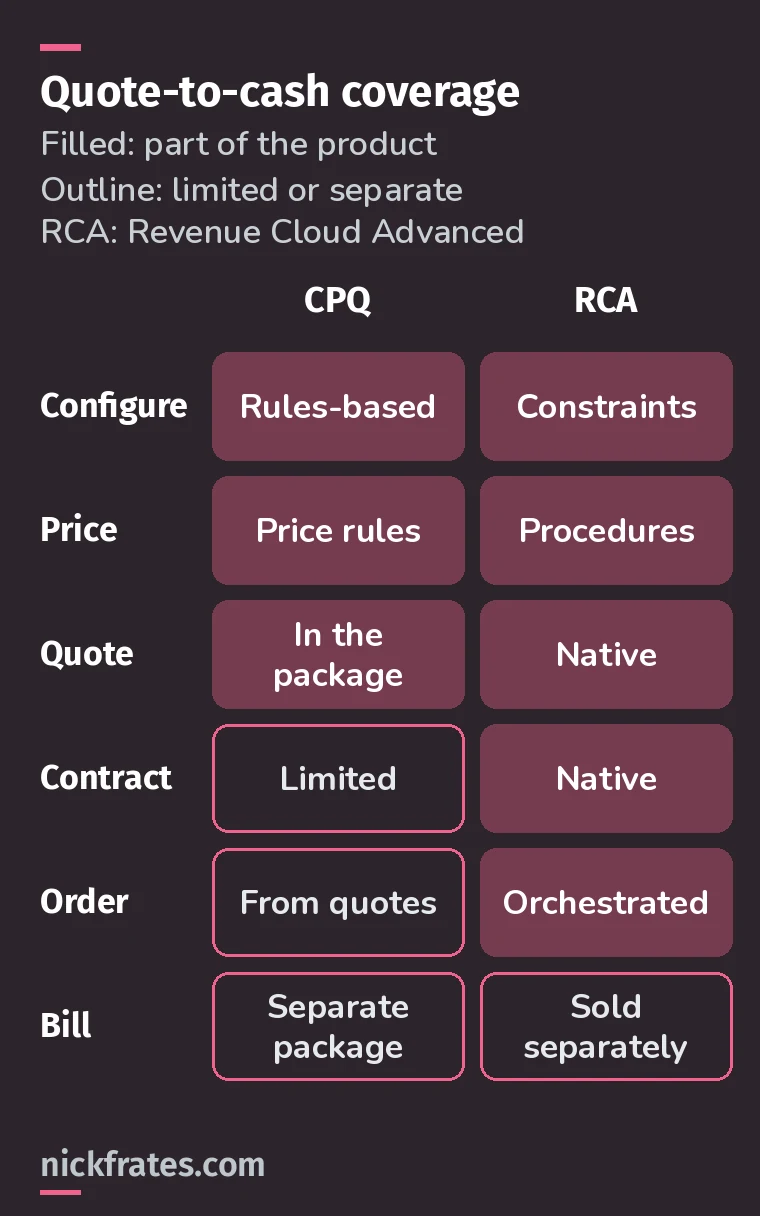
CPQ covers configure, price and quote. RCA extends through contracts and orders, with billing sold separately.
What changes for the people doing the work
- Admins: CPQ pricing leans on price rules and, for complex cases, scripts. Salesforce describes RCA pricing as declarative pricing procedures and elements, with screen flows for the UI and no-code support for most scenarios.
- Developers: CPQ customization uses quote calculator and page security Apex plug-ins. RCA adds Apex pre-hooks and post-hooks, flows, CML constraints and standard Salesforce APIs.
- Business analysts: the quote and approval requirements still matter, but the Help article notes a different data model and configuration approach, so existing CPQ configuration won't carry over one for one. My post on the CPQ business analyst role covers the requirements side.
- Sellers: CPQ sellers work in the quote line editor. Salesforce says RCA can expose the same governed workflows through Salesforce screens, APIs, Agentforce, Slack, partner portals and ecommerce.
Is Salesforce CPQ going away?
No. Salesforce says CPQ is end of sale, not end of life. Here's what that means in its words:
- End of sale: Salesforce is no longer selling new CPQ licenses to new customers. Existing customers keep their licenses, can add users and can renew.
- End of life: a product is no longer supported or maintained. Salesforce says that hasn't happened with CPQ, and it hasn't announced an end-of-life date.
- Maintenance phase: existing customers continue to get support and critical fixes. CPQ won't receive new features or innovations.
- No forced migration: existing CPQ customers don't have to move right away.
Salesforce adds that approximately 15% of RCA customers are companies that migrated from CPQ. That's Salesforce's number, not one I can check. My earlier post on CPQ as a business analyst covers whether CPQ is still worth learning.
What Salesforce lists for Revenue Cloud pricing
Salesforce's Revenue Cloud pricing page lists these in US dollars, billed annually. The page says it's for information only and subject to change, and to contact a sales representative for detailed pricing.
| Edition | List price | What Salesforce lists |
|---|---|---|
| Revenue Cloud Growth | $150 per user per month | Streamlined CPQ and subscription management: quoting and configurator, order capture, subscriptions |
| Revenue Cloud Advanced | $200 per user per month | Everything in Growth, plus contracts and orders, consumption and invoicing, AI and analytics |
| Revenue Cloud Billing | Request pricing | Usage rating and digital wallet, invoicing engine and document production, accounting subledger. Sold separately |
I didn't find a CPQ price on the pages I read. For how Salesforce prices its other clouds, my Sales Cloud pricing post has the same kind of breakdown.
If you're moving from CPQ to Revenue Cloud Advanced
Salesforce's own advice is to treat this as a redesign. Its pages say CPQ-specific objects, custom fields, pricing rules and scripts don't map directly to RCA, so a structured migration and data transformation process is needed. A sensible order of work, based on what Salesforce lists:
- Review the current CPQ implementation. List the price rules, scripts, plug-ins, approvals and integrations you actually depend on.
- Find where CPQ creates the most friction. Salesforce's examples are slow quotes, manual approvals, pricing exceptions, catalog complexity, billing handoffs and limited support for new revenue models.
- Simplify before you carry anything over. Salesforce suggests trimming unnecessary product complexity, outdated pricing rules, custom scripts and hard-to-maintain integrations.
- Decide what contracting and billing you need, and which Revenue Cloud products that means.
- Plan the timeline. Salesforce says a typical migration runs 3 to 6 months from discovery to go-live, and longer for complex implementations with extensive custom logic, large catalogs and many integrations.
Staying put is also an option. Salesforce says CPQ stays supported, but that its limits become more apparent as you add revenue models, channels and asset management needs. The risk of waiting isn't immediate, in Salesforce's words.
Which should you learn?
If your company or clients run CPQ, learn CPQ, because that's the system they're using today. If you're starting fresh, Salesforce says its investment has shifted to Revenue Cloud Advanced. The quote-to-cash thinking carries over either way: product rules, pricing logic, approvals, the handoff to orders and billing. My Salesforce certifications guide tracks the renamed exams, and if you're heading for the Business Analyst exam, the Business Analyst study guide covers all six sections. For the sales side, see the Agentforce Sales Consultant study guide.
Cert Lab by Nick Frates
Want requirements work like this to feel automatic?
Business Analyst questions on requirements, user stories and process mapping, asked rapid-fire with every option explained.
Start the Cert Lab, $9.99 →FAQ
What is the difference between Salesforce CPQ and Revenue Cloud? CPQ is a managed package built around seller-led quoting. Revenue Cloud is Salesforce's suite for pricing, quoting, contracts, orders, assets and billing, and Revenue Cloud Advanced is the product Salesforce names as CPQ's successor.
Is Revenue Cloud Advanced the replacement for Salesforce CPQ? Salesforce calls it the successor to CPQ and says its investment in quote-to-cash has shifted to it. It also says RCA is not simply CPQ with a new name.
Is Salesforce CPQ end of life? No. Salesforce says CPQ is end of sale, not end of life, and it hasn't announced an end-of-life date.
Can I still buy Salesforce CPQ? New customers can't. Salesforce says existing customers can keep using it, add users and renew.
Do I have to migrate from CPQ to Revenue Cloud Advanced? No. Salesforce says there's no forced migration and CPQ is not being switched off.
Is Revenue Cloud Advanced the same as Revenue Lifecycle Management? Salesforce says Revenue Lifecycle Management was an earlier product name and Revenue Cloud Advanced is the current product.
Does Revenue Cloud include billing? Salesforce sells Revenue Cloud Billing as a separate product that's often adopted with Revenue Cloud Advanced. Its Help article also says billing and rating are natively supported on the platform, so confirm what your contract covers.
How long does a CPQ to Revenue Cloud Advanced migration take? Salesforce says a typical migration runs 3 to 6 months, and complex setups can take longer.
How much does Revenue Cloud cost? Salesforce lists Revenue Cloud Growth at $150 and Revenue Cloud Advanced at $200 per user per month, billed annually. Revenue Cloud Billing is request-pricing and sold separately.
Hope this helps!
Best,
Nick