Hey friends,
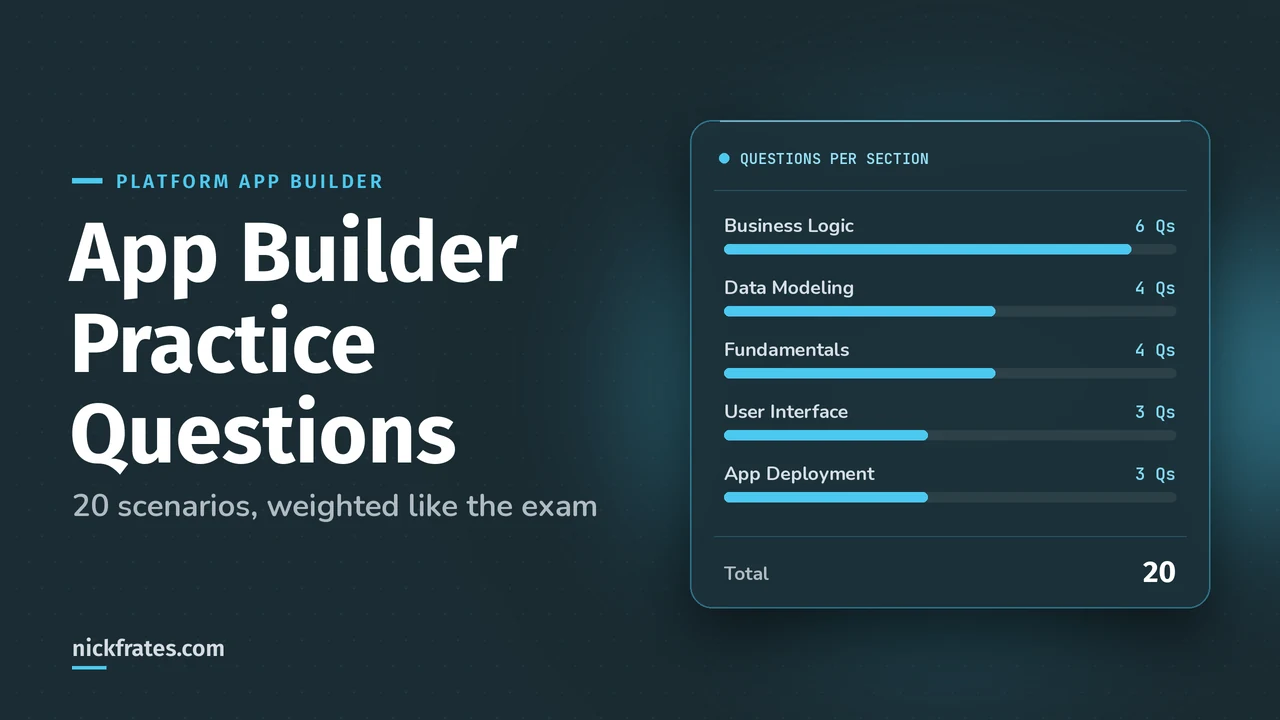
These are 20 original Platform App Builder practice questions, split across the five exam sections roughly the way the real exam is, with the reasoning and a Salesforce Help or Trailhead source for every answer. No dumps, just the kind of scenario thinking the official exam guide asks for.
If you want the full study guide first, read my Platform App Builder study guide. It has the outline, a study plan and more questions per section. Or follow my 4-week App Builder study plan.
The exam in one minute
- 60 scored questions plus up to five unscored, in 105 minutes.
- Passing score: 73%, so at least 44 correct.
- Registration USD 200, retake USD 100, plus taxes. No prerequisite.
- Maintenance: a Trailhead maintenance badge three times a year.
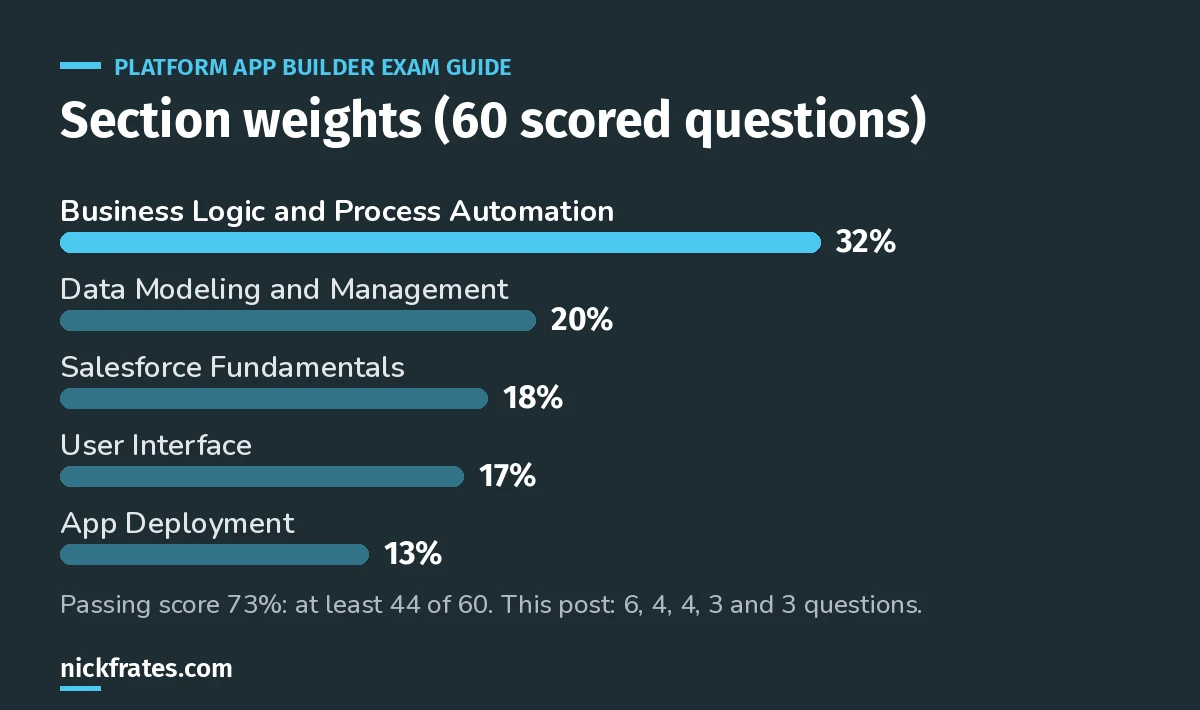
Automation alone is almost a third of the exam.
How to use these: pick an answer before you read mine. If you guessed right, still read the explanation, because the exam will ask the same idea from a different angle.
Salesforce Fundamentals (18%)
1. Sales reps should see only their own opportunities, but managers must see their team's. What do you configure?
- A. Org-wide default Public Read Only
- B. Org-wide default Private plus the role hierarchy
- C. A permission set with View All
- D. A sharing rule for every rep
Answer: B. Set org-wide defaults to the most restrictive access anyone needs, then open access up. The role hierarchy gives managers access to their subordinates' records. (Source: Trailhead)
2. A user has Read on Accounts through their profile. The Account org-wide default is Public Read/Write. Can they edit accounts they don't own?
- A. Yes, OWD grants edit
- B. No: OWD can never grant more access than object permissions
- C. Only with a sharing rule
- D. Only if they're in a queue
Answer: B. Object permissions set the ceiling. Org-wide defaults only adjust access to records the user doesn't own, within that ceiling. (Source: Trailhead)
3. A requirement needs a complex calculation across unrelated objects every time a record saves, with logic Flow can't express. What's the right call?
- A. A longer formula field
- B. Recognize it as a programmatic use case (Apex) and hand it off
- C. A roll-up summary
- D. A validation rule
Answer: B. The exam's first objective is knowing where declarative tools stop. When clicks can't do it cleanly, the answer is code, not a hack. (Source: my study guide)
4. Managers want a report that shows Accounts with or without related Opportunities. Standard report types don't fit. What do you create?
- A. A joined dashboard
- B. A custom report type with Accounts and an optional (with or without) relationship to Opportunities
- C. A summary formula
- D. A roll-up summary field
Answer: B. Custom report types define which related records can appear, including "with or without" relationships. (Source: Salesforce Help)
Data Modeling and Management (20%)
5. Students can enroll in many courses and courses have many students. Deleting a student should delete their enrollments. How do you model it?
- A. Two lookups on Student
- B. A junction object with two master-detail relationships
- C. A lookup from Course to Student
- D. A multi-select picklist
Answer: B. A many-to-many relationship uses a custom junction object with two master-detail relationships. (Source: Salesforce Help)
6. You need to convert a master-detail relationship to a lookup. What blocks it?
- A. Records on the detail object
- B. Roll-up summary fields on the master object
- C. Validation rules on the detail
- D. Page layouts
Answer: B. You can convert master-detail to lookup only if no roll-up summary fields exist on the master object. (Source: Salesforce Help)
7. An Employee object needs a Manager field that points to another Employee. Which relationship type?
- A. Master-detail
- B. Lookup
- C. Hierarchical
- D. External lookup
Answer: B. An object can relate to itself, but it must be a lookup. (Source: Salesforce Help)
8. Order data lives in an external ERP and must appear on Account pages without copying it into Salesforce. What do you use?
- A. Data Loader nightly
- B. Salesforce Connect with external objects
- C. A roll-up summary
- D. Data Import Wizard
Answer: B. Salesforce Connect maps external objects to data stored outside Salesforce, and they can be used in lookups and record pages. They're read-only by default. (Source: Salesforce Help)
Business Logic and Process Automation (32%)
9. Account needs the total Amount of its Closed Won opportunities in a field. What's the declarative answer?
- A. Cross-object formula on Account
- B. Roll-up summary on Account
- C. Formula on Opportunity
- D. Validation rule
Answer: B. Salesforce supports roll-up summaries on Accounts using the values of related opportunities, and they can SUM with a filter on Stage. Formulas can't aggregate child records. (Source: Salesforce Help)
10. A Case formula needs the parent Account owner's region, which is two relationships away. Can a formula do it?
- A. No, formulas only see their own object
- B. Yes: cross-object formulas can go up to 10 relationships away
- C. Only with a lookup filter
- D. Only in Flow
Answer: B. Cross-object formulas work on lookups and master-detail, up to 10 relationships away. (Source: Salesforce Help)
11. Before a Lead saves, you need to set a field on the same record as fast as possible. Which flow?
- A. Record-triggered flow, fast field updates (before-save)
- B. Record-triggered flow, actions and related records (after-save)
- C. Screen flow
- D. Scheduled flow
Answer: A. Before-save updates are the fastest way to update the triggering record. Use after-save when you need related records or actions. (Source: Salesforce Help)
12. Users must enter a Loss Reason when Stage is Closed Lost. What's the simplest solution?
- A. A validation rule
- B. A before-save flow
- C. A required field on the page layout
- D. A roll-up summary
Answer: A. A validation rule blocks the save when its formula returns true, and works no matter how the record is saved. A page layout requirement wouldn't cover imports or the API. (Source: Salesforce Help)
13. Your lead validation rules aren't running when leads are converted. Why?
- A. Validation rules never run on conversion
- B. Validation and triggers for lead conversion isn't enabled in the org
- C. The rule must be on Contact
- D. Conversion bypasses all automation
Answer: B. Validation rules are enforced during lead conversion only if that setting is enabled. (Source: Salesforce Help)
14. A rep clicks a button to walk through a guided discount request with several screens. Which flow type?
- A. Autolaunched
- B. Screen flow
- C. Record-triggered
- D. Platform event-triggered
Answer: B. Only screen flows show screens to users. Autolaunched flows run without user interaction. (Source: Salesforce Help)
Cert Lab by Nick Frates
Want this for all 5 sections?
The App Builder Cert Lab has lessons, practice questions and flashcards for every section of the exam guide, with each answer explained.
Start the App Builder Cert Lab, $9.99 →User Interface (17%)
15. Mobile users should see Stage, Amount and Close Date at the top of an opportunity. What do you change?
- A. The page layout
- B. The compact layout
- C. A global action
- D. The app's utility bar
Answer: B. Compact layouts control the fields in the record header in the mobile app, up to 10 fields. (Source: Trailhead)
16. Users want to log a new prospect quickly from anywhere, not tied to a record. Which action type?
- A. Object-specific action
- B. Global action
- C. Custom link
- D. List view button
Answer: B. Global actions create records with no relationship to other records and can go anywhere actions are supported. (Source: Trailhead)
17. On an Account page, a field section should only show when Type is Partner. Page layouts can't do it. What can?
- A. Record types
- B. Dynamic Forms with a visibility rule
- C. A validation rule
- D. A compact layout
Answer: B. Dynamic Forms lets you place fields and sections in the Lightning App Builder and show or hide them with visibility rules. (Source: Salesforce Help)
App Deployment (13%)
18. You need to move a new custom object and 500 sample records from a sandbox to production. What does the change set carry?
- A. Both
- B. Only the object (metadata); records need a data tool
- C. Only the records
- D. Neither
Answer: B. Change sets contain only changes you can make in Setup. They can't carry data like contact records. (Source: Salesforce Help)
19. An inbound change set has arrived in production. What still has to happen?
- A. Nothing, it's live
- B. Someone deploys it; you deploy it as a whole
- C. Each component is deployed one by one
- D. It has to be uploaded again
Answer: B. A change set must be deployed to take effect, and you deploy its contents as a whole. (Source: Salesforce Help)
20. You need a test environment with a full copy of production data for a load test. Which sandbox?
- A. Developer
- B. Developer Pro
- C. Partial Copy
- D. Full
Answer: D. Only Full sandboxes support performance testing, load testing and staging. (Source: Salesforce Help)
Scoring yourself
- 16 or more: you're close. Book the exam and keep doing timed sets.
- 12 to 15: review the sources behind your misses, especially in Business Logic.
- 11 or fewer: go back to the study guide and build things in a free Developer Edition org.
Those bands are my rule of thumb for this set, not an official prediction.
The patterns behind most wrong answers
- Formula vs roll-up: formulas look up (to parents), roll-ups look down (aggregate children) and need master-detail.
- Page layout vs compact layout vs Dynamic Forms: know which one controls what users see where. My Lightning App Builder tutorial shows each one.
- Metadata vs data: change sets and packages move configuration, never records.
- Sharing direction: lock down with OWD, open up with roles, sharing rules and permission sets.
Keep studying
- Platform App Builder study guide.
- Lookup vs master-detail: the relationship questions in more depth.
- Validation rule examples: 15 formulas you can copy.
- Flow for the Admin exam: the same Flow concepts show up here.
- Which certifications admins should get, including Admin vs App Builder.
Cert Lab by Nick Frates
Get the Platform App Builder Cert Lab
Lessons, practice questions and flashcards for all 5 App Builder exam sections, built from the official exam guide.
Start the App Builder Cert Lab, $9.99 →Hope this helps!
Best,
Nick


