Hey friends,
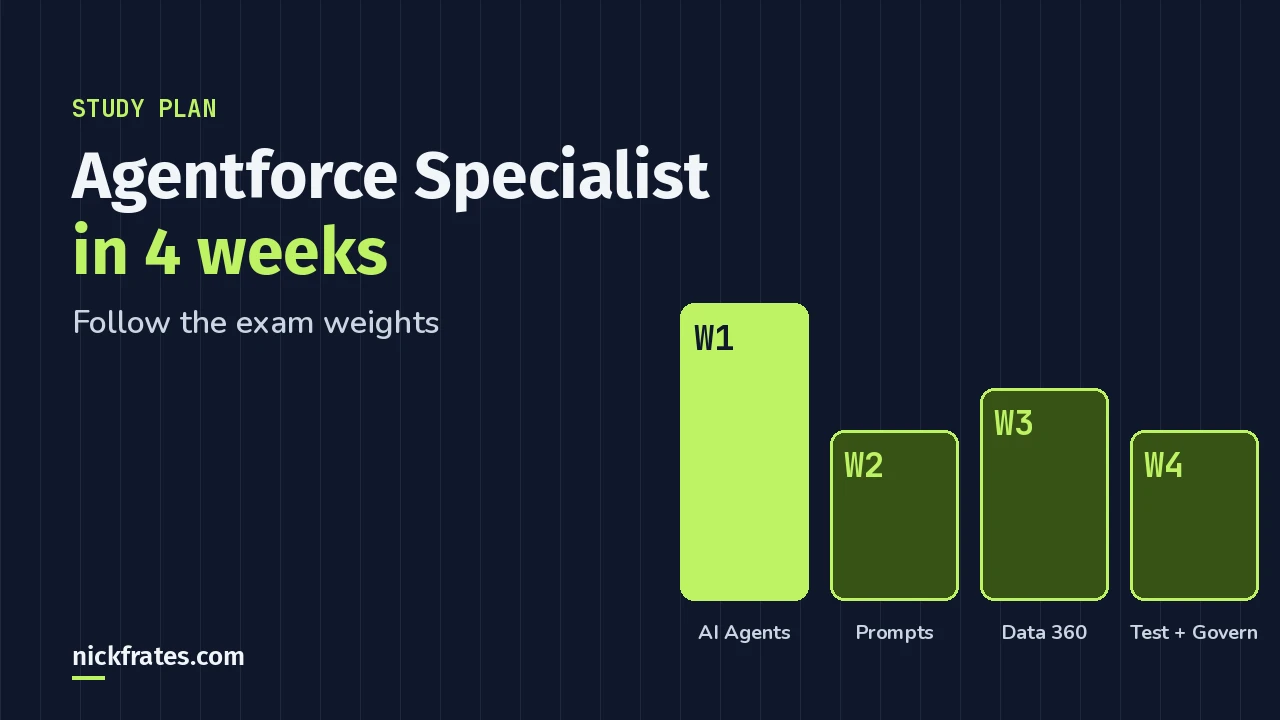
A solid Agentforce Specialist study plan takes four weeks and follows the exam's own weights: AI Agents first (35%), then Prompt Engineering (20%), then Data 360 (20%) with Multi-Agent Orchestration (5%), then Testing and Governance (10% each). Every week, you build something in a practice org, not just read about it.
Below is the calendar, what a single study session looks like, what to build each week, and how to tell you're ready to book.
What does the 4-week Agentforce Specialist study plan look like?
Here's the whole thing in one table. The sections and weights come straight from the official exam guide. The week split is my suggestion.
| Week | Exam sections (weight) | By the end of the week you can... |
|---|---|---|
| 1 | AI Agents (35%) | Build an agent with a custom subagent and action, and explain how it reasons |
| 2 | Prompt Engineering (20%) | Create, activate and run prompt templates, and pick the right template type |
| 3 | Data 360 Fundamentals (20%) + Multi-Agent Orchestration (5%) | Explain how grounding with Data 360 works, and when more than one agent makes sense |
| 4 | Testing, Deployment, and Maintenance (10%) + Governance and Observability (10%) | Test an agent, plan a sandbox-to-production move, and do timed practice sets |
Why this order? AI Agents is over a third of the exam, so it gets the first and freshest week.
Weeks 3 and 4 hold four smaller sections. Together they're 45% of the exam, so they still get a full two weeks (no skimming).
Quick exam facts, so you can book with a date in mind: 60 scored questions, 105 minutes, 72% to pass, USD 200 plus tax. The details are in exam format and passing score and exam cost.
What do I need before week 1?
Two things: an org and the exam guide.
For the org, Salesforce says its free Developer Edition includes Agentforce and Data 360. You can sign up on the Salesforce Developers sign-up page.
I can't promise every exam feature shows up in a free org. If one is missing, read the Help article for it and move on (don't burn a day fighting setup).
For the guide, keep the exam guide open in a tab all month. Check the release it lists, too. Right now it says the questions match Spring '26.
What does one study session look like?
Same loop every day. It works for any objective in the guide.
- Pick one objective from the guide, word for word.
- Search it on Salesforce Help. That's literally what the guide tells you to do: search the topics in its outline on Help and study what you find.
- Build it in your org, or click through the screen it describes.
- Say it out loud in two sentences, as if a coworker asked. If you can't, go back to step 2.
- Do a few practice questions on just that objective.
Watch the verb in each objective. "Explain" means a concept question. "Given a scenario" means you'll choose what to configure. Scenario objectives need the build step; concept ones mostly need step 4.
What should I actually build each week?
Week 1, AI Agents. Open Agentforce Builder from the App Launcher: Agentforce Studio, then Agents (Trailhead walks through it). Create an agent. Add a custom subagent (the exam guide still calls them topics) and a custom action.
Then flip between Canvas and Script View. Canvas shows your agent in plain language, and Script View shows the Agent Script code. The two stay in sync, and the guide asks you to explain how that hybrid reasoning works.
Try both preview modes. Simulate doesn't run actions or change data. Live Test runs real actions in your org, so use test records.
Finish the week by reading the guide's other AI Agents objectives: filters, variables and template expressions; channels like email, voice and Slack; the user context an agent runs as; Employee vs Service agents; and when to use the Agent API.
Week 2, Prompt Engineering. In Prompt Builder, create, activate and run a field generation template. Then do the same with a flex template. Building one of each makes the "which template type" questions easy.
Ground one of them in record data (grounding means giving the AI your real data to answer from). Then read up on who can access a template, the Trust Layer's security and privacy features, and how to block specific models.
Week 3, Data 360 and Multi-Agent. This week is more reading than building. Learn what an Agentforce Data Library is and what to think about when you set one up.
Then learn three words. Chunking splits documents into small pieces. Indexing stores those pieces so they can be searched. Retrievers find the right pieces for a question.
Save a session for Multi-Agent Orchestration. The guide wants you to know when a multi-agent design makes sense, and what the open protocols MCP (Model Context Protocol) and A2A (Agent-to-Agent) are for. It's 5%, so about 3 questions (my math, 5% of 60).
Week 4, Testing and Governance. Run a test on your week 1 agent in Testing Center, and read how its evaluations work. Then list what you'd check before moving an agent, and a prompt template, from a sandbox to production.
Cover how to manage and monitor agents, plus agent analytics and optimization. Spend the last few days on timed practice sets and your weakest section.
For a section-by-section breakdown of every objective, see my Agentforce Specialist study guide.
Agentforce Specialist Cert Lab
Practice every section as you go
Exam-style questions for all six sections, each answer explained, plus hands-on tasks to do in your own org.
Start the Agentforce Specialist Cert Lab for $9.99 →What if I have more or less than four weeks?
Use the guide's typical candidate as your yardstick. It describes about 1 year of Salesforce configuration experience, including Data 360, plus hands-on time in Agent Builder, Prompt Builder and Testing Center.
If that's you, four weeks is plenty. You could even fold weeks 3 and 4 together.
If you're newer, stretch week 1 into two weeks. Building agents is where the biggest section and the most scenario questions live. Salesforce also recommends, but doesn't require, the Platform Administrator and Platform App Builder certifications.
Whatever the length, keep the order. Biggest section first, then work down.
How do I know I'm ready to book the exam?
Here's the check I'd use. It's my rule of thumb, not Salesforce's.
- You can explain every objective in the guide in two sentences, without notes.
- You've built an agent, a field generation template and a flex template yourself.
- Your timed practice sets land comfortably above 72%, with misses spread out rather than piled in one section.
If one section keeps showing up in your misses, give it two more sessions before you book. Start with these Agentforce Specialist practice questions, and read how to pass the Agentforce Specialist exam for exam-day strategy.
One more thing: the exam allows no notes or reference material. So your practice sets should be closed-book too.
Salesforce's own free study path is the Earn Agentblazer Status trail, listed on the Trailhead credential page. It pairs well with the build-first plan above.
Share a question or feedback with me on LinkedIn.
Agentforce Specialist Cert Lab
Ready to test yourself?
Work through exam-style questions section by section and see why each answer is right.
Start the Agentforce Specialist Cert Lab for $9.99 →Planning past this exam? The Salesforce certification study guides compare every cert.
So, which week are you most worried about? Let me know!
Hope this helps!
Best,
Nick