Hey everyone,
Data 360 is Salesforce’s data engine (it used to be called Data Cloud): it pulls in data from Salesforce and outside systems, maps it to one standard data model, and links records for the same person into a unified profile that segments, flows and Agentforce agents can use.
If you’ve seen “Data Cloud” in older docs or exam guides, it’s the same product. Salesforce now calls it Data 360. Below I go through how it works, step by step, using the Data 360 Developer Guide and the Trailhead unit on mapping and unifying data.
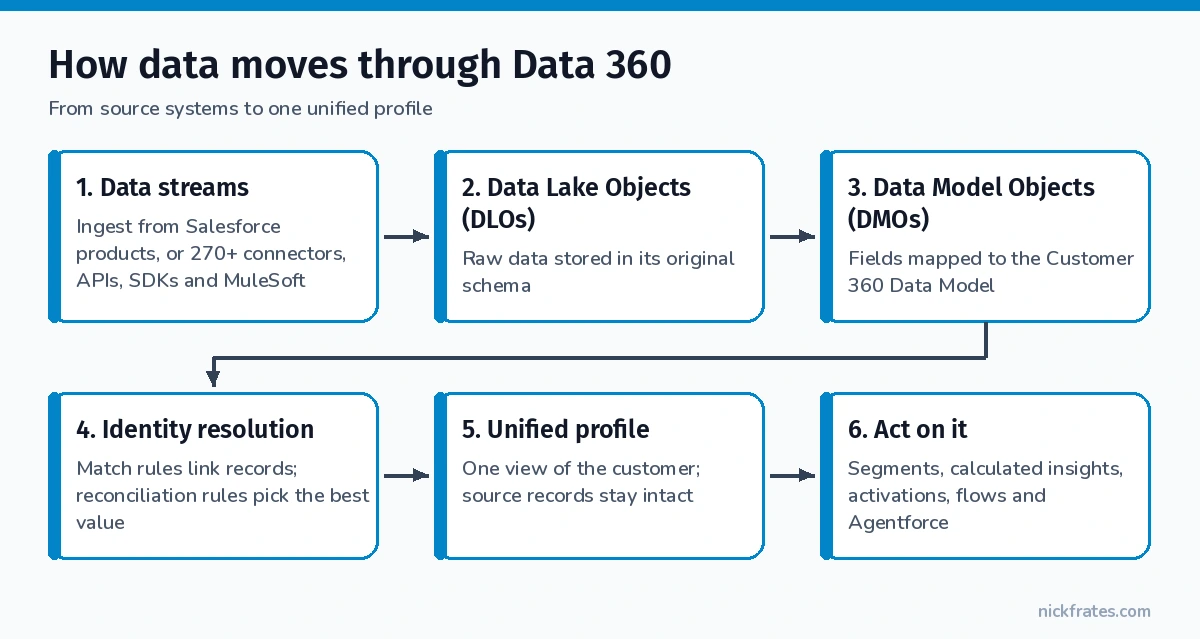
How Data 360 works in four steps
- Connect and ingest. Data streams bring data in from Salesforce products and, for outside data, from over 270 connectors, APIs, SDKs and MuleSoft.
- Store it raw. Ingested data lands in Data Lake Objects (DLOs) in its original schema.
- Harmonize. You map DLO fields to Data Model Objects (DMOs) in the Customer 360 Data Model.
- Unify and act. Identity resolution links records into unified profiles, which you then segment, analyze, query and activate.
Key Data 360 terms in plain English
Data stream. The connection that brings data from a source into Data 360.
Data Lake Object (DLO). A storage container for data ingested through data streams, kept in its original shape.
Data Model Object (DMO). A grouping of data that describes a thing or an action, like a customer or a purchase. DMOs can be standard or custom, and they follow the Customer 360 Data Model.
Customer 360 Data Model. The standard model you map everything to. Salesforce says it ships with over 300 industry-agnostic objects, and you can customize it.
Fully qualified key (FQK). A source key (like a contact ID) plus a key qualifier (the source, like Marketing Cloud). It stops two sources with the same ID values from colliding in one DMO.
Unified profile. One view of a customer, built by linking records from several sources. Trailhead compares it to a key ring: every ID stays unique, they’re just held together.
Data mapping: DLOs to DMOs
Mapping is where most of the work lives. Each DLO field gets connected to a standard DMO field, and that mapping feeds segmentation, insights and activation later on.
Starter data bundles can arrive premapped, but custom fields and unmapped standard fields you map yourself. Names, IDs, email addresses and phone numbers matter most, because identity resolution needs them to link a person’s records.
Data 360 also supports batch and streaming transformations, including inline formula transformations such as proper case, trim and concatenation, so values arrive clean.
Identity resolution: match and reconciliation rules
Identity resolution runs rulesets. A ruleset holds match rules and reconciliation rules for one object, such as Individual.
| Rule type | What it decides | Options |
|---|---|---|
| Match rules | Which source records belong to the same person | Exact, Fuzzy (“Robert” and “Bob”), Normalized (email, phone, address) |
| Reconciliation rules | Which value shows on the unified profile when sources disagree | Last Updated, Most Frequent, Source Sequence |
Source Sequence lets you trust one source over another, for example a Salesforce CRM Contact over a file uploaded from Amazon S3. Values that lose aren’t thrown away; Data 360 keeps the unique data and the original records stay intact behind link tables.
Cert Lab by Nick Frates
Learn how agents use Data 360
Lessons, section checks, flashcards and practice questions for the Agentforce Specialist exam.
Start the Agentforce Specialist Cert Lab for $9.99 →What you can do with unified data
- Segments. Group people by criteria, including waterfall and nested segments, or describe a segment in natural language with Einstein Segment Creation.
- Calculated insights. Aggregate data, like lifetime value, in batch or streaming.
- Query. Use SOQL, SQL, and vector or hybrid search.
- Activations. Send segments to places like Marketing Cloud, ad platforms or core CRM.
- Flows and actions. Trigger record-triggered flows, platform events or webhooks.
- Agentforce. Salesforce’s agents use Data 360 as their data foundation.
Unstructured data (like PDFs) goes into Unstructured Data Lake Objects, gets chunked, indexed and embedded, and is stored in a vector database for search. That’s what powers grounded agent answers; my Data 360 for Agentforce guide covers search indexes and retrievers in depth.
Zero copy: using data without moving it
Zero copy has two parts. Data federation lets Data 360 query data that lives in external data lakes and warehouses and use it in identity resolution and segmentation without duplicating it. Data sharing works the other way, giving the external system access to Data 360 data without copying it. Zero copy still consumes Data 360 credits.
Common Data 360 mistakes
- Skipping key qualifiers. Two sources with overlapping IDs can collide in the same DMO. Set up fully qualified keys.
- Leaving custom fields unmapped. Premapped bundles don’t cover your custom fields, so they never reach segments or insights.
- Using only exact matching. Typos and nicknames won’t link. Consider fuzzy or normalized match methods where they fit.
- Forgetting reconciliation. Without a deliberate rule, you may not like which email shows on the profile.
- Ignoring consumption. Data 360 usage draws on credits; check the digital wallet for usage and credit consumption.
Want to go deeper for a certification? My Data 360 Consultant study guide walks through the exam.
Cert Lab by Nick Frates
Prep for the Agentforce Specialist exam
Lessons, section checks, flashcards and practice questions that get you ready for the Agentforce Specialist exam.
Start the Agentforce Specialist Cert Lab for $9.99 →FAQ
Is Data 360 the same as Data Cloud?
Yes. Salesforce renamed Data Cloud to Data 360 on October 14, 2025, and says the functionality is unchanged.
What is the difference between a DLO and a DMO?
A Data Lake Object stores ingested data in its original schema. A Data Model Object is the standardized object in the Customer 360 Data Model that you map DLO fields to.
What does identity resolution do in Data 360?
It uses match rules to link records for the same person and reconciliation rules to pick which value appears on the unified profile.
Does Data 360 have to copy all my data?
No. Zero copy data federation lets Data 360 query data in external data lakes and warehouses without duplicating it.
Hope this helps!
Best,
Nick