Hey friends,
To pass Platform Developer I on your first try, study the platform, not just the code: governor limits, declarative-vs-code choices, the save order of execution and testing rules decide most questions. You need 41 of 60 scored questions right, so you can miss 19. Strong developers usually fail by over-engineering, not by not knowing Apex.
I'm a senior Salesforce developer with 17 certifications, and this is how I'd approach it today. Facts come from the official Platform Developer exam guide, checked October 11, 2026. For the full outline, read my PD1 study guide; this post is only about passing.
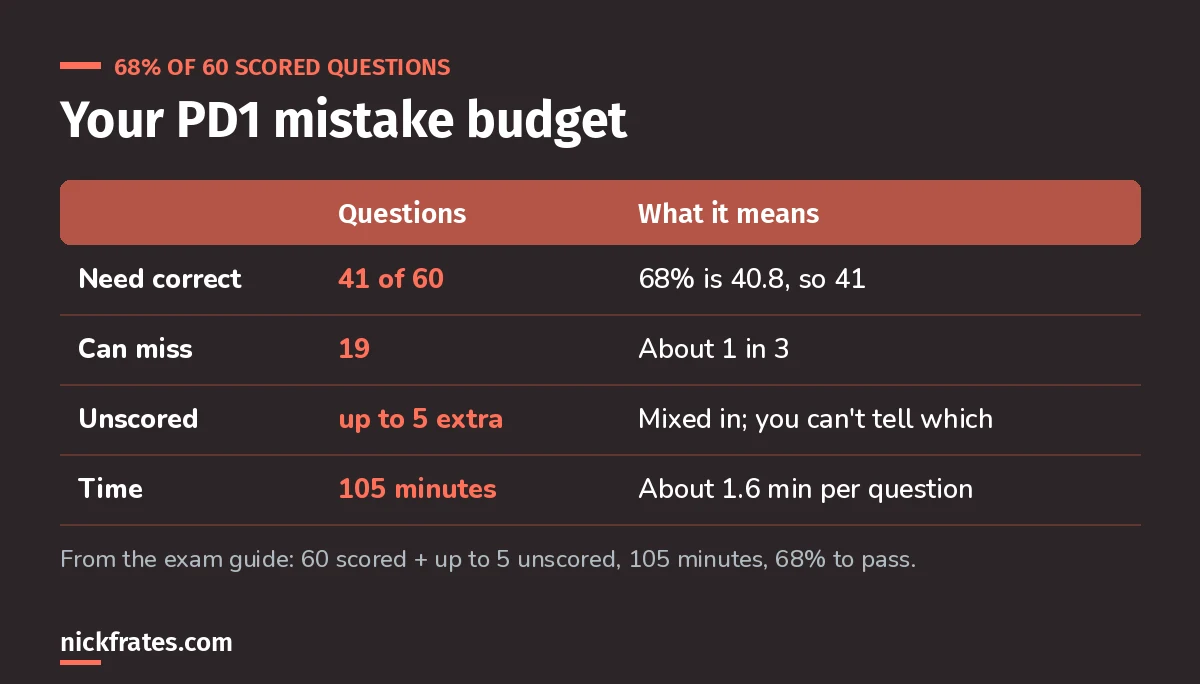
Know your budget before you walk in.
Where the points are
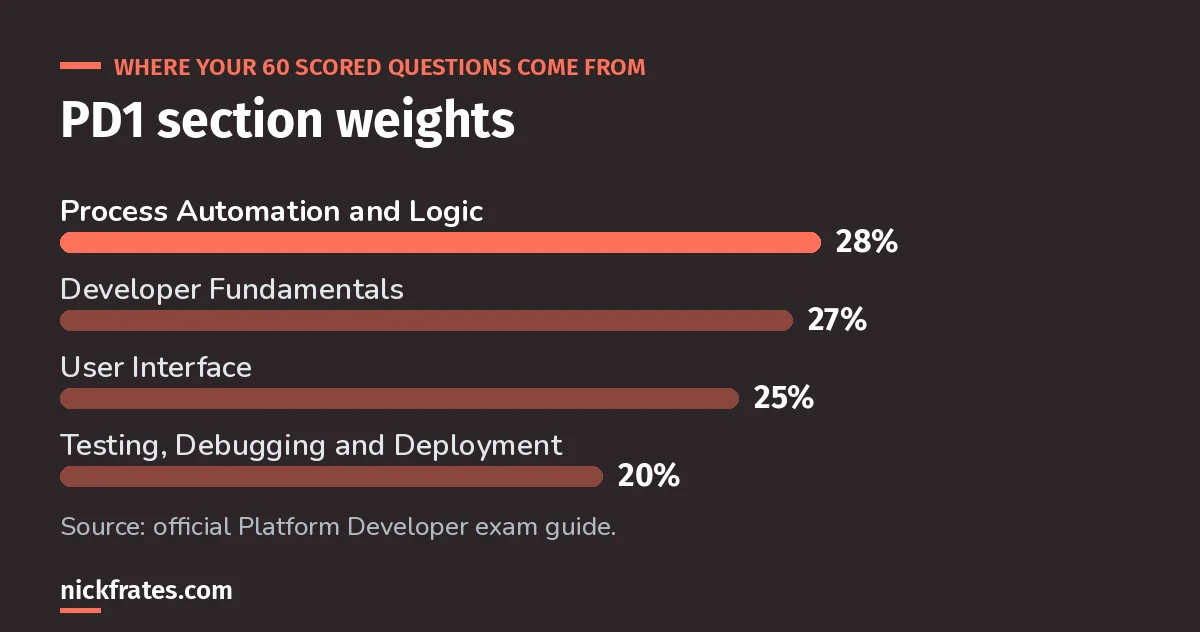
Four sections, nearly equal. You can't skip any of them.
The sections are close to even, so a weak section really hurts. User Interface (25%) is where backend developers most often lose points, because it covers Lightning Web Components, Visualforce and UI security together.
8 PD1 traps hiding in the official objectives
Each one comes from wording in the exam guide, so expect scenario questions on all of them.
1. Code when clicks would do. The objectives ask for "declarative versus programmatic" choices, including formula fields and roll-up summaries. If a no-code feature solves it, that's the answer.
2. Queries and DML inside loops. "Understand governor limits and their implications" means spotting the loop that breaks at 200 records. See my Apex trigger best practices.
3. What a query returns. "Write SOSL, SOQL, and DML statements in Apex, and assess what they will return." Know the difference between a query that returns an empty list and assigning zero rows to a single record, which throws an exception.
4. The save order of execution and recursion. The guide calls out the relationship between transactions, the order of execution, and recursion or cascading. Expect a trigger that updates a record that fires the same trigger again.
5. Context variables in the wrong event. For example, Trigger.newMap in before insert, where records don't have Ids yet.
6. UI security. "Prevent user interface and data access security vulnerabilities" means respecting the user's sharing and field access in Apex that backs a component, and avoiding injection in dynamic queries.
7. Test data and coverage. Tests for triggers, controllers, classes and flows "using various sources of test data". Create your own test data rather than relying on org data.
8. Which tool, when. Salesforce DX, the Salesforce CLI and the Developer Console each get scenario questions, as do deployment environments and debugging async and batch jobs.
Cert Lab by Nick Frates
Drill these traps with explanations
The Platform Developer Cert Lab covers all four sections with lessons, practice questions that explain every option, and flashcards. $9.99 for 12 months.
Start the PD1 Cert Lab, $9.99 →Exam-day tactics
- Read the last sentence first. It tells you whether they want the best, the most efficient, or the declarative option.
- Eliminate the over-engineered answer. If one option is a trigger and another is a roll-up summary that meets the requirement, pick the roll-up.
- Trace code with 200 records in mind. Ask what happens on a bulk insert, not a single save.
- Flag and move on. At about 1.6 minutes per question, don't burn five minutes on one. Come back at the end.
- Watch "choose 2" and "choose 3". Read how many answers it wants before you start eliminating.
Go/no-go: are you ready to book?
Book the exam when all of these are true:
- You can explain before vs after triggers and which context variables exist in each.
- You can bulkify a trigger from memory: collect Ids into a Set, query once, use a Map, DML once.
- You've written a test class that creates its own data and asserts results, not just coverage.
- You can say when you'd use a flow, a formula, a roll-up summary or Apex for a requirement.
- You're scoring comfortably above 68% on timed practice, across every section, not just on average. If you want structured prep, see the best Platform Developer I courses.
If you're not there yet, my 8-week PD1 study plan is built for working developers. Still deciding between exams? Read Admin vs Platform Developer I.
Keep studying
- 25 free PD1 practice questions with explanations.
- The PD1 study guide: every objective explained.
- Platform Developer II study guide, for what comes next.
Cert Lab by Nick Frates
Get the Platform Developer Cert Lab
Lessons, practice questions and flashcards for every PD1 exam section.
Start the PD1 Cert Lab, $9.99 →Hope this helps!
Best,
Nick


