Hey friends,
No, Salesforce doesn't list a certification with "DevOps" in its name. I checked Salesforce's Administrator, Consultant, Developer and Architect certification pages on Oct 28, 2026, and none lists one. The closest match is the Salesforce Certified Platform Development Lifecycle and Deployment Architect, whose exam guide describes it as being for people who apply DevOps, application lifecycle management and governance to Salesforce.
Lifecycle Center, the new name for DevOps Center, is a Salesforce product with Trailhead badges, not a certification. Below is what the architect exam covers, how the tool fits in, and which credential makes sense for your role.
What is the closest thing to a DevOps certification?
The Platform Development Lifecycle and Deployment Architect credential is listed on Salesforce's Architect page. Its exam guide says the exam is for professionals with the skills and experience "in applying DevOps, application lifecycle management, and governance topics to Salesforce." These are the exam details from that guide:
| Detail | What the exam guide says |
|---|---|
| Questions | 60 multiple-choice questions, plus up to five unscored questions |
| Time | 105 minutes |
| Passing score | 65% |
| Fee | US$400 plus applicable taxes; US$200 plus applicable taxes to retake |
| Prerequisite | None |
| Version | Exam questions align to the Spring '23 release |
| Maintenance | Complete the certification maintenance badge on Trailhead once a year |
Prices and exam details can change, so confirm them on the guide before you register. The guide also describes a typical candidate as having 2 to 3 years of Salesforce Platform experience and 1 to 2 years working on Salesforce DevOps topics. That's the background it describes, not a prerequisite. Its listed job roles include Release Manager, Environment Manager, Test Manager, Delivery Lead and Technical Architect.
What does it cover?
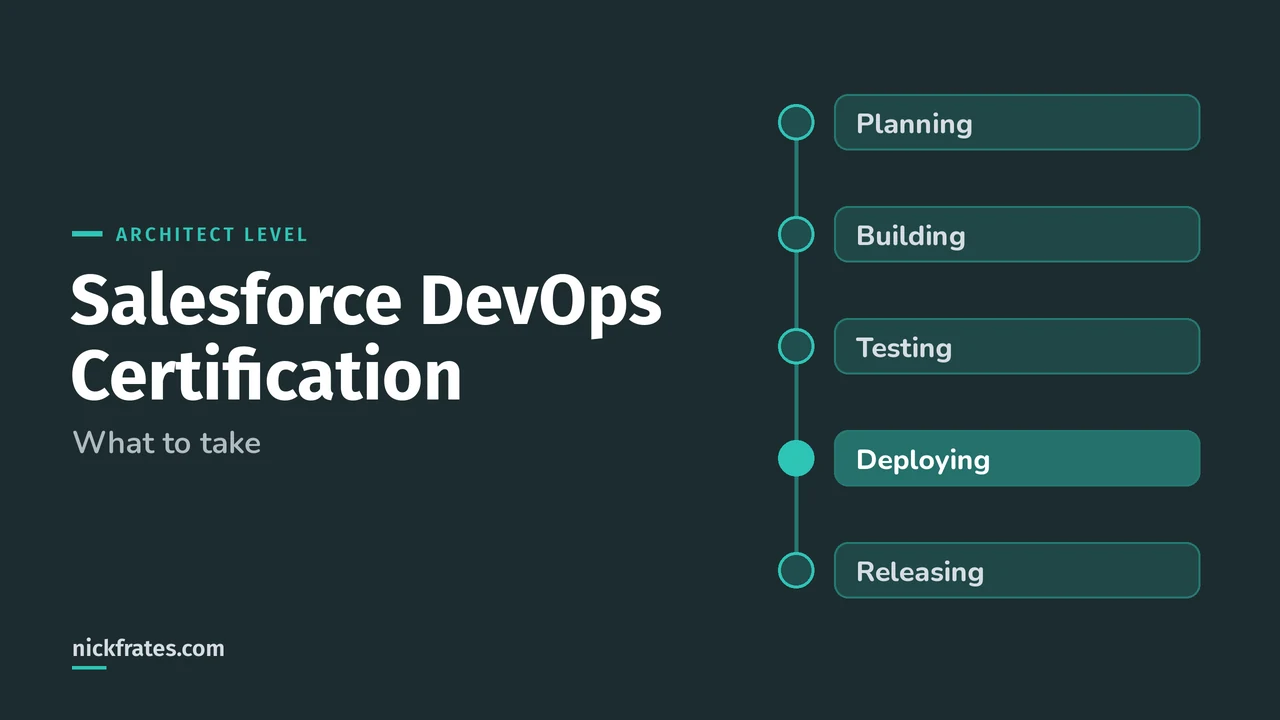
The exam outline has eight sections. Weights and topics are from the guide:
| Section | Weight | What the guide asks you to do |
|---|---|---|
| Application Lifecycle Management | 8% | Assess the benefits and risks of different development methodologies and recommend governance strategies |
| Planning | 13% | Assess ALM maturity, mitigate environment risks, recommend a governance framework, and plan for Summer, Winter and Spring releases |
| System Design | 15% | Choose an org strategy and a sandbox strategy by sandbox type, and compare deployment components and tools |
| Building | 14% | Use source control branching, versioning and merging, choose org-based or package-based development, scratch orgs or sandboxes, and keep code quality up with code review and static analysis |
| Deploying | 14% | Know the capabilities and limits of the Metadata and Tooling APIs, handle pre and post deployment steps, and deploy configuration stored as object data |
| Testing | 13% | Recommend a testing methodology, execution and coverage approach, and a test data strategy |
| Releasing | 13% | Compare managed, unmanaged and unlocked packages and choose a release management strategy |
| Operating | 10% | Explain the effects of changes made directly in production and manage common release artifacts across multiple orgs |
The guide also lists what you're not expected to know: how to write ANT or CLI migration scripts, set up the source control environment, or set up continuous integration tools. You still need to explain how source control, branching and continuous integration support application lifecycle management. For a full study plan, see my Development Lifecycle and Deployment Architect exam post and the study guide.
Cert Lab by Nick Frates
Let the Platform Development Lifecycle and Deployment Architect Cert Lab test you to success
Lessons, flashcards, a quiz for each of the eight exam sections and full practice exams, every answer explained.
Start the Cert Lab, $9.99 →Not ready to buy? Try a free lesson and see how fast you learn.
Is Lifecycle Center (DevOps Center) a certification?
No. Salesforce Help says that beginning October 2026, DevOps Center is changing its name to Lifecycle Center, and describes Lifecycle Center as a place to manage changes and releases with work items, pipelines and source control. Salesforce's Lifecycle Center setup badge says it was "previously known as DevOps Center." Help also says you may still see the old names in places during the transition.
What Trailhead offers for it is learning content, not an exam. DevOps Center: Quick Look is worth 100 points and takes about 5 minutes. Lifecycle Center Setup is an intermediate module worth 1,600 points at about 50 minutes, and its first unit asks for a GitHub account for the hands-on challenges. Salesforce's admin blog also presents DevOps Center as a way for admins to learn branching, merging and pipeline governance by using them.
The exam guide I loaded doesn't name DevOps Center or Lifecycle Center in its outline, and it's aligned to the Spring '23 release. My view: use the tool to get hands-on with pipelines and source control, but don't expect the exam to be a test of that product's screens. I compare it with other options in Salesforce DevOps: strategy, tools and CI/CD.
Which credential should you take?
There's no single DevOps credential, so match the one to your role:
| If you are | Start with | What Salesforce says |
|---|---|---|
| An admin or app builder who moves changes between orgs | Trailhead modules, not a new exam | The Platform App Builder prep trail has a Review App Deployment section with Salesforce Sandboxes: Quick Look, DevOps Center: Quick Look, Org Development Model and Package Development Model |
| A developer | Platform Developer I | Testing, Debugging, and Deployment is 20% of the exam, and its deployment unit covers deployment, debugging, Salesforce DX, Salesforce CLI and the Developer Console |
| A release manager, tech lead or architect | Platform Development Lifecycle and Deployment Architect | Its exam guide lists Release Manager, Environment Manager and Technical Architect among typical roles |
The Platform Developer I certification guide lists four sections: Developer Fundamentals at 27%, Process Automation and Logic at 28%, User Interface at 25%, and Testing, Debugging, and Deployment at 20%. If you're a developer, my view is that this is a natural first step toward the architect exam. My Platform Developer I study guide covers the full outline, and my Salesforce certifications overview shows where each credential sits.
FAQ
Is there a Salesforce DevOps certification? Not by name. No certification with DevOps in its name appears on the Administrator, Consultant, Developer and Architect pages I checked on Oct 28, 2026. The closest is the Platform Development Lifecycle and Deployment Architect.
Is DevOps Center a certification? No, it's a Salesforce tool with Trailhead modules. Salesforce Help says it's being renamed Lifecycle Center beginning October 2026.
How much does the architect exam cost? The exam guide lists US$400 plus applicable taxes, and US$200 plus applicable taxes to retake. Check the guide before you register.
Do I need experience or a prerequisite certification? The guide lists no prerequisite. It describes a typical candidate as having 2 to 3 years of Salesforce Platform experience and 1 to 2 years on DevOps topics.
Does the exam cover Lifecycle Center? The outline I loaded doesn't name it, and the guide says questions align to the Spring '23 release. It does cover source control, sandbox and release strategy, packages and the Metadata and Tooling APIs.
Do I have to write code or scripts for the exam? The guide says you're not expected to write ANT or CLI migration scripts or set up source control or continuous integration tools. You are expected to explain how they're used.
How do I keep the certification current? Complete the maintenance badge for it on Trailhead once a year, or the certification expires.
Hope this helps!
Best,
Nick