Hey friends,
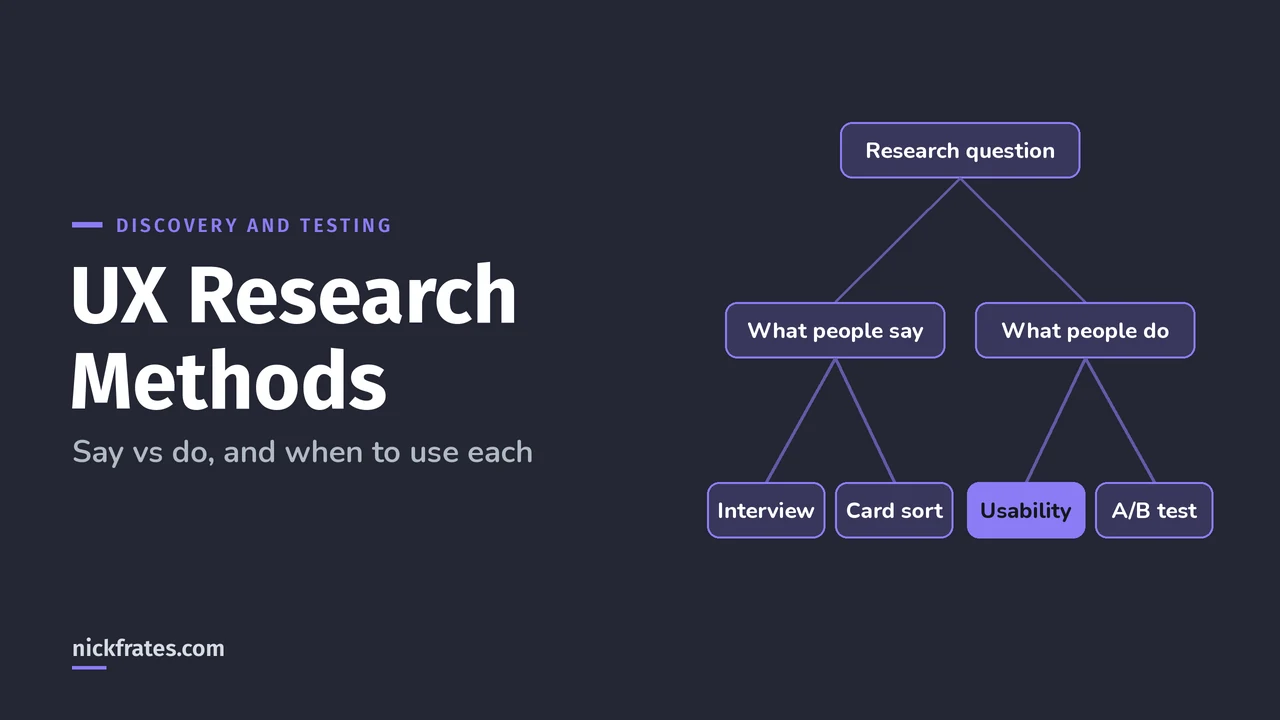
UX research methods fall along two main choices: whether they capture what people say (attitudinal) or what they do (behavioral), and whether they answer why and how (qualitative) or how many and how much (quantitative). Pick the method that matches your question and your stage of the project. User interviews and card sorting help you discover and organize, usability tests help you improve a design, and A/B tests help you measure one.
This is the core of the Discovery (13%) and Testing (11%) sections of the Salesforce Platform UX Designer exam, and it's useful on any project. I based this on NN/g's guide to choosing UX research methods, plus the topics Salesforce lists in its Trailhead prep module.
How do you choose a UX research method?
Start with two questions. What do you want to learn, and how will you collect it?
| Choice | One side | Other side |
|---|---|---|
| Attitudinal vs behavioral | Attitudinal: what people say, believe or report | Behavioral: what people actually do |
| Qualitative vs quantitative | Qualitative: observing or hearing directly, best for why and how to fix it | Quantitative: measured with an instrument like analytics or a survey, best for how many and how much |
NN/g points out that what people say and what they do are often quite different. That's why most usability studies lean on behavior, even though self-reported methods are still useful.
Which methods fit which stage of a project?
| Stage | Goal | Example methods |
|---|---|---|
| Strategize (generative) | Find new directions and opportunities | Field studies, diary studies, interviews, surveys, participatory design, concept testing |
| Design (formative) | Improve the usability of a design | Card sorting, tree testing, usability testing, remote testing |
| Launch and assess (summative) | Measure performance against itself or competitors | Usability benchmarking, A/B testing, analytics, surveys |
When should you run user interviews?
Use interviews in discovery, when you need to learn who your users are, what their experiences are like and what they need. NN/g describes a user interview as asking participants questions about a topic, listening, and following up. It's an attitudinal, qualitative method.
A few habits make interviews work:
- Write research goals first. "Learn about users" is too broad; "What makes users abandon the product?" is useful.
- Prepare a short guide of open-ended questions, such as "Tell me about the last time you did this."
- Pilot the guide with a colleague before the real sessions.
- Start easy, build rapport, then follow up and probe with questions like "Tell me more about that."
- Don't lead the participant. Leading questions damage the validity of the data.
Interviews are limited by memory and by social-desirability bias, since people may not recall events accurately or may present themselves favorably. If you need to know what users actually do, observe them or look at behavioral data.
What's the difference between a user interview and a usability test?
| User interview | Usability test | |
|---|---|---|
| Purpose | Generate knowledge about users, their experiences and needs | Assess a design: how it performs and what isn't working |
| Type | Attitudinal: reported behaviors, thoughts and feelings | Behavioral: observing how users interact with a design |
| When | Discovery, or the empathize stage of design thinking | Later, in the test stage |
| Design present? | No | Yes |
When should you use card sorting vs tree testing?
Use card sorting to build a structure and tree testing to check one. In card sorting, participants group labeled cards into piles that make sense to them, then name the piles. It uncovers users' mental models of your information architecture, so it's best when you need to organize content, services or products. Tree testing asks users to find items in a proposed structure, so you can evaluate its organization and terminology.
- NN/g recommends 30 to 50 cards, so people don't tire out.
- For a qualitative card sort, recruit at least 15 participants. For a quantitative one, recruit at least 30 to 50.
- Avoid repeating the same word on different cards, because people will group them by that word.
A Salesforce example: a company is rebuilding its Experience Cloud help center and has 40 articles. Card sort first to design the categories, then tree test the draft before you build any pages.
If you learn best by testing yourself, the Platform User Experience Designer Cert Lab has quick practice questions on research methods and testing, with every option explained.
How does a usability test work?
NN/g's usability testing 101 says the core elements are a facilitator, tasks and a participant. The facilitator gives task scenarios, watches the participant's behavior and listens, and may ask follow-up questions. Participants are often asked to think out loud. Wording matters: small mistakes in a task can confuse people or influence how they perform it.
The goals are to find problems in the design, uncover opportunities to improve, and learn about the target user's behavior and preferences.
What are A/B tests and focus groups good for?
- A/B testing shows variants of a design to random samples of visitors while holding other things constant, so you can see the effect on behavior. A single-variant test compares one difference, and a multivariant test compares more than one.
- Focus groups lead a group of 3 to 12 participants through a discussion. NN/g notes they tend to be less useful for usability purposes, but they can give a top-of-mind view of what people think about a brand or concept.
- Surveys measure and categorize attitudes or collect self-reported data, so they're good for tracking issues, not for watching behavior.
What research biases should you watch for?
Trailhead's prep module lists the Hawthorne effect, which is people changing their behavior because they know they're being observed. Also watch for leading questions and the gap between what people say and do. Think about aim and scope too: the aim is what you're trying to find out, and the scope is who you're researching and how you'll analyze it.
How does this show up on the Salesforce exam?
Expect scenarios: which method gives you evidence of behavior, which one helps organize content, which checks a structure, and which compares two variants. Match the method to the question and the stage and you'll get most of them. Also review personas for Salesforce, which Trailhead says are based on goals, behaviors and motivations, and turn the findings into user stories, which I cover in my post on Salesforce user stories.
Here's why I care about practice questions so much. I earned 17 Salesforce certifications, and Focus on Force was a big part of that. My early approach was study guide first, tests later. Flipping it, taking practice tests fast and often, cut my study time way down. Cert Lab is my version of that: fast testing with explanations that link to current docs.
FAQ
What are the main types of UX research methods?
Attitudinal and behavioral, and qualitative and quantitative. Methods also differ by project stage: generative, formative and summative.
What's the difference between qualitative and quantitative research?
Qualitative research observes or hears behaviors and attitudes directly and answers why or how. Quantitative research measures them with an instrument and answers how many or how much.
When do you use card sorting?
When you need to organize content, services or products in a way that matches how users think.
What is tree testing?
A way to evaluate a site structure by asking users to find items in it, using the structure's own organization and terminology.
What is the difference between a user interview and a usability test?
An interview learns about users and their needs, with no design present. A usability test watches users try a design to assess how it works.
Where should you go next?
- The Platform UX Designer study guide for the full exam outline.
- Low-fidelity vs high-fidelity wireframes for what to test.
- Platform UX Designer practice questions with Discovery and Testing scenarios.
Nick Frates, a senior Salesforce developer with 17 certifications, built the Platform User Experience Designer Cert Lab at nickfrates.com: rapid-fire practice questions for every exam section, each answer explained.
Cert Lab by Nick Frates
Let the Platform User Experience Designer Cert Lab test you to success
Lessons, flashcards, a quiz for each of the six exam sections and full practice exams, every answer explained.
Start the Platform User Experience Designer Cert Lab for $9.99 →Not ready to buy? Try a free lesson and see how fast you learn.
Hope this helps!
Best,
Nick