Hey friends,
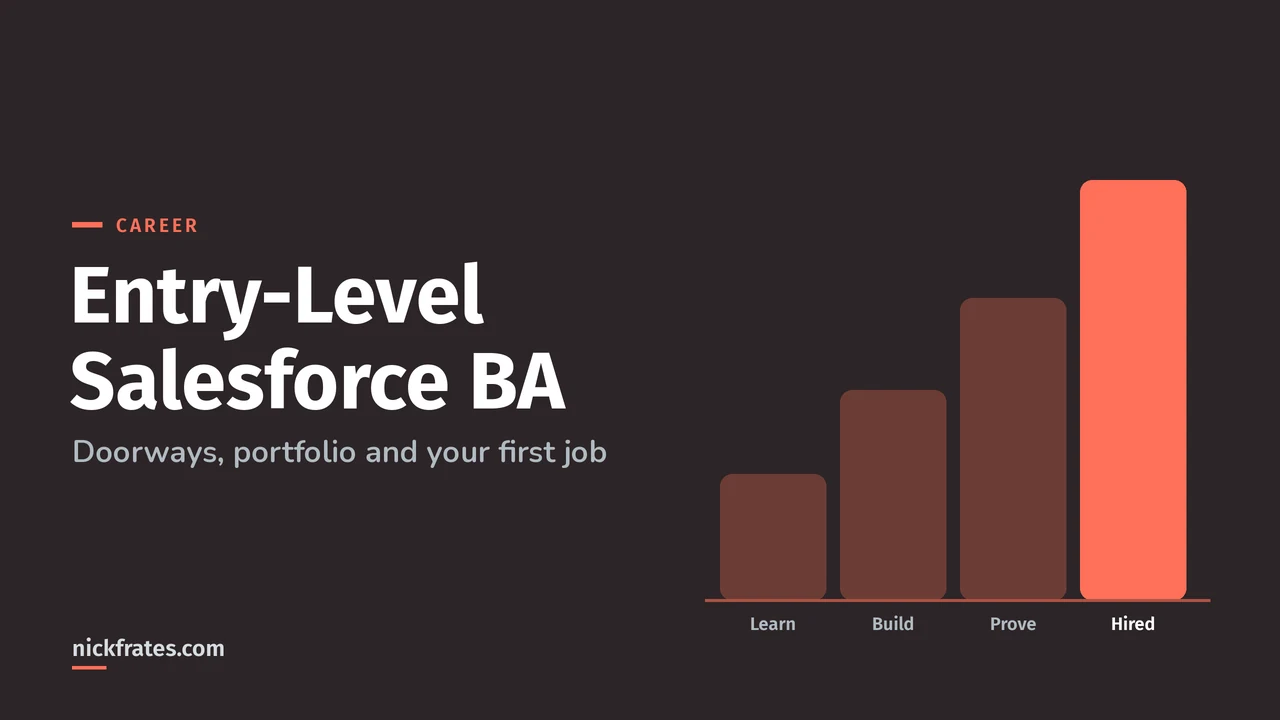
Most people don't start as a Salesforce business analyst. They get close to a Salesforce project first, as an admin, an operations person or a BA on another system, then prove BA skills with a small portfolio and step into the role. This post is the plan I'd follow if I were starting today.
Quick definition: the Salesforce BA is the interpreter between the business and IT, eliciting and documenting requirements and steering solutions (Trailhead). If you want the full picture first, read what a Salesforce business analyst does.
Which doorway fits you?
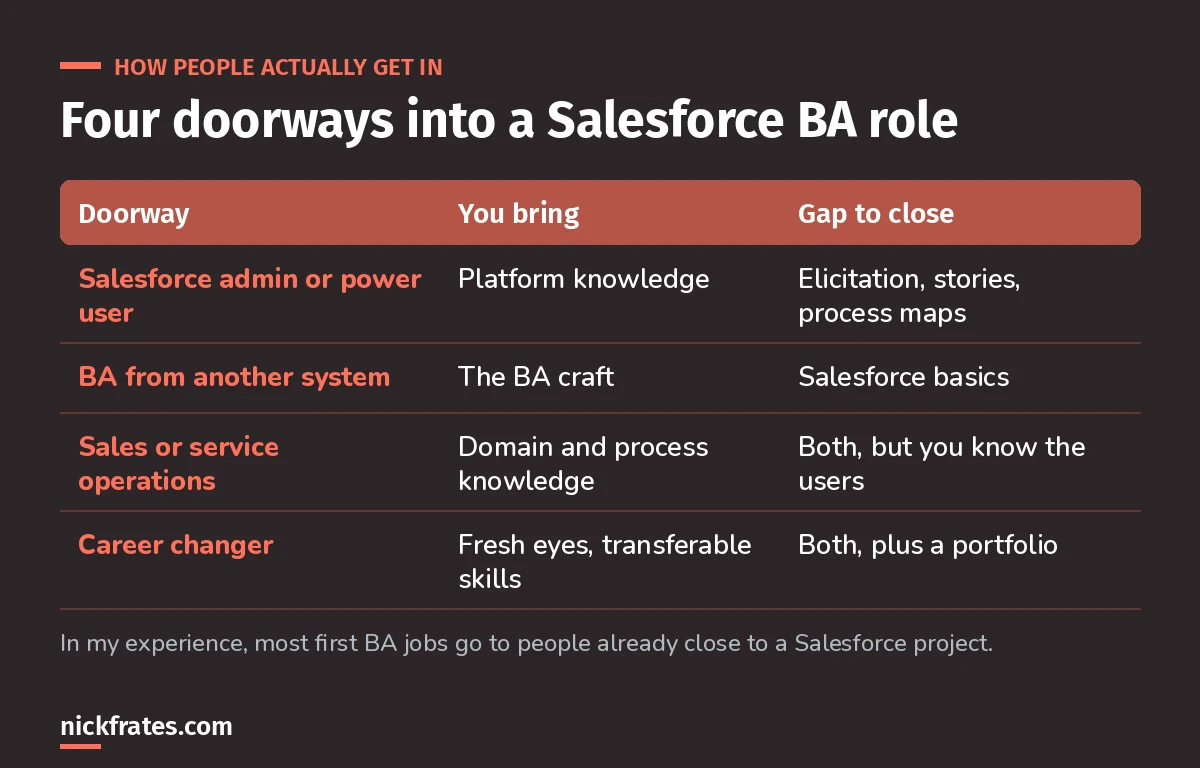
Pick the row that sounds like you, then close the gap.
The Business Analyst exam guide even lists Salesforce Administrator, business operations and CRM manager as typical job roles for candidates. Titles vary; the work is what counts.
Step 1: Learn the two halves
- The BA craft: eliciting needs, writing user stories with acceptance criteria, mapping processes, supporting user acceptance testing (UAT).
- The platform: objects, fields, records, security, Flow and reports. My Salesforce for business analysts post covers the six concepts to learn first.
For a structured start, Platform Foundations covers the platform basics and has no prerequisite.
Step 2: Build a small portfolio
Entry-level candidates lose to experienced ones because there's nothing to show. Fix that with three artifacts from one made-up (or volunteer) project:
- A process map. Current state and future state of one process, like "new inquiry to booked appointment" for a local business. Use Universal Process Notation (UPN) (Trailhead).
- Five user stories with acceptance criteria. "As a.., I want.., so that.." plus testable conditions (Trailhead).
- A working build in a free Developer Edition org. A custom object, a validation rule, a simple flow and a report that proves the stories are met. Record a 3-minute walkthrough.
That package tells a hiring manager you can go from conversation to working solution. It beats a list of badges.
A bit about how I study. Focus on Force was my favorite resource on the way to 17 Salesforce certs. But what actually made things stick was taking practice tests rapid-fire, again and again. That's the loop Cert Lab is built on: quick questions, explanations with current links and screenshots, then go again.
Cert Lab by Nick Frates
Let the Business Analyst Cert Lab test you to success
Rapid scenario quizzes on discovery, stakeholders, process mapping, requirements, user stories and UAT, every answer explained, so you can talk like a BA in interviews.
Start the Business Analyst Cert Lab for $9.99 →Step 3: Get certified when it helps
The Business Analyst certification has no prerequisite, but the guide recommends 2 years of BA and 2 years of Salesforce experience. For an entry-level candidate, the cert won't replace experience, but it gets your résumé past keyword filters and gives you structured knowledge to talk about.
My BA prerequisites post covers whether to take Admin first.
Step 4: First-job tactics
- Look inside first. If your company uses Salesforce, offer to help with requirements on the next change. Trailhead's career planning module suggests shadowing and joining special projects; that works.
- Search the adjacent titles. Business systems analyst, CRM analyst, Salesforce analyst, junior consultant, operations analyst.
- Target Salesforce partners. Consulting firms hire junior analysts and train them on real client projects.
- Use the portfolio in interviews. Walk through your process map and stories. Show how you asked "why" to find the real need.
- Tell the story in your résumé. Lead with outcomes: "mapped intake process, cut handoffs from 6 to 3." My breaking into Salesforce with no experience post has more.
Mistakes I see
- Collecting badges instead of building something.
- Pitching yourself as "technical" when the role values listening and clarity.
- Applying only to jobs titled "Salesforce Business Analyst" and missing the adjacent ones.
FAQ
Can you be a Salesforce BA with no experience?
It's hard straight away. Most people get there through an adjacent role. A portfolio and the cert shorten the path.
Do entry-level Salesforce BAs need to code?
No. The exam guide says candidates aren't expected to develop custom code.
Where should you go next?
- Salesforce Business Analyst study guide
- Business Analyst vs Administrator
- Entry-level Salesforce admin jobs
Cert Lab by Nick Frates
Let the Business Analyst Cert Lab test you to success
Lessons, flashcards, a quiz for each of the six exam sections and full practice exams, every answer explained.
Start the Business Analyst Cert Lab for $9.99 →Hope this helps!
Best,
Nick