Hey friends,
A Salesforce business analyst (BA) figures out what the business actually needs, turns it into clear requirements and user stories, and makes sure what gets built in Salesforce solves the real problem. Trailhead calls the BA an interpreter: the go-to person between IT and business stakeholders (Trailhead Quick Look).
If you're wondering whether the role fits you, this post walks through the day-to-day work, the skills that matter, where a BA sits on a team, and how people get in.
What does a Salesforce BA do day to day?
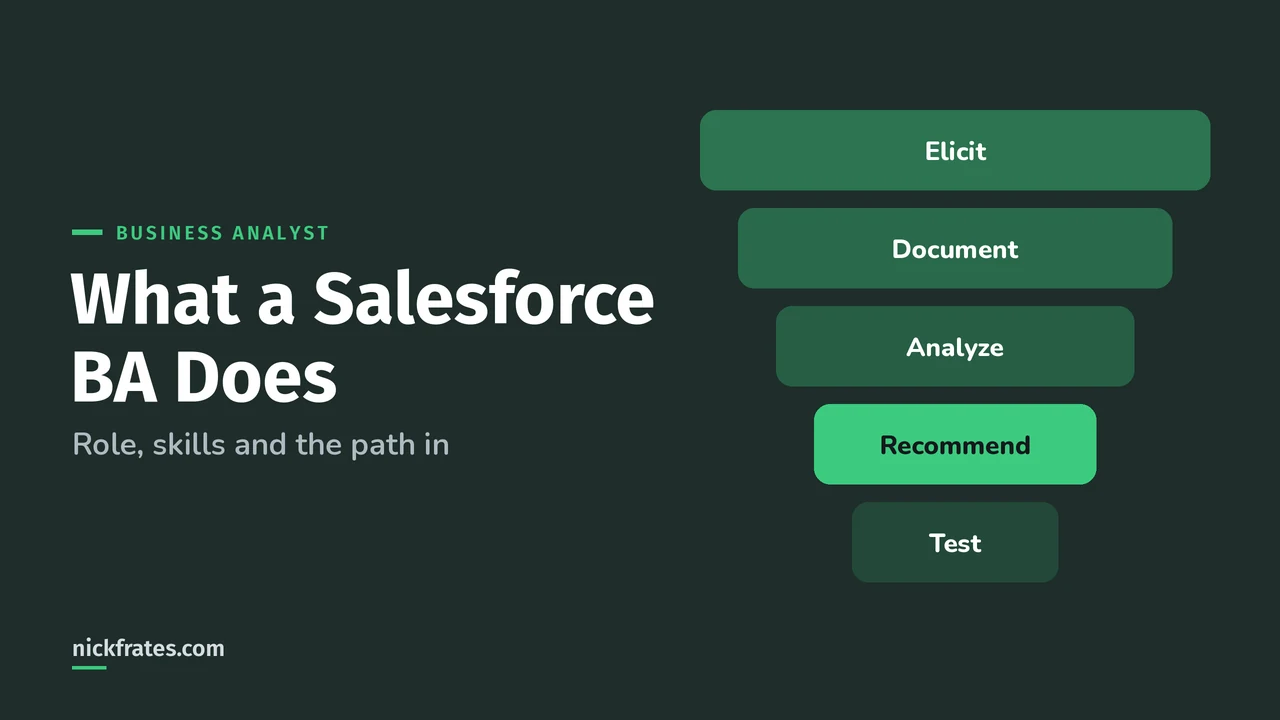
Salesforce describes it as a project-based, business-improvement role. On any given day you might be running a discovery call, mapping how a sales team really works a lead, writing acceptance criteria, or sitting with testers during user acceptance testing (UAT).
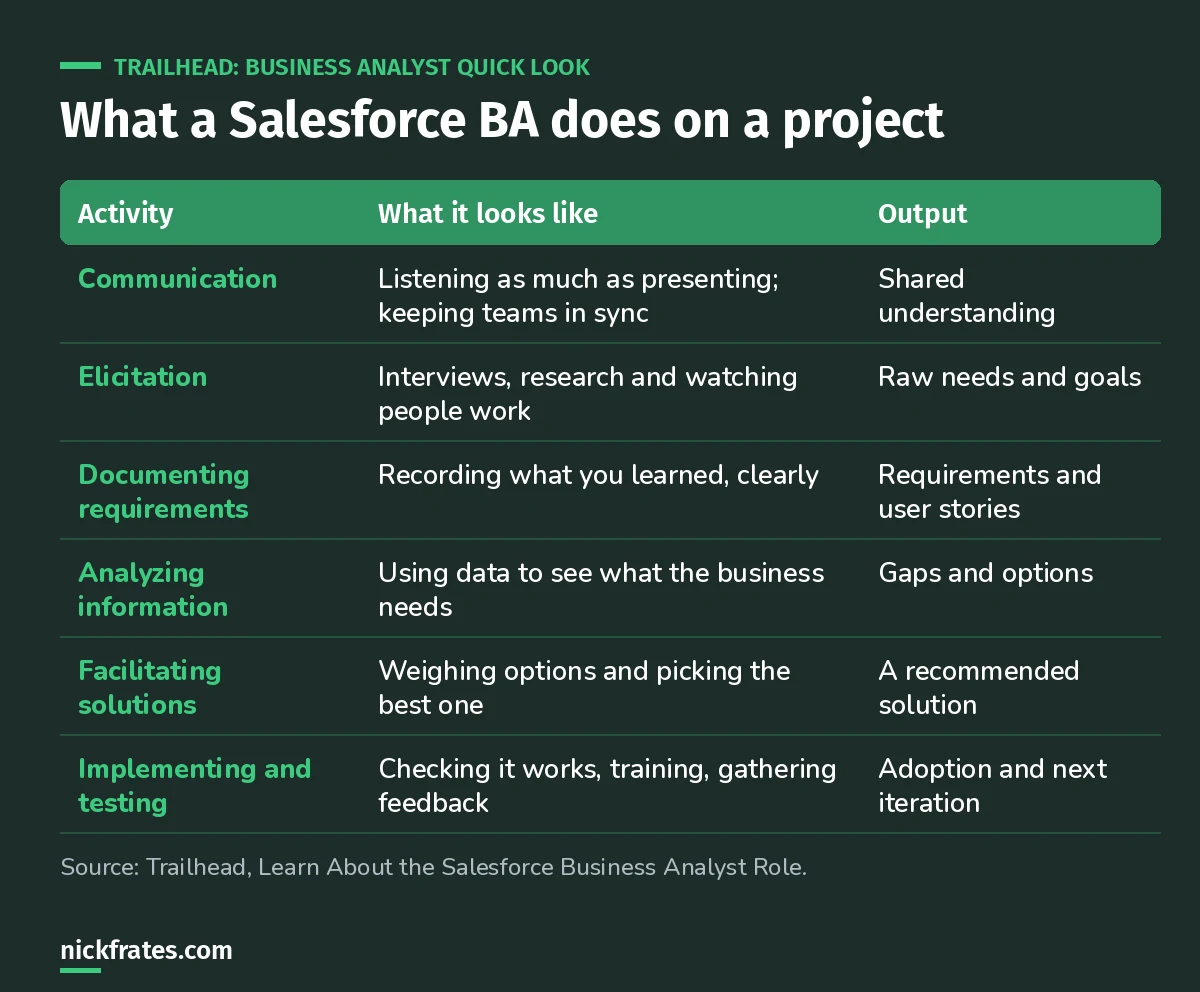
The same loop repeats on every project, big or small.
A quick example. A sales VP says "I need to adjust my team's forecast." Trailhead uses almost this exact case. Sounds like a quick setting, but a BA asks the follow-ups: who adjusts, when, what happens to the rep's original number, who needs to see the change? That's the job: turning a one-line request into something a builder can deliver without guessing.
What skills does a Salesforce BA need?
Trailhead splits them into two groups. The people skills carry most of the weight:
| Business skills | Salesforce know-how (basic level) |
|---|---|
| Needs analysis and eliciting requirements | Automation |
| Business case definition | Data management |
| Requirements writing and review | Reports and dashboards |
| Flow and process diagramming | Collaboration features |
| Wireframing | Sales and marketing apps |
| Business data analytics and problem solving | Platform and AgentExchange |
The Business Analyst Skills and Strategies module adds the one I'd put first: curiosity. Good BAs are great listeners who keep asking until the real need shows up.
Does a Salesforce BA need to be technical?
No, not deeply. Trailhead lists this as the top misconception. You need enough platform knowledge to understand what Salesforce can and can't do, and to keep up with releases. The heavy configuration is usually the admin's job.
That said, plenty of BAs do configure, especially on small teams. Trailhead says that's up to the person and the company. In my experience, BAs who can build a quick prototype in a sandbox win arguments faster, because people react better to a screen than a document.
Two other myths worth dropping: BAs aren't only brought in after kickoff (scoping is one of the most important parts), and they don't only write requirements.
Quick backstory. I loved Focus on Force and used it on my way to 17 Salesforce certifications. Over time I noticed I learned way faster when I took practice tests rapid-fire, over and over, and read the explanation for every miss. So I built Cert Lab around fast testing, with up-to-date Help links and screenshots in every explanation. It's designed to test you to success.
Cert Lab by Nick Frates
Let the Business Analyst Cert Lab test you to success
Rapid-fire scenario questions on discovery, stakeholders, process mapping, requirements, user stories and UAT. Every answer is explained, so you learn to think like a BA fast.
Start the Business Analyst Cert Lab for $9.99 →Where does a BA fit on a Salesforce project team?
Think of a typical team: a product owner or sponsor decides what matters, the BA defines it, admins and developers build it, and testers and users confirm it. The BA is the thread running through all of it.
- With stakeholders: plan discovery, run workshops, get agreement on priorities.
- With builders: hand over user stories with acceptance criteria that are ready for development, then answer questions as they build.
- With testers and users: support UAT and check the solution meets the requirements.
The official Business Analyst exam guide lists job titles that do this work: business analyst, consultant, business systems analyst, product owner, CRM manager, business process specialist and even Salesforce Administrator. Same core skills, different badge.
How do you become a Salesforce business analyst?
- Learn the platform basics. Objects, records, reports, automation. The Platform Foundations exam is a gentle first step.
- Practice the BA craft. Write user stories, map a process, run a mock discovery session with a friend's business.
- Get close to real projects. Many BAs start as admins, in sales or service operations, or as a power user who becomes the team's go-to person.
- Earn the Business Analyst certification. The guide recommends 2 years of BA experience and 2 years on the Salesforce Platform, but there's no formal prerequisite.
For the exam itself, my Salesforce Business Analyst study guide breaks down all six sections. If you're choosing between paths, Business Analyst vs Administrator compares them.
FAQ
Is a Salesforce BA the same as an admin?
No. The admin owns configuration and ongoing support. The BA owns understanding the need and defining the solution. On small teams one person often does both.
Do Salesforce BAs write code?
No. The exam guide says candidates aren't expected to develop custom code or design a technical solution.
What does the Business Analyst exam cover?
Six sections: Collaboration with Stakeholders (23%), Requirements (18%), User Stories (18%), Customer Discovery (17%), Business Process Mapping (12%), and Development Support and User Acceptance (12%).
Where should you go next?
- Salesforce Business Analyst study guide
- Business Analyst practice questions
- How to break into Salesforce with no experience
Cert Lab by Nick Frates
Let the Business Analyst Cert Lab test you to success
Lessons, flashcards, a quiz for each of the six exam sections and full practice exams, every answer explained.
Start the Business Analyst Cert Lab for $9.99 →Hope this helps!
Best,
Nick