Hey friends,
A Salesforce admin resume gets read in under a minute, usually by someone who has run an org themselves. They are scanning for three things: what size of org you ran, what you changed in it, and proof that the change mattered. A list of features you “know” doesn’t answer any of those.
Below are six sample resumes you can download and copy, one for each common starting point, plus what each section needs to show and the portfolio pieces that close the gap when you don’t have the job title yet. All six people are fictional. Swap in your own facts.
What hiring managers actually scan for
The resumes that get a call answer these questions in the top third of the page:
How big was the org?
Weak: Managed Salesforce for the company
Strong: Ran a 350-user Sales Cloud and Service Cloud org
Can you build automation safely?
Weak: Experienced with Flow
Strong: Migrated 14 workflow rules and processes to record-triggered flows
Do you understand security?
Weak: Knowledge of profiles and roles
Strong: Replaced 9 custom profiles with permission set groups on 2 base profiles
Did it matter to the business?
Weak: Built dashboards
Strong: Built the support KPI dashboard used in the weekly ops review
Can you ship changes without breaking things?
Weak: Familiar with sandboxes
Strong: Run biweekly releases from a full sandbox with change sets
The pattern is the same every time: a verb, a specific Salesforce feature, and a number or an outcome. If you can’t put a number on it, name who used the result.
What makes these resumes work
We started by asking why a recruiter would skip a resume, then designed against each answer. These are the ideas behind every sample below:
- Proof in the top third. Recruiters spend about 7.4 seconds on a first look, and their eyes go to job titles first (Ladders eye-tracking study). Each resume puts certs, org size and the biggest win in one line at the top.
- Every bullet is X, measured by Y, by doing Z. That's former Google HR head Laszlo Bock's formula. We added a before/after baseline wherever possible, so "31%" means something.
- Name the feature, not just "Salesforce." Hiring managers want the tool and the result together: record-triggered Flow, permission set groups, Duplicate Rules, DevOps Center (Salesforce's own admin resume advice).
- Show judgment, not volume. Fault paths, before-save Flows, no DML in loops, knowing when not to write code. Salesforce Ben's hiring panel says this is what separates real admins.
- Honest ranges beat fake precision. "About 6 hours a week" survives an interview question. "Increased revenue 300%" doesn't.
- Designed for the ATS and for people. One column, real text, standard headings, nothing in headers or footers, no icons or skill bars. Parser tests from Jobscan, ReadableResume and QuickCV all found that columns, text boxes and graphics drop or scramble content.
- Proof you can check. A Trailhead profile link, Salesforce's credential verification page, and a portfolio or GitHub link where it fits.
Six sample Salesforce admin resumes
All six people and companies are fictional. Each resume is one page and parses cleanly in an applicant tracking system. Under each one you’ll find why it works and a bullet you can adapt for your own resume. Click an image for full size, or download the PDF.
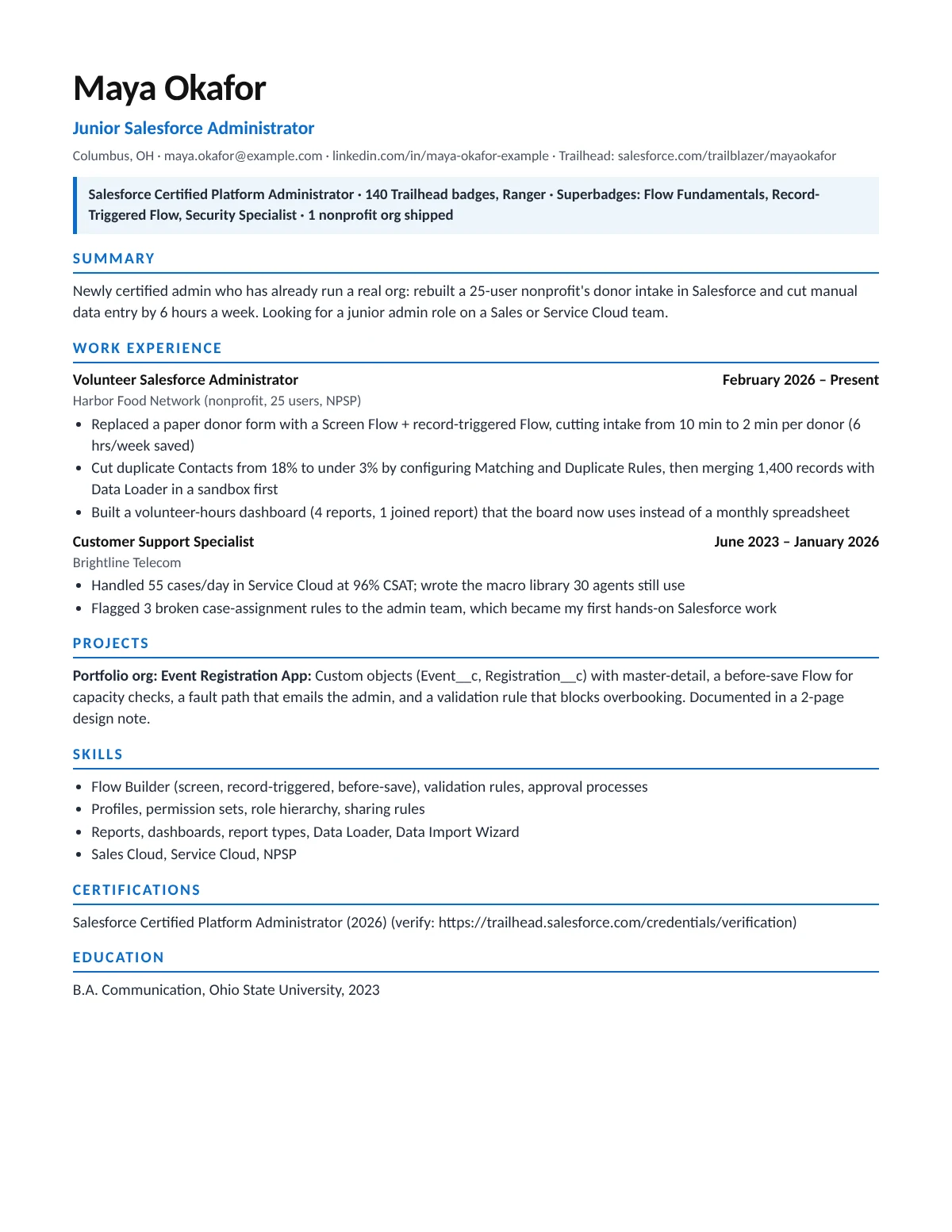
Entry level: first admin role
Maya Okafor (fictional)
Why it works
- The Proof line names the cert, specific Superbadges and a real org she shipped, so a recruiter sees proof within the 7.4-second first look.
- Her volunteer admin job is listed first because it matches the target role, even though it's unpaid.
- "Duplicates from 18% to under 3%, in a sandbox first" gives a before/after number and shows good judgment.
Steal this: Replaced [manual process] with a [Flow type], cutting [task] from [before] to [after] per [unit].
Download PDF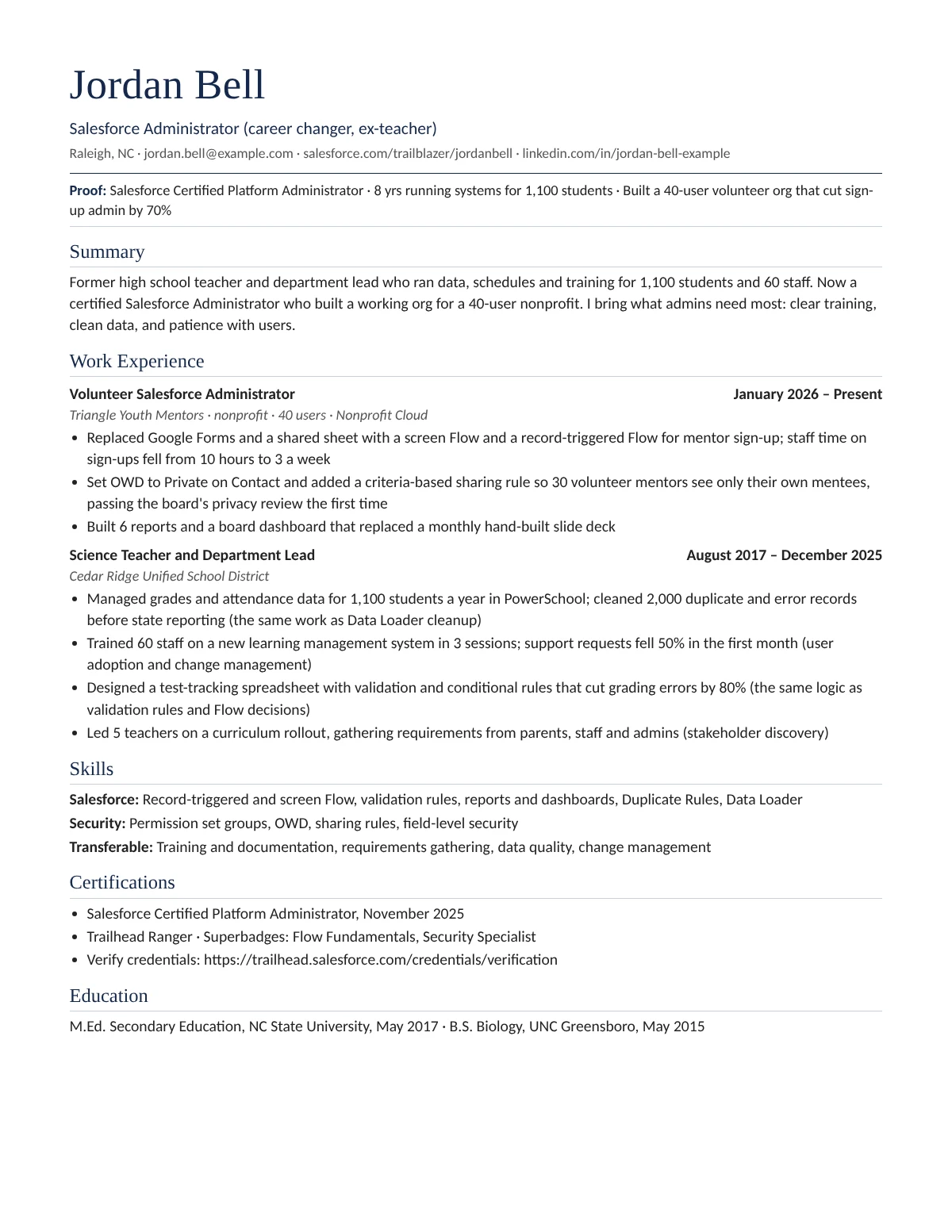
Career changer: teacher to admin
Jordan Bell (fictional)
Why it works
- Teaching work is written in admin language: data, training, adoption. A hiring manager can see the transfer without guessing.
- Training 60 staff and cutting support requests in half is change management, the skill that makes users adopt what an admin builds.
- The sharing bullet (OWD Private on Contact plus a criteria-based sharing rule) proves Jordan understands the security model, not just the buttons.
Steal this: In [non-Salesforce role], [did admin-like work] for [N people], which [moved a metric from A to B].
Download PDF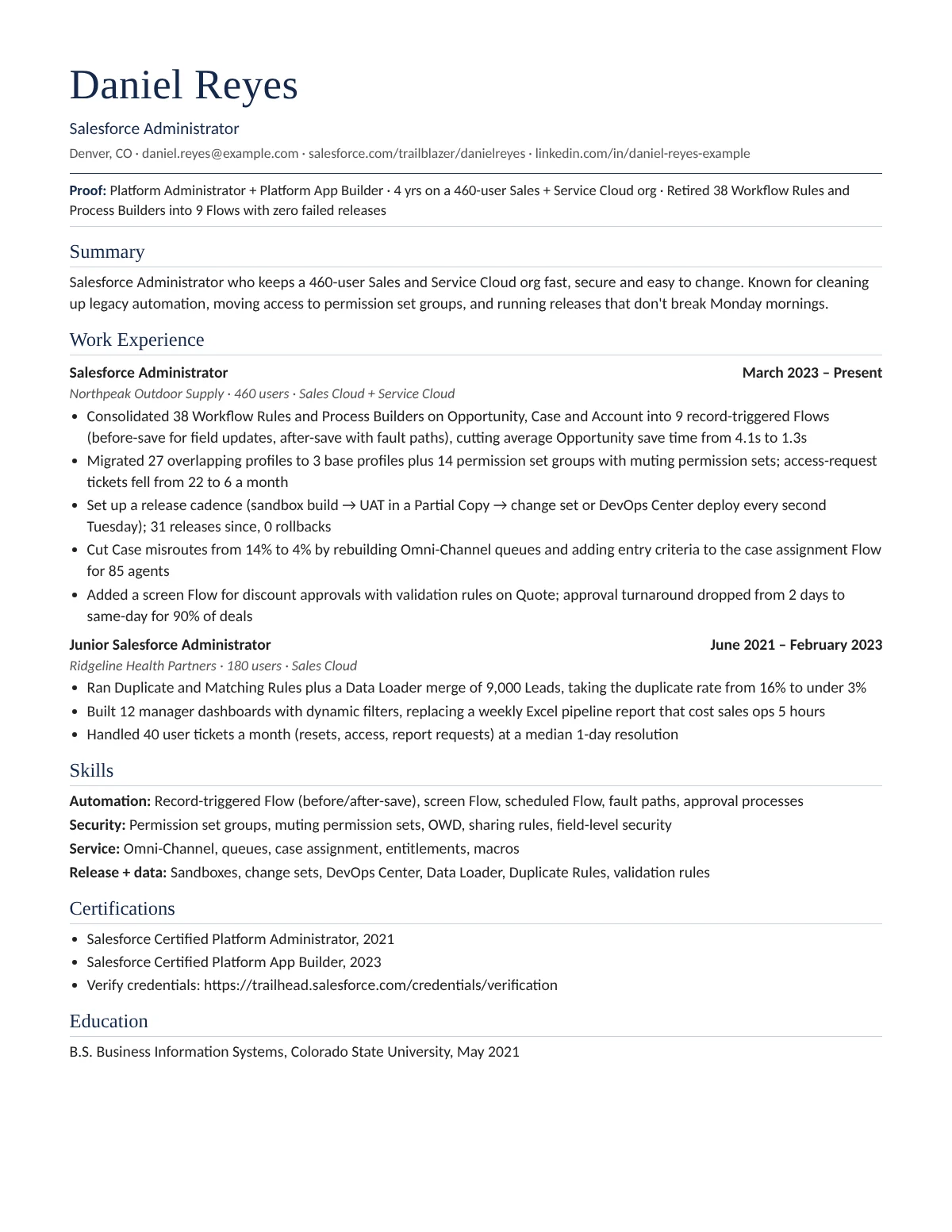
Mid level: owns the org
Daniel Reyes (fictional)
Why it works
- "38 Workflow Rules and Process Builders into 9 Flows" shows cleanup work, the skill hiring managers trust most.
- Before-save vs after-save with fault paths, and muting permission sets: details only someone who has done the work would write.
- "31 releases, 0 rollbacks" answers the hiring manager's unspoken question: will this person break my org?
Steal this: Consolidated [N] automations into [M] Flows on [objects]; [speed or error metric] went from [A] to [B].
Download PDF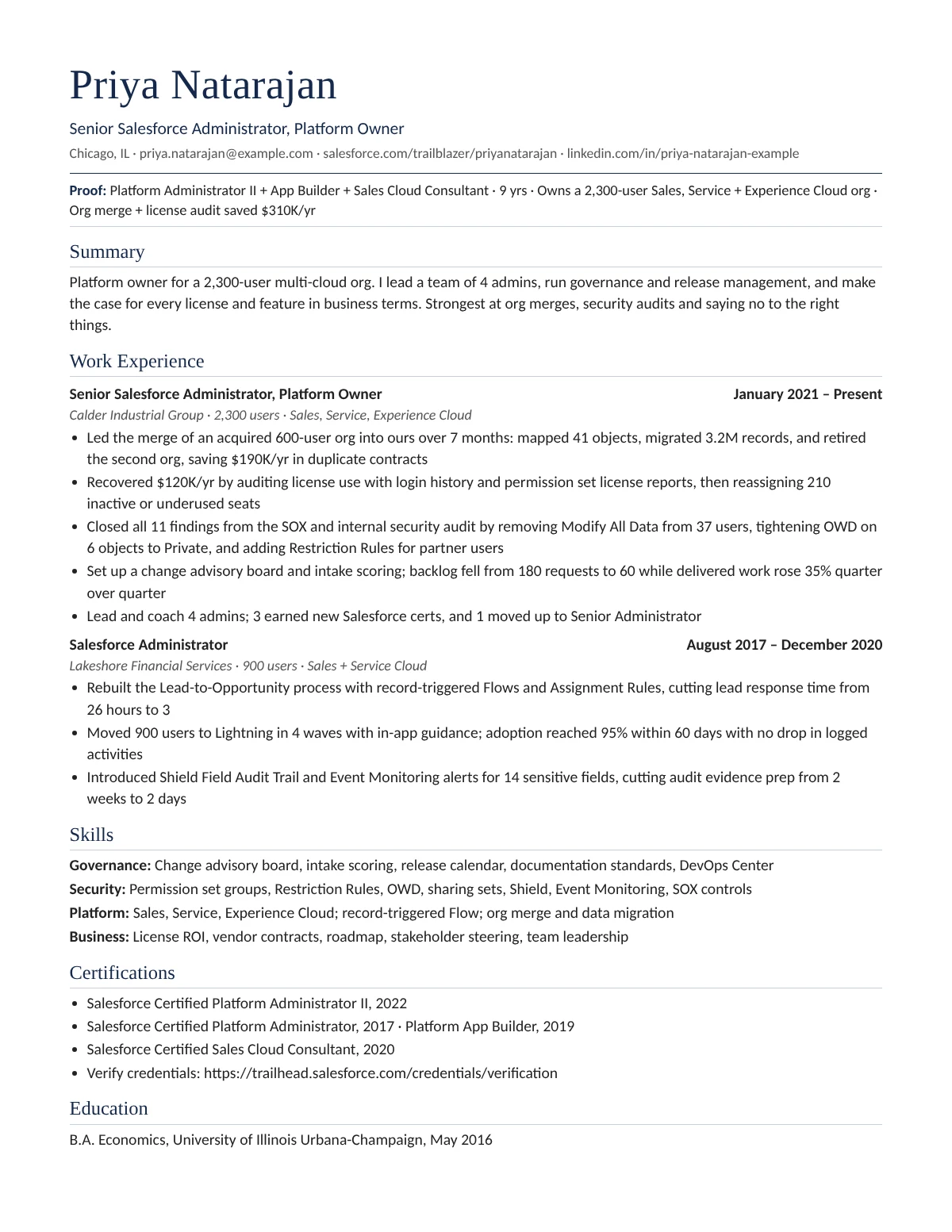
Senior: platform owner
Priya Natarajan (fictional)
Why it works
- Leads with business outcomes (org merge, $120K/yr from license reclaims, audit findings closed), which is what a director is hired for.
- "Backlog 180 to 60 while delivered work rose 35%" shows governance as throughput, not paperwork.
- The people line (3 admins certified, 1 promoted) proves leadership with numbers too.
Steal this: Recovered $[X]/yr by [governance action] using [report or tool], reassigning [N] licenses.
Download PDF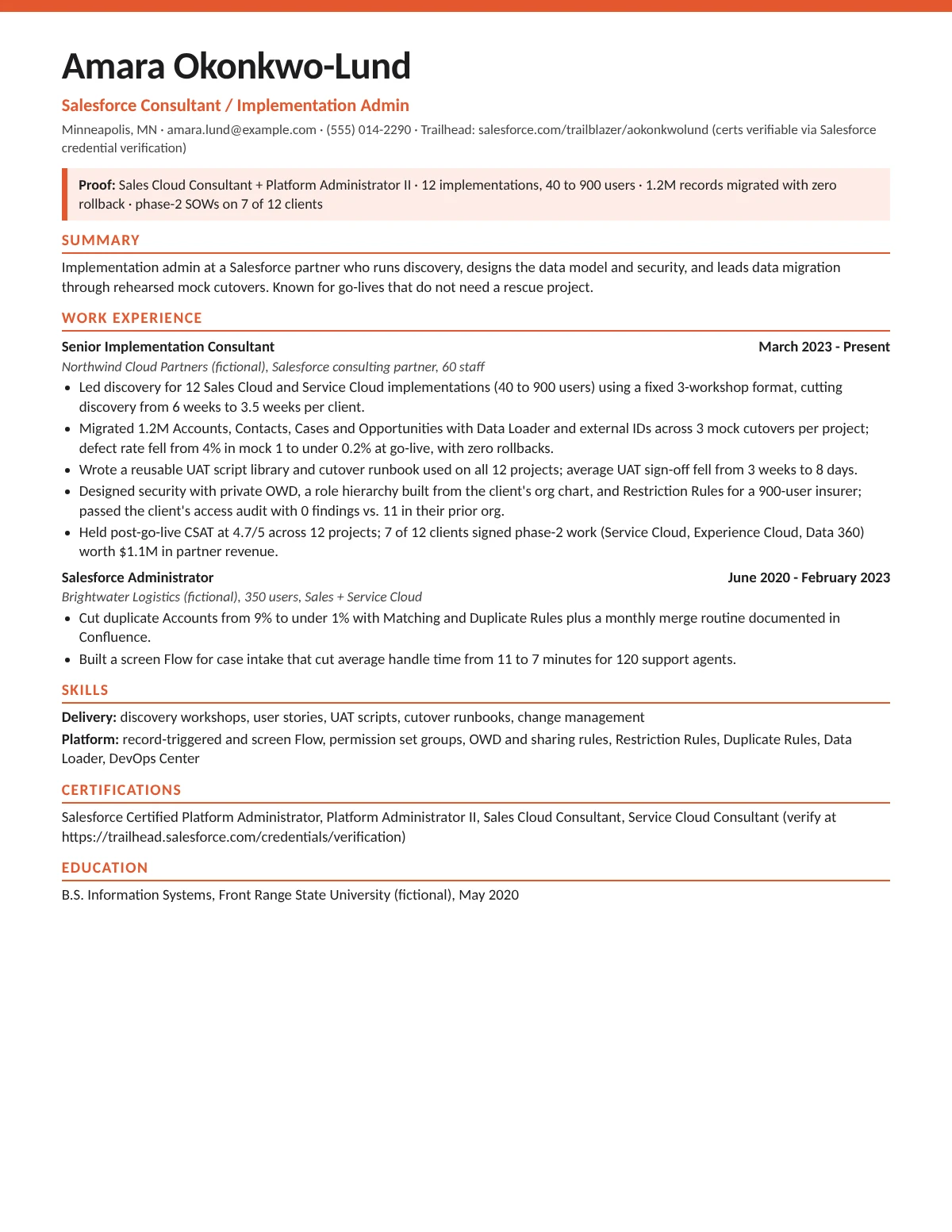
Consultant: implementation admin
Amara Okonkwo-Lund (fictional)
Why it works
- "12 implementations, 40 to 900 users" sets the range up front, which is how partners judge delivery experience.
- Her signature is delivery method: 3 mock cutovers with external IDs, and a UAT runbook that cut sign-off from 3 weeks to 8 days.
- "7 of 12 clients signed phase-2 work" ties delivery quality to revenue, which partner firms care about most.
Steal this: Delivered [N] [cloud] implementations ([user range]) using [method], with [quality metric].
Download PDF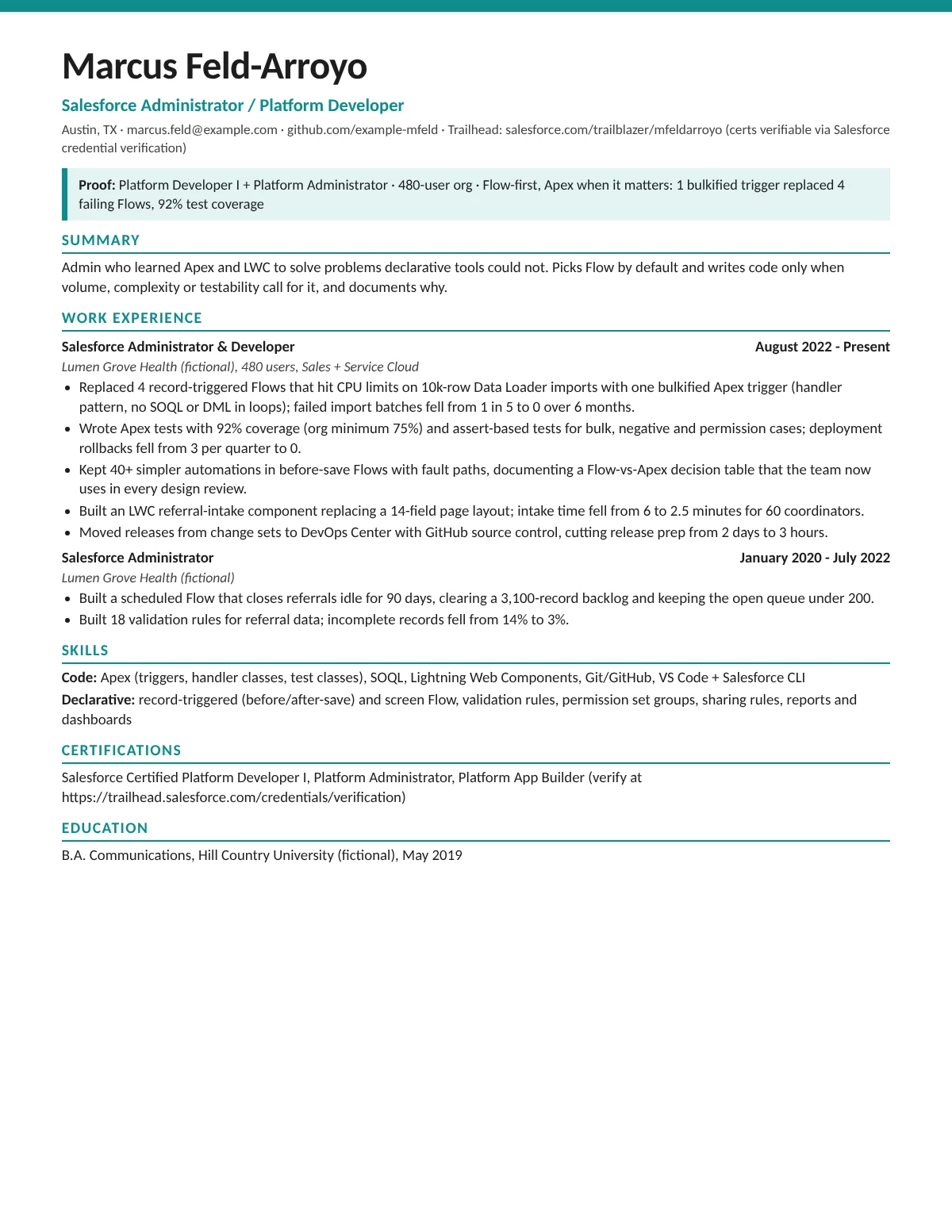
Admin to developer
Marcus Feld-Arroyo (fictional)
Why it works
- "Flow-first, Apex when it matters" is the judgment hiring managers look for in a hybrid role.
- The bulkified trigger replaced 4 Flows that hit CPU limits on 10k-row imports: a concrete governor-limit problem, solved.
- 92% test coverage (against the 75% minimum) plus a GitHub link makes the code skills checkable.
Steal this: Replaced [Flow that hit limit X] with [Apex pattern]; [volume] now runs without errors.
Download PDFSection by section: what to write
Summary (2 lines)
Your level, the org you ran, and your strongest area. “Salesforce Administrator with 4 years running a 350-user Sales and Service Cloud org. Strong on the sharing model and Flow migrations.” Skip “passionate” and “results-driven”. They tell the reader nothing.
Skills (6 to 10 items)
Use the words from the job post, because applicant tracking systems match on them. Group them by what admins actually do: security (profiles, permission set groups, sharing rules), automation (record-triggered, screen and scheduled flows), data (Data Loader, duplicate rules), and release (sandboxes, change sets, DevOps Center). Leave out Microsoft Office.
Experience
Three or four bullets per role, each one a change you made. Put Salesforce work first even if it was only part of your job. “Customer Support Lead (part-time Salesforce admin)” is honest and gets you past the keyword filter.
Certifications
List the exact credential name, such as Salesforce Certified Platform Administrator. Most hiring managers check it on the Trailhead verification site, so make sure your Trailhead profile is public.
Cert Lab by Nick Frates
Get the Platform Administrator credential on your resume
The Admin Cert Lab is free: lessons, practice questions and hands-on exercises for every exam section.
Start the free Admin Cert Lab →The portfolio: how to prove it without the title
If you’re an accidental admin or a career changer, a portfolio closes the experience gap faster than more badges. Build these in a free Developer Edition org and show them with screenshots or a short screen recording:
- A small custom app with a master-detail relationship, a roll-up summary field and a validation rule. Marcus’s volunteer-hours app is the template here.
- One record-triggered flow and one screen flow, with a one-paragraph note on why you chose before-save or after-save.
- A security setup: two personas with different access, built with a permission set group, and a sharing rule that opens records to one team.
- A dashboard with a dynamic filter that answers a real question, such as “which open cases are past their SLA”.
- A data cleanup: import a messy CSV with the Data Import Wizard, then show the duplicate rule that caught the repeats.
Volunteer work counts as experience. A nonprofit running Nonprofit Success Pack with no admin is the fastest way to earn a real “Salesforce Administrator” line, as Maya and Marcus did.
Mistakes that get resumes skipped
- Listing every Trailhead badge. Put the badge and superbadge count in one line and link your profile.
- Two pages before five years of experience. One page is the norm until you’ve run multiple orgs.
- Saying “knowledge of” instead of what you did. “Knowledge of Flow” reads as “watched a video about Flow”.
- Using old feature names with no context. If you built Process Builder processes, say you migrated them to Flow. That’s what hiring managers want to hear now.
- Sending a design-heavy template. Columns built from tables and icons for skill levels often break applicant tracking systems. The sidebar samples above use real text in a simple two-column layout, but if a job portal mangles yours, switch to a single-column version.
FAQ
Do I need the Platform Administrator certification to get hired? It isn’t legally required, but most admin job posts ask for it, and recruiters filter on it. It’s the cheapest way to get past the first screen.
Should I put my Trailhead rank on my resume? One line at most. Hiring managers care more about one real project than about a rank.
Can I copy these resumes? Yes. That’s what they’re for. Download the PDF, rebuild it in your own editor with your details, and keep the bullet structure.
What if my only Salesforce work is a Developer Edition org? Put it under a “Portfolio org” heading with 3 bullets, like Marcus’s resume, and link the screenshots.
Hope this helps!
Best,
Nick