Hey friends,
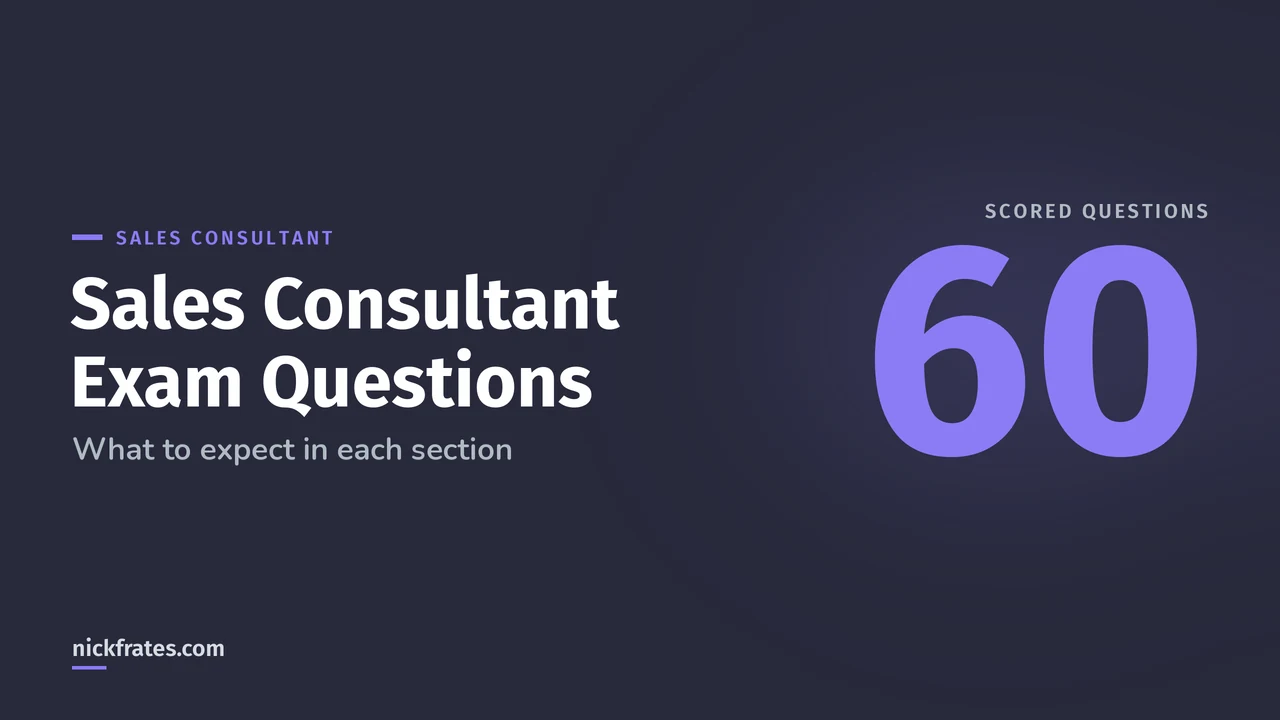
The Agentforce Sales Consultant exam has 60 scored multiple-choice questions plus up to five unscored ones, you get 105 minutes, and you need 73% to pass the English version. Most questions are short business scenarios that ask which Sales Cloud feature or consulting step fits best, spread across five weighted sections.
Knowing what each section asks lets you spend study time where the points are, and walk in already used to the question style. Everything here comes from the official Agentforce Sales Consultant exam guide, and the practice questions are ones I wrote myself to match each section.
How is the Sales Consultant exam structured?
It's a proctored exam, taken at a test center or online, with no reference materials allowed. The prerequisite is the Salesforce Administrator certification, and the unscored questions are mixed in randomly, so treat every question like it counts.
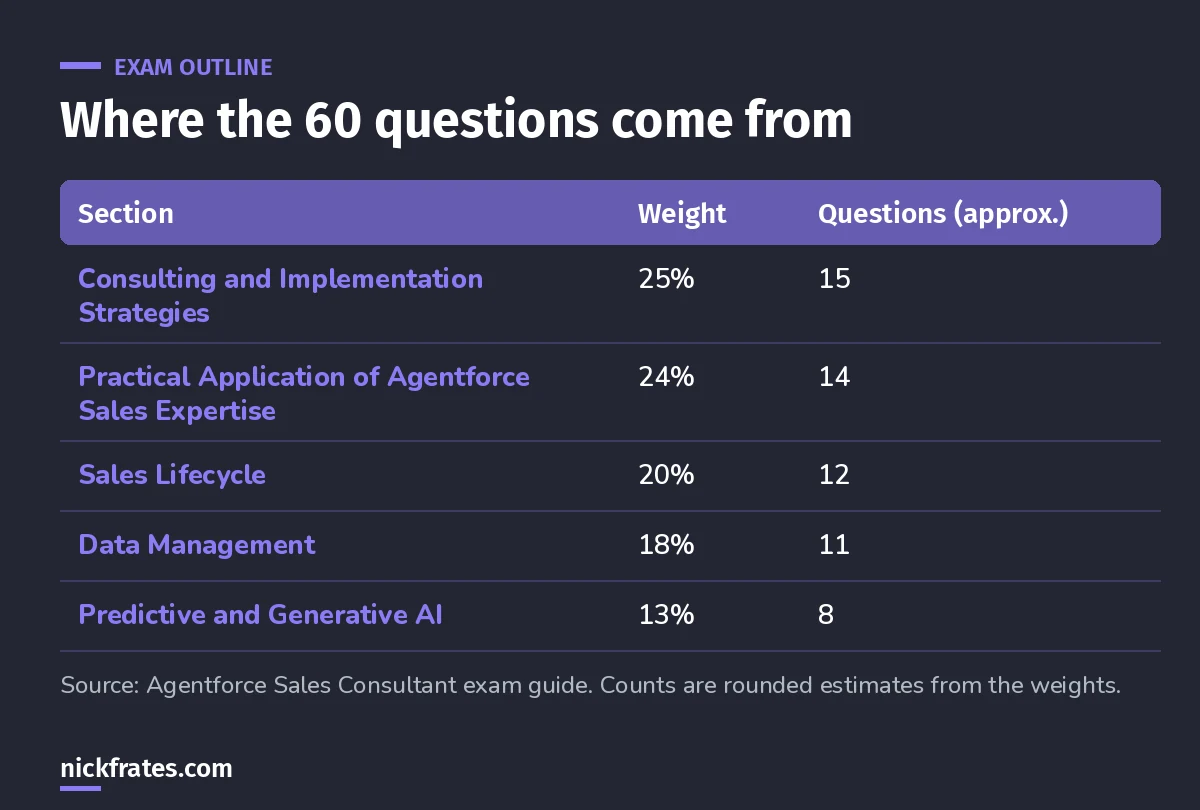
Consulting and practical application together are almost half the exam.
Once you pass, you keep the certification current by completing a maintenance badge on Trailhead once a year.
What do Consulting and Implementation Strategies questions ask?
This is the biggest section at 25%, and it tests how you run a project, not how you click through Setup. Expect discovery workshops, requirements and use case prioritization, deployment considerations, change management, training, and what to do about low adoption after go-live.
Question 1. Three months after a Sales Cloud go-live, the VP of Sales says reps "aren't really using it." What should the consultant do first?
- A. Rebuild the opportunity page layouts
- B. Measure adoption with login rates and record creation and update activity to see where usage drops
- C. Ask the admin to make every opportunity field required
- D. Recommend an AppExchange gamification app
Show the answer and explanation
Answer: B. You can't fix low adoption until you know where it's happening. Trailhead lists login rates, record creation and record updates as early indicators of success (Measure Salesforce Usage).
Changing layouts, forcing required fields or buying an app are guesses until the data shows which teams and steps are the problem.
What do Practical Application questions ask?
At 24%, this section asks you to build the end-to-end sales process: Lead to Opportunity to Quote to Close. It also covers when to go beyond declarative tools, the right security model (sharing rules, role hierarchy, account and opportunity teams, permission sets), products, price books, quotes, multi-currency, and campaigns.
Question 2. An account executive and an inside sales rep work a deal together. Finance wants them to share credit for the deal amount, and the total must never go over 100%. What should the consultant recommend?
- A. Overlay splits
- B. Revenue splits
- C. An account team
- D. A second opportunity for the inside rep
Show the answer and explanation
Answer: B. Revenue splits share credit for the deal among team members and must add up to 100%, which fits compensation tied directly to revenue (Sell as a Team and Split the Credit).
Overlay splits can go over 100% and recognize extra help, like a specialist. An account team relates people to the account but doesn't split credit, and a second opportunity double-counts the pipeline.
Here's how I actually got good at this stuff. I used Focus on Force on my way to 17 Salesforce certifications, and for the first few I did it the slow way: read the whole study guide, then test. Things clicked much faster once I flipped it. I took practice tests rapid-fire, and every wrong answer told me exactly what to go read. That's the idea behind Cert Lab: it tests you to success.
Cert Lab by Nick Frates
Let the Sales Consultant Cert Lab test you to success
Scenario questions for all five exam sections, written to feel like the real thing, with an explanation for every option.
Start the Agentforce Sales Consultant Cert Lab for $9.99 →What do Sales Lifecycle questions ask?
This 20% section asks you to match business goals and KPIs to the right Sales Cloud feature. The guide names Sales Engagement, Salesforce Inbox, Enterprise Territory Management, Opportunity Forecasting, Einstein and turning KPIs into reports and dashboards. My territory management guide covers one of those in depth.
Question 3. A company assigns a group of specialists to each strategic customer, and they stay with that customer for years across many deals. What should the consultant use to relate those people to the customer?
- A. An opportunity team on each deal
- B. An account team
- C. A public group
- D. A sharing set
Show the answer and explanation
Answer: B. Account team members are expected to have a long-term relationship with the customer. An opportunity team is a temporary group that helps close one deal (Sell as a Team and Split the Credit).
A default account team can still be added to new opportunities, so the specialists show up on deals too. Public groups and sharing sets control access, not relationships.
What do Data Management questions ask?
At 18%, these questions cover data migrations, integrations, scalability and data quality. Picking the right import tool is a classic.
Question 4. An admin needs to load about 120,000 lead records from a marketing system every night with the same field mapping. Which tool fits?
- A. Data Import Wizard
- B. Data Loader
- C. Manual entry by reps
- D. A report export
Show the answer and explanation
Answer: B. Data Loader fits regularly scheduled loads, like nightly imports, and complex mappings you load consistently. The Data Import Wizard is for loads of less than 50,000 records (When to Use Data Loader).
Report exports move data out of Salesforce, not in, and manual entry doesn't scale.
What do Predictive and Generative AI questions ask?
This 13% section checks that you know which predictive and generative AI tools Agentforce Sales has, and how Salesforce's Trusted AI Principles apply to sales scenarios. See Einstein Lead Scoring and Einstein for Sales for the feature details.
Question 5. A young company with very little lead conversion history turns on Einstein Lead Scoring and scores all its leads together. What happens?
- A. No scores appear until the company has more conversions
- B. Einstein uses a global model
- C. The admin must write rules-based scoring first
- D. Scores refresh every day
Show the answer and explanation
Answer: B. When you score all leads together and don't have enough conversion data for your own model, Einstein uses a global model (Einstein Lead Scoring).
Einstein reanalyzes lead data every 10 days, not daily, and it replaces rules-based scoring rather than requiring it.
How should you practice for these questions?
- Weight your time like the exam does. Consulting and practical application are about half the points.
- Read for the requirement. Words like "must never exceed" or "every night" usually decide the answer.
- Learn why the wrong answers are wrong. Questions love options that are real features used in the wrong place.
- Take full practice exams, like my 30-question Sales Consultant practice exam, then study only what you missed.
Where should you go next?
- The Agentforce Sales Consultant study guide covers every section with weights and study links.
- Agentforce Sales Consultant practice exam for 30 more scenario questions.
- The science of studying for Salesforce certifications for a study plan that sticks.
Cert Lab by Nick Frates
Practice the whole Sales Consultant exam
Short quizzes for each exam section plus full practice exams, every answer explained with links to current Salesforce docs.
Start the Agentforce Sales Consultant Cert Lab for $9.99 →Hope this helps!
Best,
Nick