
Pass Platform Development Lifecycle and Deployment Architect and run releases you can defend.

Walk into the exam ready for the scenario questions: development methodologies and governance, sandbox and environment strategy, source control, deployment tools, testing, release management and life in production. Learn, practice and review every section until picking the right lifecycle call feels routine.

$9.99for 12 months of access ✓ 30-day refund

Checked against official sources Oct 25, 2026 · Enrolled right after checkout

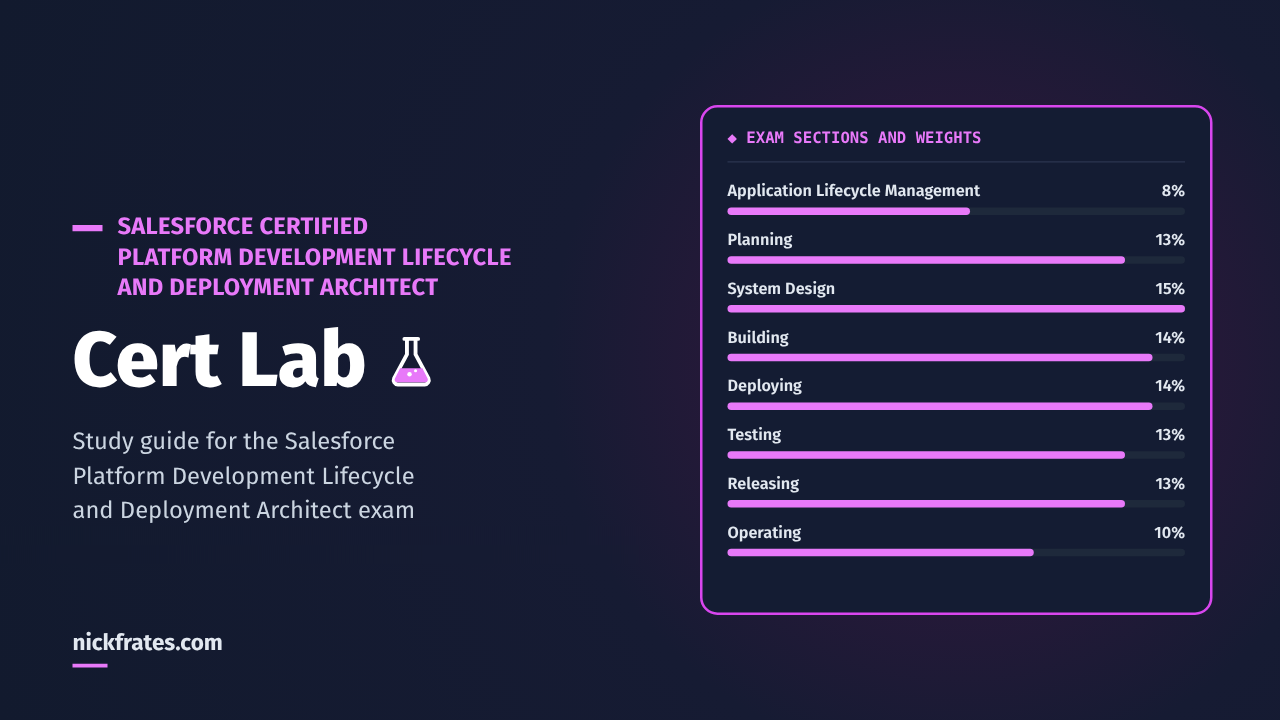
Platform Development Lifecycle and Deployment Architect Cert Lab: exam sections and weights
29lessons weighted like the exam, so your time goes where the points are
670practice questions that explain every answer
4timed practice exams that show you're ready before you book
$9.99for 12 months, with a 30-day refund

What the Platform Development Lifecycle and Deployment Architect cert can do for you

Salesforce Certified Platform Development Lifecycle and Deployment Architect says you can design the governance, environments, source control, testing and release approach that keep Salesforce changes safe as a team grows. Here's what people usually want from it, and how this course helps you get there.

A credential for the delivery work you already do

It's a credential anyone can verify with Salesforce, covering lifecycle management, planning, system design, building, deploying, testing, releasing and operating. That's something concrete for your next review, résumé or rate conversation.

A step toward architect roles

Salesforce's exam guide describes a candidate with 2 to 3 years of Salesforce Platform experience plus 1 to 2 years each on DevOps topics, governance committees and application lifecycle management. Typical roles in the guide include Technical Lead, Release Manager, Environment Manager and Technical Architect. The exam has no prerequisite, so you can show that depth when you're ready.

A calm voice when a release gets risky

When someone proposes a change, you'll be able to ask which sandbox it belongs in, how it will be tested, how it will be deployed and what happens if it has to be rolled back, and explain your answer with the platform's own reasoning.

Walking into the exam calm

By exam day you'll have taken 4 full practice exams on a 105-minute timer, so you'll know where you stand against the 65% pass mark before you pay the US$400 fee (US$200 to retake).

Every feature, and what it does for you

Lessons weighted like the exam

29 lessons follow the official guide's 8 sections and weights. System Design (15%) is the biggest section, with Building and Deploying (14% each) right behind. Application Lifecycle Management has 2 lessons, Operating has 3 and every other section has 4.

10 questions after every lesson

You find out right away whether a lesson stuck, while it's still fresh, instead of finding the gap on exam day.

Every answer explained

Each question explains why the right answer is right and why the other options are wrong, so a scenario you've never seen before still makes sense.

Scenarios like the real thing

Questions put you in the architect's seat: a team, an org landscape, a release date and a risk. Short Try it tasks you can do in a Trailhead Playground or a free org.

A section check, flashcards and a practice quiz per section

Short, self-contained study sessions. Ten minutes of flashcards on a lunch break still moves you forward when your week is full.

4 full practice exams

60 questions, a 105-minute timer and the 65% pass mark. Your results show which sections need work, so you book with evidence instead of hope.

What you'll be able to do

The exam tests whether you make the right lifecycle and deployment call for a given scenario. Here's what you'll know when you finish, and why it matters at work.

  • Compare development methodologies and recommend governance based on a customer's maturity and project risk (Application Lifecycle Management).
  • Assess ALM maturity, the people, technology and process a customer needs, and plan for each Salesforce release (Planning).
  • Define a sandbox strategy for multiple project streams, training, staging, production and hotfixes, and choose deployment tools (System Design).
  • Choose branching and merging approaches, org-based or package-based development, scratch orgs or sandboxes, and the quality practices that keep code healthy: coding standards, pull requests, reviews and static analysis (Building).
  • Explain what the Metadata and Tooling APIs can and cannot do, handle pre- and post-deployment steps, and move configuration stored as data (Deploying).
  • Recommend a testing methodology, execution approach, coverage targets and a secure, representative test data strategy (Testing).
  • Compare managed, unmanaged and unlocked packages and recommend a release management strategy (Releasing).
  • Explain the implications of changes made directly in production and how to bring them back into the lifecycle (Operating).

Try one before you buy

This is a real question from the free lesson, SYS3: Sandbox Types and Environment Strategy. Pick an answer, then open the explanation.

Which environment do the DevOps patterns recommend for integration testing?

  • A. A Full Copy sandbox that the whole team uses for daily development work
  • B. Scratch orgs that are shared across the feature teams for daily integration
  • C. Partial Copy sandboxes with representative data configured through templates
  • D. Developer sandboxes with test data that each of the developers creates by hand
Show the answer and explanation

Answer: C. Partial Copy plus templates gives representative data at lower cost than Full Copy.

Developer sandboxes are for individual work.

Your 6-week plan

A suggested schedule of about 5 hours a week. Go faster or slower, you have 12 months. Each section ends with a section check, flashcards and a practice quiz, so you know it stuck before you move on.

Step 1

Application Lifecycle Management and Planning

Development methodologies, governance by customer maturity and risk, ALM maturity, environment risks, governance bodies and seasonal release planning.

Step 2

System Design

Agile tools and process, org strategy, sandbox types and environment strategy, and the components and tools of a deployment strategy.

Step 3

Building

Source control and branching, test data and unit tests, org and package development, and code quality with pull requests and static analysis.

Step 4

Deploying and Testing

The Metadata and Tooling APIs, pre- and post-deployment steps, technical reference data, then testing methodology, coverage, test data and automation.

Step 5

Releasing and Operating

Managed, unmanaged and unlocked packages, release plans and strategy, CI and delivery, then production changes and common release artifacts.

Step 6

Review, practice exams and exam day

Start the 4 practice exams on a 105-minute timer, reread the lessons behind each miss, and use flashcards for your two weakest sections before you book.

Why a plan built on practice works

Pulling an answer out of memory strengthens it more than rereading does. Researchers call it retrieval practice. In a 2006 study by Roediger and Karpicke, students who practiced recall remembered about 61% a week later, against about 40% for students who reread. Read more in The Science of Studying for Salesforce Certifications.

That's why every part of this course asks you to answer, not just read: lessons, section checks, flashcards, quizzes and practice exams.

See exactly what you'll study

8 sections · 29 lessons · 670 practice questions · 4 practice exams. Try a free lesson before you decide.

Start here · study guide
  • Platform Development Lifecycle and Deployment Architect study guide🔒 Locked
Application Lifecycle Management · 8% · 2 lessons
  • ALM1: Development Methodologies: Agile, Waterfall and Hybrid Compared🔒 Locked
  • ALM2: Matching Governance to Customer Maturity and Project Risk🔒 Locked
  • Section check, flashcards and a 6-question practice quiz🔒 Locked
Planning · 13% · 4 lessons
  • PLN1: Assessing ALM Maturity: People, Technology and Process🔒 Locked
  • PLN2: Customer Environment Risks and Mitigation🔒 Locked
  • PLN3: Governance Frameworks and Governance Bodies🔒 Locked
  • PLN4: Planning for Salesforce Seasonal Releases🔒 Locked
  • Section check, flashcards and a 10-question practice quiz🔒 Locked
System Design · 15% · 4 lessons
  • SYS1: Agile Tools and the Agile Development Process🔒 Locked
  • SYS2: Org Strategy: Business, Technical and Architectural Considerations🔒 Locked
  • SYS3: Sandbox Types and Environment StrategyTry a free lesson
  • SYS4: Components and Tools of a Deployment Strategy🔒 Locked
  • Section check, flashcards and a 10-question practice quiz🔒 Locked
Building · 14% · 4 lessons
  • BLD1: Source Control: Branching, Versioning and Merging🔒 Locked
  • BLD2: Test Data and Unit Test Approaches🔒 Locked
  • BLD3: Org Development vs Package Development, Scratch Orgs vs Sandboxes🔒 Locked
  • BLD4: Code Quality: Standards, Pull Requests, Review and Static Analysis🔒 Locked
  • Section check, flashcards and a 10-question practice quiz🔒 Locked
Deploying · 14% · 4 lessons
  • DPL1: Metadata API for deployment: capabilities and limits🔒 Locked
  • DPL2: Tooling API and deployment considerations🔒 Locked
  • DPL3: Pre- and post-deployment steps and unsupported metadata🔒 Locked
  • DPL4: Managing and deploying technical reference data🔒 Locked
  • Section check, flashcards and a 10-question practice quiz🔒 Locked
Testing · 13% · 4 lessons
  • TST1: Choosing a Testing Methodology🔒 Locked
  • TST2: Test Execution and Coverage Requirements🔒 Locked
  • TST3: Unified Test Data Strategy and Secure Representative Data🔒 Locked
  • TST4: Test Automation and Testing Across Salesforce Releases🔒 Locked
  • Section check, flashcards and a 10-question practice quiz🔒 Locked
Releasing · 13% · 4 lessons
  • REL1: Managed, unmanaged and unlocked packages🔒 Locked
  • REL2: Mapping sandboxes to a release plan: streams, training, staging and hotfixes🔒 Locked
  • REL3: Release management strategy🔒 Locked
  • REL4: Continuous integration and delivery considerations🔒 Locked
  • Section check, flashcards and a 10-question practice quiz🔒 Locked
Operating · 10% · 3 lessons
  • OPS1: Changes made directly in production: implications🔒 Locked
  • OPS2: Bringing production changes back into the ALM process🔒 Locked
  • OPS3: Managing common release artifacts across multiple orgs🔒 Locked
  • Section check, flashcards and an 8-question practice quiz🔒 Locked
Practice exams · 4 full exams · 60 questions each
  • Practice Exam 1: 60 questions, 105-minute timer🔒 Locked
  • Practice Exam 2: 60 questions, 105-minute timer🔒 Locked
  • Practice Exam 3: 60 questions, 105-minute timer🔒 Locked
  • Practice Exam 4: 60 questions, 105-minute timer🔒 Locked

How it's built

The lessons start where candidates lose points on this exam: reading what a scenario really asks, matching it to the right governance, environment or deployment practice, and spotting the choice that causes a failed release. It's not a glossary drill.

Every fact in the course is checked against Trailhead, Salesforce developer documentation, Salesforce Help or the Salesforce Well-Architected DevOps patterns, and each lesson lists its sources. If a fact can't be sourced, it isn't in the course. For a wider look at the exam, read the Platform Development Lifecycle and Deployment Architect study guide.

Is it right for you?

You're an admin or developer growing into release management

You already build on the platform. This shows you the lifecycle reasons behind the choices: methodologies, governance, environments, source control and deployment.

You're a technical lead who owns environments and deployments

You decide where changes are built, tested and released every week. This gives you the exam's way of reasoning about those choices.

You've done Trailhead and want exam-style practice

Badges teach the topics. This adds hundreds of exam-style questions with the reasoning behind each answer, and timed practice exams that tell you when you're ready.

You're retaking after a miss

Use the section weights and the practice exam results to find where the points went, then fix those lessons first.

Everything you get

29 lessons across all 8 exam sections, plus a study guide
Every section covered, in proportion to its weight on the exam
✓
670 practice questions with explanations: 290 in lessons, 66 in section checks, 74 in 8 practice quizzes, 240 in practice exams
Enough repetition that the right answer comes quickly under time pressure
✓
4 full practice exams of 60 questions each, timed at 105 minutes
Know your score before you book the exam
✓
A section check and flashcards for every section (29 flashcard decks)
Quick reviews that fit into a short break
✓
Scenario questions and Try it tasks you can do in a free org
Practice the decisions, not just the definitions
✓
Sources on every lesson, checked against official pages
Verify any fact yourself
✓
12 months of access and a 30-day refund
Study at your pace, with no risk
✓

For comparison, the exam costs US$400 and a retake costs US$200, according to the official Salesforce exam guide.

✓ 30-day refund

Questions

How much does the Platform Development Lifecycle and Deployment Architect Cert Lab cost?

$9.99 for 12 months of access to every lesson, quiz and practice exam.

How long does it take to study for the Platform Development Lifecycle and Deployment Architect exam with Cert Lab?

Roughly 29 hours at a steady pace, or about 6 weeks at 5 hours a week. It's self-paced, with 12 months of access, so you can go faster or slower. The course has 29 lessons across 8 exam sections, a section check, flashcards and a practice quiz for each section, and 4 practice exams of 60 questions. Start with the heaviest weights: System Design is 15%, and Building and Deploying are 14% each.

What's in the practice exams?

4 full practice exams of 60 questions each, 105 minutes each, weighted by section like the official exam guide. After you submit, you see the correct answers and an explanation for every question.

Do I need Salesforce experience for the Platform Development Lifecycle and Deployment Architect exam?

No. The exam has no prerequisite. Salesforce's exam guide describes a candidate with 2 to 3 years of Salesforce Platform experience, plus 1 to 2 years each working on Salesforce DevOps topics, working with governance committees and working in application lifecycle management.

What is the passing score for the Platform Development Lifecycle and Deployment Architect exam?

65% on 60 questions plus up to five unscored ones, in 105 minutes, according to the official Salesforce exam guide. The exam fee is US$400, and a retake is US$200.

What if it's not for me?

Email refunds@nickfrates.com within 30 days for a full refund.

Earn the cert, and run releases with proof behind your choices.

Pass the exam, bring sharper governance, environment and deployment habits to your next release and give yourself a credential you can point to.

$9.9912 months of access ✓ 30-day refund

Not ready to buy? Try a free lesson and judge it for yourself.

$9.99 · 12 months
Platform Development Lifecycle and Deployment Architect Cert Lab · 30-day refund
Get the Cert Lab, $9.99

Platform Development Lifecycle and Deployment Architect Cert Lab

Categories: Salesforce Developer
Wishlist Share

About Course

Study course for the Salesforce Certified Platform Development Lifecycle and Deployment Architect exam: lessons for all 8 exam sections (Application Lifecycle Management; Planning; System Design; Building; Deploying; Testing; Releasing; and Operating), each with a section check, flashcards and a practice quiz, plus a study guide.

Who it's for

  • Admins and developers growing into release management who want the credential for the delivery work they already do.
  • Technical leads, release managers and environment managers who want the governance, sandbox, source control and deployment reasoning behind their choices in one exam-weighted course.
  • Anyone who missed a pass and wants timed, exam-weighted practice on their weak sections.

What it costs

$9.99 for 12 months of access to every lesson, quiz and practice exam.

How long it takes

Roughly 29 hours at a steady pace, or about 6 weeks at 5 hours a week. It's self-paced, with 12 months of access, so go faster or slower. The course has 29 lessons across 8 exam sections, a section check, flashcards and a practice quiz for each section, and 4 practice exams of 60 questions. Start with the heaviest weights: System Design is 15%, and Building and Deploying are 14% each.

What you get out of it

  • Lessons follow the official exam guide sections and weights, so your time goes where the points are. Application Lifecycle Management has 2 lessons, Operating has 3 and every other section has 4.
  • Every quiz question explains why each option is right or wrong and links to the source: Trailhead, Salesforce developer documentation, Salesforce Help or the Salesforce Well-Architected DevOps patterns.
  • Scenario questions that ask which lifecycle, environment or deployment choice a team should make, plus a section check and flashcards at the end of every section.
  • 4 full practice exams of 60 questions each, weighted like the real exam, show your weak sections before you book.

Why practice tests work

Drilling practice tests works because of retrieval practice: pulling an answer out of memory strengthens it more than rereading does. In a 2006 study by Roediger and Karpicke, students who practiced recall remembered about 61% a week later, against about 40% for students who reread. A 2013 review led by John Dunlosky rated practice testing as one of only two high-utility study techniques. Read more in The Science of Studying for Salesforce Certifications.

Pass mark and exam format

60 questions plus up to 5 unscored ones, 105 minutes, and a passing score of 65%. The fee is US$400, with a US$200 retake. There's no prerequisite. Salesforce says the exam questions align to the Spring '23 release.

FAQ

How much does the Platform Development Lifecycle and Deployment Architect Cert Lab cost?

$9.99 for 12 months of access to every lesson, quiz and practice exam.

How long does it take to study for the Platform Development Lifecycle and Deployment Architect exam with Cert Lab?

Roughly 29 hours at a steady pace, or about 6 weeks at 5 hours a week. It's self-paced, with 12 months of access, so you can go faster or slower. The course has 29 lessons across 8 exam sections, a section check, flashcards and a practice quiz for each section, and 4 practice exams of 60 questions. Start with the heaviest weights: System Design is 15%, and Building and Deploying are 14% each.

What's in the practice exams?

4 full practice exams of 60 questions each, 105 minutes each, weighted by section like the official exam guide. After you submit, you see the correct answers and an explanation for every question.

Do I need Salesforce experience for the Platform Development Lifecycle and Deployment Architect exam?

No. The exam has no prerequisite. Salesforce's exam guide describes a candidate with 2 to 3 years of Salesforce Platform experience, plus 1 to 2 years each working on Salesforce DevOps topics, working with governance committees and working in application lifecycle management.

What is the passing score for the Platform Development Lifecycle and Deployment Architect exam?

65% on 60 questions plus up to five unscored ones, in 105 minutes, according to the official Salesforce exam guide. The exam fee is US$400, and a retake is US$200.

What if it's not for me?

Email refunds@nickfrates.com within 30 days for a full refund.

Show More

Course Content

Start here: Study guide

  • Platform Development Lifecycle and Deployment Architect study guide

Application Lifecycle Management (8%)

Planning (13%)

System Design (15%)

Building (14%)

Deploying (14%)

Testing (13%)

Releasing (13%)

Operating (10%)

Practice Exams

Student Ratings & Reviews

No Review Yet
No Review Yet