Hey friends,
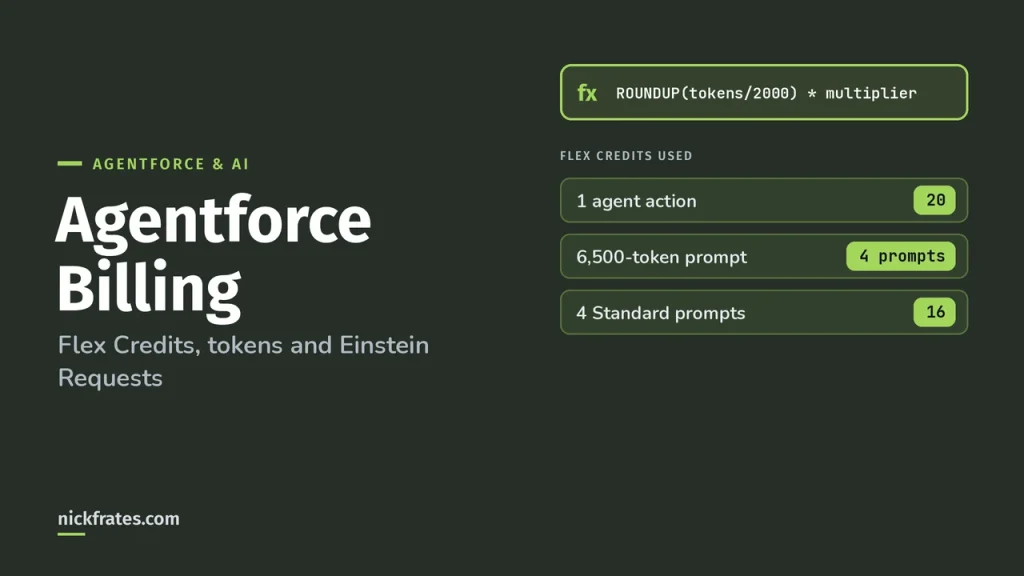
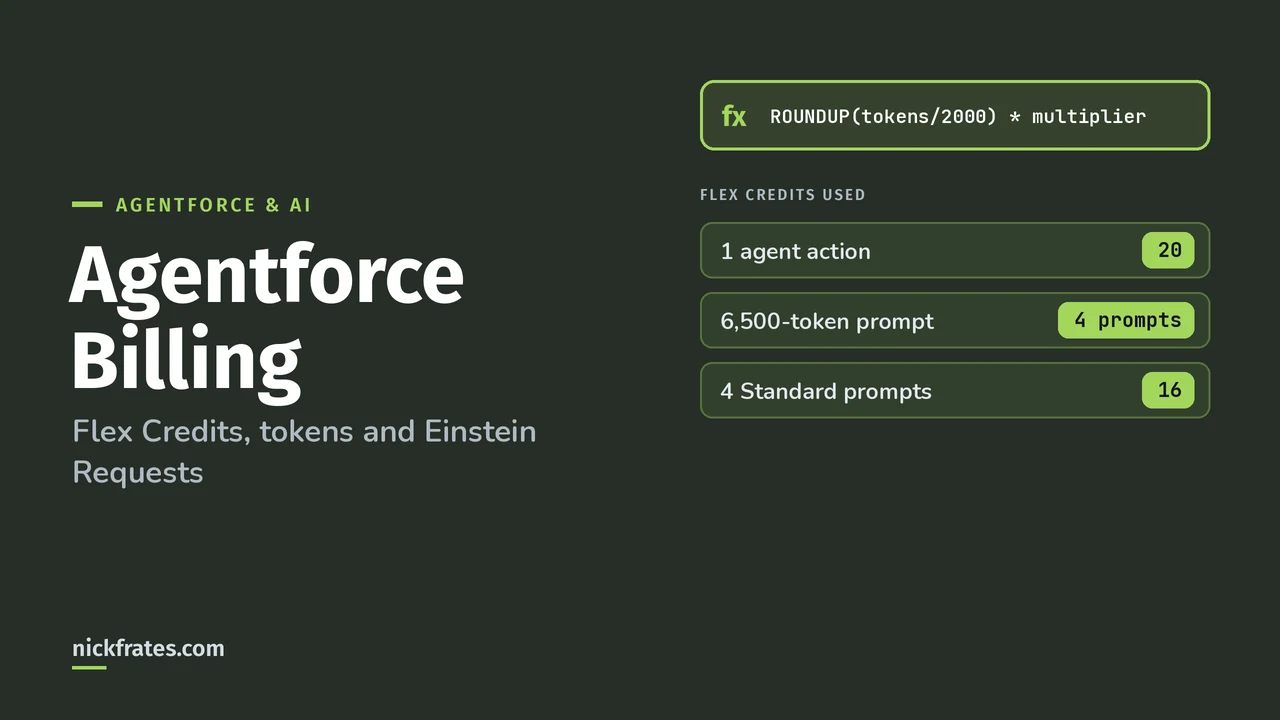
Agentforce billing is based on what the agent does, not on how many tokens it reads. Every standard or custom action an agent runs costs 20 Flex Credits in production (16 in a sandbox), and Salesforce Help says each action is metered as one action "irrespective of the number of tokens processed." Tokens only matter for prompts, which Salesforce meters in 2,000-token chunks, rounded up.
At the list price of $500 per 100,000 Flex Credits on the Agentforce pricing page, one action works out to $0.10, which is the number Salesforce uses in its own examples. If you want the price list and buying models, start with my Agentforce pricing breakdown. This post is about the meter itself: what counts, what doesn't and how to read the rate cards.
I'm Nick Frates, a senior Salesforce developer with 17 Salesforce certifications. Every number below comes from Salesforce Help or an official Salesforce rate card, with the link next to it.
What are the three Agentforce billing meters?
Salesforce describes three units in Agentforce and Generative AI Usage and Billing. Which ones your org uses depends on what you bought.
| Meter | What it counts | Where it shows up |
|---|---|---|
| Flex Credits | Agent actions, prompts, voice actions, Help Agent resolutions, speech services and more, each at its own multiplier | The Flex Credits card in Digital Wallet |
| Conversations | Conversation windows for ASA Messaging, plus Sales Coach and SDR conversations | The Conversations card |
| Einstein Requests | Direct calls to the LLM gateway (large language model gateway) from embedded generative AI features, for products that still use them | The Einstein Requests card |
Help explains the conversion in three steps: usage is mapped to a usage type, the raw units are counted (one action, one prompt), then the units are converted to Flex Credits with the multiplier from the rate card. That multiplier is what lets very different AI services bill against one pool.
How are agent actions billed?
These are the rules from Flex Credits Billable Usage Types that matter most when you design an agent:
- One action, one charge. Every standard or custom action called in a text conversation is metered as one action, no matter how many tokens it processes.
- Deterministic actions count too. Actions are billed when they run, whether the agent runs them from reasoning instructions or picks them during LLM reasoning.
- Utilities are free. Escalating to a representative, setting variables and transitioning to another topic aren't billed as agent actions.
- Voice costs more. Standard and custom actions in a voice conversation are separate usage types at 30 Flex Credits in production.
- Custom code can add charges. Help notes that async calls to Salesforce AI inside a custom action implementation may incur additional charges.
Salesforce's own example on the pricing page: a self-service "Where is My Order?" agent uses 2 actions per request, so 40 Flex Credits. At 20 requests a day for 30 days, that's 24,000 Flex Credits, or $120 a month.
How do Agentforce tokens turn into prompts?
Prompts are where tokens come in. Help's rule for every prompt type is the same: each prompt covers up to 2,000 tokens of input plus output, usage is rounded up in 2,000-token increments, and every extra chunk counts as a new prompt.
Prompts metered = ROUNDUP((input tokens + output tokens) / 2,000)
Credits used    = Prompts metered x usage type multiplier
Help's example: a prompt with 6,500 input and output tokens is metered as 4 prompts. The Flex Credits Rate Card then sets the multiplier by model tier:
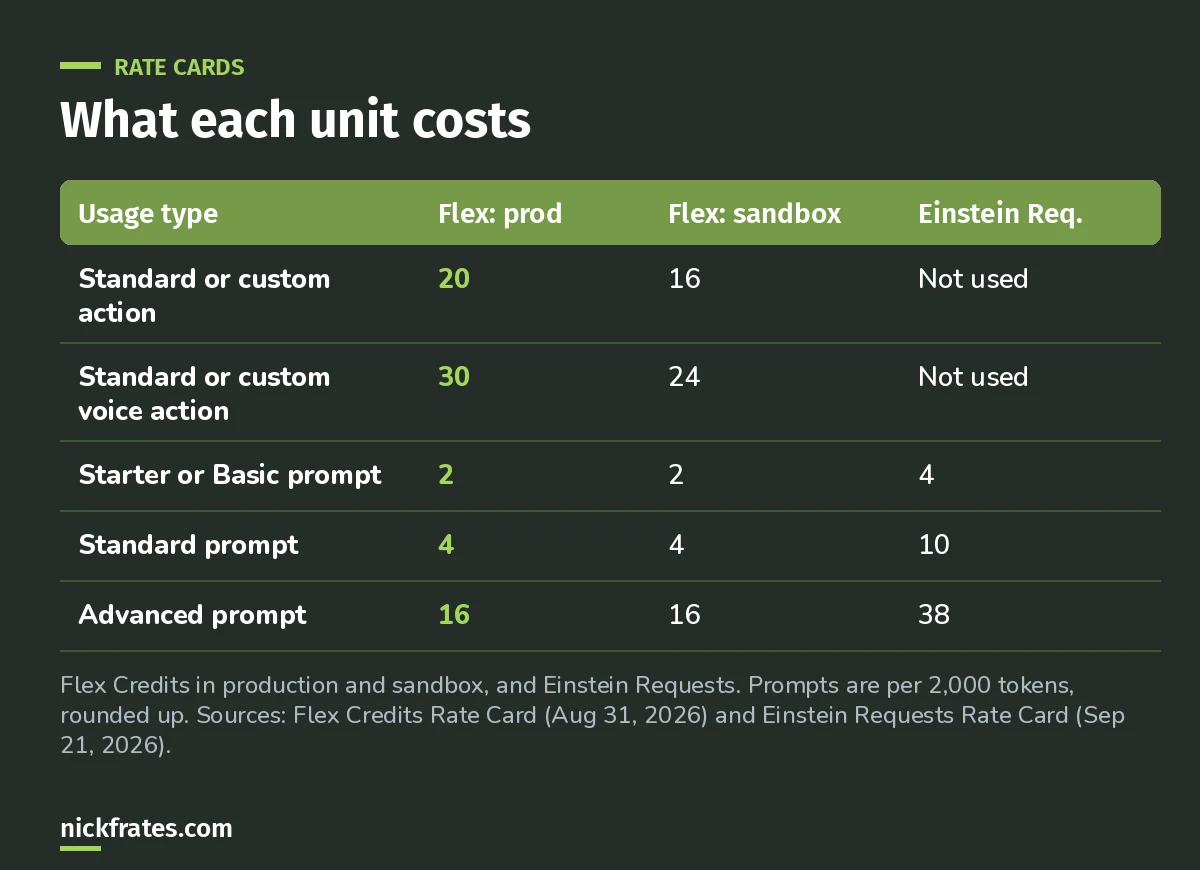
Actions don't use Einstein Requests. The prompt multipliers depend on the model behind the prompt.
So that 6,500-token prompt on a Standard model costs 4 x 4 = 16 Flex Credits. At $500 per 100,000 credits, that's $0.08. The same prompt on a Starter or Basic model is 8 Flex Credits. That's my arithmetic from the official multipliers, and it's the quickest way to sanity-check a prompt-heavy design.
Which tier applies depends on the model, and Help points you to its Large Language Model Support page for the mapping. Starter Prompts are the Bring Your Own Large Language Model (BYOLLM) tier. One date to know: Help says Salesforce starts metering Advanced Prompts on July 21, 2026.
Einstein Requests vs Flex Credits: which does your org use?
If you have Agentforce 1 Edition or an Agentforce for Sales, Service or Industries add-on, you're on Flex Credits. Salesforce's Einstein Request and Flex Credit Rate Card Updates FAQ says these customers stopped needing Einstein Requests as of October 24, 2025, and the Prompt usage types were added to the Flex Credits Rate Card instead.
Einstein Requests still apply to products that consume them, and the FAQ names Tableau Cloud, Marketing Cloud, Commerce Cloud and MuleSoft as the ones where many features became unmetered. If you bought Salesforce Foundations Flex Credits before October 24, 2025, you consume both: Einstein Requests for generative AI and Flex Credits for actions.
The Einstein Requests Rate Card uses the same size rule with its own multipliers. Its two examples: a Starter call with 1,000 tokens consumes 4 Einstein Requests, and a Standard call with 3,500 tokens consumes 20. The FAQ also notes the BYOLLM multiplier dropped from 7 to 4.
Conversations work differently. On the Conversations card, ASA Messaging counts conversation windows (24 hours for authenticated Messaging for Web users), Sales Coach counts each "Get Feedback" click and SDR counts the first email to a lead. Help adds that each conversation consumes Einstein Requests when it accesses the LLM.
Cert Lab by Nick Frates
Let the Agentforce Specialist Cert Lab test you to success
Billing, metering and agent design all show up in Agentforce Specialist scenarios. Practice them with questions that explain every option and link to the Help page behind it.
Start the Agentforce Specialist Cert Lab for $9.99 →What Agentforce usage isn't metered?
Some usage is free, but only when every condition is met. From Metering for Agentforce and Generative AI Usage, global unmetering needs all three of these:
- The user has the Unmetered User-Based AI permission.
- The action or prompt runs as the current user, not as the Automated Process user or another identity.
- Usage stays within 30 LLM calls per minute per user. Help says this limit isn't technically enforced yet.
| Scenario (Help examples) | Metered? | Why |
|---|---|---|
| A user clicks a button to launch a prompt template | Unmetered | Runs as the current user with the right permissions |
| A record-triggered flow runs as the Automated Process user | Metered | Not the current user |
| A record-triggered flow runs as the current user | Unmetered | Runs as the current user |
| Scheduled Apex or batch jobs | Metered | No direct user interaction |
| An agent runs on a schedule to summarize cases | Metered | Scheduled execution |
Two catches. Data 360 services still consume credits even when the AI call is unmetered. And anything driven by Agentforce Grid is always metered. The permission set license setup is in Configure User Permissions for Unmetered Licenses.
Do testing and sandboxes use Flex Credits?
Yes. Help says building agents in Agentforce Builder isn't metered, but previewing an agent in chat or voice is. Testing through Agentforce Builder, Testing Center and sandboxes is metered too. My Agentforce Testing Center guide covers how those batch tests work.
Sandboxes get a discount on some usage types. The Flex Credits Rate Card applies its Sandbox multiplier to sandboxes and scratch orgs: 16 instead of 20 for actions, 24 instead of 30 for voice actions, and 0 for Help Agent Resolutions (400 in production). Prompt multipliers are the same in both.
What else consumes Flex Credits?
- Help Agent Resolutions: billed only when a session counts as resolved, at 400 Flex Credits in production. A chat resolution covers up to 2 hours and a voice resolution up to 10 minutes.
- Agentforce Voice Minutes: for customers who bought them, calls are rounded up to the next minute, so 61 seconds bills as 2 minutes.
- Speech Foundations: speech to text is 150 per hour of transcription, text to speech 6,000 per 1M characters and translation 4,000 per 1M characters.
- Data 360: its own usage types, with volume tiers, on the same rate card.
One more from the rate card: Flex Credits must be used before the Order End Date on your order form, with no rollover. And per Help, using Flex Credits requires Salesforce Foundations.
Where do you check Agentforce usage?
In Digital Wallet. It shows every consumption card, credits consumed and remaining, and breakdowns by usage type, agent and action. I wrote a separate step-by-step on monitoring Agentforce usage in Salesforce Digital Wallet, including the threshold alert flow.
Mistakes I see with Agentforce billing
- Estimating by tokens for agents. Agent actions are a flat 20 Flex Credits each. Count actions per conversation instead.
- Forgetting deterministic actions. An action fired from instructions costs the same as one the LLM picks.
- Assuming flows are free for AI. A prompt that runs as the Automated Process user is metered.
- Ignoring testing. Previews, Testing Center runs and Grid all draw credits.
- Huge prompt context. Every 2,000 tokens is another prompt, so trim what you ground the prompt with.
- Mixing up meters. If your org still has Einstein Requests, the prompt multipliers are 4, 10 and 38, not 2, 4 and 16.
If you're studying for the Agentforce Specialist exam, the Agentforce Specialist Cert Lab that Nick Frates built at nickfrates.com drills these scenarios with short quizzes and explained answers.
FAQ
How much does one Agentforce action cost?
20 Flex Credits in production, which is $0.10 at the list price of $500 per 100,000 Flex Credits. Voice actions are 30 Flex Credits.
Does Agentforce charge per token?
Not for actions. Actions are metered per action regardless of tokens. Prompts are metered per 2,000 tokens of input plus output, rounded up.
What's the difference between Einstein Requests and Flex Credits?
Both meter generative AI. Agentforce 1 Edition and the Agentforce add-ons moved to Flex Credits on October 24, 2025. Einstein Requests remain for products that still consume them, with higher multipliers (4, 10 and 38).
Is Agentforce usage in a sandbox free?
No. Actions are 16 Flex Credits in a sandbox instead of 20, and prompts cost the same as production. Help Agent Resolutions are 0 in sandboxes.
Where should you go next?
- Agentforce pricing explained: list prices, Conversations and buying models.
- Salesforce Digital Wallet: monitor usage and set alerts.
- Agentforce topics and actions: design agents that use fewer actions.
- Agentforce Specialist study guide.
Cert Lab by Nick Frates
Let the Agentforce Specialist Cert Lab test you to success
Lessons, practice questions and flashcards for every Agentforce Specialist exam section, with each answer explained and linked to Salesforce Help.
Start the Agentforce Specialist Cert Lab for $9.99 →Hope this helps!
Best,
Nick