Hey friends,
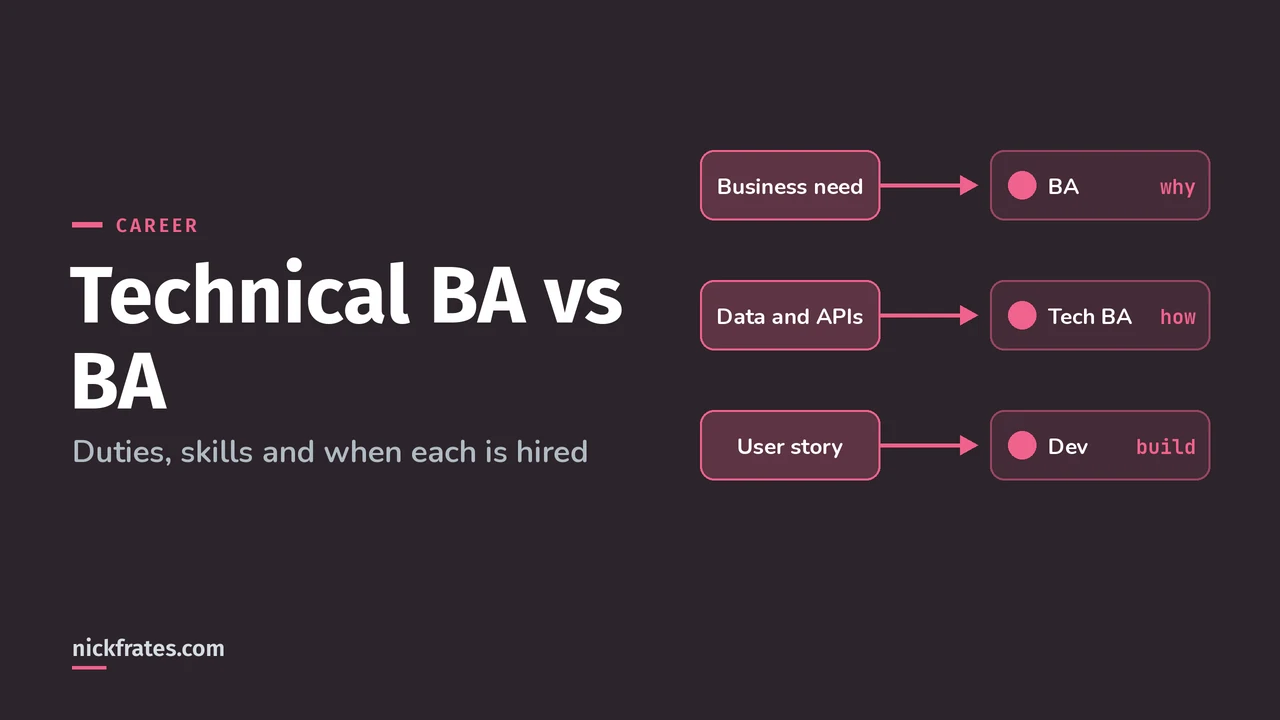
A Salesforce business analyst focuses on what the business needs and why. A technical business analyst focuses on how the system will meet it: data mappings, integrations and detailed specs that developers build from. Same family of skills, different depth, and many people move from one to the other.
There's no official Salesforce definition of "technical BA," so what follows is my take from working with both on real projects, anchored to what Salesforce says about the BA role.
The differences at a glance
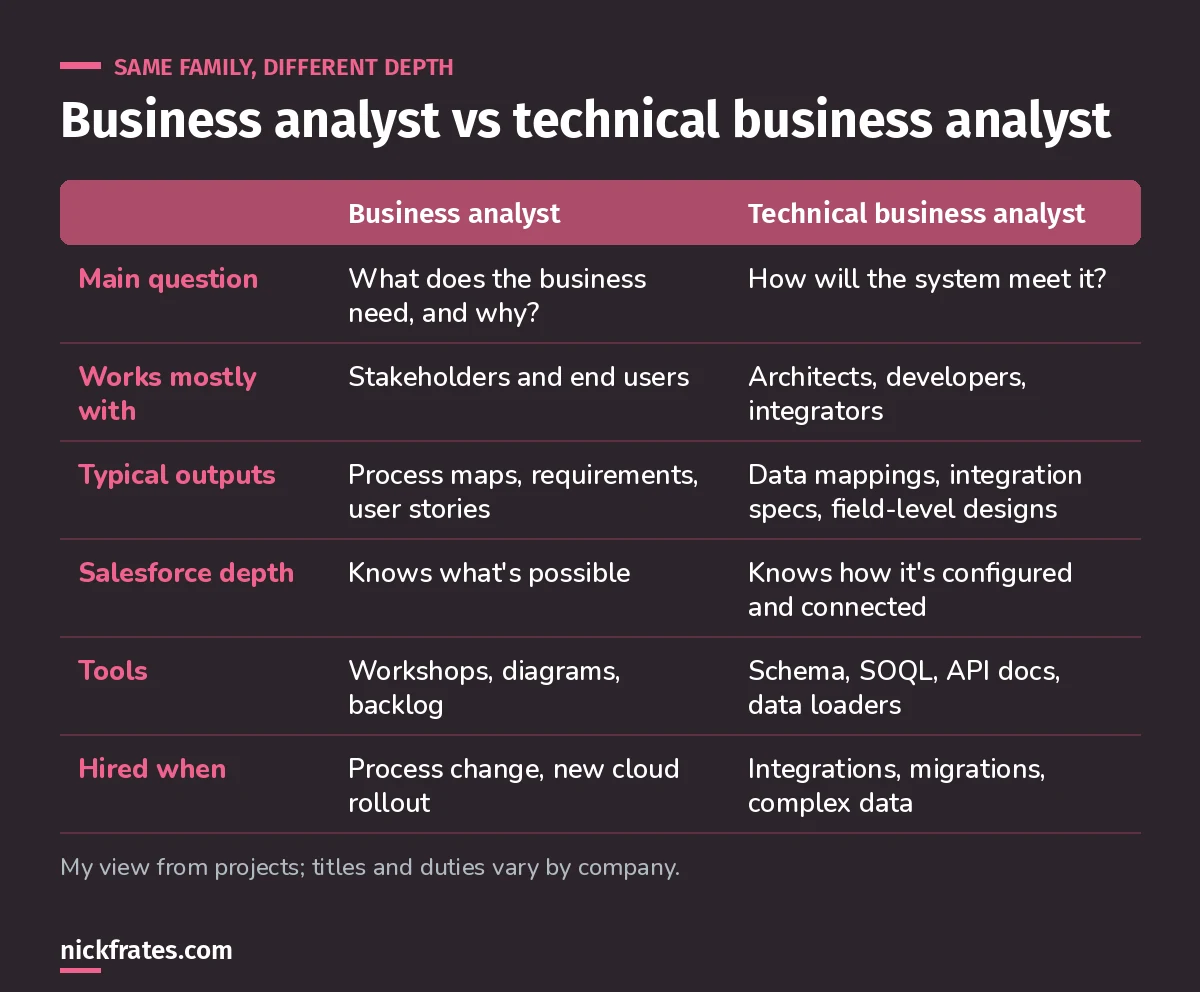
One owns the why, the other owns the how. Good teams need both.
What a Salesforce BA owns
Trailhead describes the BA as the interpreter between IT and business stakeholders who elicits, documents and analyzes requirements (Quick Look). The Business Analyst exam guide is explicit about the boundary: candidates aren't expected to develop custom code or design a technical solution.
- Discovery workshops and stakeholder interviews
- Current and future state process maps
- Requirements and user stories with acceptance criteria
- Supporting user acceptance testing (UAT)
What a technical BA adds
A technical BA takes those requirements one level deeper, so developers and integration teams don't have to guess:
- Data mapping. Which source field lands in which Salesforce field, with types, picklist values and transformations.
- Integration specs. What system sends what, when, and what happens on failure.
- Field-level design. Objects, relationships, validation rules and automation described precisely enough to build.
- Querying data. Running SOQL or reports to check assumptions before they become requirements.
Trailhead's documentation unit covers the range of documents BAs produce. Technical BAs live at the detailed end. Many teams also keep specs in version control alongside the build, which Trailhead explains in its Git and GitHub basics module.
I'll be honest about how I learned this stuff. I loved Focus on Force and used it through 17 Salesforce certifications. Rereading was slow for me; taking practice tests rapid-fire and studying every wrong answer was fast. So I built Cert Lab around that: test yourself quickly, see why each option is right or wrong, with up-to-date links and screenshots.
Cert Lab by Nick Frates
Let the Business Analyst Cert Lab test you to success
The BA exam tests the business side: discovery, stakeholders, requirements, stories and UAT. Practice those fast with scenario quizzes and every answer explained.
Start the Business Analyst Cert Lab for $9.99 →When do companies hire each one?
| Project | Usually hires |
|---|---|
| Rolling out Sales Cloud to a new team | Business BA |
| Redesigning a sales or service process | Business BA |
| Migrating data from a legacy CRM | Technical BA |
| Integrating Salesforce with an ERP | Technical BA |
| Large multi-cloud program | Both, often in the same team |
Small teams often want one person who can do both. If that's you, lead with business skills in interviews; technical depth is easier to borrow from a developer than stakeholder trust is.
How to move from BA to technical BA
- Learn the data model properly. My data modeling post and lookup vs master-detail are good starts.
- Get comfortable reading and writing basic SOQL.
- Shadow an integration or migration and write the data mapping yourself.
- Add Platform App Builder or Administrator. See my best certs for BAs ranking.
FAQ
Does a technical BA need to code?
Usually not to build, but reading code, queries and API payloads helps a lot.
Which pays more?
It varies by market and company. Technical depth often adds leverage, but so does strong stakeholder leadership. I wouldn't pick a path on pay alone.
Which certification fits a technical BA?
Business Analyst for the core craft, plus Platform App Builder or Administrator for the technical side.
Where should you go next?
Cert Lab by Nick Frates
Let the Business Analyst Cert Lab test you to success
Lessons, flashcards, a quiz for each of the six exam sections and full practice exams, every answer explained.
Start the Business Analyst Cert Lab for $9.99 →Hope this helps!
Best,
Nick