Hey friends,
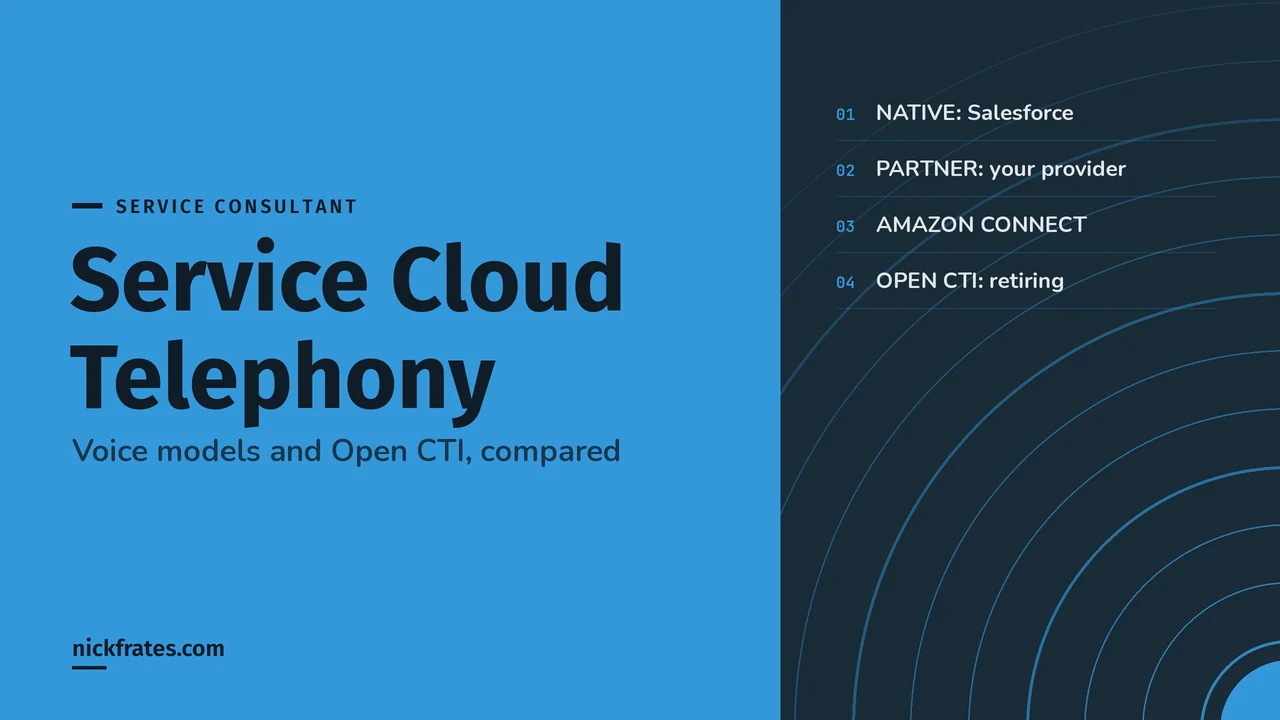
Salesforce Service Cloud telephony integration in 2026 comes down to two paths: Salesforce Voice, which puts calls, transcripts and call records right inside Salesforce using native telephony, Amazon Connect or a partner provider, and Open CTI, the older JavaScript toolkit for building your own softphone, which is now in maintenance mode and scheduled to retire in February 2028. For a new contact center, Voice is the answer.
If you're studying for the Agentforce Service Consultant exam, this matters. The exam guide lists "recommend contact models/channels" including telephony as a skill, and "use telephony, SMS, and Salesforce Voice" as an ability. Intake and Interaction Channels is 13% of the exam. Below I'll walk through each option, the renames that confuse everyone, and how I'd pick between them.
What happened to the name Service Cloud Voice?
Service Cloud Voice was renamed Salesforce Voice with Telephony Providers, and that product is now part of Partner Contact Center. The built-in option, Salesforce Voice (Native Telephony), is now part of Agentforce Contact Center (Choose Your Voice Telephony Model).
Salesforce says you'll still see the old names in the app and docs, so learn both. If an exam question or a client says "Service Cloud Voice," they mean phone calls handled inside Salesforce through a connected telephony provider.
What are the Salesforce Voice telephony models?
There are four, and the difference is who provides the phone lines, how much setup you do, and how you're billed:
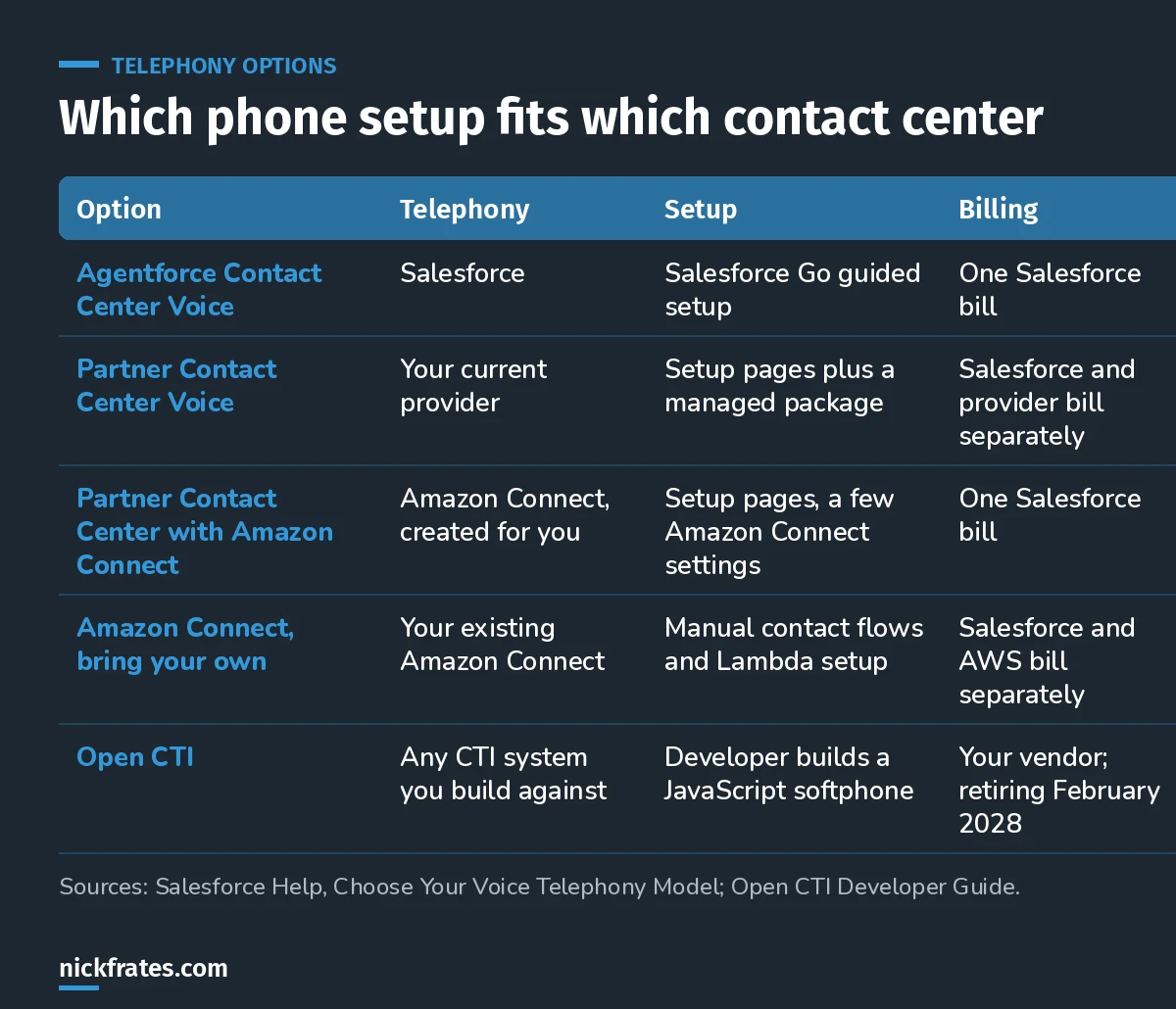
The billing row is a common tiebreaker: some clients want one bill, others want to keep a provider they already pay.
- Agentforce Contact Center Voice (formerly Salesforce Voice Native Telephony). Salesforce is the telephony provider. Salesforce positions it for fast, end-to-end setup with Agentforce voice-enabled agents out of the box.
- Partner Contact Center Voice (formerly Salesforce Voice with Partner Telephony). Keep the provider you already have and integrate it through a managed package. Ask your Salesforce rep whether your provider is supported.
- Partner Contact Center with Amazon Connect (formerly Salesforce Voice with Amazon Connect). Salesforce creates the Amazon Connect instance for you and handles most of the setup. You can monitor telephony usage in a Salesforce report.
- Partner Contact Center with Amazon Connect, bring your own (formerly Salesforce Voice with Partner Telephony from Amazon Connect). For teams that already built an Amazon Connect contact center and want to keep it. You configure contact flows and AWS services like Lambda functions yourself.
All four include Salesforce Standard Support. Salesforce keeps a learning map for the partner models on Connect Voice from a Partner Contact Center, covering setup, testing, supervisor tools and the developer APIs.
What do reps and supervisors get with Salesforce Voice?
This is the part I'd lead with in a client conversation, because it's why teams move off a separate phone system. From the Voice learning map, reps and supervisors can:
- Answer and make calls from Salesforce, or use a desk phone.
- Read call transcripts and see the sentiment of a conversation.
- Link calls to customer contact records and take notes during the call.
- Pause call recording to honor a customer's privacy.
- Add callers or transfer calls, then wrap up after the call.
- As a supervisor, listen in on a call or barge in, and change which reps are assigned to voice queues.
- Track contact center KPIs with the CRM Analytics app.
Voice calls also route like other work through Omni-Channel, so a rep's calls, chats and cases share one capacity model.
Here's how I actually got good at this stuff. I used Focus on Force on my way to 17 Salesforce certifications, and for the first few I did it the slow way: read the whole study guide, then test. Things clicked much faster once I flipped it. I took practice tests rapid-fire, and every wrong answer told me exactly what to go read. That's the idea behind Cert Lab: it tests you to success.
Cert Lab by Nick Frates
Let the Service Consultant Cert Lab test you to success
Scenario questions on channels, telephony, Omni-Channel and the rest of the exam, with an explanation for every option so you know why the right answer is right.
Start the Agentforce Service Consultant Cert Lab for $9.99 →What is Open CTI, and should you still use it?
Open CTI is a JavaScript API that lets a third-party computer telephony integration (CTI) system put a softphone inside Salesforce, using the browser as the client, without installing CTI adapters on each machine. You connect it to Salesforce through Salesforce Call Center (Open CTI Developer Guide).
Things worth knowing:
- There are separate Open CTI APIs for Salesforce Classic and Lightning Experience, and you can't swap them in your JavaScript. The methods aren't always the same.
- It works across browsers and operating systems, which was the big win over the old desktop adapters.
- It's in maintenance mode and scheduled for retirement in February 2028. No new features are being added.
- It's already unavailable for newly created Agentforce Service orgs. Salesforce recommends moving development to Salesforce Voice with Partner Telephony.
A softphone user has to be a member of a call center. Each call generates a call log, an activity record that tracks the phone number, caller, date, time and duration, which shows up in the record's Activity History (Use a Softphone in a Salesforce Console).
How do you choose a telephony option for a client?
Here's the decision path I'd use, and it's the same reasoning exam scenarios reward:
| If the client says... | Recommend |
|---|---|
| "We want the fastest setup and AI voice agents." | Agentforce Contact Center Voice |
| "We're under contract with our phone provider and happy with it." | Partner Contact Center Voice (confirm the provider is supported) |
| "We want Amazon Connect but don't have AWS skills in house." | Partner Contact Center with Amazon Connect |
| "We already run a tuned Amazon Connect contact center." | Amazon Connect, bring your own |
| "We have an old Open CTI softphone that works." | Keep it running for now, but plan a move to Voice before February 2028 |
Worked example: picking a model for a support team
Say a 60-rep support team uses a cloud phone vendor on a two-year contract. Reps copy caller details into cases by hand, and the director wants transcripts and sentiment for coaching.
- Why not native telephony? They'd be paying for two phone systems until the contract ends.
- Why not Open CTI? It's retiring and gets no new features, so building a new softphone on it is wasted effort.
- Recommendation: Partner Contact Center Voice with their current provider, if it's supported. Calls land in Salesforce, transcripts and sentiment show up for coaching, and calls route through Omni-Channel with chats and cases.
Then revisit native telephony when the contract is up.
What mistakes should you avoid?
- Starting a new Open CTI build. The retirement date is published. Point new work at Voice.
- Ignoring billing. Two of the models mean two bills. Finance teams care.
- Assuming any provider works with Partner Contact Center Voice. Salesforce says to check with your rep first.
- Mixing up the Classic and Lightning Open CTI APIs when maintaining an existing softphone.
- Forgetting call center membership. A user who isn't in a call center doesn't get the softphone.
FAQ
Is Service Cloud Voice still a product?
The capability is, under new names. Service Cloud Voice became Salesforce Voice with Telephony Providers, now part of Partner Contact Center. Native telephony is part of Agentforce Contact Center.
When is Open CTI being retired?
Salesforce says Open CTI is in maintenance mode and scheduled for retirement in February 2028, and it's already unavailable for newly created Agentforce Service orgs.
Can I keep my current phone provider?
Yes, that's what Partner Contact Center Voice is for, as long as Salesforce supports your provider.
Do I need Amazon Web Services skills for Voice with Amazon Connect?
Not for the version where Salesforce creates the instance for you. The bring-your-own version expects you to configure contact flows and Lambda functions yourself.
Is telephony on the Agentforce Service Consultant exam?
Yes. Telephony and Salesforce Voice are named in the exam guide, under the Intake and Interaction Channels section.
Where should you go next?
- The Agentforce Service Consultant study guide covers every exam section with weights.
- Omni-Channel routing explained for how calls, chats and cases reach the right rep.
- Sales and Service apps cheat sheet for the admin-level basics.
Cert Lab by Nick Frates
Practice the whole Service Consultant exam
Short quizzes for each of the eight exam sections and full practice exams, every answer explained with links to current Salesforce docs. Test yourself, find the gaps, and walk in ready.
Start the Agentforce Service Consultant Cert Lab for $9.99 →Hope this helps!
Best,
Nick