Hey friends,
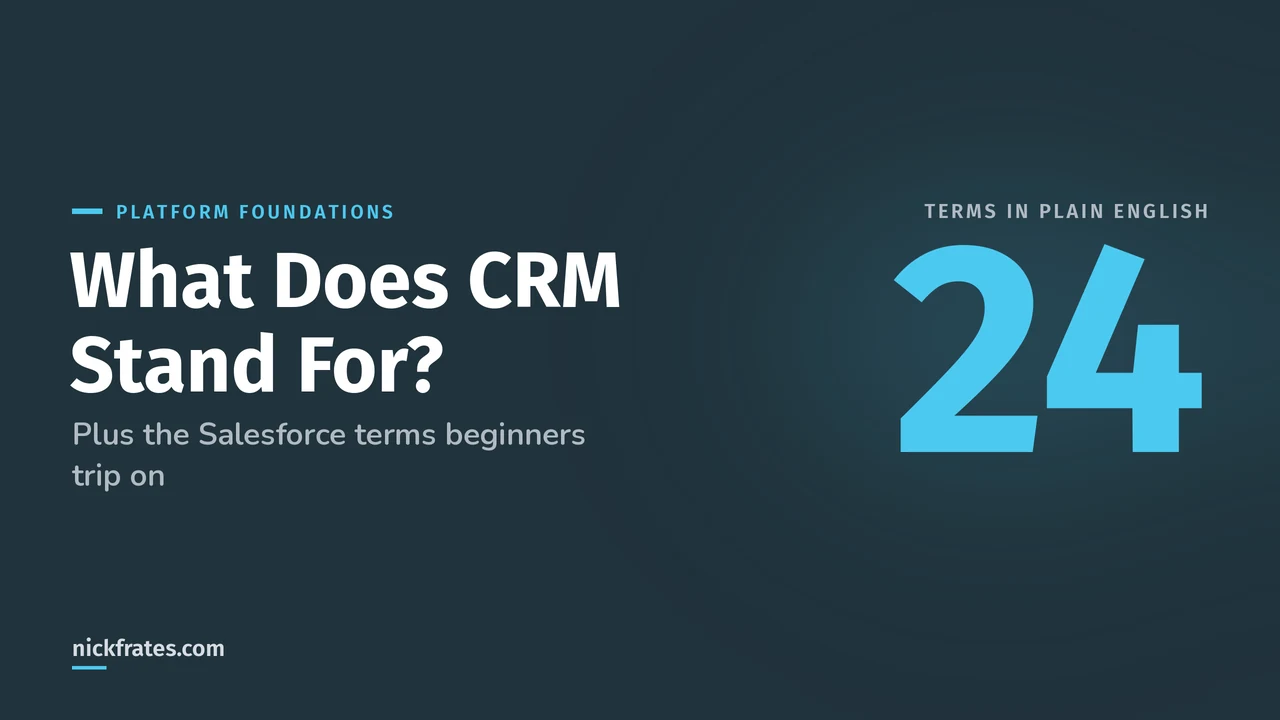
CRM stands for Customer Relationship Management. In Salesforce, it means software that keeps track of your customers and prospects and every interaction you have with them, so your whole team works from the same information. That's straight from Trailhead's Salesforce User Basics module.
The acronym is the easy part. The hard part is the 20 other words people throw at you in your first week. So below is the glossary I wish someone had handed me, grouped the way you'll actually meet them.
What does CRM mean in practice?
Trailhead describes CRM as technology to manage relationships with customers and prospects and track data about all your interactions. It also helps teams collaborate, track important metrics and communicate over email, phone, social and other channels (Salesforce User Basics).
Salesforce does CRM, but Trailhead is clear it's more than a CRM: it's also a platform you customize and build on (Platform Basics). That's why the vocabulary goes beyond sales words.
Which data terms do you need first?
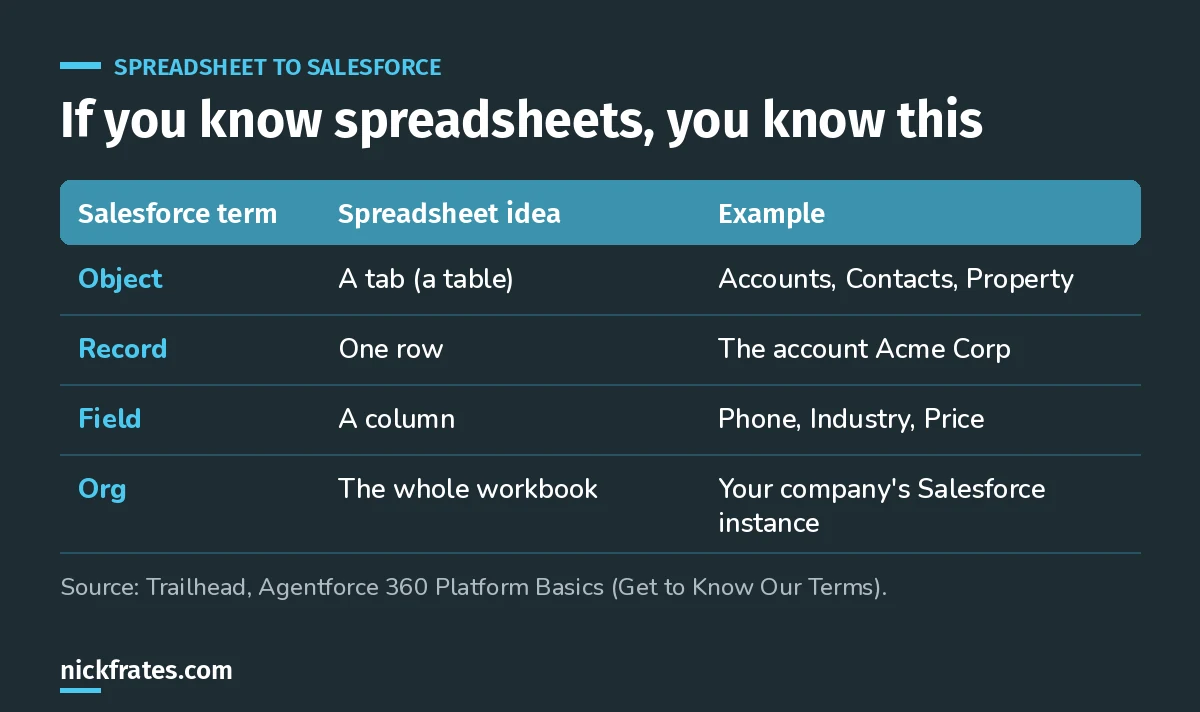
Objects are tables, records are rows, fields are columns.
- Object. A table in the Salesforce database that stores one kind of information. Standard objects like Accounts come built in; custom objects like Property are ones you create.
- Record. One row in an object, the actual data. For example, one specific property or one customer.
- Field. A column on an object, like Address or Price. Both standard and custom objects have fields.
- App. A set of objects, fields and other functionality that supports a business process. You switch apps with the App Launcher.
- Org. Short for organization: a specific instance of Salesforce. A company can have one or several.
- Metadata. Data about data: the structure itself, like your fields, page layouts and security settings, not the values in them (Trailhead).
What are the core CRM objects?
- Account. A company you do business with (Accounts and Contacts).
- Contact. A person who works for an account.
- Lead. A prospect you haven't qualified yet.
- Lead conversion. When a lead is qualified, converting it uses the lead's information to create a business account, a contact and an opportunity (Trailhead).
- Opportunity. A potential sale, a deal you're working (Trailhead).
- Case. A customer question or problem. Cases come in through channels like Email-to-Case, Web-to-Case and phone (Salesforce Help).
A bit about how I study. I loved Focus on Force and used it on my way to 17 Salesforce certs. What really made things stick, though, was taking practice tests fast and often instead of reading cover to cover. That's what Cert Lab is built on: quick questions, explanations with current links and screenshots, then go again until you pass. Certs have paid me back many times over in interviews, raises and knowing what actually matters on the platform.
Cert Lab by Nick Frates
Let the Platform Foundations Cert Lab test you to success
These terms are the backbone of the Platform Foundations exam. Fast quizzes show you which ones you really know, and every answer is explained.
Start the Platform Foundations Cert Lab for $9.99 →Which security terms will you hear?
These come from Trailhead's Data Security module. They decide who sees what.
- Org-wide defaults. The default level of access users have to each other's records. You set them to the most restrictive level, then open access up with the tools below.
- Role hierarchy. Users higher in the hierarchy get access to records owned by users below them.
- Sharing rule. An automatic exception to org-wide defaults that gives particular groups access to records they don't own.
- Profile and permission set. They control what users can do with each object and field. Salesforce recommends permission sets and permission set groups to manage that access.
Which everyday tool terms matter?
- Report. A list of records that meet criteria you define, which you can filter, group, summarize and chart (Trailhead).
- Dashboard. A visual display of key metrics. Each dashboard widget is based on a single source report.
- Validation rule. A rule that checks data meets your standards before a record can be saved (Trailhead).
- Sandbox. A copy of your production org for building and testing safely. A Full sandbox is a replica including all data (Salesforce Help).
- Trailhead Playground. A free practice org from Trailhead, a special kind of Developer Edition org.
- API. Lets different pieces of software connect and exchange information. All your Salesforce data and metadata is API enabled.
- AgentExchange. The Salesforce marketplace for apps, agents and components, formerly AppExchange (Trailhead).
- Agentforce. Salesforce's conversational AI made up of autonomous agents that sit on the Salesforce Platform.
Which Salesforce exam tests these terms?
Salesforce Certified Platform Foundations (formerly Salesforce Associate). From the official exam guide: 40 multiple-choice questions (plus up to five unscored), 70 minutes, a 62% passing score, $75 to register and free retakes. The Data Model section is where most of these terms show up:
| Exam section | Weight |
|---|---|
| Salesforce Ecosystem | 32% |
| Navigation | 28% |
| Data Model | 25% |
| Reports & Dashboards | 15% |
Which terms do beginners mix up?
- Lead vs contact. A lead is unqualified and stands alone. A contact belongs to an account.
- Object vs record. Opportunity is the object. "Acme renewal" is a record.
- Report vs dashboard. The report holds the data. The dashboard displays it, one report per widget.
- Role vs profile. Roles affect which records you see. Profiles and permission sets affect what you can do.
- Org vs app. The org is the whole instance. Apps are views of it built for a job.
FAQ
What does CRM stand for?
Customer Relationship Management.
Is Salesforce only a CRM?
No. It's a CRM and a platform you can customize and build apps on.
Which Salesforce certification covers these terms?
Platform Foundations, the beginner exam that used to be called Salesforce Associate. My Platform Foundations study guide walks through all four sections, and you can try a free lesson first.
Where should you go next?
- Platform Foundations practice questions to test these terms.
- Salesforce data modeling for how objects relate.
- The Salesforce security model for the access terms in depth.
- Salesforce reports and dashboards for the reporting side.
Studying for something else too? All my labs are on the Cert Lab page, and the Administrator lab is free.
Cert Lab by Nick Frates
Let the Platform Foundations Cert Lab test you to success
Fast quizzes for all four exam sections, full practice exams and an explanation for every answer, so you walk in knowing you're ready.
Start the Platform Foundations Cert Lab for $9.99 →Hope this helps!
Best,
Nick