Category: Newsletter

  • Einstein's Consciousness, Creativity, and Mindstorming

    Einstein's Consciousness, Creativity, and Mindstorming

    Creativity has taken our species from living in caves to sending rockets to space.

    Your greatest asset is between your ears.

    But are you using it enough?

    One way to train creativity and idea generation is mindstorming.

    Get a blank piece of paper and write a meaningful question at the top.

    • What would building this Flow look like if it were easy?

    • How can I double my income by 12/31/24?

    • What should I stop doing so I can focus on my greatest strengths and highest impact?

    • What's my hardest task today? How can I get it done first?

    • How should I study so it's impossible to fail my next certification exam?

    Then force yourself to write 20 answers to your question.

    The first 3 to 5 answers will be easy.

    The next 5 ideas will be challenging.

    After 10 ideas you might feel like stopping.

    And the final 5 ideas will push your creativity to the limit.

    But if you go all the way through, at the end, you'll have 20 answers.

    And you'll have put your creativity muscle through an intense workout.

    "No problem can be solved from the same level of consciousness that created it." — Albert Einstein

    This method trains you to adopt new perspectives.

    Maybe Einstein would call it a higher level of consciousness.

    All I know is it works. 

    Big and small problems bend to this technique.

    Write a question.

    Discipline yourself to generate 20 ideas on paper.

    And then pick one to act on (act on it immediately).

    Repeat. Repeat. Repeat.

    By training your solution muscles, your ability to solve problems will grow.

    What is the reward for solving problems?

    The opportunity to solve more problems of course!

    Problems never end. But don't despair.

    “You get paid in direct proportion to the difficulty of problems you solve.” — Elon Musk

    Being intensely solution oriented increases the quality of your life in every area.

    Sharpening your creativity improves your life, and is great fun. 

    So give mindstorming a shot, and let me know how it goes :) 

    Best,

    Nick

  • Road Trips and DLRS (Declarative Lookup Rollup Summaries)

    Road Trips and DLRS (Declarative Lookup Rollup Summaries)

    I just got back from Bryce Canyon National Park in Utah and it was awesome.

    Totally recommend checking out any of the National Parks if you get a chance, they're a great way to reconnect with the natural world.

    The road trip is also why I'm writing this email later than usual... :)

    Today's Salesforce tip is a workaround for rollup summaries.

    Oftentimes in Salesforce, we want to be able to perform roll up summaries and we hit road blocks.

    • The two objects we want the rollup summary on aren't in a Master-Detail relationship
    • The two objects we want the rollup summary on aren't in a direct relationship at all (perhaps separated by an object in the middle)
    • We already used all 25 rollup summaries on an object and still need to create more

    What to do?


    Enter DLRS also known as Declarative Lookup Rollup Summaries

    (You can scroll down on the GitHub page at the link above for more info)

    In a nutshell, DLRS is an open source Salesforce tool that, once installed, lets you create unlimited rollup summaries between any two objects, no master-detail relationship required. 

    And you don't need to write Apex to do it, it's all declarative.

    This is an installation link.

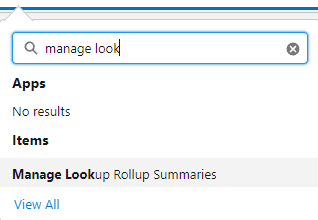
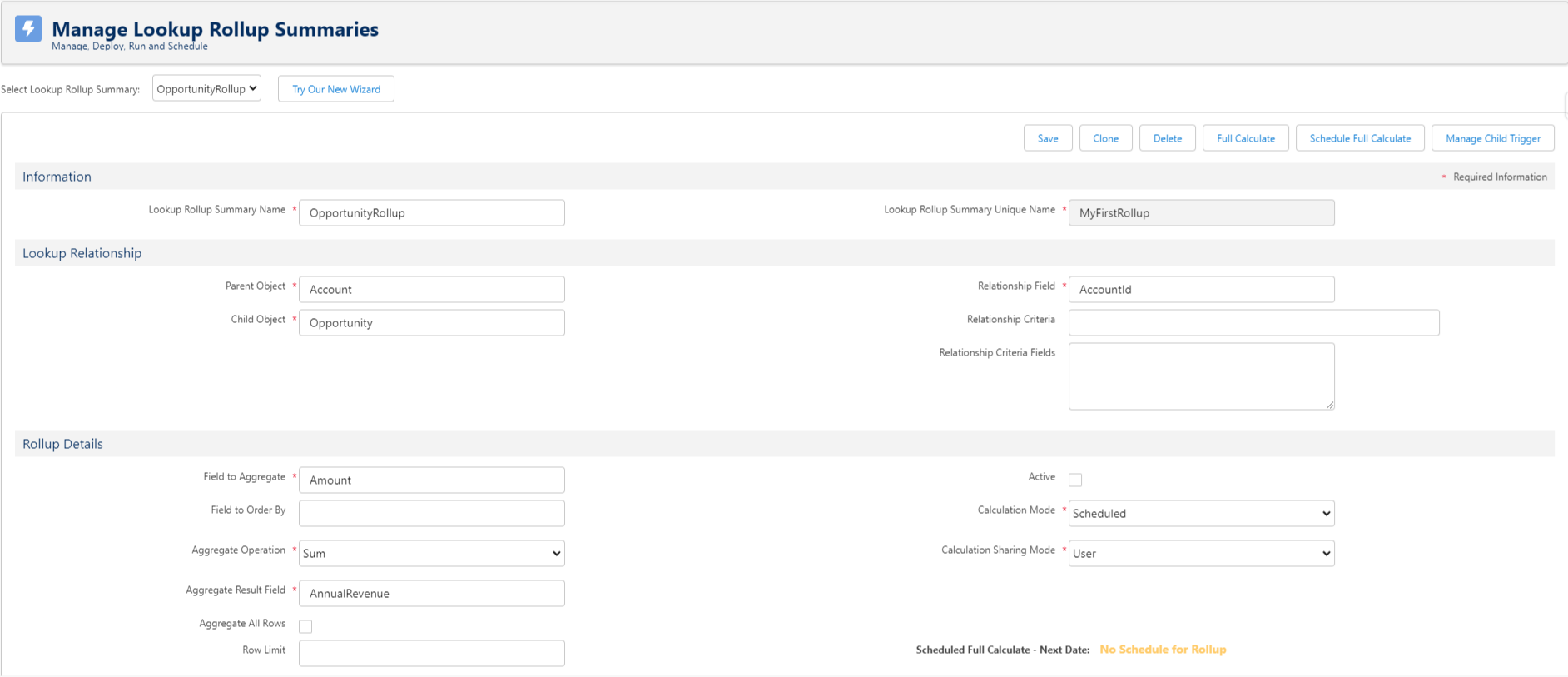
    You can get to roll up builder provide by the package (after installation) by searching for "Manage Lookup Rollup Summaries" in the App Launcher:

    Which takes you to a page where you can build a new rollup.

    Here you can specify both the parent and child object, the roll up operation type, and any other field criteria for the rollup (including formula fields!!)

    You can even decide if you want the rollup to run in real-time for records, or run on a schedule.

    This tool is a huge help in getting an extra layer of insight through rollup fields that otherwise would not be available.

    And if you've never used it before it could become a gamechanger for you.

    To recap:

    1. DLRS is a free, open-source tool that lets you build rollup summaries between any objects in Salesforce (without the usual rollup summary limits)
    2. You can install at this installation link
    3. And the documentation will help you dive deeper once you're ready

     Hope this helps!


    Best,

    Nick


  • Walks, Exercise Snacks, and the Salesforce life

    Walks, Exercise Snacks, and the Salesforce life

    Happy Saturday!

    It's warming up where I live and I've been walking a lot.

    It's a great way to relax and think creatively about 1) everything and 2) nothing at all.

    I love walking for waking up, taking a mid-day break, or "cooling down" after work.

    But there isn't always enough time to walk as much I'd like!

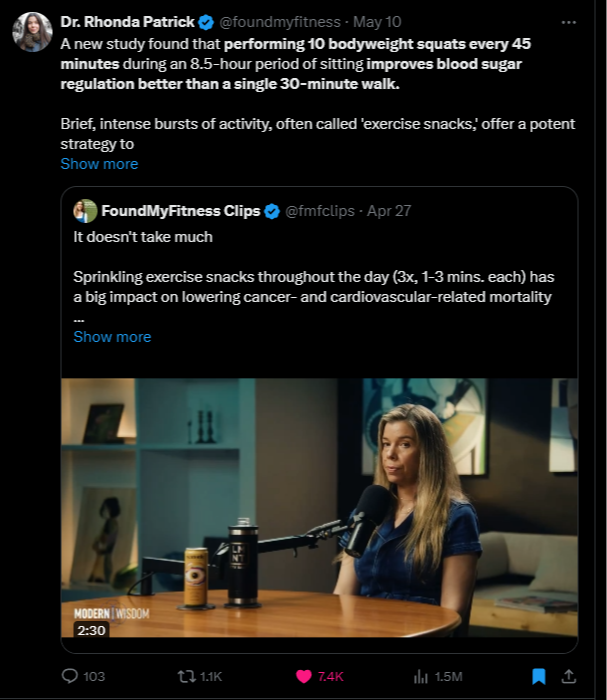
    Which is why this post from Dr. Rhonda Patrick caught my eye this week.

    "A new study found that performing 10 bodyweight squats every 45 minutes during an 8.5-hour period of sitting improves blood sugar regulation better than a single 30-minute walk."

     She introduces the idea of exercise snacks (which is just a super short exercise break) done from time-to-time throughout the day.

    And apparently these offer serious benefits.

    Exercise snacks improve blood sugar regulation, and lower both cancer and caridovascular related mortality.

    I'd also add that my ability to focus seems to be a bit better on days when I try out some of the exercise snacks Dr. Patrick discusses.

    I can't claim I'm disciplined enough to do these exercise snacks for the rest of my life or anything like that.

    But I did want to pass on the idea to you, that something as simple as 10 bodyweight squats once an hour throughout the day is as good as 30 minutes of walking.

    Of course, in an office setting this may not be pratical.

    It might be hard to explain why you're doing squats in your next Zoom call...

    But if you have the option to try out exercise snacks (in a way that works for you) consider doing them as an experiment!

    Have a great upcoming week :)

    Best,

    Nick

  • Custom Flow Error For the Win!

    Custom Flow Error For the Win!

    This week a client of mine had a requirement to prevent their users from deleting tasks.

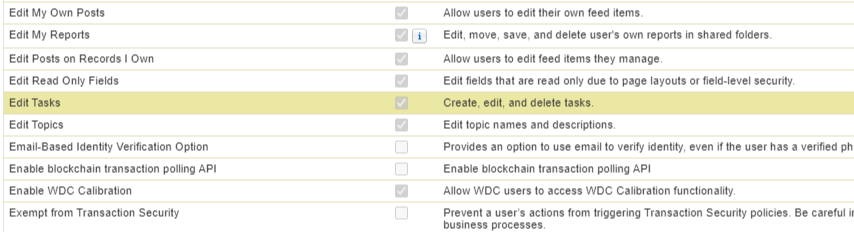
    You may know that the ability to create, edit, and delete tasks are bundled together in a single permission at the profile level.

    If we want to take away one of those permissions, users lose them all (which in this case they absolutely needed).

    What to do?

    Enter the Salesforce Flow Custom Error component (and new Custom Permission of our own).

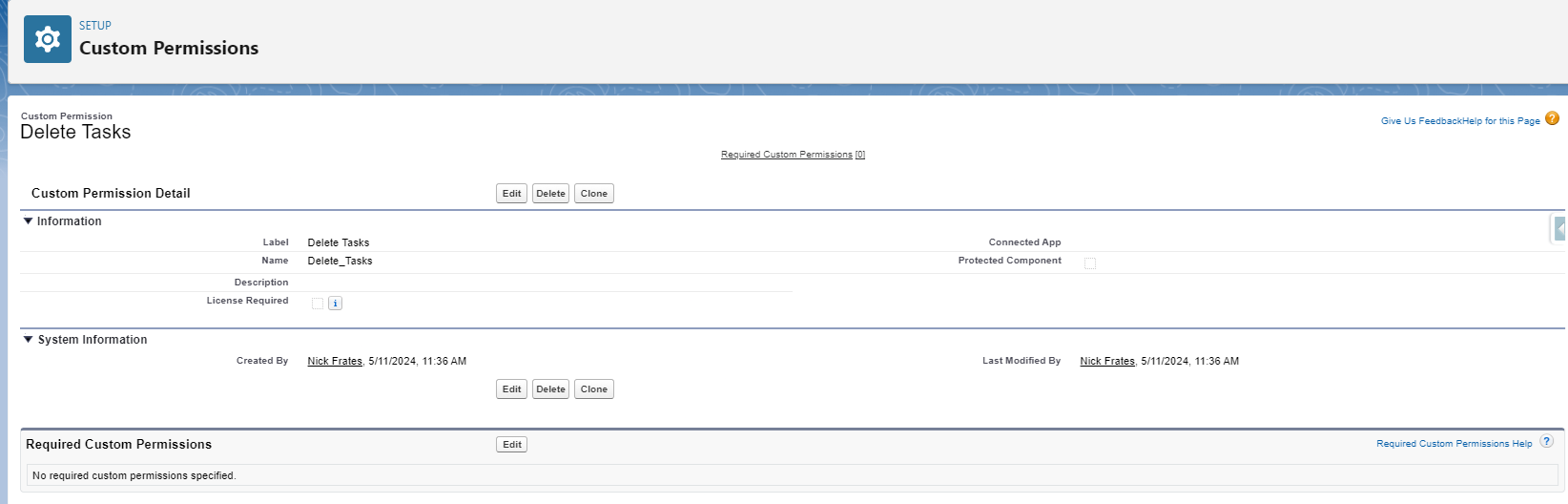
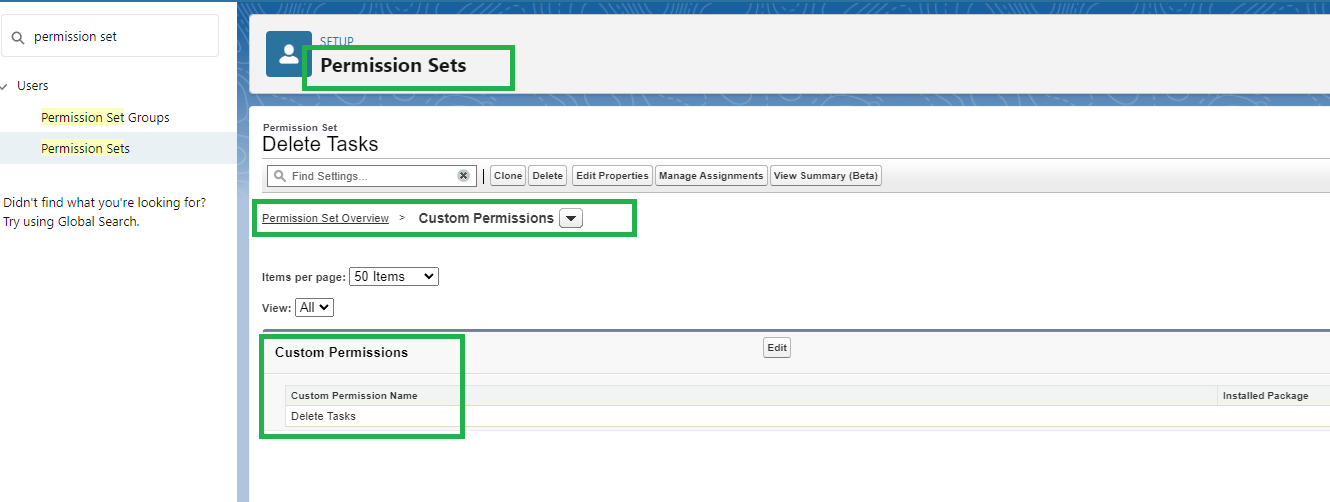
    First, we'll create a custom permission named "Delete Tasks" and assign it to a new permission set we created for this requirement.

    With this done, we now have the ability to assign that new custom  permission (Delete Tasks) to anyone by using the permission set.

    This is key, because it unlocks a cool feature in the Flow Builder, as you'll soon see.

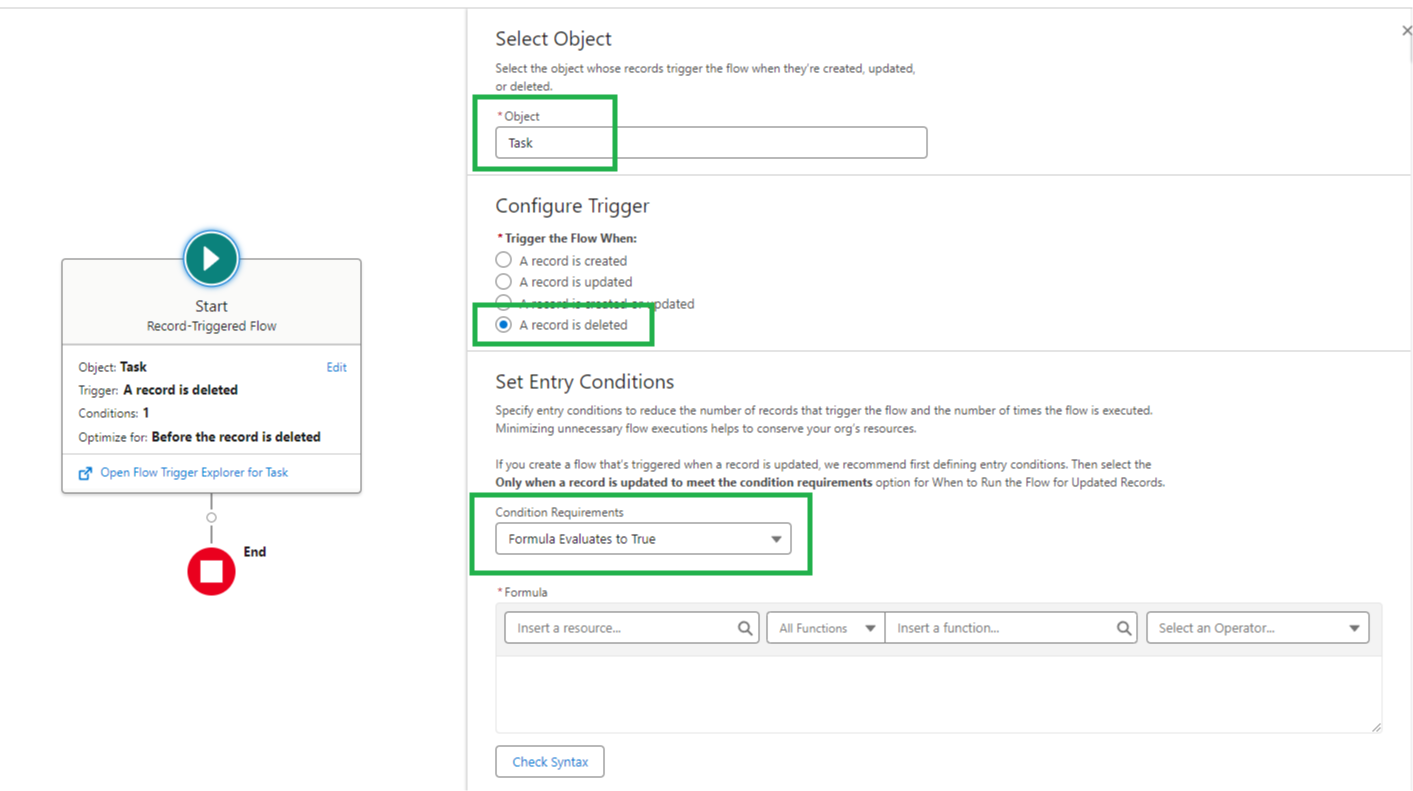
    We'll next create a Record-Triggered Flow designed to fire when a Task record is deleted.

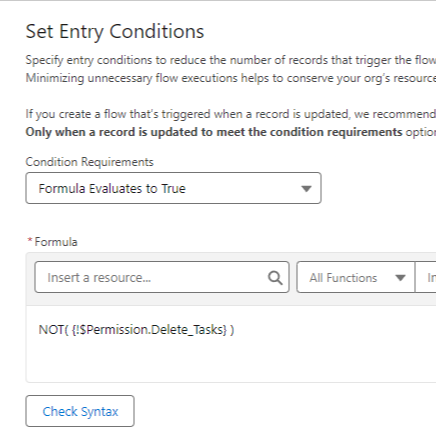
    We'll choose that the Formula Evalutes to True in the condition requirement so the Flow only fires when our condition (which we're about to set) is true.

    And this is where the cool feature I mentioned comes into play. By using Formula Evaluates to True we can check if the current user has our custom Delete Tasks permission.

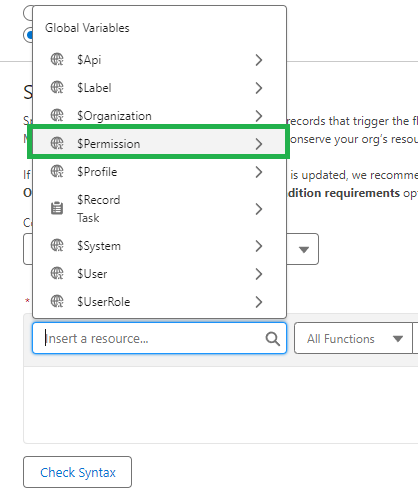
    Just click on Insert a Resource and select the Permission option from the list.

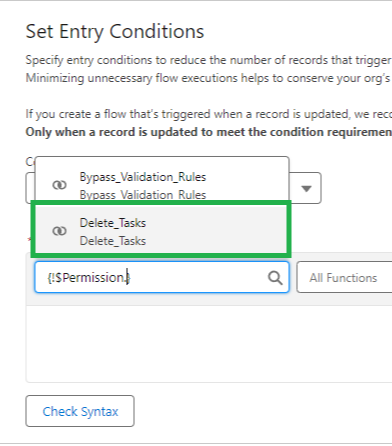
    This will show you all the Custom Permissions in the environment you're in. In this environment there are two, but we'll just select the one we need (Delete Tasks).

    Click once and that permission will appear in the Formula Editor.

    Wrap the formula in a NOT() statement.

    This tells Salesforce we only want the Flow to run when the current running user does not  have this permission i.e. they aren't allowed to delete tasks.

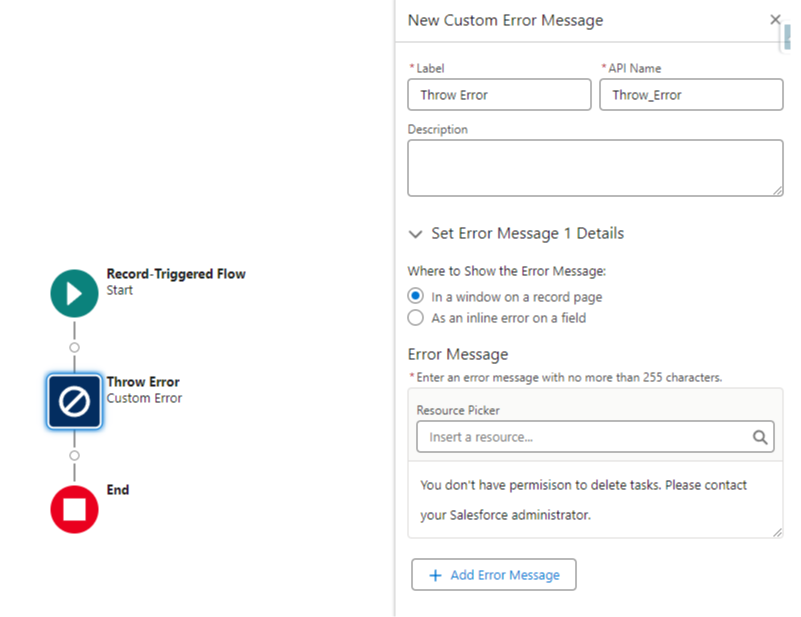
    Final step is to add the Custom Error element to the canvas and set the error message.

    With that done we can save and activate our Flow.

    With the Flow now active, it will run whenever a Task is deleted.

    If the user doesn't have the permission set, it will throw the error, otherwise nothing will happen and they can delete the task.

    And that's how I was able to separate the delete task permission from everything else.

    Hope this helps!

    Best,

    Nick


  • Summer '24 Release is Here

    Summer '24 Release is Here

    Happy Saturday :)

    The Summer '24 Saleforce release is right around the corner with updates scheduled to run from May 10 - May 17.

    As always, the Salesforce Summer '24 Release Notes are available and worth a read.

    Here are 10 features that caught my eye:

    Lightning App Builder

    Use Blank Spaces to Align Fields on Dynamic Forms-Enabled Pages

    Customize field alignment in Dynamic Forms field sections with the new Blank Space component. Finally get that perfect page layout alignment!

    Set Conditional Visibility for Individual Tabs in Lightning App Builder

    You can set the conditions to dynamically show or hide an individual tab in the Tabs component. I've guessed this would be coming for years, and here it is.

    Create Rich Text Headings in Lightning App Builder

    Customize rich text on your Lightning pages by giving it style values such as Heading 1 and Heading 2 using the new dropdown menu in the Rich Text component editor.

    Add New Custom Fields to Dynamic Forms-Enabled Pages

    Quickly and easily add a new custom field to your Dynamic Forms-enabled pages by using a new step in the custom-field creation wizard.

    Fix Formula Syntax Errors with Einstein for Formulas

    Einstein for Formulas now helps you fix syntax errors in a formula in addition to providing an explanation for a formula that’s used in Formula fields, default field values, and record validation rules.

    It remains to be seen how effective this is, but its clear that AI is going to be leveraged more and more on the platform to make life simpler.

    Salesforce Flows

    Let Einstein Build a Draft Flow for You

    Reach your automation goals with Einstein by describing what you want to automate and letting Einstein generative AI handle the heavy lifting. 

    This requires paying extra for Salesforce Einstein, but once again, make note of how quickly AI will be taking on admin responsibilities.

    Configure Conditions More Easily with Is Blank and Is Empty Operators in Flows

    Use the Is Blank operator in a condition to check whether a text value contains no characters or only white space.

    Check for Duplicates Before Creating Records in a Flow

    To prevent duplicate records, check for records that match a set of criteria in the Create Records element. Also specify whether to skip or update matching records. 

    Debug Scheduled Flows More Successfully

    New options are available when debugging scheduled flows. You can skip the start condition requirements for the flow. You’re no longer restricted to using the first available record to debug. Instead, you select the specific record on which to run.

    This is long overdue.

    Organize Your Flows Based on Categories and Subcategories That You Define

    Group your flows into categories and subcategories with two new fields on the flow record Details page.

    And a bonus 11th feature for Financial Service Cloud:

    Create Record Rollup Definitions More Easily

    Using an easy-to-use and intuitive UI, you can create record rollup definitions with just a few clicks.

    Could this be a native DLRS? I'm excited to see.

    And that's a wrap.

    Check out the release notes yourself and let me know about any other cool things you see!

    Best,

    Nick

  • Reading the Mind in the Eye

    Reading the Mind in the Eye

    I took an online test this week and my results made me feel like a superhero.

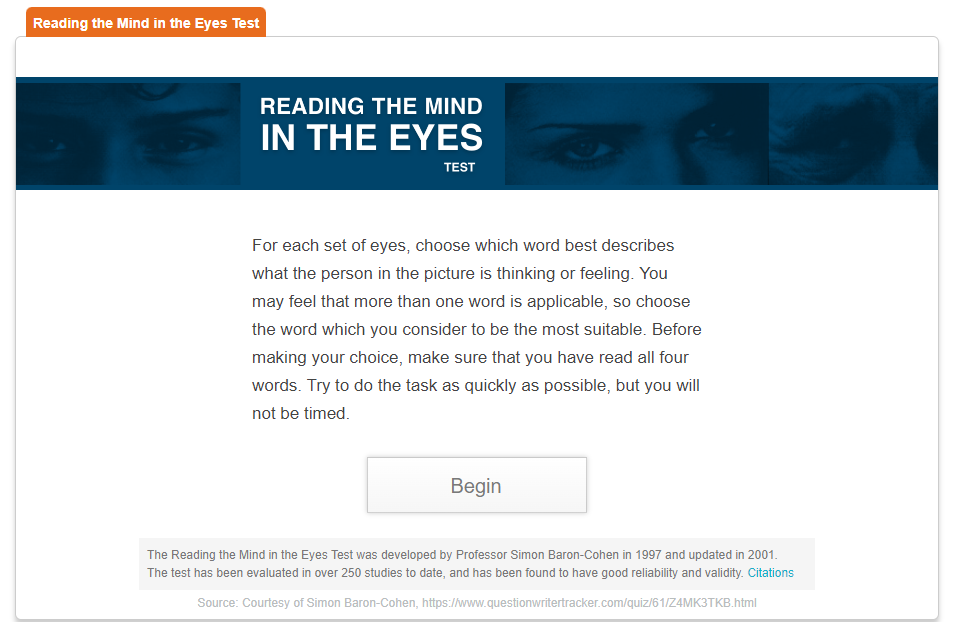
    The test shows you 36 sets of eyes and asks you to connect each picture with an emotion.

    (Take the free test here)

    I've always felt a bit awkward socially, so I expected to do... poorly.

    I surprised myself by scoring 33/36!

    With my low expectations, it felt awesome to find I can read emotions better than I thought.

    How good are you at reading other people?

    If you didn't already, go take the test!

    If you scored high, that's awesome. Your ability to read emotion in others is probably quite strong. 

    If you scored low, it's no big deal. One test on the internet doesn't mean much.

    And to be fair the test is somewhat confusing.

    Some of the words are really similar.

    Contemplative or reflective?

    Irritated or annoyed?

    Aghast! I can't recall a single time I've said "aghast" seriously...

    No matter your score, the idea that connecting with others is a skill (just like writing code or building automation) is important.

    Learning to read people is a key skill.

    In the Salesforce world, its fairly straightforward to "skill up" on something technical.

    There's Trailhead. Udemy. Salesforce Help. YouTube.

    It's pretty abundant.

    But how do we practice our ability to read people?

    And why does it matter?

    The good news is that "the secrets" of connecting with others have already been discovered.

    To skill up we can read books like:

    We can join groups and clubs (like Crossfit or pickleball).

    We can reach out to family members.

    A few key principles go a long way (make the other person feel important!) 

    And the risks of low social connection, tricks to improve our empathy, and benefits of high quality relationships are well documented.

    • A study published in Medical Xpress emphasized that the health risks associated with loneliness are comparable to those of smoking 15 cigarettes a day.
    • Several studies have demonstrated that reading fiction, particularly literary fiction, can significantly enhance empathy.
    • The Harvard Study of Adult Development (one of the longest studies of adult life) showed that those who were most satisfied in their relationships at age 50 were the healthiest at age 80, showing a clear connection between relationship satisfaction and physical health.

    Salesforce skills are valuable only to the extent that we help others with them.

    We could have the sharpest Salesforce technical skillset in the world, but...

    • If we can't emphatize with our users
    • Communicate effectively
    • Or work with others on our team to get results

    Then we're not as a valuable as someone with average technical skills who can.

    Our soft skills amplify our technical skills.

    So if you found out you have social superpowers on the test or are just starting to hone your people skills, remember: like any skill, understanding and connecting with others gets better with practice.

    And in the Salesforce world, that practice will pay off!


    Best,

    Nick

  • Navy SEALs, Box Breathing, and Stress

    Navy SEALs, Box Breathing, and Stress

    Happy Saturday!

    The Navy SEALs are well known for being special forces soldiers tasked with the most demanding missions the US military has to offer.

    Their training is legendary for how hard it is to complete.

    As you might imagine, being a Navy SEAL can be a high stress job.

    To help SEALs manage high-stress situations their instructors teach them to use a technique called box breathing.

    This type of breathing involves inhaling, holding, exhaling, and holding again, all for equal counts, typically four seconds. 

    This controlled breathing helps to slow down the heart rate and promotes relaxation, signaling the body to calm down and relax.

    Just like Navy SEALs, we all face stressful situations in our everyday lives.

    I'm 100% not a Navy SEAL.

    But I 100% do get stressed working as a Salesforce consultant.

    It could be before leading a training session for two dozen people.

    Or just the day-to-day desire to get all my tasks done.

    Sometimes we all just feel a little frazzled.

    And so today's takeaway is that some simple breath work can be an awesome tool in the toolkit.

    No joke, that GIF has been on my various computers for over 6 years.

    • I've used it before difficult conversations.
    • I've used it before interviews.
    • I've used it when I'm stuck on a problem.
    • I've used it for fun

    Stress is normal and natural.

    One of our responsibilities to ourselves is to manage it.

    So why not give box breathing a try the next time you're feeling a little overwhelmed?

    It just might become your go-to stress reliever!


    Best,

    Nick

  • Salesforce AI Associate Certification Is Retired: What Replaces It and What to Study Now

    Salesforce AI Associate Certification Is Retired: What Replaces It and What to Study Now

    This certification is retired. Salesforce retired the Salesforce Certified AI Associate exam in February 2026 (the exam was withdrawn on February 2, 2026). You can no longer register for it. Salesforce now recognizes AI skills through Agentblazer Status on Trailhead and validates them with the Agentforce Specialist certification.

    Updated for 2026: this page used to be a short note about passing the AI Associate exam. It's now a guide to what replaced it, what to study instead, and the AI fundamentals from the old exam that are still worth knowing, with practice questions for each topic.

    Quick factsDetail
    StatusRetired in February 2026; registration closed
    AnnouncedSpring 2025
    Replaced byAgentblazer Status (Champion, Innovator, Legend) and the Agentforce Specialist certification
    Old exam format40 questions, 70 minutes, $75 with free retakes
    Old exam weightsData for AI 36%, Ethical Considerations of AI 39%, AI Fundamentals 17%, AI Capabilities in CRM 8%
    Official sourcesAI Associate credential page (with a retirement FAQ) and Salesforce Ben's coverage

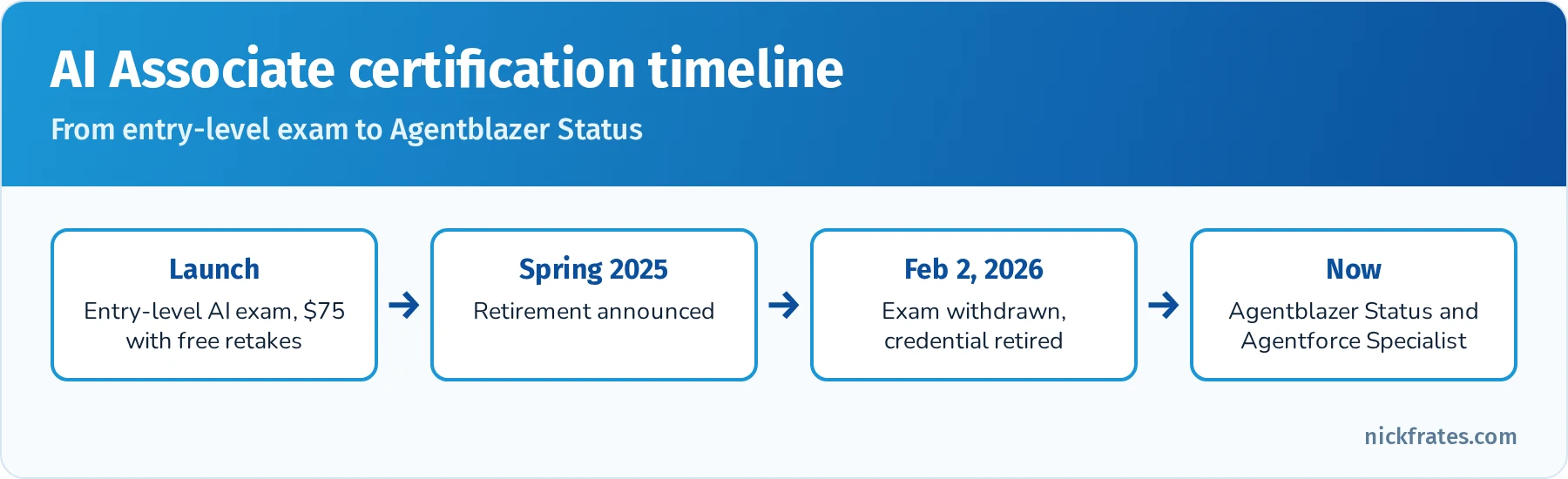
    Timeline of the AI Associate certification: launched as an entry-level AI exam, retirement announced in spring 2025, exam withdrawn February 2, 2026, replaced by Agentblazer Status and the Agentforce Specialist certification

    From entry-level exam to Agentblazer Status.

    A light personal note: I passed the AI Associate exam in April 2024 after one pass through the official Trailmix and one round of practice exams. It was one of the most relaxed Salesforce exams I've taken, and at $75 with free retakes it was a great first certification for a lot of people. That door is closed now, but the concepts it covered are more useful than ever.

    Contents

    1. What happened to the AI Associate certification
    2. What replaces it: Agentblazer Status
    3. What replaces it: the Agentforce Specialist certification
    4. AI fundamentals that still matter
    5. AI capabilities in CRM
    6. Ethical considerations of AI
    7. Data for AI
    8. How to study for Agentforce Specialist now
    9. Frequently asked questions
    10. Related study guides

    What happened to the AI Associate certification

    Salesforce launched the AI Associate certification as a low-cost, entry-level exam on AI concepts: what AI is, how it shows up in CRM, how to use it ethically and why data quality matters. As Agentforce and autonomous agents became central to Salesforce's strategy, the company decided a short theory exam no longer represented real AI skills.

    In spring 2025 Salesforce announced the retirement, and in February 2026 the exam was withdrawn. The credential page now says Salesforce "retired the AI Associate certification in February 2026" and points to Agentblazer Status. In its retirement FAQ, Salesforce describes the replacement this way: as you advance from Champion to Innovator to Legend, an Agentblazer badge displays on your Trailblazer profile, and you can validate your skills with the Agentforce Specialist certification, which Salesforce offered for free as part of its "AI for All" initiative. Offers like that change, so check the current price before you register.

    The community reaction was mixed. Many people agreed that the exam was lightweight. Others, including writers at Salesforce Ben, pointed out that cheap entry-level exams with free retakes were a valuable on-ramp for newcomers nervous about their first certification. If you want that low-cost first-exam experience today, the Platform Foundations certification (formerly Associate) is the closest remaining option, at $75 with free retakes.

    If you already hold the AI Associate certification: it no longer needs maintenance, and you can't earn it anymore. Check the retirement FAQ linked from the credential page for exactly how retired credentials display on your Trailblazer profile, and consider adding Agentblazer Status or the Agentforce Specialist certification to show current AI skills.

    What replaces it: Agentblazer Status

    Agentblazer Status is a Trailhead learning program with three levels. Each level is a curated set of trails and hands-on badges; there's no proctored exam. When you complete a level, an Agentblazer badge shows on your Trailblazer profile.

    LevelFocusTypical activities
    Agentblazer ChampionUnderstand AI agents and Agentforce basicsLearn what agents are, explore Agentforce use cases, build and test a simple agent in a Trailhead Playground
    Agentblazer InnovatorBuild and customize agentsCreate topics (now called subagents in the new builder), instructions and actions, use Prompt Builder, ground agents in data
    Agentblazer LegendAdvanced agent design and deploymentMulti-agent scenarios, testing and monitoring, advanced data and integration patterns

    Salesforce updates the Agentblazer curriculum as Agentforce changes, so the exact trails differ year to year. Start from the Agentblazer page on Trailhead and follow the current Champion path.
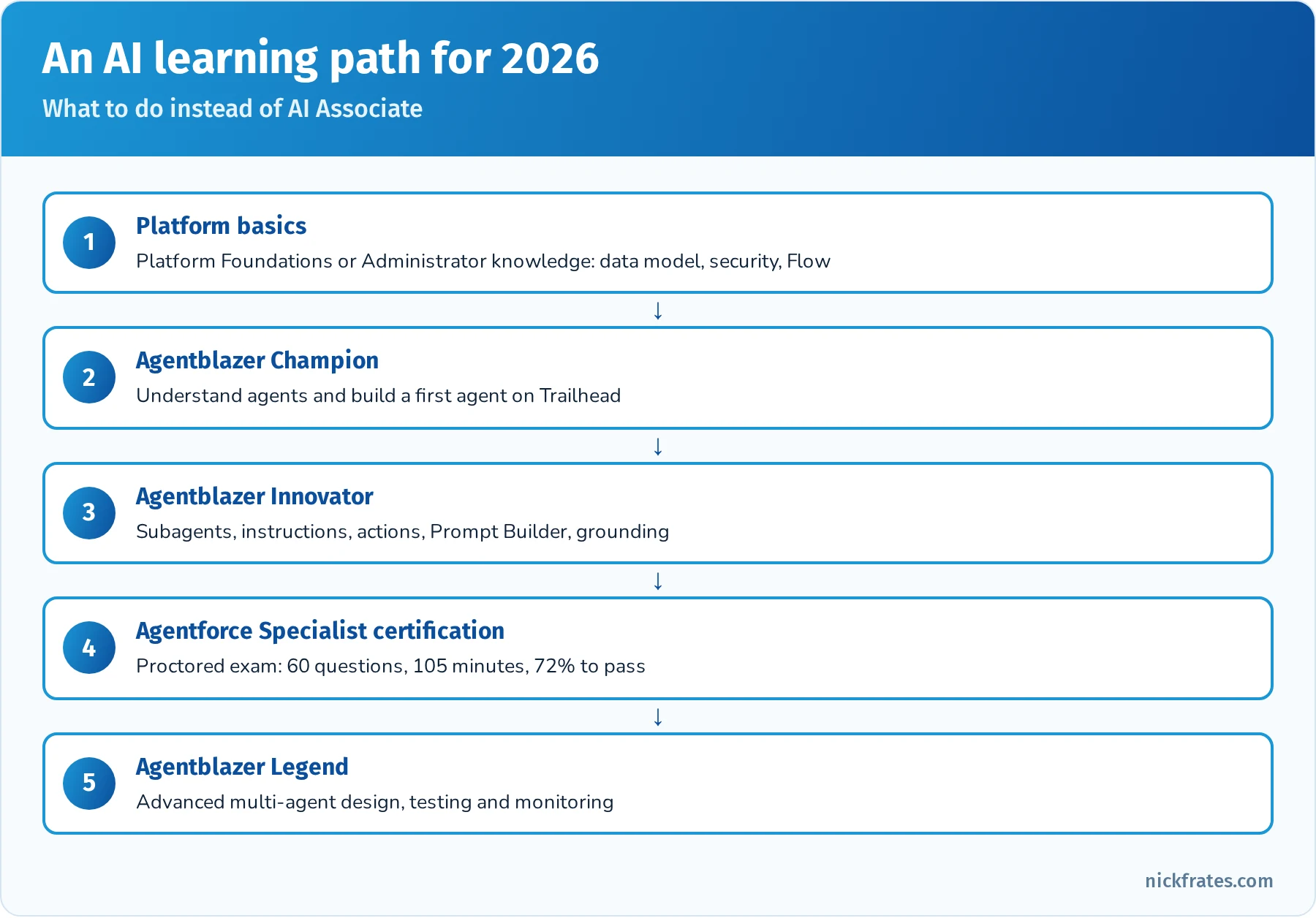
    Suggested AI learning path after the AI Associate retirement: Platform Foundations or Administrator basics, Agentblazer Champion, Agentblazer Innovator, Agentforce Specialist certification, Agentblazer Legend

    A practical order for building AI skills on Salesforce in 2026.

    What replaces it: the Agentforce Specialist certification

    The Agentforce Specialist certification (exam code AI-201, formerly AI Specialist) is now Salesforce's main AI credential. It's much deeper than AI Associate: it tests building, testing and governing agents, not just understanding AI concepts.

    Exam factDetail
    Format60 scored multiple-choice/multiple-select questions, plus up to 5 unscored
    Time105 minutes
    Passing score72%
    Fee$200 USD, retake $100 USD (check for free-voucher programs such as "AI for All")
    PrerequisitesNone; Administrator and Platform App Builder knowledge recommended
    Official resourcesCredential page and exam guide
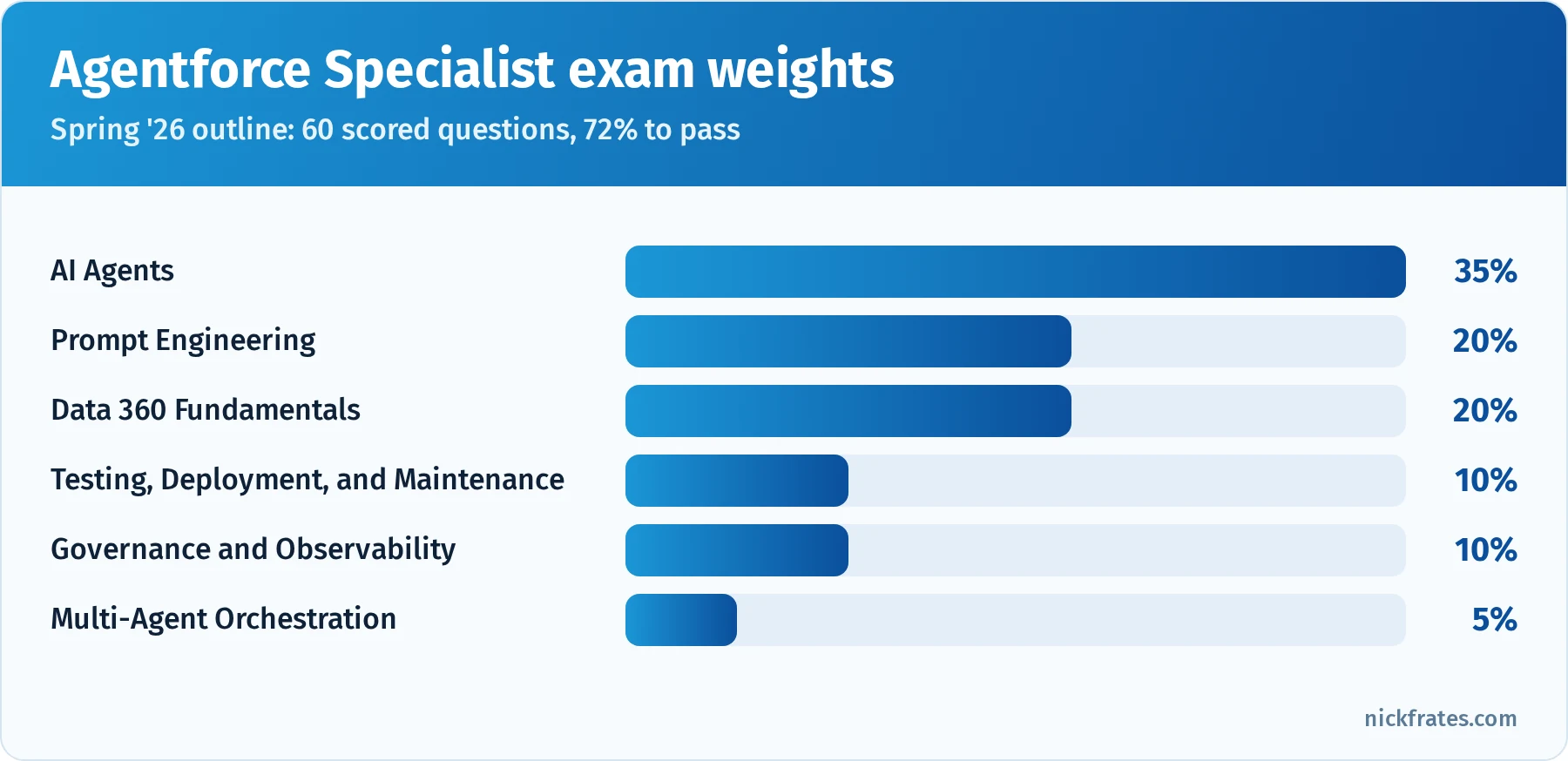
    Section (Spring '26 outline)Weight
    AI Agents35%
    Prompt Engineering20%
    Data 360 Fundamentals20%
    Testing, Deployment, and Maintenance10%
    Governance and Observability10%
    Multi-Agent Orchestration5%

    Bar chart of Agentforce Specialist exam weights: AI Agents 35%, Prompt Engineering 20%, Data 360 Fundamentals 20%, Testing, Deployment and Maintenance 10%, Governance and Observability 10%, Multi-Agent Orchestration 5%

    The Agentforce Specialist exam is heavily weighted toward building agents.

    Expect questions on the new Agentforce Builder (with canvas and script views and Agent Script), subagents (the exam guide still calls them topics), instructions and actions (flows, Apex, prompt templates), Prompt Builder template types and grounding, the Einstein Trust Layer, Data 360 data libraries and retrievers, the Testing Center, agent analytics and observability, and multi-agent patterns like the Agent API, MCP and agent-to-agent handoffs. You won't be asked to fine-tune models or write code.

    How AI Associate topics map to Agentforce Specialist. Most of the old exam's "Data for AI" content now lives inside Data 360 Fundamentals, "Ethical Considerations" became Governance and Observability plus the Einstein Trust Layer, "AI Capabilities in CRM" grew into the whole AI Agents section, and "AI Fundamentals" is assumed background knowledge for Prompt Engineering.

    Old AI Associate sectionWhere it lives now
    AI Fundamentals (17%)Background knowledge for Prompt Engineering and AI Agents
    AI Capabilities in CRM (8%)AI Agents (35%), Prompt Builder and Agentforce features
    Ethical Considerations of AI (39%)Governance and Observability (10%), Einstein Trust Layer
    Data for AI (36%)Data 360 Fundamentals (20%), grounding and retrieval

    AI fundamentals that still matter

    The rest of this guide keeps the useful content from the AI Associate outline, updated for 2026. It's a solid foundation for Agentblazer Champion and for the background knowledge the Agentforce Specialist exam assumes.

    Types of AI. Predictive AI uses historical data to predict outcomes, for example a lead score, the likelihood a case will escalate, or a forecast. Generative AI creates new content such as emails, summaries, code or images from a prompt. Agentic AI combines a language model with instructions, data and actions so it can reason about a request and take steps on a user's behalf, which is what Agentforce agents do.

    Key terms. Machine learning finds patterns in data instead of following hand-written rules. Supervised learning trains on labeled examples (emails labeled spam or not spam); unsupervised learning finds structure in unlabeled data (customer segments). Deep learning uses neural networks with many layers. Natural language processing (NLP) lets computers understand and generate human language. A large language model (LLM) is a deep learning model trained on huge amounts of text to predict the next word, which is what powers generative AI. Hallucination is when a model produces confident but false output. Grounding adds trusted data to a prompt so the model answers from facts. Retrieval augmented generation (RAG) retrieves relevant documents or records at run time and includes them in the prompt.
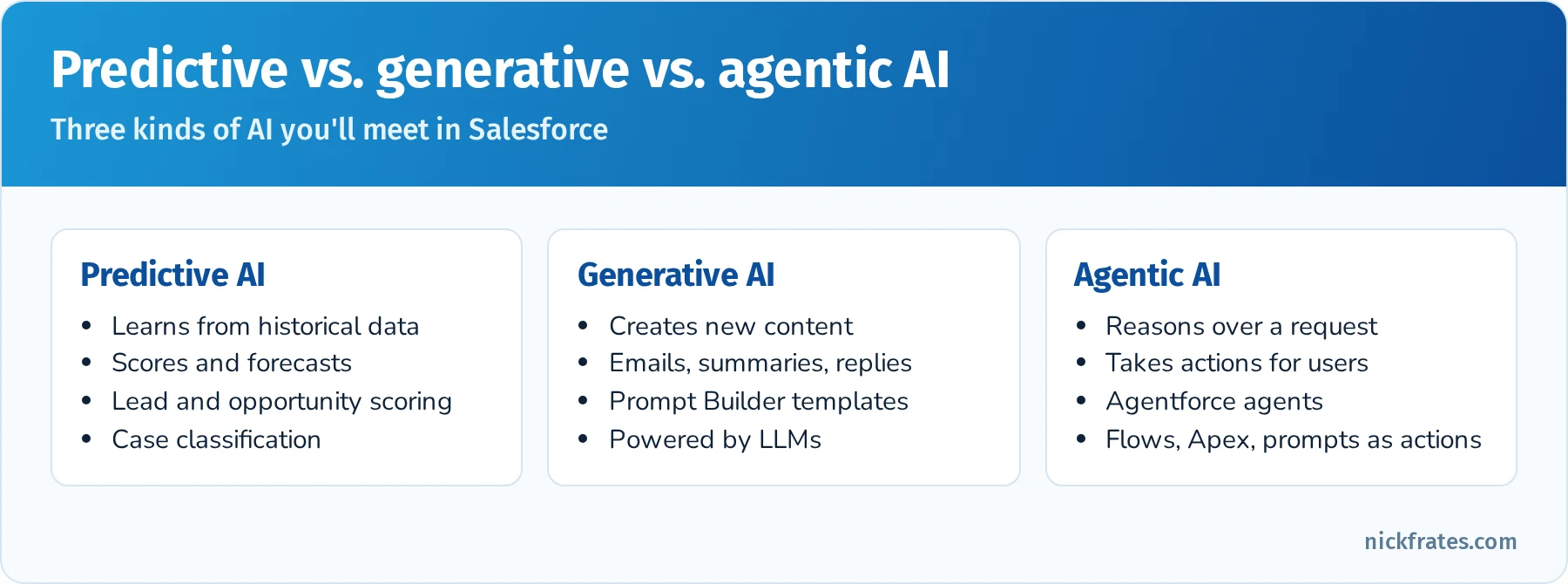
    Comparison of predictive AI, generative AI and agentic AI with examples on Salesforce

    Predictive AI scores, generative AI writes, agentic AI acts.

    Quick reference: AI terms

    TermPlain-English meaning
    ModelA program trained on data to make predictions or generate content
    Training dataThe examples a model learns from
    PromptThe instructions and context you give a generative model
    TokenA chunk of text a language model reads or writes
    GroundingAdding trusted, relevant data to a prompt
    HallucinationConfident but incorrect output
    BiasSystematic unfairness that comes from data, design or use
    AgentAI that reasons over a request, then uses actions to complete tasks

    Practice questions: AI fundamentals

    Question 1. A model predicts which open opportunities are most likely to close this quarter based on past deals. What type of AI is this?

    • A. Generative AI
    • B. Predictive AI
    • C. Robotic process automation
    • D. Rules-based automation

    Answer: B. Predicting an outcome from historical data is predictive AI. Generative AI creates new content.

    Question 2. A service rep asks AI to draft a reply to a customer email. What type of AI is being used?

    • A. Predictive AI
    • B. Generative AI
    • C. Unsupervised clustering
    • D. A validation rule

    Answer: B. Drafting new text is generative AI, usually powered by a large language model.

    Question 3. What's the main difference between supervised and unsupervised learning?

    • A. Supervised learning needs a human to approve every prediction
    • B. Supervised learning trains on labeled examples; unsupervised learning finds patterns in unlabeled data
    • C. Unsupervised learning is always more accurate
    • D. There is no difference

    Answer: B. Labels (known correct answers) define supervised learning. Clustering customers into segments without labels is unsupervised.

    Question 4. An LLM invents a return policy that doesn't exist. What is this called, and what helps prevent it?

    • A. Overfitting; add more training epochs
    • B. Hallucination; ground the prompt in trusted company data
    • C. Tokenization; shorten the prompt
    • D. Bias; remove all data

    Answer: B. Grounding the model in real policy documents or records reduces hallucinations.

    Question 5. Which statement best describes an AI agent?

    • A. A static report
    • B. AI that interprets a request, reasons about it and uses actions such as flows or Apex to complete tasks
    • C. A spreadsheet macro
    • D. A human support agent

    Answer: B. Agents combine a language model with instructions, data and actions to take steps on a user's behalf.

    AI capabilities in CRM

    Salesforce AI shows up in three broad ways: predictions built into apps, generative features that help users write and summarize, and agents that can complete tasks.

    Predictive features. Examples include lead and opportunity scoring, case classification and routing suggestions, forecasting and next best action recommendations. They help users prioritize work, and they're only as good as the historical data behind them.

    Generative features. Prompt Builder lets admins create reusable prompt templates (for example, field generation templates that fill a field with a summary, sales email templates and flex templates) grounded with record fields, related lists, flows, Apex or retrievers. Generative features also power email drafting, call summaries, knowledge article drafting and service replies.

    Agents. Agentforce agents (built in Agentforce Builder) handle conversations with employees or customers. Each agent has subagents (topics) that define jobs to be done, instructions that guide reasoning, and actions such as flows, Apex, prompt templates and API calls. Agents can be deployed in Salesforce, on websites, in messaging channels and through APIs.

    The Einstein Trust Layer. Salesforce's security architecture for generative AI. It includes secure data retrieval that respects user permissions, dynamic grounding, data masking of sensitive fields before prompts reach an external model, prompt defense, zero data retention agreements with model providers, toxicity detection and an audit trail. Expect it on the Agentforce Specialist exam.
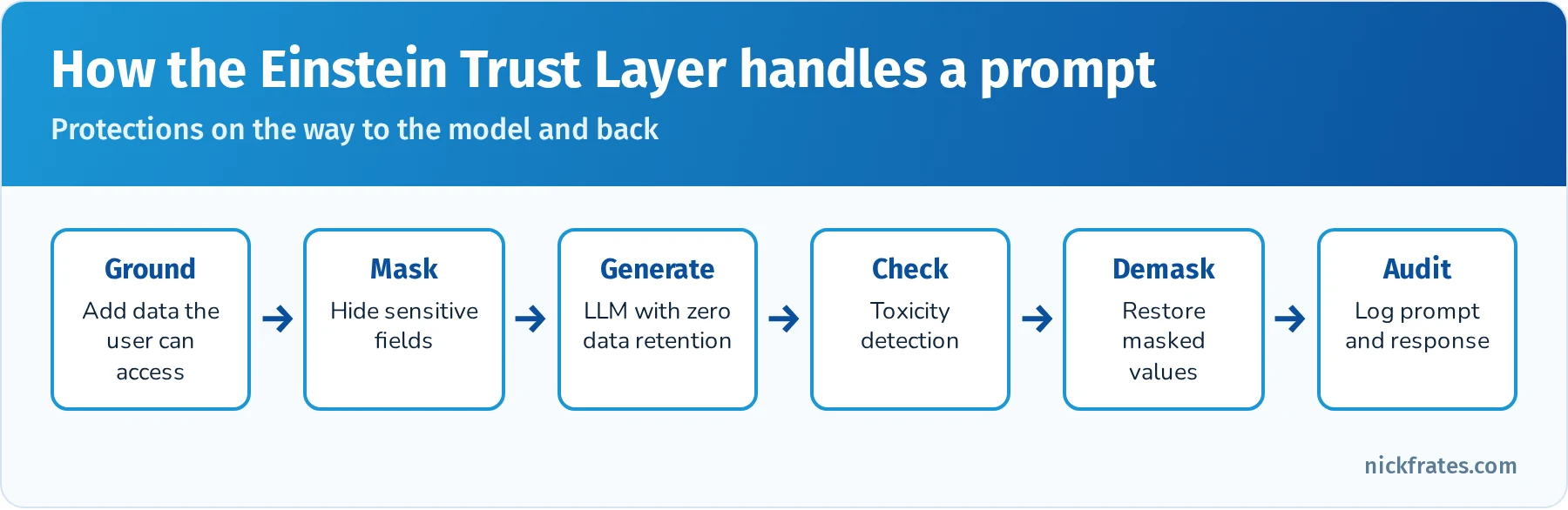
    Einstein Trust Layer flow: prompt is grounded with permitted data, sensitive data is masked, the model generates a response under zero data retention, then toxicity is checked, data is demasked and the interaction is logged

    The Einstein Trust Layer wraps every generative request.

    Quick reference: picking the right AI feature

    NeedFeature
    Prioritize leads by likelihood to convertPredictive scoring
    Fill a summary field automatically from a recordPrompt Builder field generation template
    Draft a personalized sales emailSales email prompt template
    Answer customer questions 24/7 and take actionsAgentforce service agent
    Help employees complete tasks in SalesforceAgentforce employee agent
    Protect sensitive data in promptsEinstein Trust Layer data masking

    Practice questions: AI capabilities in CRM

    Question 1. A sales manager wants each opportunity to show a short AI-generated summary of recent activity in a field. Which feature fits?

    • A. A validation rule
    • B. A Prompt Builder field generation template
    • C. A roll-up summary
    • D. A report

    Answer: B. Field generation templates write generated content into a field, grounded in record data.

    Question 2. Which component of an Agentforce agent defines what the agent can actually do, like look up an order or create a case?

    • A. Actions
    • B. Page layouts
    • C. Reports
    • D. Roles

    Answer: A. Actions (flows, Apex, prompt templates, APIs) are the steps an agent can take. Subagents and instructions guide when to use them.

    Question 3. How does the Einstein Trust Layer protect customer data sent to an external LLM?

    • A. It sends all data unchanged
    • B. It masks sensitive data, relies on zero data retention agreements and logs interactions in an audit trail
    • C. It disables AI features
    • D. It deletes the customer record

    Answer: B. Masking, zero data retention and auditing are core Trust Layer protections.

    Question 4. A company wants customers on its website to get answers about order status at any time, with the ability to start a return. What should it consider?

    • A. A dashboard
    • B. An Agentforce service agent with order lookup and return actions
    • C. A list view
    • D. A static FAQ page only

    Answer: B. A service agent can answer questions and take actions such as starting a return.

    Question 5. Predictive lead scores are poor at a new company with only 20 historical leads. What's the most likely reason?

    • A. The model is too big
    • B. There isn't enough historical data for the model to learn reliable patterns
    • C. Leads can't be scored
    • D. The org needs more page layouts

    Answer: B. Predictive AI depends on enough quality historical data. Small or skewed data sets produce unreliable predictions.

    Ethical considerations of AI

    This was the largest section on the old exam, and it's still essential. Salesforce frames responsible AI with two sets of principles.

    Salesforce's Trusted AI principles: Responsible, Accountable, Transparent, Empowering and Inclusive.

    Salesforce's guidelines for trusted generative AI: Accuracy (verifiable, grounded results and clear uncertainty), Safety (mitigating bias, toxicity and harmful output, and protecting privacy), Honesty (respecting data provenance and being transparent that content is AI-generated), Empowerment (keeping humans in the loop where it matters) and Sustainability (using right-sized models to limit environmental cost).

    Types of bias. Bias can enter at many points:

    BiasExample
    Measurement or dataset biasTraining data over-represents one region, so predictions are worse elsewhere
    Association biasA model links certain jobs with one gender because of historical data
    Confirmation biasDesigners only test cases that confirm what they expect
    Automation biasUsers trust AI output without checking it
    Societal biasHistorical inequities in data are reproduced by the model
    Survivorship biasOnly successful cases are in the data, so failures are invisible
    Interaction biasUsers teach a system biased behavior through their inputs

    Practical safeguards. Use diverse, representative data; remove or carefully handle sensitive attributes and their proxies (such as postal code standing in for ethnicity); test outcomes across groups; keep humans in the loop for consequential decisions; tell people when they're interacting with AI; give users ways to give feedback; and monitor models after launch.
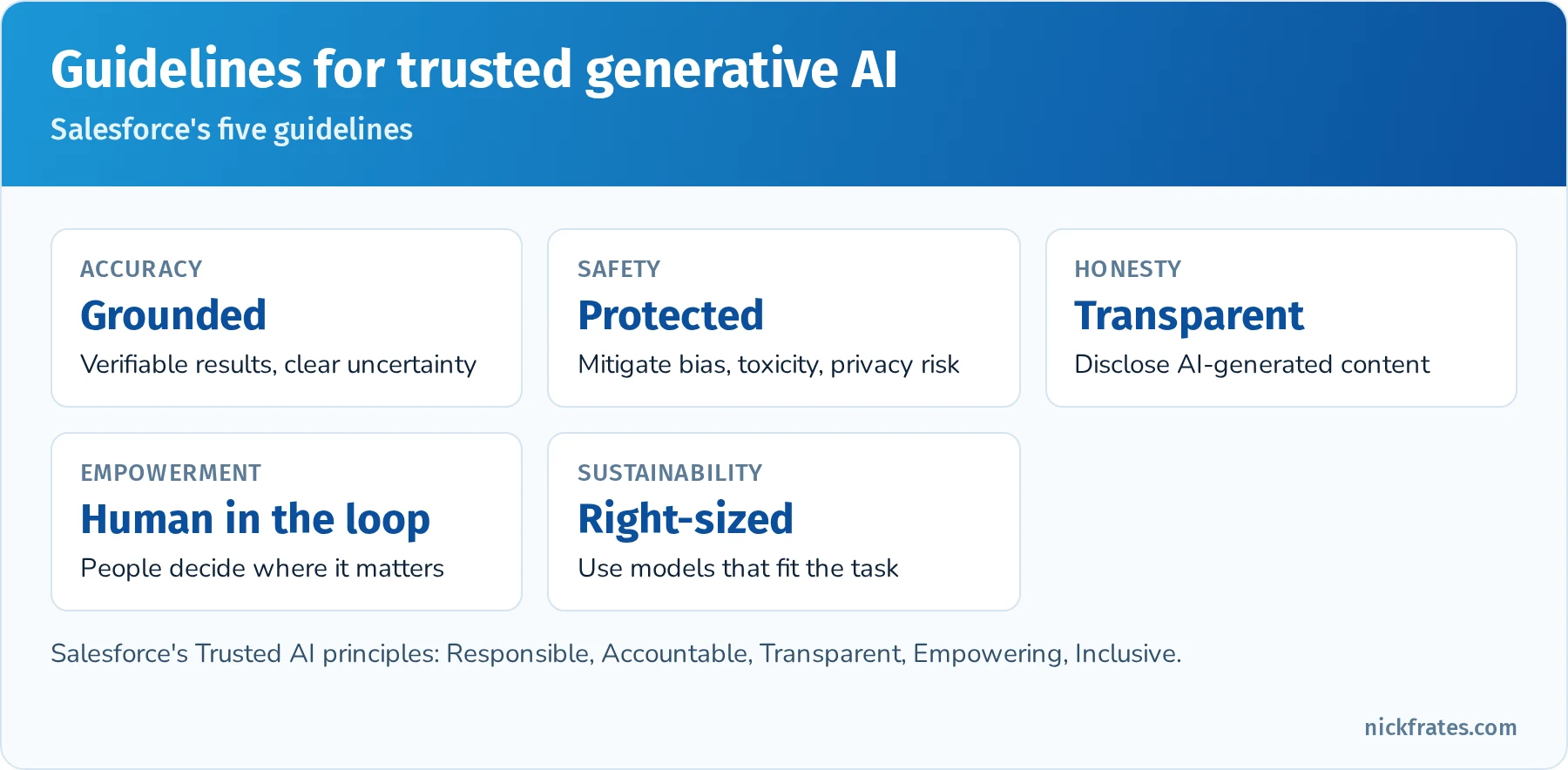
    Salesforce guidelines for trusted generative AI: accuracy, safety, honesty, empowerment and sustainability

    Five guidelines for trusted generative AI.

    Practice questions: Ethical considerations of AI

    Question 1. A loan pre-approval model rejects applicants from certain postal codes at much higher rates even though postal code isn't supposed to matter. What's the most likely problem?

    • A. The model is too accurate
    • B. Postal code is acting as a proxy for a protected attribute, introducing bias
    • C. There's no problem
    • D. The model needs more page layouts

    Answer: B. Seemingly neutral fields can act as proxies for sensitive attributes. Test outcomes across groups and remove or adjust proxy features.

    Question 2. Which Salesforce generative AI guideline is about telling users that content was AI-generated?

    • A. Sustainability
    • B. Honesty
    • C. Safety
    • D. Accuracy

    Answer: B. Honesty covers transparency about AI-generated content and respecting data provenance.

    Question 3. Service reps accept every AI-suggested reply without reading it. What bias is this?

    • A. Survivorship bias
    • B. Automation bias
    • C. Association bias
    • D. Measurement bias

    Answer: B. Automation bias is over-trusting automated output. Keep humans meaningfully in the loop.

    Question 4. What is a good practice when deploying an AI feature that affects important decisions about people?

    • A. Hide that AI is being used
    • B. Keep a human in the loop, explain how the AI is used and monitor outcomes for bias
    • C. Never collect feedback
    • D. Use as much personal data as possible

    Answer: B. Transparency, human oversight and monitoring are central to responsible AI.

    Question 5. Which choice best supports the Sustainability guideline?

    • A. Always use the largest available model
    • B. Use an appropriately sized model for the task
    • C. Run every prompt twice
    • D. Disable caching

    Answer: B. Right-sizing models reduces energy use and cost without hurting quality for the task.

    Data for AI

    AI is only as good as its data. This was over a third of the old exam and it maps directly to Data 360 Fundamentals on the Agentforce Specialist exam.

    Data quality dimensions.

    DimensionQuestion it answersSalesforce tools that help
    CompletenessAre required values filled in?Required fields, validation rules, Flow
    AccuracyDo values reflect reality?Validation rules, data enrichment, verification
    ConsistencyIs the same thing recorded the same way everywhere?Picklists, global value sets, standard formats
    TimelinessIs the data current?Integrations, scheduled updates, data freshness checks
    UniquenessAre there duplicates?Duplicate rules and matching rules, identity resolution in Data 360
    ValidityDoes data follow formats and rules?Field types, validation rules, input masks

    Why it matters for AI. Incomplete or duplicated customer data leads to bad predictions and badly grounded answers. Agents grounded in stale knowledge articles give stale answers. Data 360 (formerly Data Cloud) unifies data from many sources into unified profiles, and its data libraries, search indexes and retrievers let agents and prompts find the right content at run time.

    Data privacy and governance. Collect only what you need, respect consent and regional privacy laws, classify sensitive fields, control access with permissions, and use masking for sensitive data in prompts. Remember that agents act with permissions, so least-privilege access matters.
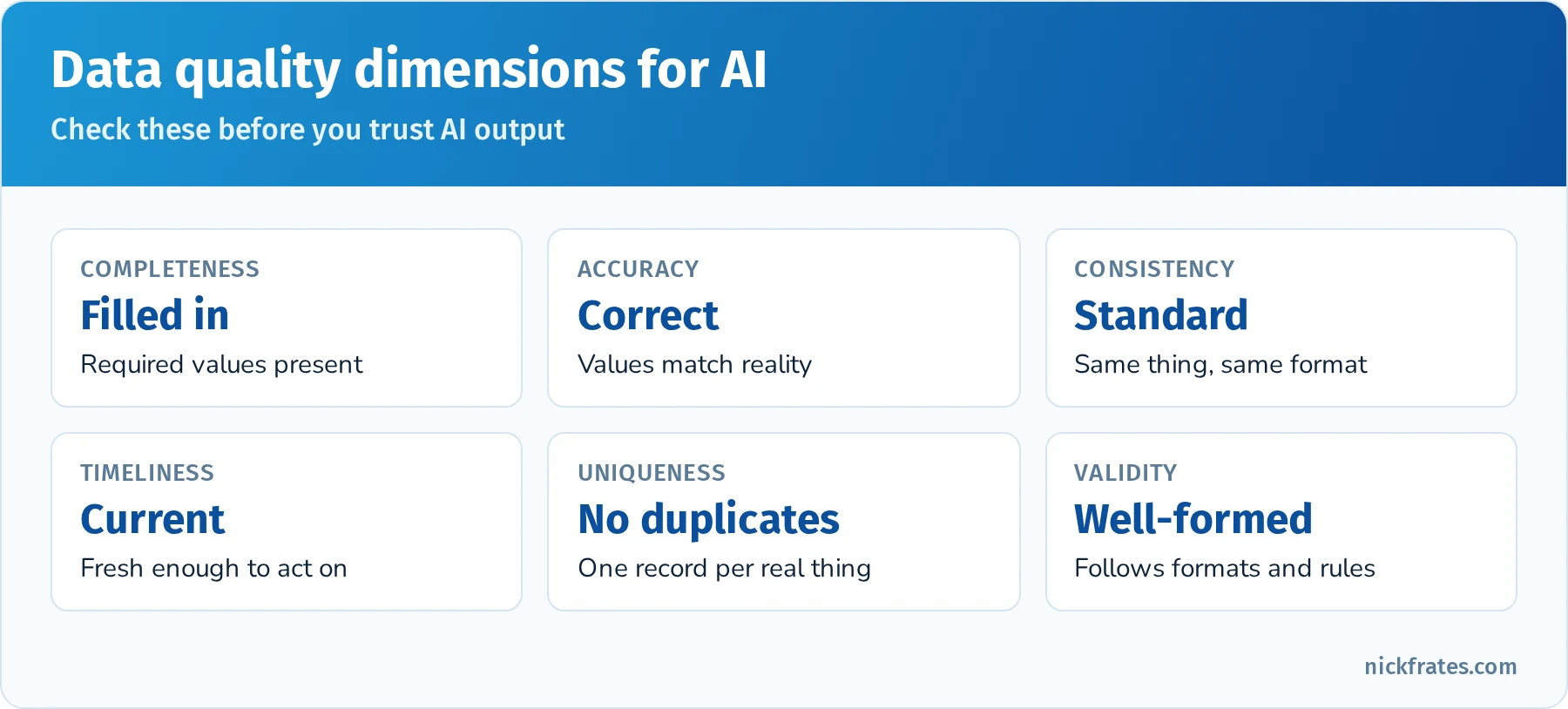
    Data quality dimensions for AI: completeness, accuracy, consistency, timeliness, uniqueness and validity

    Six data quality dimensions to check before you trust AI output.

    Practice questions: Data for AI

    Question 1. An AI model trained on CRM data gives poor predictions because 40% of opportunity records have no Close Reason. Which data quality dimension is the issue?

    • A. Timeliness
    • B. Completeness
    • C. Uniqueness
    • D. Sustainability

    Answer: B. Missing values are a completeness problem. Validation rules or required fields can help going forward.

    Question 2. The same customer appears three times with slightly different names, splitting their history. What should be addressed first?

    • A. Uniqueness, with duplicate and matching rules or identity resolution
    • B. Timeliness
    • C. Model size
    • D. Prompt length

    Answer: A. Duplicates hurt both predictions and grounding. Duplicate management and identity resolution create a single view of the customer.

    Question 3. An agent answers questions using knowledge articles that haven't been updated in two years. Which dimension is the risk?

    • A. Validity
    • B. Timeliness
    • C. Consistency
    • D. Inclusivity

    Answer: B. Outdated content produces outdated answers even if the AI works perfectly.

    Question 4. Which approach best protects sensitive data when using generative AI in Salesforce?

    • A. Paste records into public chatbots
    • B. Use the Einstein Trust Layer's masking and permission-aware grounding, and limit what data templates include
    • C. Give agents System Administrator access
    • D. Turn off field-level security

    Answer: B. Masking, permission-aware retrieval and minimal data in prompts protect sensitive information.

    Question 5. What does Data 360 add for AI use cases?

    • A. Page layouts
    • B. Unified customer profiles from many sources plus retrieval of structured and unstructured content for grounding
    • C. Apex compilation
    • D. Email deliverability settings

    Answer: B. Data 360 harmonizes and unifies data, and its search indexes and retrievers ground prompts and agents.

    How to study for Agentforce Specialist now

    If you were planning to take AI Associate, here's a simple path forward:

    1. Week 1: Agentblazer Champion. Complete the current Champion trails and build your first agent in a Trailhead Playground or a Developer Edition org with Agentforce enabled.
    2. Week 2: Prompt Builder and grounding. Build a field generation template and a flex template, ground them with record data and a flow, and test them in the preview panel.
    3. Week 3: Agents in depth. Create subagents, instructions and actions (a flow action and a prompt template action). Test conversations in the builder, then use the Testing Center to run batch tests.
    4. Week 4: Data 360, governance and multi-agent topics. Learn data libraries, retrievers, the Einstein Trust Layer, agent analytics and how agents hand off to each other or connect through the Agent API and MCP.
    5. Week 5: Practice exams and review. Take timed practice tests and turn every miss into a flashcard.

    Flows are the most common agent action, so strong Flow skills pay off on this exam. Want to go deeper on automation? My Salesforce Flows course walks through record-triggered, screen, scheduled and platform event flows with real-world challenges.

    Frequently asked questions

    Can I still take the AI Associate exam? No. Salesforce retired it in February 2026, and registration is closed.

    Is my AI Associate certification still valid? Salesforce's retirement FAQ, linked from the credential page, explains how retired credentials appear on your profile. The best way to show current AI skills is to add Agentblazer Status or the Agentforce Specialist certification.

    Is Agentblazer Status a certification? No. It's a Trailhead recognition program with badges for completing learning paths. Agentforce Specialist is the proctored certification.

    Is the Agentforce Specialist exam hard? It's much harder than AI Associate was. The passing score is 72%, and questions are scenario-based. Hands-on experience building agents makes the biggest difference.

    What's the cheapest Salesforce certification now? Platform Foundations (formerly Associate) is $75 with free retakes. Salesforce has also offered free Agentforce Specialist vouchers through programs like AI for All, so check current offers.

    Hope this helps!

    Best,

    Nick

  • Bulk Field Creation and the Schema Builder

    Bulk Field Creation and the Schema Builder

    Happy Saturday!

    Quick tip today...

    I found myself having to create a new custom object this week with many fields.

    I started to navigate to the "Fields & Relationships" section of the custom object, unenthusiastic at the prospect of repetitvely clicking through the field build out screens roughly 50 times for each of the new fields I needed.

    And then I remembered!

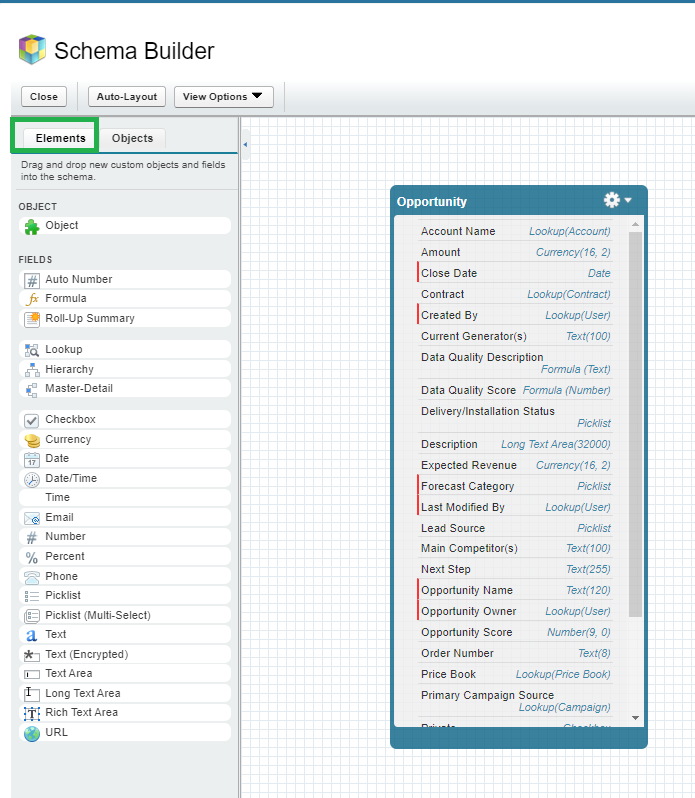
    Schema Builder lets you rapidly create fields.

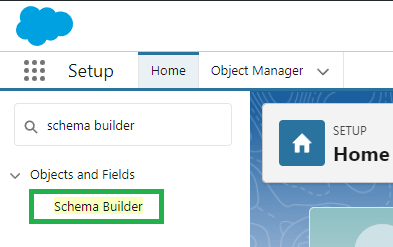
    Just search "Schema Builder" in the setup menu and click it open.

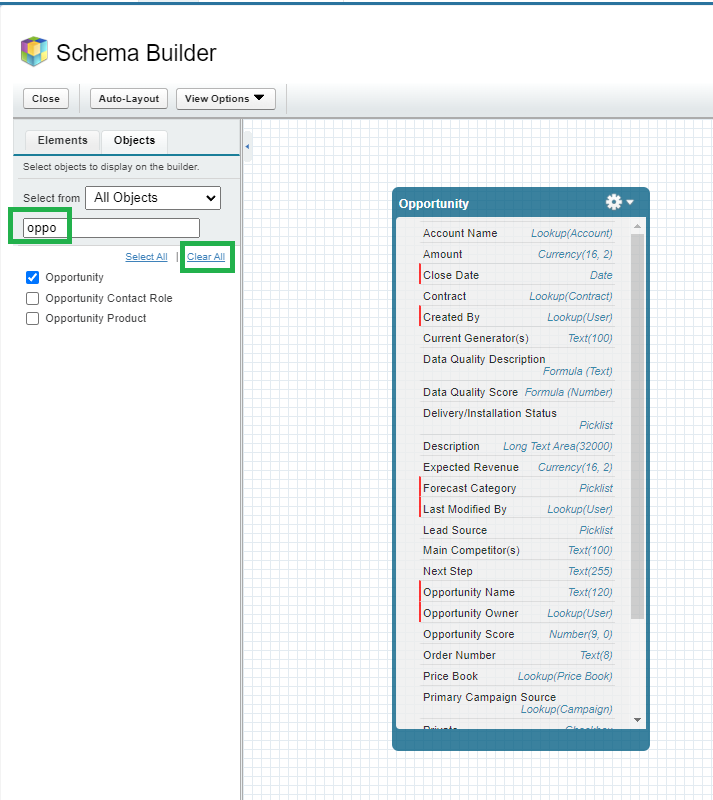
    Use the Clear All button to clear the Canvas.

    And then search for the object you want to make fields on.

    In the screenshot below I'm showing the Opportunity object.

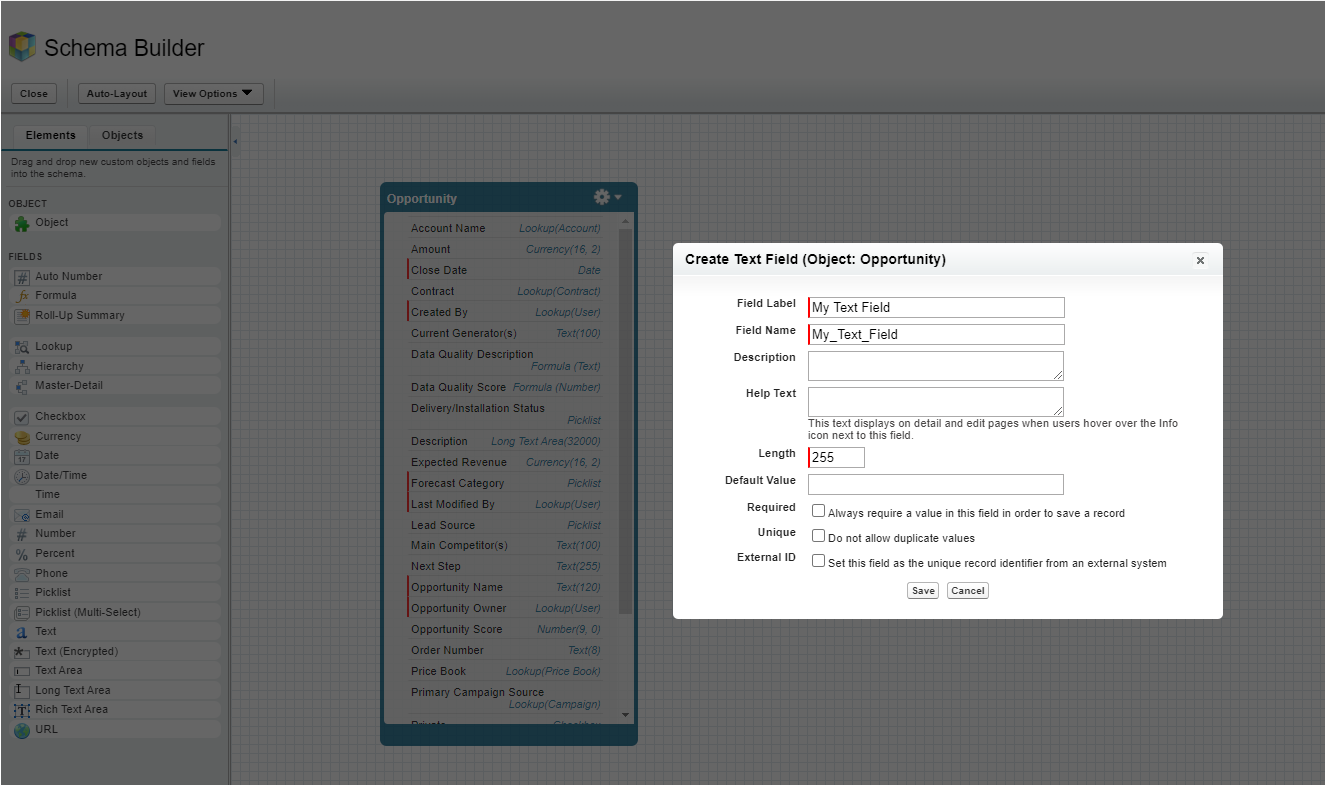
    Then click the Elements tab - and boom! - you can drag and drop these field types onto the object in the canvas to quickly make new fields.

    A single customization screen appears, which you can quickly fill in to complete the field creation.

    And just like that you can rapidly create new fields.

    I was able to create all 50 of mine in about 20 minutes.

    I did notice I wasn't able to use the new Address field type, however.

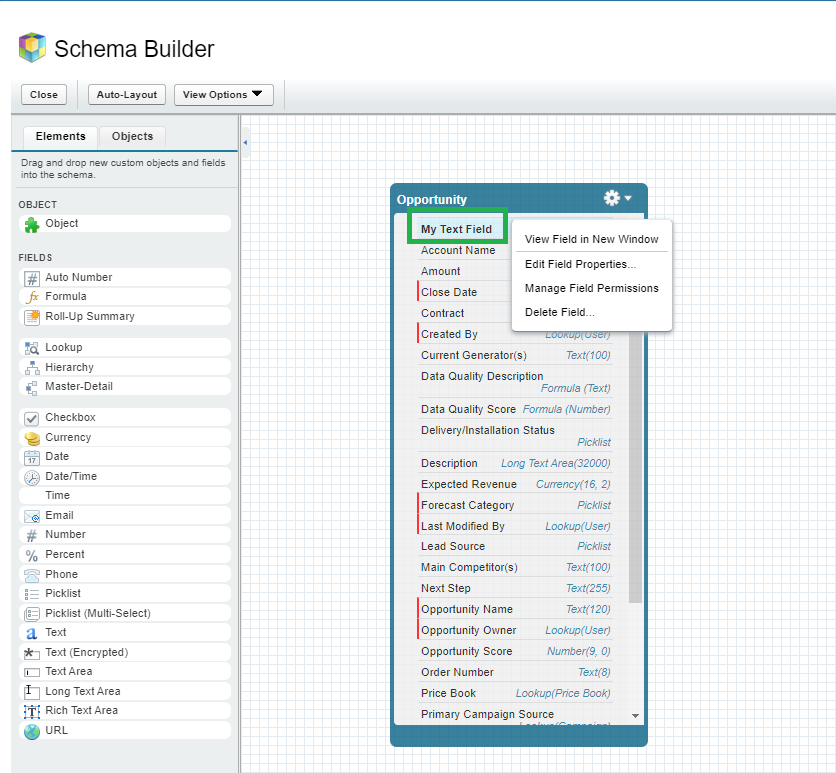
    On a final note, the Builder also offers some cool functionality when you right-click on fields.

    A menu opens up that lets you change profile level access, edit the field properties, and even delete fields.

    This was useful when I realized I created some extra fields I didn't actually want because I was able to quickly delete them.

    And that's it!

    I'm sure almost all of us have used Schema Builder before, but if you're like me you may have forgotten how useful it is for adding new fields in bulk.

    Now you'll remember right away :)


    Best,

    Nick


  • Bypass Validation Rules in Salesforce Flow

    Bypass Validation Rules in Salesforce Flow

    Happy Saturday!

    Have you ever wished you could bypass a validation rule in a Flow?

    Just while the flow is running, skip that validation rule!

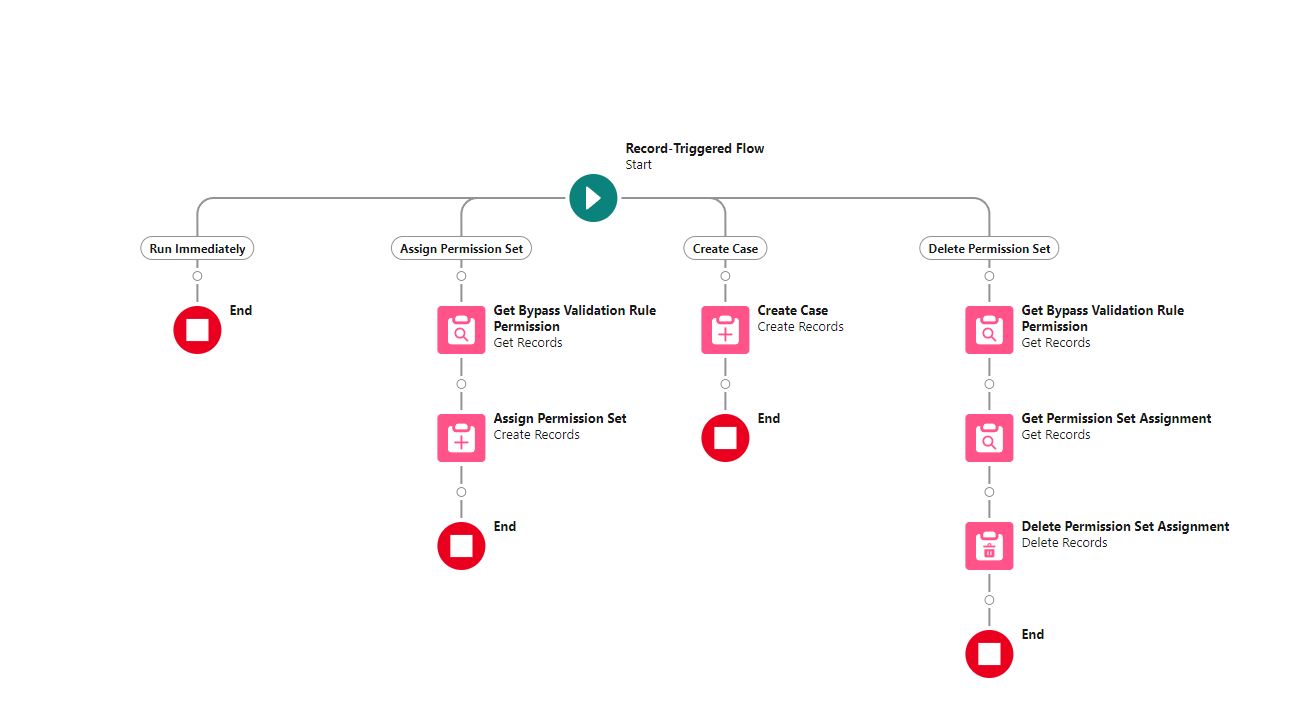
    Here's a short walk through on how to do it using a custom permission and scheduled Flow paths.

    Let's pretend you and I work at Universal Containers.

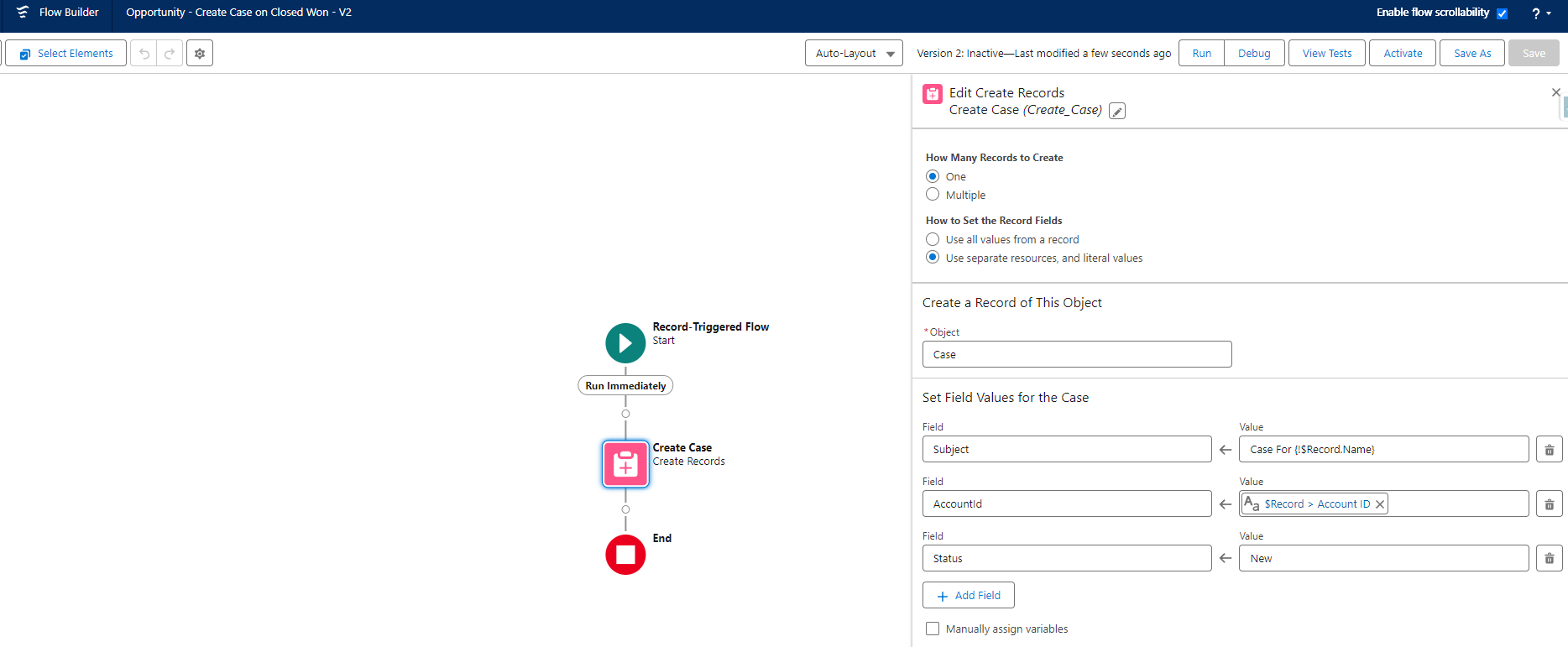
    We have a Flow that creates new cases when an Opportunity is Closed Won.

    And we want to make sure Case Validation rules never block the Flow from running.

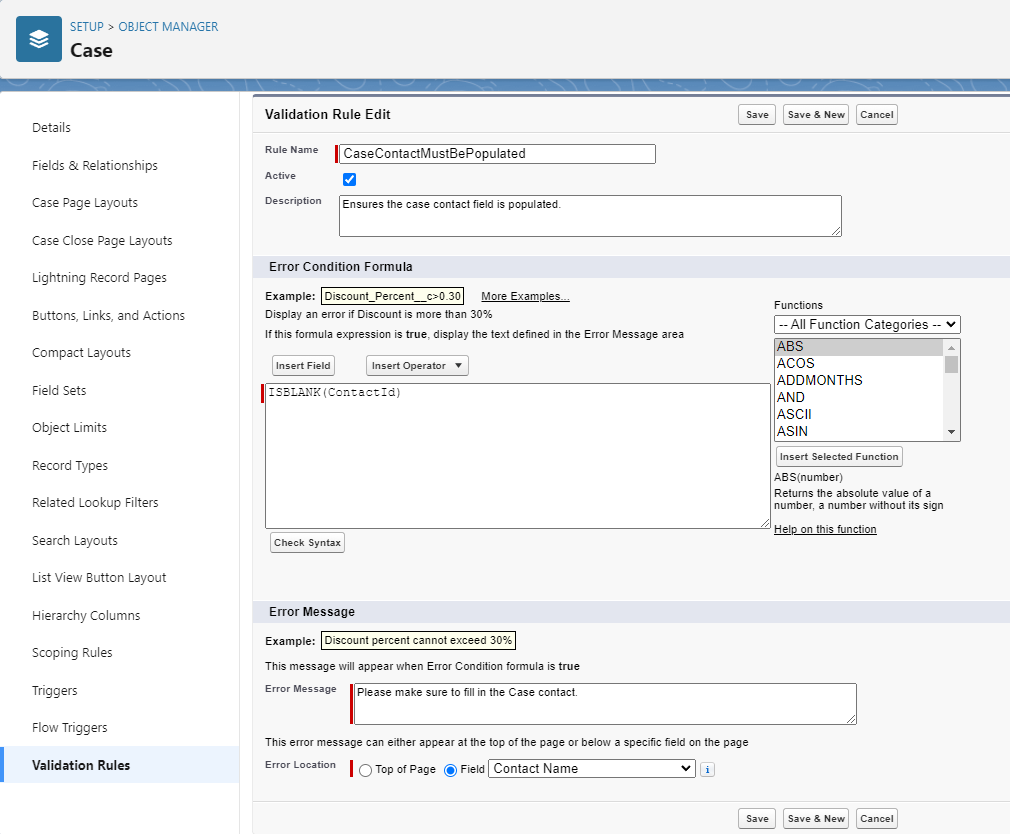
    Further, in our pretend jobs at Universal Containers, there is currently a validation rule which says the Contact field on a Case can't be empty.

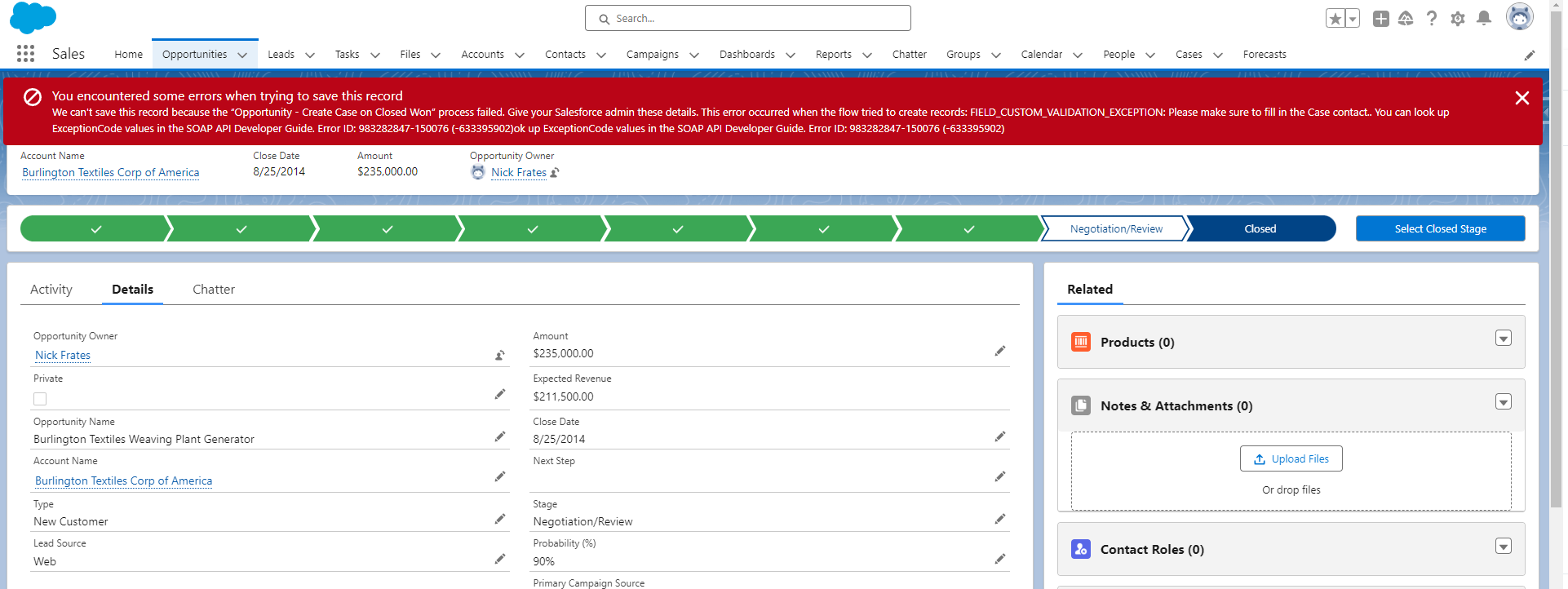
    Triggering our Flow by putting an Opportunity into Closed Won throws a big red error message (because we didn't map the Contact field in the create Case element).

    We could absolutely map the Contact field in our Flow and solve this error that way.

    But this method is for when you need to skip the rule entirely.

    To make our Flow immune to this rule we'll take the following steps.

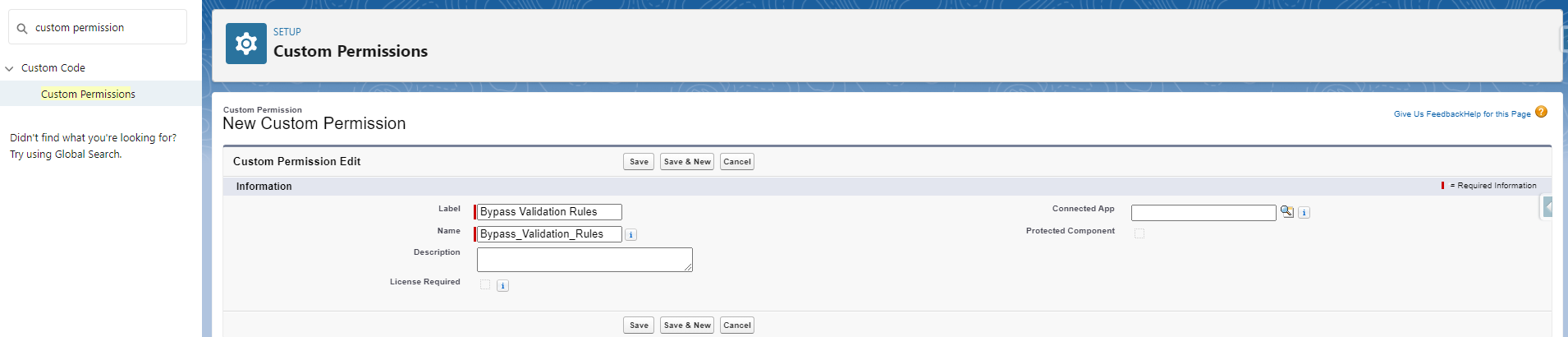
    Step 1: Create a Custom Permission

    Name it: Bypass Validation Rules

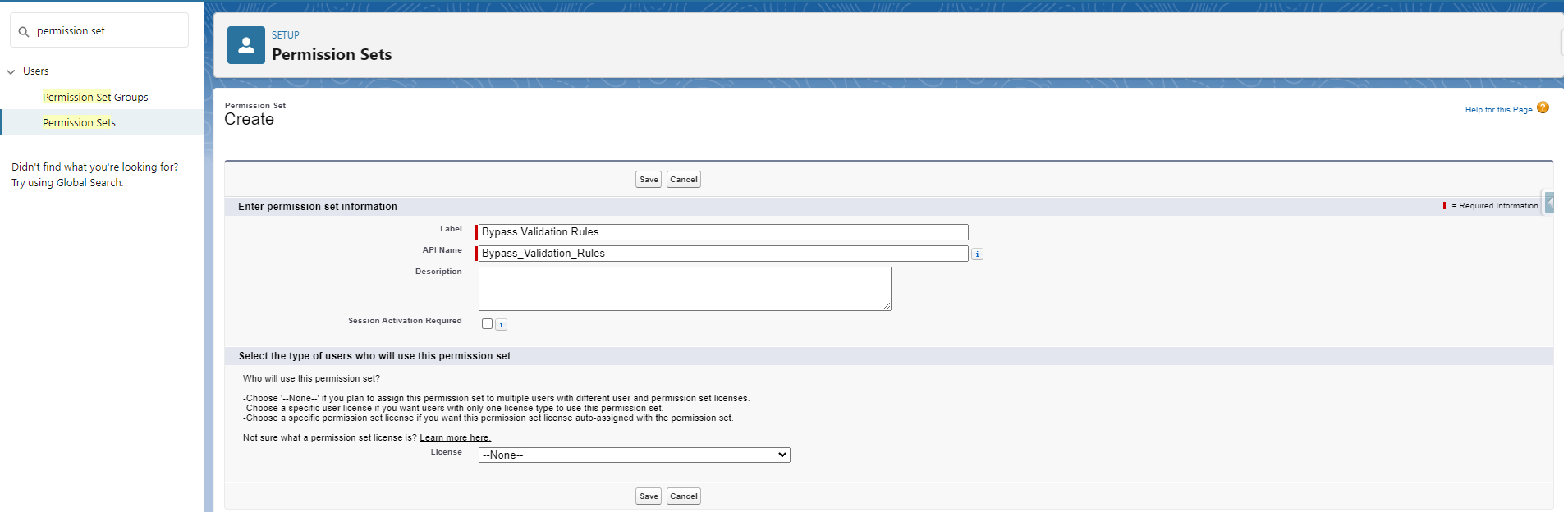
    Step 2: Create a Permission Set

    Name it the same as our Custom Permission: Bypass Validation Rules

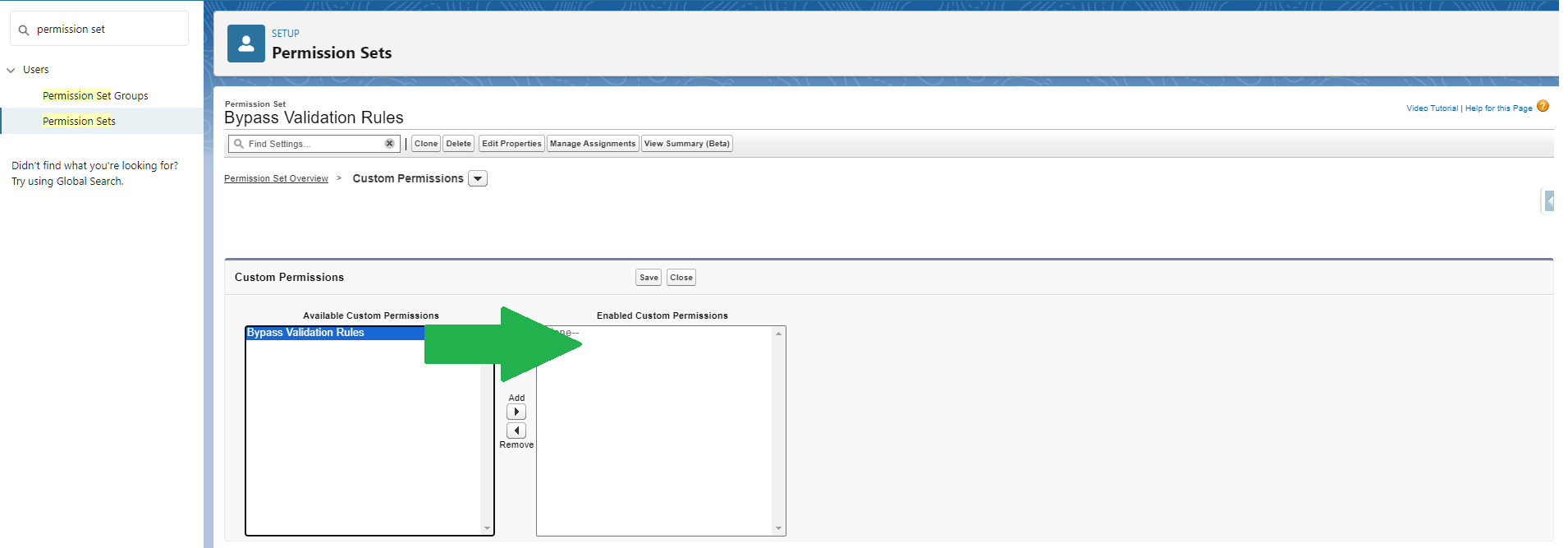
    Step 3: Add the Custom Permission to the Permission Set

    • Go to the Permission Set from the Setup menu
    • Click Custom Permissions
    • Move the Custom Permissions to the Enabled Column
    • And then press Save

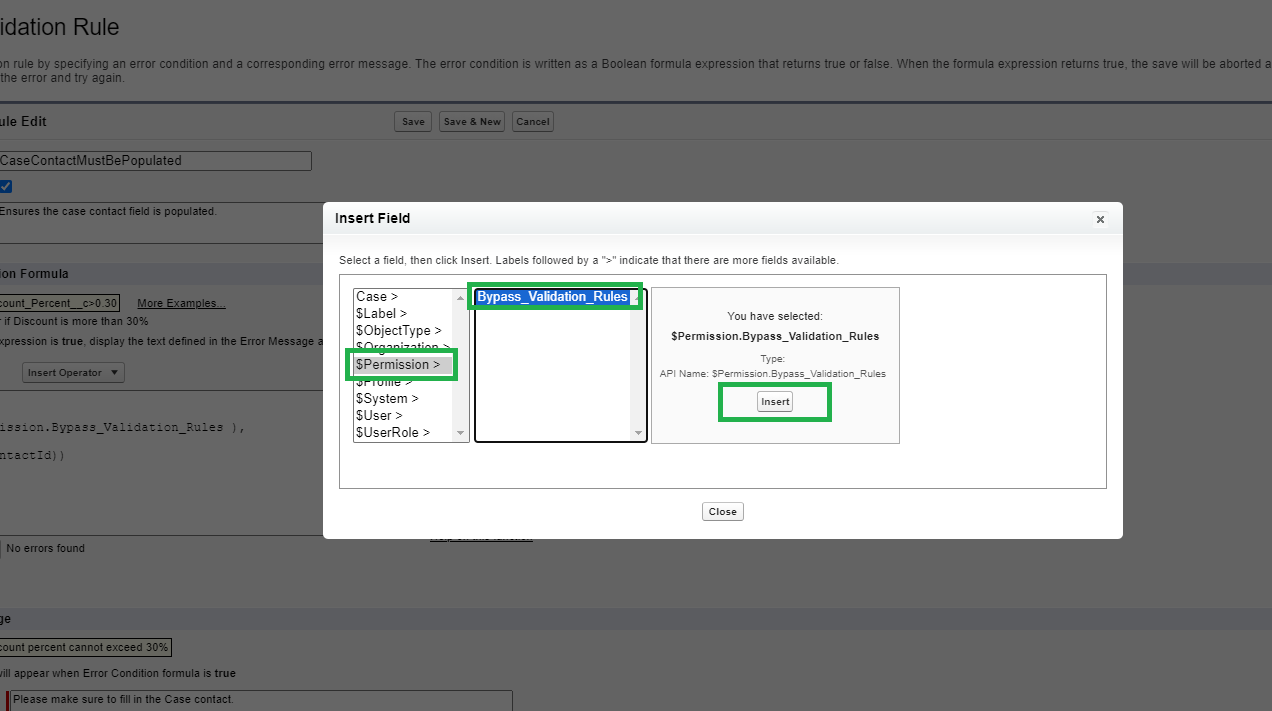
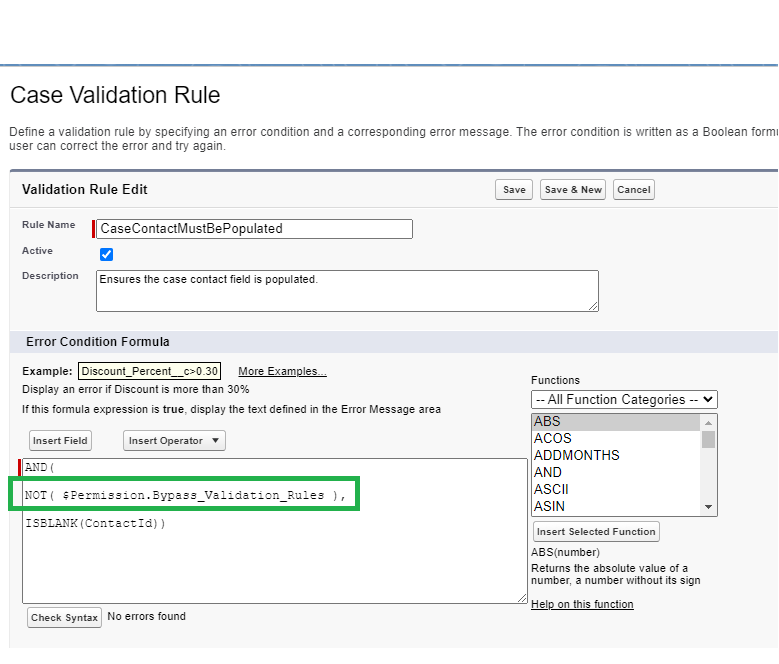
    Step 4: Exempt Users with this Permission Set from the Validation Rule

    Use the Insert Field functionality and the NOT() formula to add the exemption to the rule.

    Step 5: Update our Flow

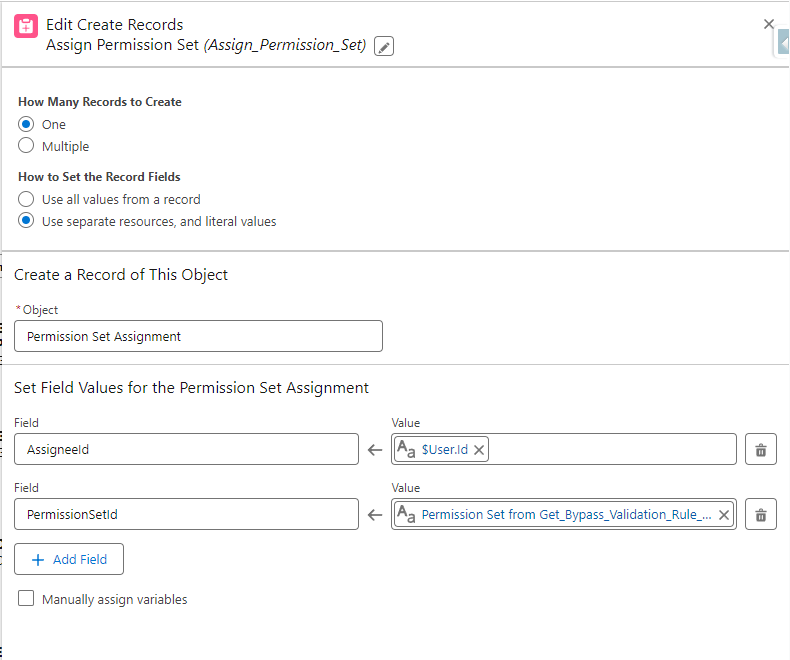
    With our Permission Set created, and our Validation Rule updated, we can use the Flow to assign our Bypass Validation Rule permission set to the current running user.

    By assigning the permission set before the Flow creates the Case, the Flow doesn't trigger the Case validation rule!

    After the Case is created, we'll want to unassign the Bypass Validation Rule from the running user so they have to follow the rule again.

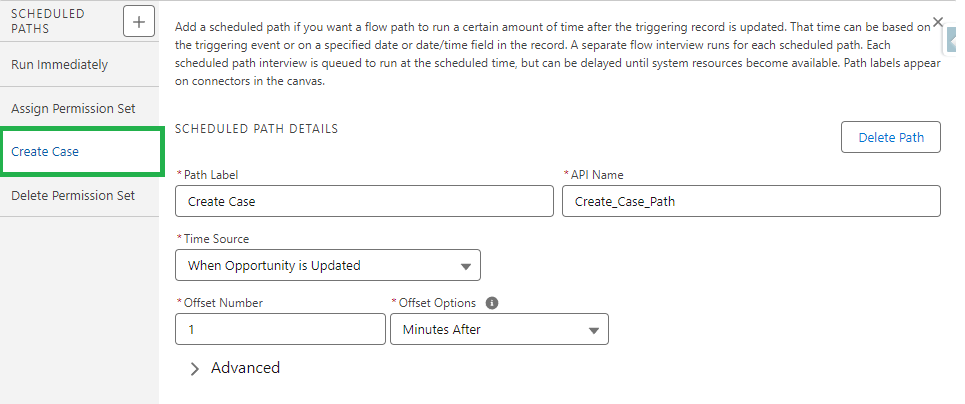
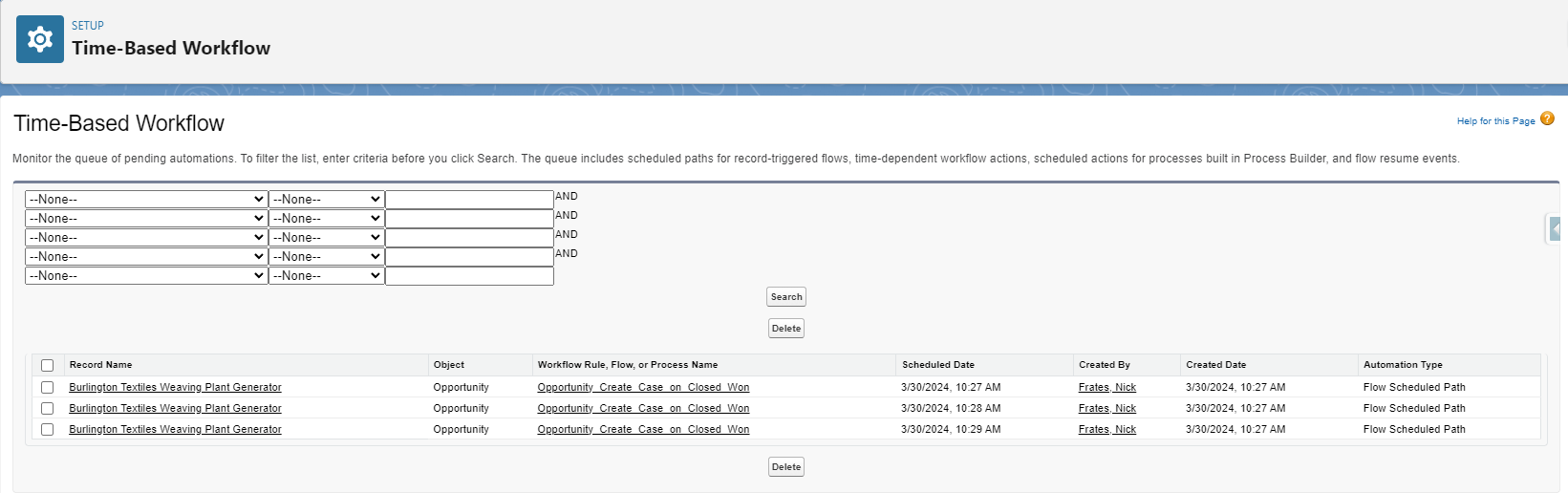
    To make all this work, we use three scheduled Flow paths.

    • The first path runs right away and Assigns the Permission
    • The second path runs 1 minute later and creates the Case
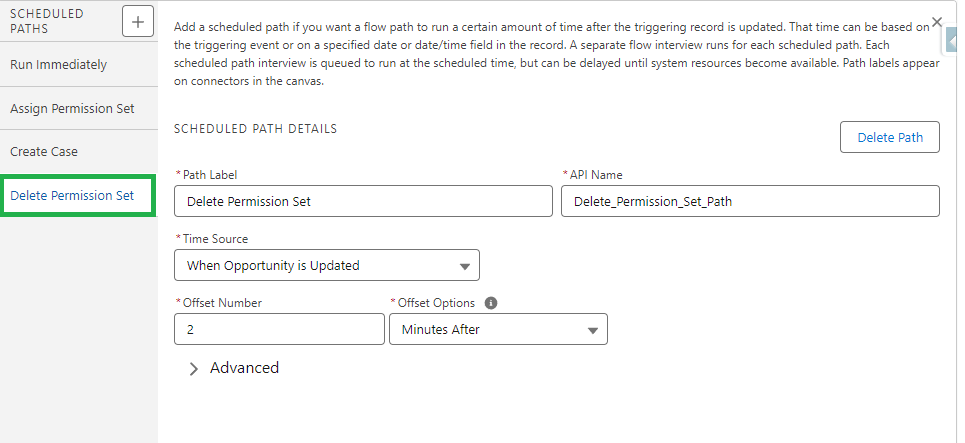
    • The third path runs 2 minutes later and Unassigns the Permission

    The reason we need three scheduled Flow paths is to avoid a MIXED_DML_OPERATION error (otherwise it would be much easier to put all these operations in a single path).

    Each scheduled path gets its own transaction, meaning it doesn't trigger the MIXED DML error.

    And there you have it, five steps to Bypass Validation Rule in your Flows :)


    Have a great weekend!


    Best,

    Nick
    P.S. If you're interested in the nitty gritty, I've posted screenshots of the Flow scheduled path and element configuration down below.

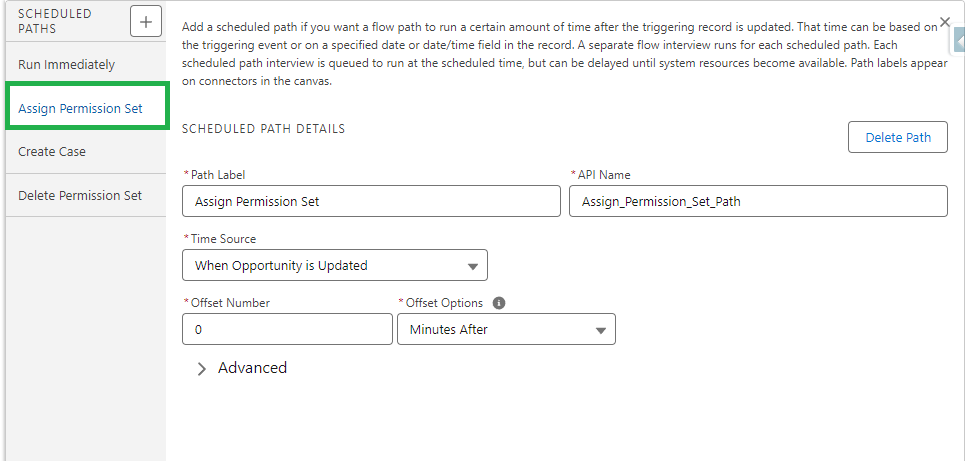
    1. Assign Permission Set Path Configuration

    a. Path Configuration


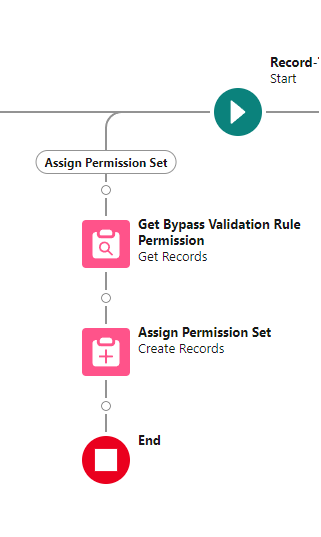
    b. Path Order on Canvas


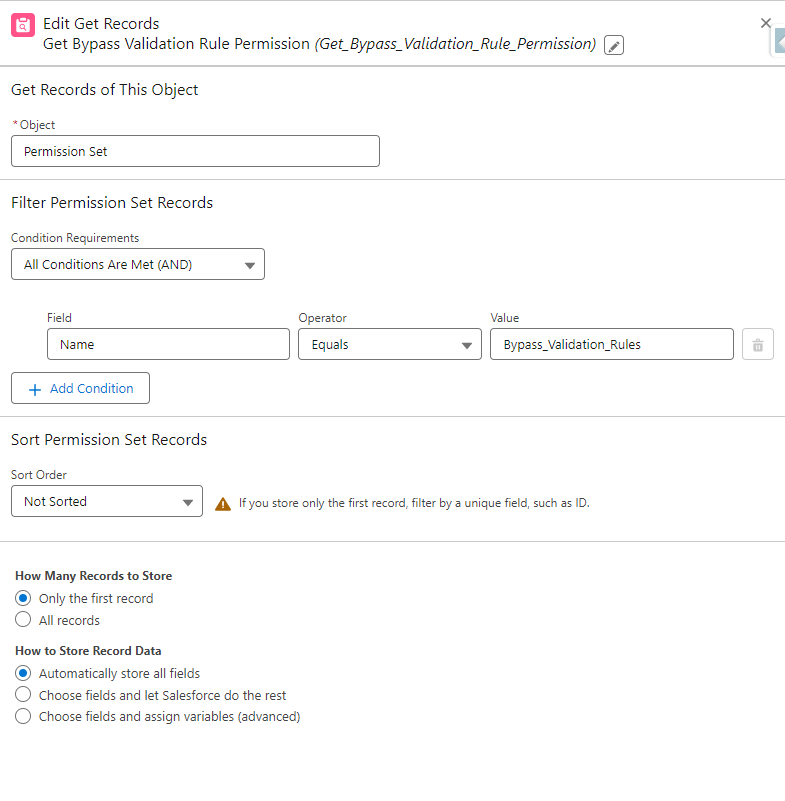
    c. Get Bypass Validation Rule Permission Element

    d. Assign Permission Set Element


    2. Create Path Configuration

    a. Path Configuration


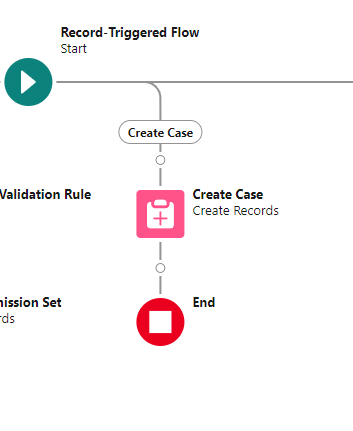
    b. Path Order on Canvas

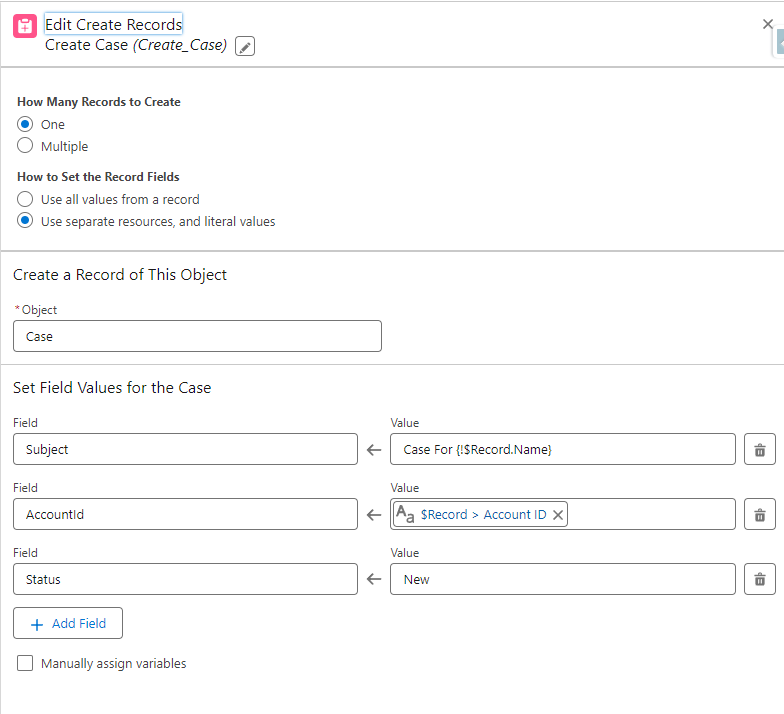
    c. Create Case Element


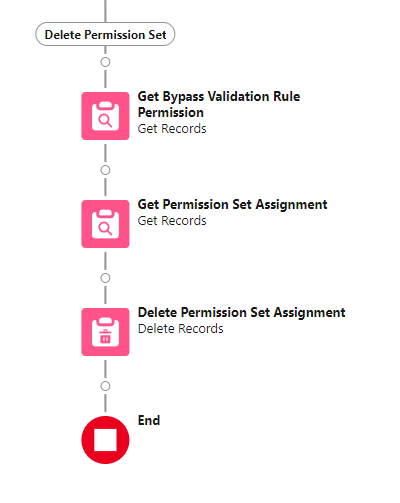
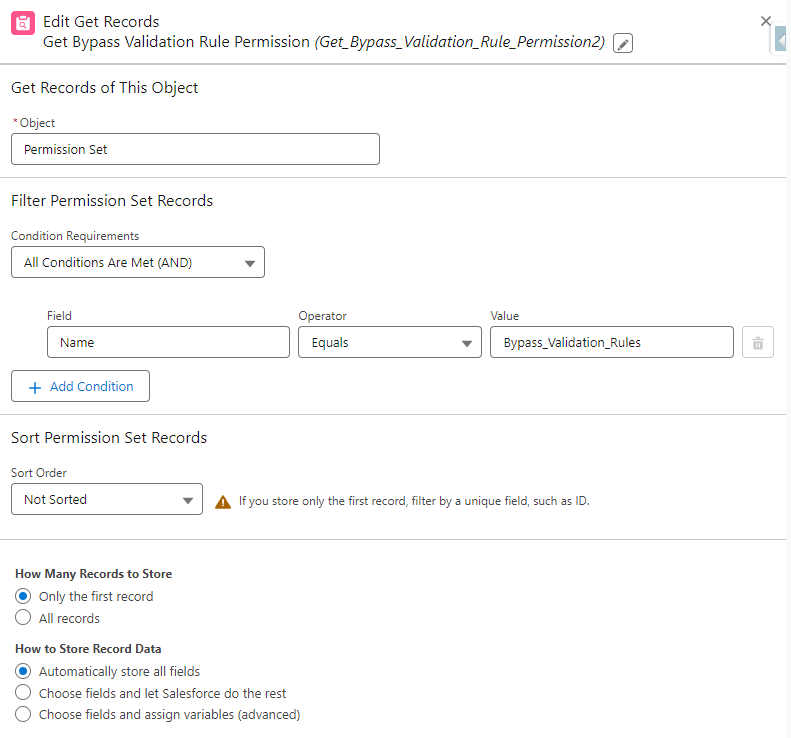
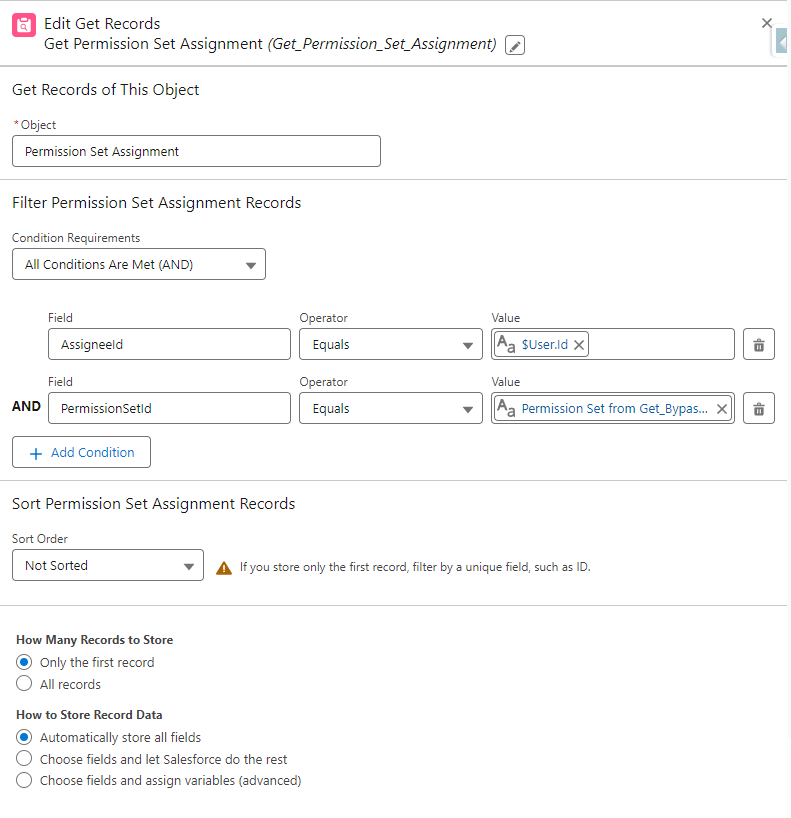
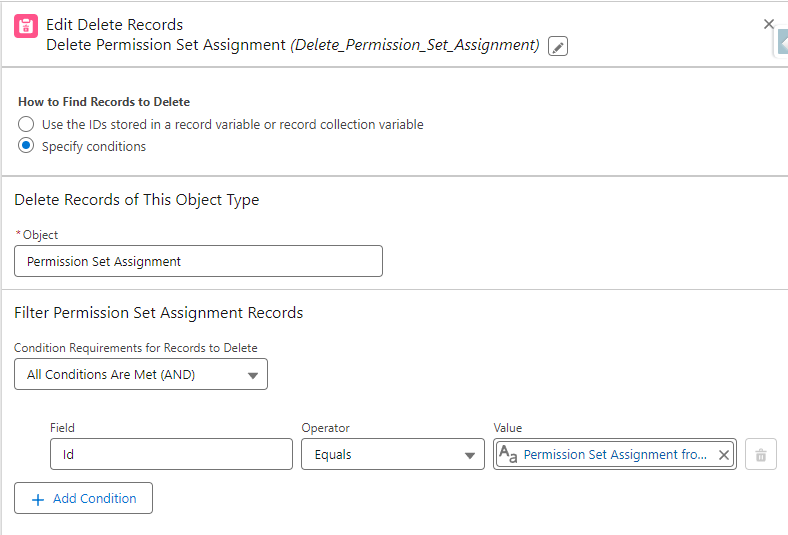
    3. Delete Permission Set Path Configuration

    a. Path Configuration


    b. Path Order on Canvas


    c. Get Bypass Validation Rule Permission Element


    d. Get Permission Set Assignment Element


    e. Delete Permission Set Assignment Element


    3. When Triggered All Paths Appear in Time-Based Workflows