Hey friends,
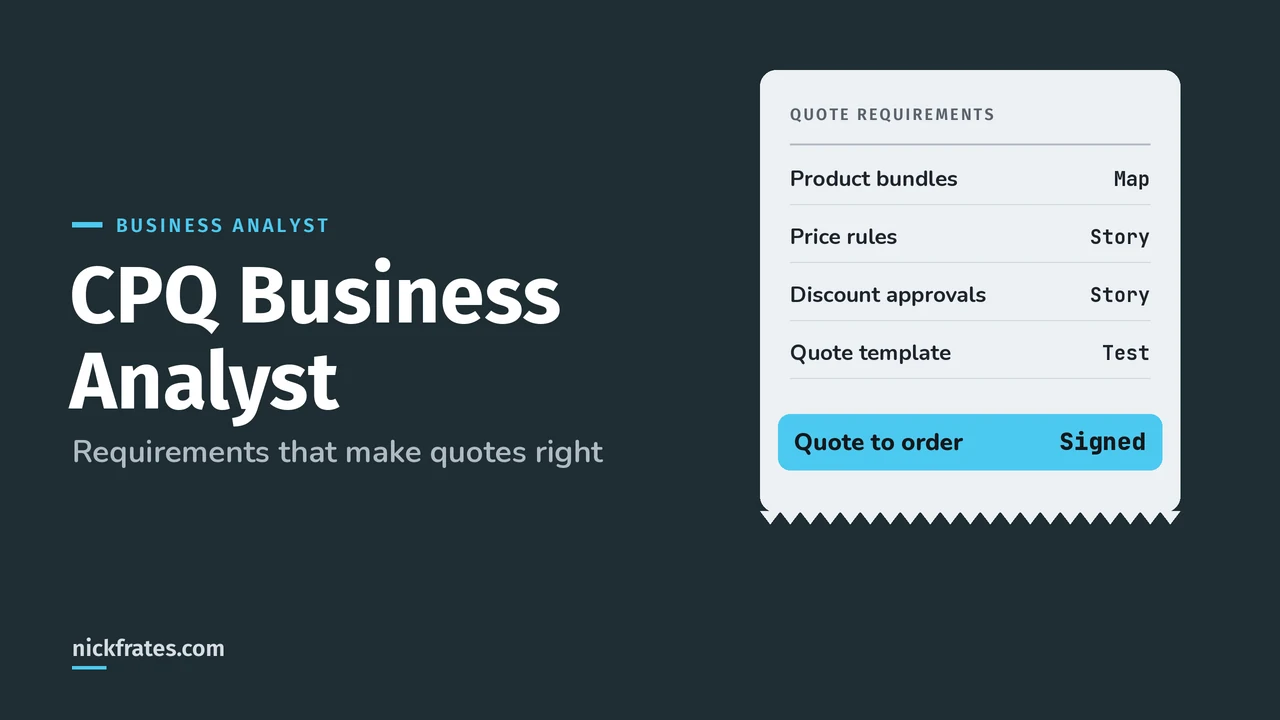
A Salesforce CPQ business analyst turns how a company really prices and quotes into rules the system can follow: which products go together, how prices and discounts are calculated, who approves what, and what the customer sees on the quote. Get those requirements right and reps quote faster with fewer errors. Get them wrong and the system faithfully produces wrong quotes.
Below are the skills that matter, the requirements to gather, worked user stories and the testing I'd insist on. All of it maps to the Salesforce Business Analyst exam, which is the cert I'd pair with this work.
Is Salesforce CPQ still worth learning in 2026?
Yes, with context. Salesforce says CPQ is end of sale, not end of life: existing customers keep using it, add users, renew and get support, but new customers aren't sold CPQ licenses. New investment goes to Revenue Cloud Advanced, which Salesforce positions as the successor. The CPQ Administrator certification is also retiring on February 1, 2027.
For a BA, that's good news. Lots of companies are running CPQ today, and many will migrate. Both need someone who can document the current quoting process and turn it into clean requirements. The BA skills transfer across CPQ and Revenue Cloud, even when the setup screens differ.
What skills does a CPQ business analyst need?
- Pricing literacy. List price, discounts, volume tiers, bundles and margins. You don't need to be in finance, but you need to follow how a price is built.
- Process mapping. Quote to order crosses sales, deal desk, finance, legal and often an ERP. Map it end to end before anyone configures rules.
- Requirements precision. CPQ rules are exact. "Big discounts need approval" isn't a requirement; "discounts above 20% need the regional manager" is.
- Data awareness. The product catalog is the foundation. Duplicate or messy products become messy quotes.
- Testing discipline. Every pricing rule needs test cases at its boundaries.
Start with the quote-to-order process
Trailhead's Business Process Mapping module uses Quote to Order as an example: the input is a customer requesting a quote, and the outcome is an order the customer confirms. That framing is perfect for CPQ, because it forces you past the quote screen to everything around it: approvals, contract terms, document generation and the handoff to order and billing.
In the Trailhead lead-to-revenue example, the quoting, invoicing and revenue steps happen in Agentforce Revenue Management while shipping runs in the ERP. Real projects look like that too. Your map should show which system owns each step.
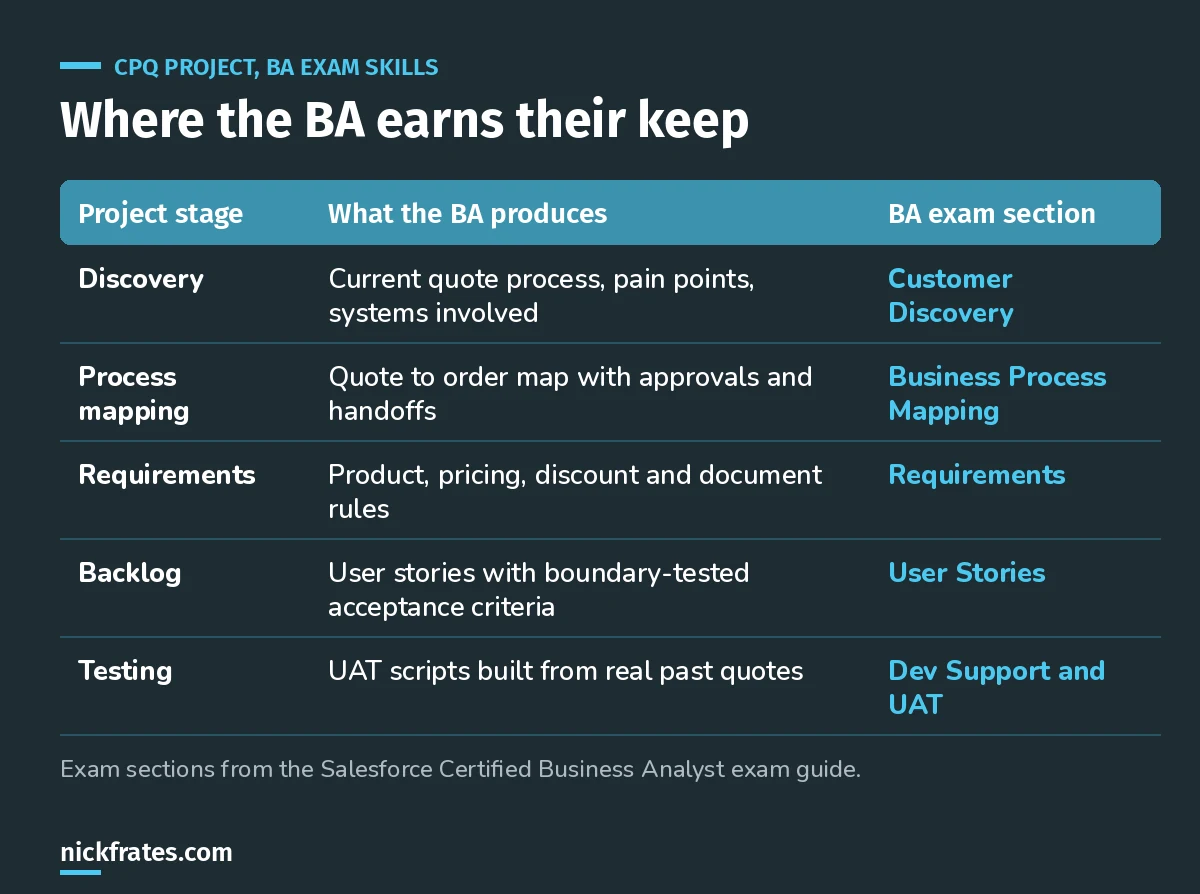
Each project stage lines up with a Business Analyst exam section.
What requirements should you gather?
| Area | Questions to ask |
|---|---|
| Products and bundles | Which products are sold together? Which are required, optional or mutually exclusive? What can't be sold together? |
| Pricing | Where does list price come from? Are there tiers by quantity, region or currency? Any customer-specific prices? |
| Discounts and approvals | Who can discount, by how much, and who approves above each threshold? What happens on rejection? |
| Quote documents | What must appear on the customer-facing quote? Which terms vary by product or region? |
| Downstream | What happens after acceptance: order, contract, invoice? Which system gets what data? |
For each answer, ask "how do you handle it today?" and ask for a real example. Past quotes are the best requirements source you'll find.
Quick backstory. I loved Focus on Force and used it on my way to 17 Salesforce certifications. Somewhere along the way I noticed I learned fastest by taking practice tests rapid-fire, over and over: answer, read why I missed it, go again. So I built Cert Lab around that loop, with up-to-date Help links and screenshots in every explanation. The certs paid off in ways I didn't expect: I learned what actually matters fast, I had a credential to point to, and they got me interviews and raises.
Cert Lab by Nick Frates
Let the Business Analyst Cert Lab test you to success
Requirements, user stories and UAT scenarios like these, asked rapid-fire with every option explained, so the BA way of thinking becomes automatic.
Start the Business Analyst Cert Lab for $9.99 →What do good CPQ user stories look like?
Same format as any Salesforce user story, with extra care on boundaries:
| User story | Acceptance criteria |
|---|---|
| As a sales rep, I want required add-ons included automatically when I pick a product so that I never send an incomplete quote. | Selecting the product adds its required add-ons. Required add-ons can't be removed. Optional add-ons stay optional. |
| As a regional manager, I want discounts above 20% to need my approval so that margins stay inside policy. | A discount of exactly 20% needs no approval. 20.01% and above routes to the manager. The rep sees the decision on the quote. |
| As a customer, I want the quote document to show my contract terms so that I can sign without a follow-up call. | The document shows the terms for the products quoted. Regional terms match the customer's region. |
Notice the 20% story spells out exactly 20% and 20.01%. Pricing bugs live at boundaries, so put them in the criteria.
How should you run UAT on a CPQ project?
- Rebuild real past quotes. Pick a set of recent quotes, including weird ones, and recreate them in the sandbox. Totals must match.
- Test every threshold. Just below, at and just above each discount or approval limit.
- Use the people who quote. Reps and the deal desk run UAT, not the build team.
- Check the document, not just the total. A correct price on a wrong quote document still loses the deal.
- Get business sign-off before go-live, and record it.
What mistakes should you avoid?
- Copying every legacy exception. Ask whether each special case is still needed before turning it into a rule.
- Skipping the catalog cleanup. Rules on top of a messy catalog multiply the mess.
- Writing solutions as requirements. Say what must happen; let the builders pick the CPQ feature that does it.
- Forgetting downstream systems. If the order or invoice is wrong, the quote project failed.
If you learn best by testing yourself, I (Nick Frates) built the Business Analyst Cert Lab here at nickfrates.com for exactly that: short rapid-fire quizzes, then an explanation for every option.
FAQ
Do I need a CPQ certification to be a CPQ business analyst?
Not necessarily. Product knowledge helps, but the BA skills (discovery, process mapping, requirements, user stories, UAT) are what you're hired for. The Business Analyst cert proves those.
Is a CPQ business analyst a technical role?
It sits in between. You don't configure every rule, but you need to understand how pricing rules behave well enough to write precise requirements and test them.
Is the CPQ Administrator certification still available?
No. Per the CPQ Administrator exam guide, the last day to take the exam was August 31, 2026, and the certification retires on February 1, 2027.
Should I learn CPQ or Revenue Cloud?
If your company or clients run CPQ, learn it. If you're starting fresh, Salesforce's investment is in Revenue Cloud Advanced. The BA skills carry over either way.
Where should you go next?
- The Salesforce Business Analyst study guide covers all six exam sections.
- Business Analyst practice questions with explanations.
- Writing Salesforce user stories and acceptance criteria.
Cert Lab by Nick Frates
Let the Business Analyst Cert Lab test you to success
Lessons, flashcards, a quiz for each of the six exam sections and full practice exams, every answer explained.
Start the Business Analyst Cert Lab for $9.99 →Studying for more than one cert? Cert Lab has a lab for each of the main Salesforce exams.
Hope this helps!
Best,
Nick