Hey friends,
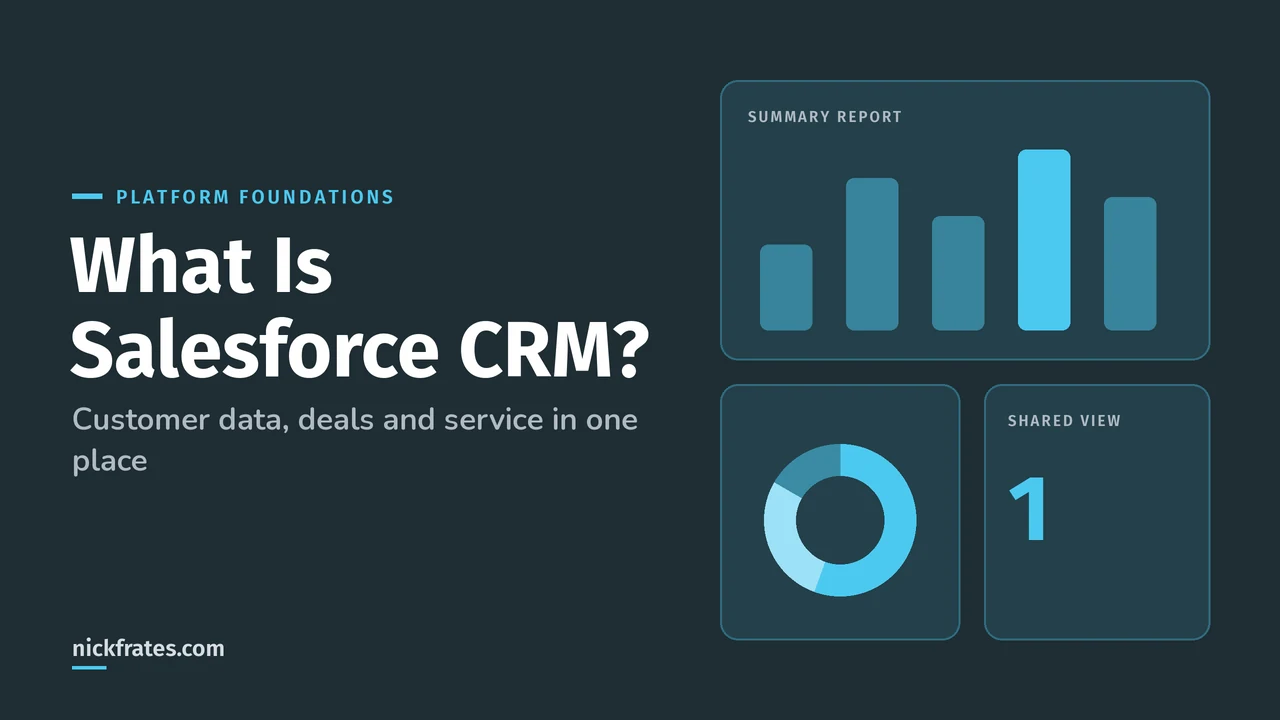
Salesforce CRM is cloud software that keeps everything about your customers in one place: who they are, every conversation you've had, the deals you're working and the problems you've solved for them, so your whole team sees the same up-to-date picture from any device. CRM stands for Customer Relationship Management.
That's the short version. Below is the plain-English longer version, based on Trailhead's Salesforce User Basics module. It's also the starting point for the Salesforce Platform Foundations exam.
What problem does Salesforce CRM solve?
Picture a sales team before a CRM. Contacts live in spreadsheets, deal notes are buried in email, follow-ups are on sticky notes. Nobody has the full picture of a customer, and the only way a manager knows how a deal is going is to ask.
Salesforce puts that data in one interface. Trailhead lists what that gives you: manage your contacts, work your prospects, organize tasks, focus on the right deals, collaborate with your team and close more business. Your manager can log in and see the latest numbers instead of calling you for an update.
How does Salesforce organize your data?
If you've used a spreadsheet, you already understand most of it.
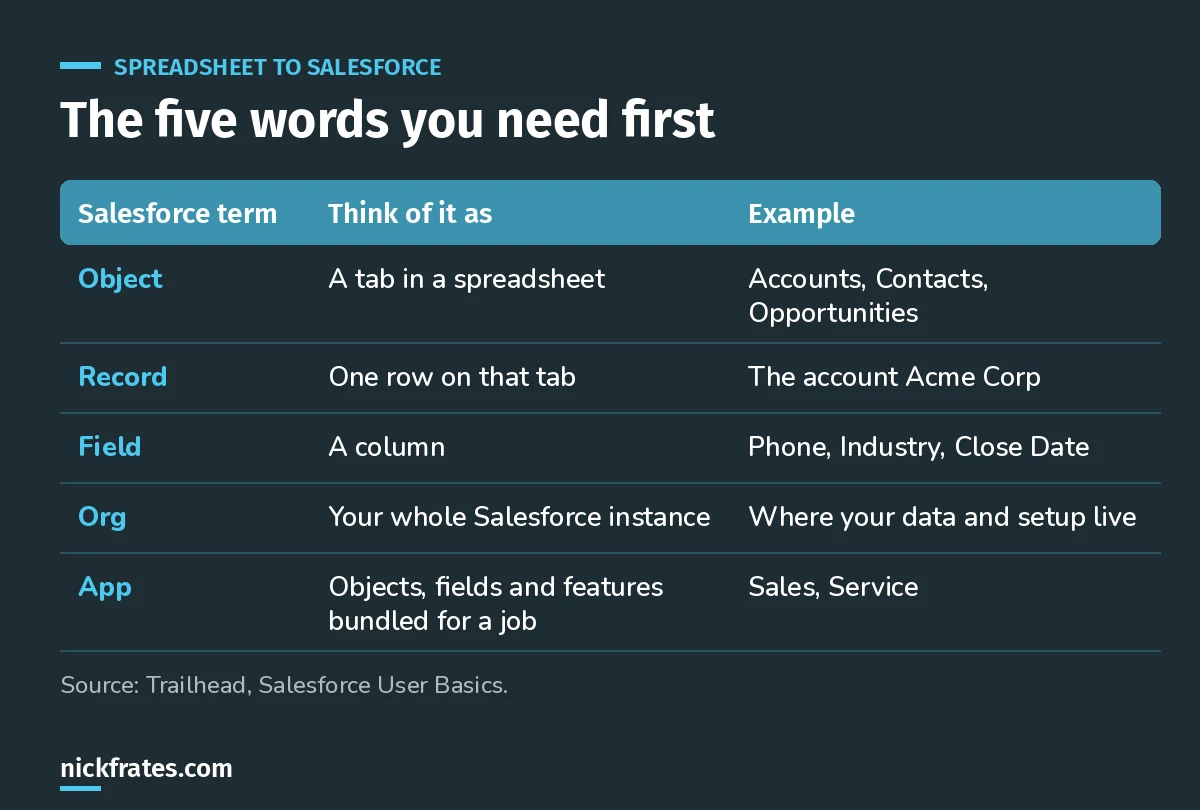
Objects are tabs, records are rows, fields are columns.
Unlike a spreadsheet, records are linked to each other. An account shows its contacts, its open deals and its support cases on one page, so you see how everything is related.
What are the core Salesforce objects?
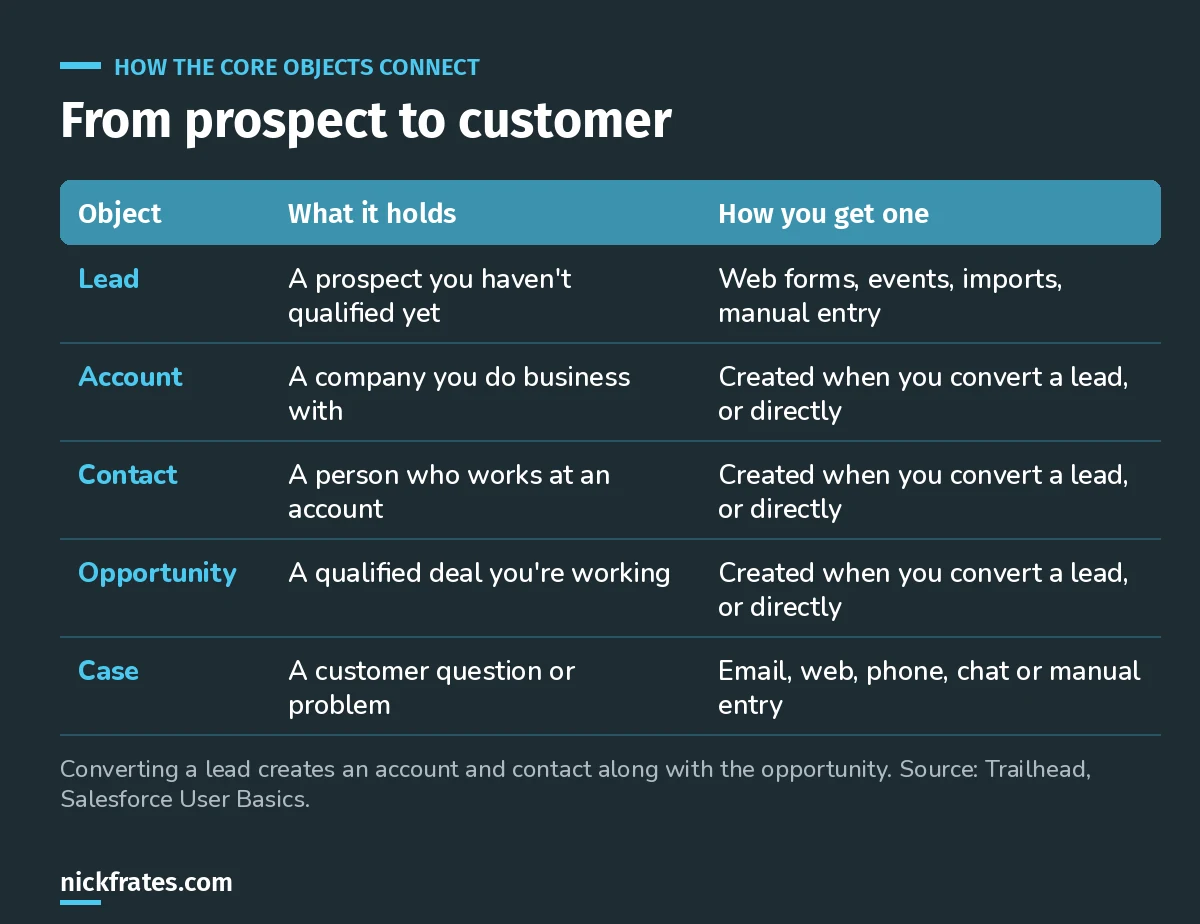
Lead conversion is the moment a prospect becomes an account, contact and opportunity.
You don't have to use leads. Trailhead notes they help most when you have team selling or different processes for prospects and qualified buyers. If you want to go deeper on how objects relate, my Salesforce data modeling post covers it.
Here's why I care about this. Certs have opened real doors for me: interviews, a new job, raises and the chance to work in new parts of Salesforce. I studied with Focus on Force early on and learned fastest from rapid-fire practice tests, so that's what I built Cert Lab around, with current links and screenshots. One honest caveat: hiring managers still want experience. Use the cert to get in the room, and bring stories of what you've done.
Cert Lab by Nick Frates
Let the Platform Foundations Cert Lab test you to success
Learn the ecosystem, navigation, data model and reports with fast quizzes and full practice exams. Every answer is explained with links to the Salesforce pages behind it.
Start the Platform Foundations Cert Lab for $9.99 →Can everyone see everything?
No. Your admin controls what each person can create, view, edit and delete. Access can be simple or layered, depending on the company. My Salesforce security model post explains how those layers work.
Is Salesforce just a CRM?
No. Trailhead's Platform Basics module puts it this way: Salesforce does CRM, but it's also a platform you customize and build on. The standard features cover common needs:
| You need to | Salesforce gives you |
|---|---|
| Sell to prospects and customers | Leads and Opportunities |
| Help customers after the sale | Cases and Communities |
| Work on the go | The Salesforce mobile app |
| Collaborate | Slack and Communities |
| Market to your audience | Marketing Cloud Engagement |
| Automate business processes | Flow Builder |
| Bring data together from many sources | Data 360 |
| Use predictive and generative AI | Salesforce Einstein |
Trailhead compares those standard features to a model home: you could live in it, but the platform is how you make it yours. That customization work is what Salesforce admins and developers do.
Who uses Salesforce CRM?
- Sales reps working leads and opportunities.
- Service agents resolving cases.
- Managers watching pipeline and performance on reports and dashboards. For heavier analysis, see how CRM Analytics compares with reports.
- Admins who customize it for everyone else. See the free Platform Foundations lesson for a taste of that side.
If you learn best by testing yourself, the Platform Foundations Cert Lab is built for that: short quizzes, then explanations for every option.
FAQ
What does CRM stand for?
Customer Relationship Management.
Is Salesforce CRM hard to learn?
The basics aren't. If you understand tabs, rows and columns, you understand objects, records and fields. The depth comes later, in automation, security and data modeling.
Where can I try Salesforce for free?
Trailhead lets you create a free Trailhead Playground, a practice org you can experiment in.
Which certification covers these basics?
Platform Foundations, the exam that used to be called Salesforce Certified Associate (Trailhead's cert prep module still has "associate" in its URL). The Platform Foundations study guide covers the whole exam.
Where should you go next?
- Platform Foundations study guide.
- Platform Foundations practice questions.
- Salesforce reports and dashboards.
Cert Lab by Nick Frates
Let the Platform Foundations Cert Lab test you to success
Lessons, flashcards, a quiz for each of the four exam sections and full practice exams, every answer explained.
Start the Platform Foundations Cert Lab for $9.99 →Hope this helps!
Best,
Nick