Hey friends,
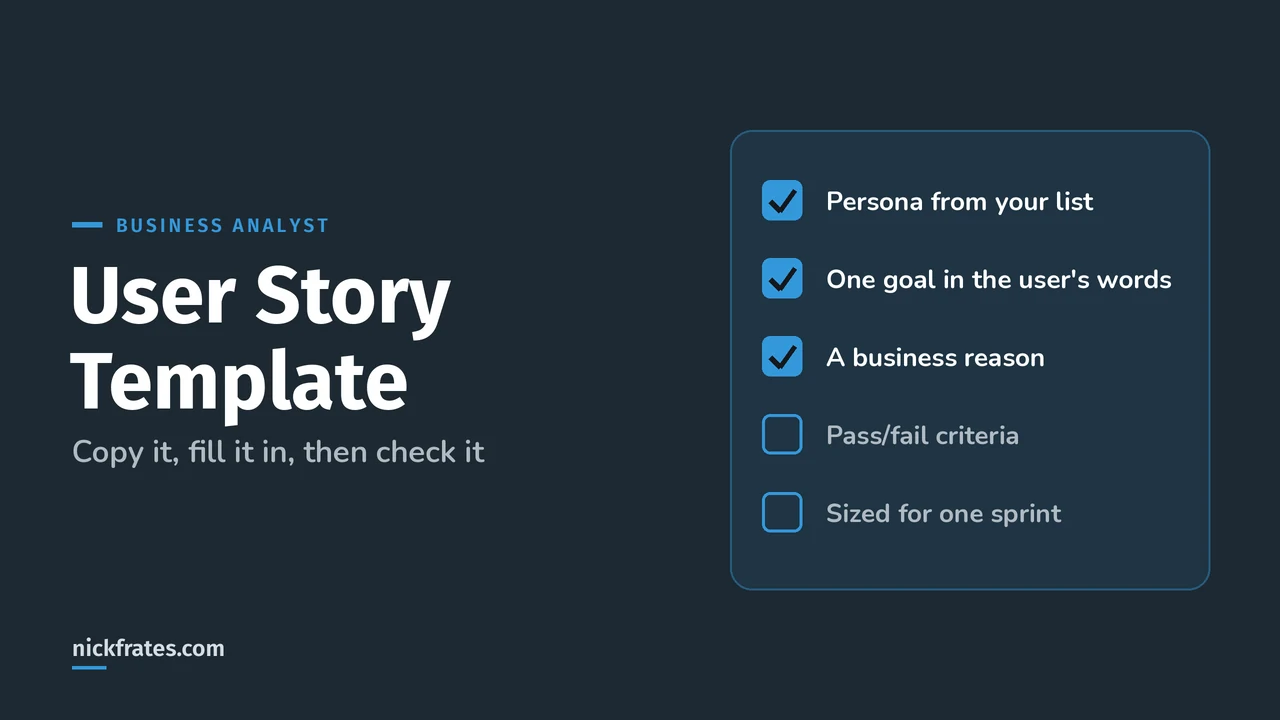
Here's the user story template I use: a title, one "As a [persona], I want [goal] so that [business reason]" sentence, two to five pass/fail acceptance criteria, notes, an estimate and a sign-off line. Copy it below, then use the 15 Salesforce examples to see what good looks like for sales, service, admin, reporting and Agentforce work.
If you want the why behind each part, read my guide to writing Salesforce user stories first. This post is the copy-and-use version.
What should a Salesforce user story template include?
Copy this into your backlog tool, a doc or a spreadsheet:
Title: [short name]As a [persona], I want [goal] so that [business reason].Acceptance criteria:1. [pass/fail statement]2. [pass/fail statement]Notes: [links, open questions, dependencies]Priority / estimate: [ ]Sign-off: [stakeholder, date]
Why each line is there:
| Line | Why it matters |
|---|---|
| Title | Lets people find and discuss the story in standups. |
| As a / I want / so that | The who, what and why. Trailhead calls all three equally important. |
| Acceptance criteria | How the team and testers know it's done. Each one is true or false. |
| Notes | Links, assumptions and open questions, so they don't live in someone's inbox. |
| Priority / estimate | INVEST says a story should be estimable. If you can't size it, split it. |
| Sign-off | Who accepted it and when. The BA exam's User Stories section includes sign-offs. |
What do 15 good Salesforce user stories look like?
Each example has a real persona, one goal, a reason and testable criteria. None of them name the Salesforce feature that will deliver it. That choice belongs to the people building it.
| # | Area | User story | Acceptance criteria |
|---|---|---|---|
| 1 | Sales | As a sales rep, I want to log a call from my phone so that my activity history is complete when I'm on the road. | A call can be logged from the mobile app. The call appears on the related contact and account. |
| 2 | Sales | As a sales manager, I want to see every deal over 50,000 closing this quarter so that I can coach the reps who own them. | One view lists open opportunities over 50,000 closing this quarter. Each shows the owner and stage. |
| 3 | Sales | As a sales rep, I want to be warned when I create a duplicate account so that we don't split one customer's history across two records. | Creating an account that matches an existing one shows a warning before save. |
| 4 | Sales | As a sales operations analyst, I want to require a loss reason on lost deals so that we can report on why we lose. | An opportunity can't be saved as Closed Lost without a loss reason. |
| 5 | Service | As a service agent, I want to see a customer's open cases when they call so that I don't ask them to repeat themselves. | Open cases for the contact are visible from the contact page. |
| 6 | Service | As a support supervisor, I want to have high-priority cases reach senior agents first so that urgent issues get experienced help. | High-priority cases are worked by the senior team before other cases. |
| 7 | Service | As a customer, I want to get an email confirming my case was received so that I know someone is on it. | A confirmation email is sent within minutes of a web case being created. It includes the case number. |
| 8 | Service | As a knowledge manager, I want to review articles before they're published so that customers only see accurate answers. | An article can't be published until a reviewer approves it. |
| 9 | Admin | As a Salesforce admin, I want to see who changed an account's owner so that I can answer audit questions quickly. | Owner changes on accounts show the old value, new value, user and date. |
| 10 | Admin | As a new hire, I want to get the right access on day one so that I can start working immediately. | A new user in the Sales team can see and edit the records Sales needs, and nothing else. |
| 11 | Admin | As a Salesforce admin, I want to deactivate leavers without breaking ownership so that their records keep a valid owner. | When a user is deactivated, their open records have an active owner. |
| 12 | Reporting | As a VP of sales, I want to see pipeline by region on one dashboard so that I can spot gaps before the quarter ends. | One dashboard shows open pipeline grouped by region. It refreshes at least daily. |
| 13 | Reporting | As a marketing manager, I want to see which campaigns produced closed deals so that I can shift budget to what works. | A report links closed-won opportunities to their source campaigns. |
| 14 | Reporting | As a finance analyst, I want to export closed-won deals by month so that month-end revenue checks are quick. | Closed-won opportunities can be exported grouped by close month. |
| 15 | Agentforce | As a service agent, I want to get a suggested reply drafted from our knowledge articles so that I answer common questions faster. | For a case on a covered topic, a draft reply is offered. The agent can edit it before sending. |
Notice examples 2 and 4. Thresholds and required values are exactly where testers find bugs, so write the boundary into the criteria.
I learned most of what I know by testing myself fast and often. Focus on Force was the resource I loved early on, and rapid-fire practice tests were what made things stick. Cert Lab is my version of that: quick tests, explanations with current Help links and screenshots. Certs brought me interviews, hires, raises and new domains to work in, but they work best alongside hands-on experience, not instead of it.
Cert Lab by Nick Frates
Let the Business Analyst Cert Lab test you to success
Practice spotting weak stories and vague acceptance criteria the way the exam asks, with an explanation for every option.
Start the Business Analyst Cert Lab for $9.99 →How do you fill in the template well?
- Start from a persona list. Trailhead lists an undefined "who" as a classic mistake.
- Write the why in business terms. "So that the field is required" isn't a reason.
- Write criteria as intent. "A manager can approve a discount", not "click the Approve button".
- Check it against INVEST: independent, negotiable, valuable, estimable, small, testable.
- Review it with the team before it goes into a sprint.
What does a bad version look like?
| Weak | Better |
|---|---|
| As a user, I want a better case page. | As a service agent, I want to see a customer's open cases when they call so that I don't ask them to repeat themselves. |
| Criteria: works well and is fast. | Criteria: open cases for the contact are visible from the contact page. |
| As an admin, I want a validation rule on Amount. | As a sales operations analyst, I want lost deals to require a loss reason so that we can report on why we lose. |
The last one is the most common: the story names the solution. Trailhead's Construct a User Story unit calls this out directly.
If you learn best by testing yourself, the Business Analyst Cert Lab is built for that: short quizzes, then explanations for every option.
FAQ
Can I use this template in Jira or Salesforce?
Yes. It's plain text, so it works in any backlog tool or in a custom object in Salesforce.
How many acceptance criteria should a story have?
At least one. If you need more than five or six, split the story.
Should the template include the solution?
No. Keep the story about the need. Put solution ideas in Notes if you have them.
Where should I keep my stories?
In one shared, version-controlled place with history. The BA exam lists version-controlled repositories as an objective.
Where should you go next?
Cert Lab by Nick Frates
Let the Business Analyst Cert Lab test you to success
Lessons, flashcards, a quiz for each of the six exam sections and full practice exams, every answer explained.
Start the Business Analyst Cert Lab for $9.99 →Hope this helps!
Best,
Nick