Hey friends,
A Salesforce Administrator configures and maintains the org, while a Salesforce Business Analyst works out what the business needs and turns it into requirements, user stories and tested outcomes. The certifications follow the same split. Platform Administrator tests features and setup. Business Analyst tests discovery, stakeholders, process mapping, requirements, user stories and UAT (user acceptance testing).
Every exam number here comes from the official guides: the Business Analyst exam guide and the Platform Administrator exam guide. For the full BA outline, see my Salesforce Business Analyst study guide.
Business Analyst vs Platform Administrator certification at a glance
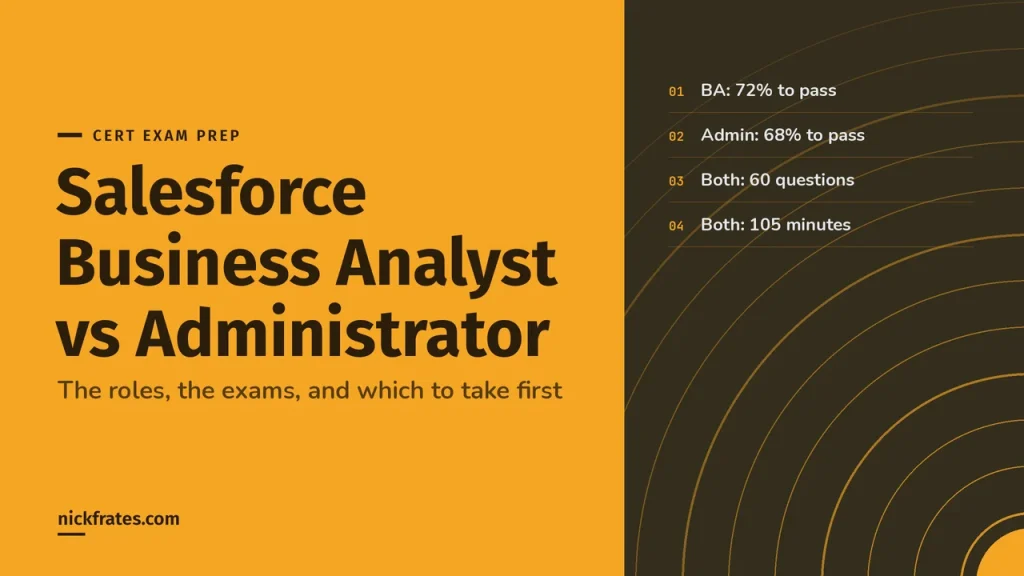
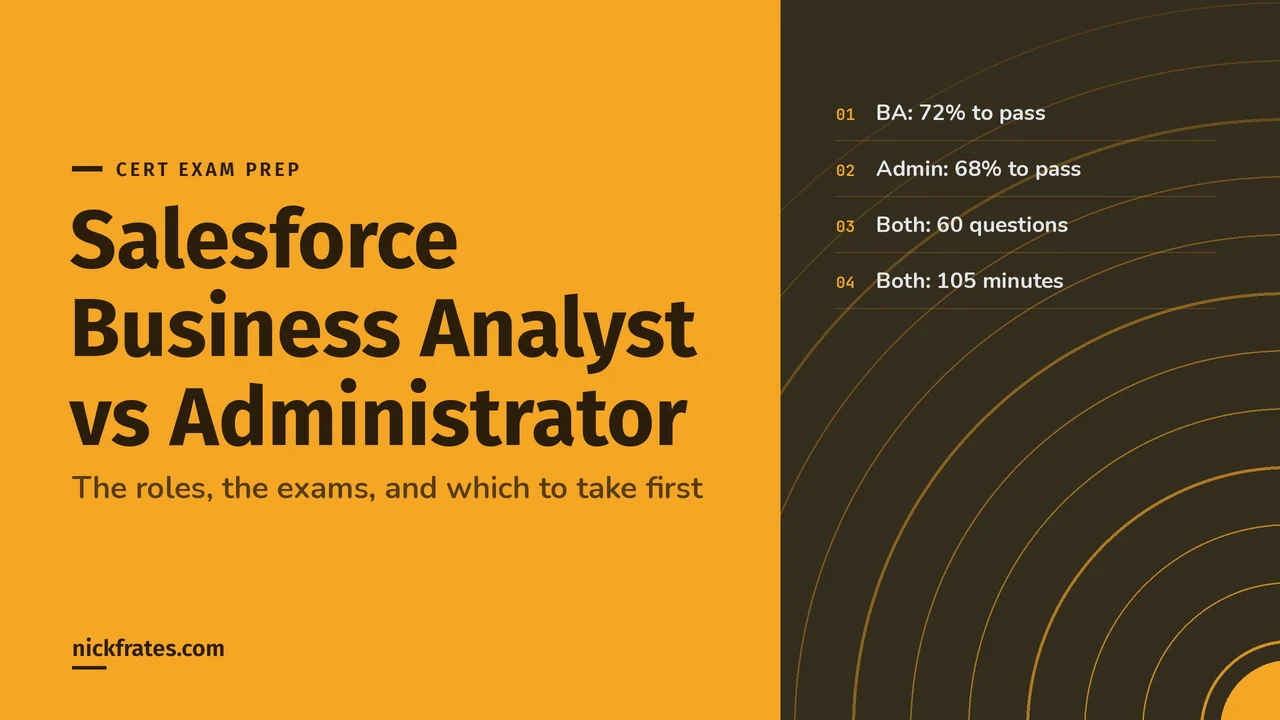
| Business Analyst | Platform Administrator | |
|---|---|---|
| Prerequisite | None (the Admin requirement was dropped May 2, 2023) | None |
| Questions | 60, plus up to 5 unscored | 60, plus up to 5 unscored |
| Time | 105 minutes | 105 minutes |
| Passing score | 72% | 68% (English), 65% (Japanese) |
| Sections | 6 | 8 |
| Recommended experience | 2 years as a BA and 2 years on the Salesforce Platform | 6 or more months as an admin |
| Fees | See certification cost | See certification cost |
Source for the prerequisite change: Salesforce Certified Business Analyst FAQ.
What does a Salesforce Business Analyst do that an admin doesn’t?
A Salesforce BA spends most of the time before and after the build: asking questions, documenting requirements, and confirming the result works for the business. Trailhead describes the BA as a project-based, business-improvement role, a kind of interpreter between the business and the technical team.
Trailhead lists the BA’s key activities as communication, elicitation, documenting requirements, analyzing information, facilitating solutions, implementing solutions and testing. (Learn About the Salesforce Business Analyst Role)
The Admin exam guide describes an admin who maintains a Salesforce org, responds to common business requirements and performs administrative functions with current features. In practice, the admin builds and runs the configuration the BA helped define.
How do the two exam outlines differ?
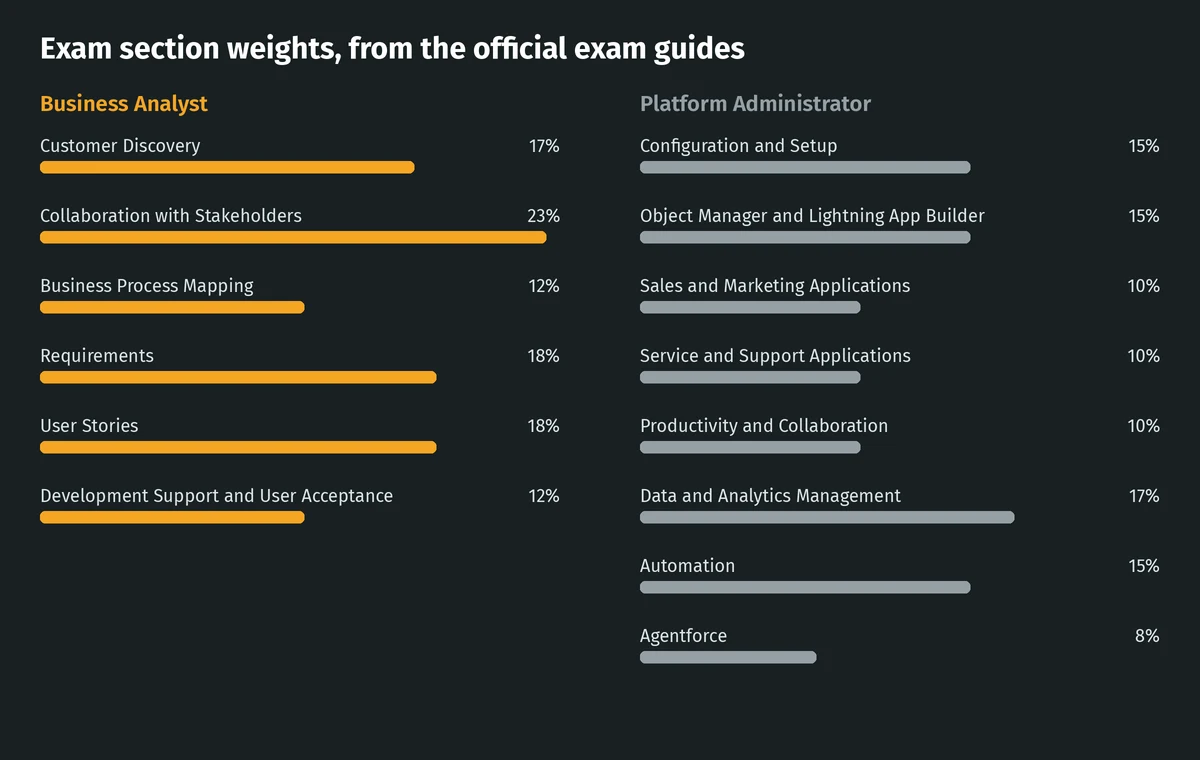
The outlines barely overlap. I checked both word by word.
- In the BA outline and not the Admin outline: stakeholders, user stories, acceptance criteria, UAT, and documenting work in a version-controlled repository.
- In the Admin outline and not the BA outline: named features like Flow, reports and dashboards, Object Manager, permission sets and Agentforce, each with its own objectives.
- Shared ground: both expect you to know Salesforce capabilities. The BA guide asks you to align Salesforce capabilities with business needs and recommend solutions.
A worked example: one request, two jobs
Request: “Managers need to approve big discounts.”
- The BA asks who approves, at what amount, how fast, and what happens on rejection. Then they write a user story with acceptance criteria that state intent, like “A district manager can approve or reject a discounted price,” plan the UAT scripts and get sign-off.
- The admin picks the tool (an approval process or a flow), builds it, sets up the approvers and tests it.
- On the BA exam, the right answer is usually the step that clarifies or validates. On the Admin exam, it’s the feature that does the job.
Cert Lab by Nick Frates
Studying for the BA exam?
The Business Analyst Cert Lab covers all six sections with lessons, flashcards and practice quizzes that explain every answer.
Start the Business Analyst Cert Lab, $9.99 →Is the Salesforce Business Analyst exam hard?
I’d say it’s hard in a different way than Admin. There’s less to memorize about features, but the 72% passing score is higher than Admin’s 68%, so you can only miss 16 of 60. And most questions ask for the best next step in a scenario, where two answers sound reasonable.
The guide recommends 2 years of BA experience and 2 years on the Salesforce Platform. If you’ve run discovery workshops, written user stories and run UAT, a lot of it will feel familiar. If you haven’t, expect to study the techniques, not just the vocabulary.
A 6-week Business Analyst study plan
This is the order I’d use. It front-loads the biggest sections:
| Week | Focus | Weight |
|---|---|---|
| 1 | Collaboration with Stakeholders: elicitation techniques, RACI, journey maps, Scrum vs Kanban | 23% |
| 2 | Requirements: scope vs requirements vs user stories, current state, prioritization | 18% |
| 3 | User Stories: format, acceptance criteria, INVEST, definition of done | 18% |
| 4 | Customer Discovery: business goals, implementation lifecycle, current-state analysis | 17% |
| 5 | Business Process Mapping (UPN) plus Development Support and User Acceptance | 12% + 12% |
| 6 | Full practice exams, then review every miss by section |
After each practice exam, put your section scores into my Salesforce exam score calculator to see which sections are costing you points.
Should you take Business Analyst or Administrator first?
- You configure Salesforce day to day: Platform Administrator first. Start with my Admin certification guide. The Admin Cert Lab is free, no card, no trial.
- You run requirements and workshops but rarely build: Business Analyst first. You don’t need Admin for it anymore.
- You want both: I’d still do Admin first. Knowing what Salesforce can do makes the BA’s “recommend a solution” questions easier.
Mistakes I see when admins take the BA exam
- Answering like an admin. Picking the feature when the question wants the conversation, the document or the sign-off.
- Putting solutions in acceptance criteria. The BA exam rewards intent, not buttons.
- Underestimating the 72% line. It’s higher than Admin’s, so weak sections hurt more.
- Skipping the soft-skill sections. Collaboration with Stakeholders is the biggest section, at 23%.
Frequently asked questions
Do I need the Admin certification to take the Business Analyst exam? No. Salesforce removed that prerequisite effective May 2, 2023.
What’s the passing score for each? 72% for Business Analyst, and 68% for Platform Administrator (English version).
Is a Salesforce business analyst a technical role? Partly. Trailhead lists soft skills like elicitation and requirements writing, plus a basic understanding of Salesforce areas like automation, data management and reports.
How many questions are on the Business Analyst exam? 60 questions plus up to five unscored ones, in 105 minutes.
Where can I practice? Try my 25 Salesforce Business Analyst practice questions, each with the answer and its Trailhead source. My Business Analyst study guide has more.
Where to go next
- Salesforce Business Analyst study guide
- Platform Administrator study guide
- All my Salesforce certification study guides
Cert Lab by Nick Frates
Get the Business Analyst Cert Lab
Lessons, flashcards, section quizzes and practice exams for all six Business Analyst sections, built from the official exam guide.
Start the Business Analyst Cert Lab, $9.99 →Hope this helps!
Best,
Nick