Hey friends,
These are 25 original Salesforce Business Analyst practice questions, split across the six exam sections by the official exam guide’s weights, each with the answer, the reasoning, and the Trailhead unit it comes from. They’re not exam dumps. I wrote them from the official Business Analyst exam guide and the Trailhead modules Salesforce points to for each section.
For the full section-by-section outline, start with my Salesforce Business Analyst study guide, then come back here to test yourself.
How many questions are on the Salesforce Business Analyst exam?
The Salesforce Certified Business Analyst exam has 60 multiple-choice questions plus up to five unscored ones, you get 105 minutes, and the passing score is 72%. Here’s the rest from the exam guide:
| Exam fact | Detail |
|---|---|
| Questions | 60, plus up to 5 unscored |
| Time | 105 minutes |
| Passing score | 72% |
| Prerequisite | None |
| Recommended experience | 2 years as a business analyst and 2 years on the Salesforce Platform |
| References allowed | None |
| Fee | See my Salesforce certification cost table |
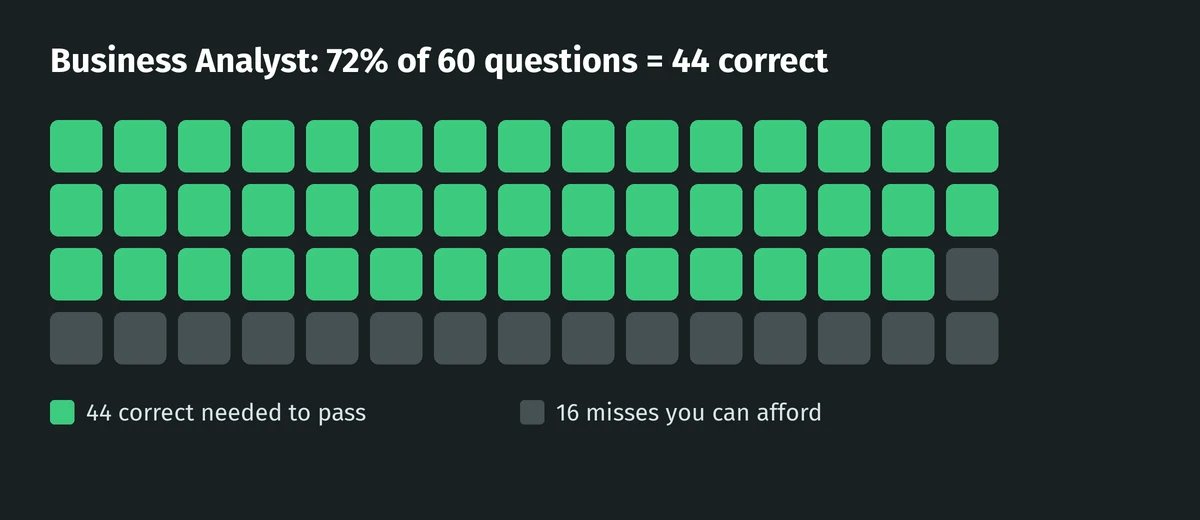
72% of 60 is 43.2, so you need 44. That’s only 16 misses, a tighter line than the admin exams.
Which sections matter most?
| Section | Weight | Questions here |
|---|---|---|
| Collaboration with Stakeholders | 23% | 6 |
| Requirements | 18% | 4 |
| User Stories | 18% | 5 |
| Customer Discovery | 17% | 4 |
| Business Process Mapping | 12% | 3 |
| Development Support and User Acceptance | 12% | 3 |
How to use these: read the scenario, commit to a letter, then open the answer. BA questions are about judgment, so the explanation matters more than the letter.
Customer Discovery practice questions (17%)
Question 1. A sales VP asks you to “add a forecast dashboard.” Before you touch Setup, what do you do first?
- A. Build a prototype dashboard so they can react to it
- B. Ask who needs to see the forecast, how and where they need it, and how often they check it
- C. Install a forecasting app from AgentExchange
- D. Write the user stories from the request as stated
Show the answer and explanation
Answer: B. Discovery starts with who, what, where, why, when and how questions. Trailhead uses almost this exact request (a VP who wants to see the quarterly forecast) to show the questions a BA asks first: who’s on the team, how and where they need to see it, whether anyone else needs it, and how often they check it.
Prototyping (A) and story writing (D) come after you understand the need. (Source: Trailhead, Explore Techniques for Information Discovery)
Question 2. You’re joining a project to improve an existing case process. A previous team tried a redesign last year. What’s the main reason to collect project history first?
- A. To estimate the budget
- B. So you don’t repeat work that’s already been done or rehash earlier decisions
- C. To pick the development methodology
- D. To write the UAT scripts
Show the answer and explanation
Answer: B. Project history (sometimes called project orientation) is background on the existing systems, design, requirements and processes. Trailhead’s reason for it is exactly this: so you don’t repeat work or reopen decisions that were already made. (Source: Trailhead, Explore Techniques for Information Discovery)
Question 3. You’ve identified the business need. Which analysis compares the current state with the desired future state?
- A. Enterprise analysis
- B. Gap analysis, as part of strategy analysis
- C. Stakeholder analysis
- D. Regression testing
Show the answer and explanation
Answer: B. In strategy analysis you identify the business need, observe the current state, define the future and transition states, then compare them. Trailhead calls that comparison a gap analysis. Enterprise analysis (A) is about org structure: who reports to whom and how departments interact. (Source: Trailhead, Explore Techniques for Information Discovery)
Question 4. Early in a project you need to understand who reports to whom and how the sales and service departments interact. Which type of analysis is this?
- A. Enterprise analysis
- B. Gap analysis
- C. Root cause analysis
- D. Data analysis
Show the answer and explanation
Answer: A. Enterprise analysis is learning the organization’s structure and how departments function and interact. It helps the team collaborate and communicate with the right people. (Source: Trailhead, Explore Techniques for Information Discovery)
Collaboration with Stakeholders practice questions (23%)
Question 5. On your RACI chart for a new lead-routing process, the sales ops manager will make the final call and own the outcome, while an admin builds it. Which letter goes on the sales ops manager?
- A. R, Responsible
- B. A, Accountable
- C. C, Consulted
- D. I, Informed
Show the answer and explanation
Answer: B. In a RACI chart, Responsible is the person doing the work (the admin here) and Accountable is the person ultimately accountable for the outcome. Consulted people give feedback, and Informed people just need to know. (Source: Trailhead, Learn Documentation Types)
Question 6. You need to work out who can explain the business problem, who can help flesh out requirements, and who will give you a range of perspectives. Which BA document captures that?
- A. Glossary of terms
- B. Stakeholder analysis
- C. Use case
- D. Business analysis plan
Show the answer and explanation
Answer: B. A stakeholder analysis identifies who to talk to about the business problem, who can help flesh out the requirements, and who gives you a range of perspectives. A business analysis plan (D) lists the BA activities across the project. (Source: Trailhead, Learn Documentation Types)
Question 7. On a customer journey map, which section shows the moments where your product or service reaches the customer, or the customer reaches you?
- A. Phases
- B. Touchpoints
- C. Context
- D. Opportunities
Show the answer and explanation
Answer: B. Touchpoints are where your brand, product or service comes into play. Phases are the stages of the experience, context covers environmental, social and time factors, and opportunities are where you can have the most impact. (Source: Trailhead, Start Your Journey Map)
Question 8. You’re inviting people to a journey mapping workshop. Which approach matches Salesforce’s guidance?
- A. Invite every director whose team touches the customer
- B. Invite five to seven people chosen by behavior: people who know the customer, generative thinkers, optimists and realists, and diverse perspectives
- C. Invite only the executive sponsor and the project manager
- D. Invite as many people as possible for maximum input
Show the answer and explanation
Answer: B. Trailhead says to think behaviorally rather than by title, and to aim for five to seven people mixing those four traits. (Source: Trailhead, Start Your Journey Map)
Question 9. A support team’s priorities change constantly. They find it hard to commit to two weeks of work, and at least a quarter of their work changes mid-sprint. Which workflow fits better?
- A. Scrum with longer sprints
- B. Kanban
- C. Waterfall
- D. Scrum with daily sprint planning
Show the answer and explanation
Answer: B. Salesforce’s own guidance: if priorities change often, committing to two weeks is hard, or at least 25% of the work changes mid-sprint, Kanban can work better. Scrum limits capacity with a two-week slice of the backlog. Kanban limits it with work-in-progress limits. (Source: Trailhead, Choose the Best Workflow)
Question 10. At the end of a sprint, the team meets to look at how well they worked together and what to change next sprint. Which meeting is this?
- A. Sprint demo
- B. Retrospective
- C. Backlog refinement
- D. Sprint planning
Show the answer and explanation
Answer: B. The retrospective looks back at the process and the team, then picks changes to try next sprint. The sprint demo is where finished work is shown to product owners and stakeholders for feedback. (Source: Trailhead, Implement Scrum)
Cert Lab by Nick Frates
Want more scenarios like these?
The Business Analyst Cert Lab has a practice quiz for every exam section, flashcards and full-length practice exams, with every answer explained.
Start the Business Analyst Cert Lab, $9.99 →Business Process Mapping practice questions (12%)
Question 11. Your Universal Process Notation (UPN) map of the onboarding process has 25 activity boxes on one screen, and stakeholders are lost. What’s the fix?
- A. Switch to a swim-lane flowchart
- B. Keep 8 to 10 boxes per screen and drill down from activity boxes to lower-level diagrams
- C. Remove the resources from each box
- D. Split it into 25 separate maps with no links
Show the answer and explanation
Answer: B. UPN maps are a hierarchy. Trailhead’s guidance is to aim for no more than 8 to 10 activity boxes per screen, and to drill down from any box to the next level of detail. There’s no limit on how many levels you go down. (Source: Trailhead, Understand Universal Process Notation)
Question 12. In a UPN activity box, how is the “who” shown?
- A. A swim lane
- B. A resource tagged with RACI letters
- C. A colored arrow
- D. An attachment
Show the answer and explanation
Answer: B. Each activity box has a resource that names who does the work, tagged with RACI (responsible, accountable, consulted, informed). Some teams use RASCI to show who’s supporting. Attachments hold documents, metadata or metrics. (Source: Trailhead, Understand Universal Process Notation)
Question 13. A company wants to try process mapping but expects pushback. Which first process does Salesforce suggest as a better starting point than lead to revenue?
- A. Lead to revenue, because it’s the most important
- B. A narrower, lower-risk process like recruit to day one
- C. Every process at once
- D. Whatever process has the most stakeholders
Show the answer and explanation
Answer: B. Define a process by its input and outcome, not by the app it runs in. Lead to revenue has lots of stakeholders and politics. Trailhead suggests showing the value with a simpler, low-risk, high-impact process like recruit to day one, which has fewer stakeholders and clear metrics. (Source: Trailhead, Create a Business Process Map)
Requirements practice questions (18%)
Question 14. Which BA deliverable does Trailhead call the most fundamental on any project?
- A. The glossary
- B. The scope statement
- C. The RACI chart
- D. The UAT plan
Show the answer and explanation
Answer: B. The scope statement specification is described as the most fundamental deliverable on any project: a clear definition of what needs to be achieved and the work needed to deliver it. Requirements and stories trace back to it. (Source: Trailhead, Learn Documentation Types)
Question 15. Nobody can explain how renewals actually work today. What should you do before scoping the improvement project?
- A. Write future-state user stories right away
- B. Analyze and document the current state
- C. Start UAT on the existing process
- D. Skip ahead to the solution design
Show the answer and explanation
Answer: B. When the current process or domain isn’t well understood, the BA analyzes and documents the current state before scoping a project to improve it. (Source: Trailhead, Learn Documentation Types)
Question 16. A stakeholder asks why the backlog has short user stories instead of full requirements. What’s the accurate explanation?
- A. User stories replace requirements completely
- B. User stories offer a synopsis of a requirement from the user’s point of view, not the entire requirement
- C. User stories are only for developers
- D. Requirements are only used in Kanban
Show the answer and explanation
Answer: B. Trailhead describes user stories as simple descriptions of a feature from the user’s point of view. They don’t outline the entire requirement. They offer a synopsis of it. That’s the scope vs requirements vs user stories distinction the exam guide calls out. (Source: Trailhead, Learn About User Stories)
Question 17. Which BA artifact identifies, defines and organizes system requirements from the perspective of a user?
- A. A use case
- B. A glossary
- C. A RACI chart
- D. A scope statement
Show the answer and explanation
Answer: A. A use case organizes system requirements from a user’s perspective. A user story is the shorter “As a, I want, so that” description, often called a ticket or work item. (Source: Trailhead, Learn Documentation Types)
User Stories practice questions (18%)
Question 18. Which part is missing from this user story? “As a service manager, I want to see all escalated cases on one page.”
- A. The who
- B. The what
- C. The why (so that…)
- D. Nothing; it’s complete
Show the answer and explanation
Answer: C. The format is “As a [who], I want [what] so that [why].” This story has no “so that,” so the team doesn’t know the value behind it. Trailhead stresses that each part matters equally. (Source: Trailhead, Learn About User Stories)
Question 19. Which acceptance criterion is written correctly?
- A. A manager clicks a green Approve button in the top-right corner
- B. A manager can approve or reject a discounted price
- C. Build an approval process with two steps
- D. Use a screen flow for approvals
Show the answer and explanation
Answer: B. Acceptance criteria state intent, not a solution: the what, not the how. Trailhead’s own bad example is an Approve/Disapprove button. Its good example is that a district manager can approve or disapprove a discounted price. (Source: Trailhead, Construct a User Story)
Question 20. A developer treats a user story as a fixed contract and refuses to discuss details. Which INVEST quality is being ignored?
- A. Independent
- B. Negotiable
- C. Small
- D. Testable
Show the answer and explanation
Answer: B. Negotiable means a user story isn’t a contract. It’s an invitation to a conversation that captures the essence, not every detail. INVEST is Independent, Negotiable, Valuable, Estimable, Small and Testable. (Source: Trailhead, Construct a User Story)
Question 21. What’s the minimum Trailhead sets for acceptance criteria on a user story?
- A. None; acceptance criteria are optional
- B. At least one, and each must be independently testable with a true or false result
- C. Exactly three
- D. One per developer
Show the answer and explanation
Answer: B. Every user story should have at least one acceptance criterion, and each should be independently testable and answerable with true or false. They can be written as lists or if/then statements. (Source: Trailhead, Construct a User Story)
Question 22. Developers keep misreading stories that start “As a user…” What’s the recommended fix?
- A. Add more technical detail to the why
- B. Create defined personas first and write each story from one of them
- C. Remove the who entirely
- D. Let developers write the stories
Show the answer and explanation
Answer: B. An undefined who is a common mistake. The team can’t understand that user’s motivations and needs. The fix is to build a list of defined personas and reference them when writing, building and testing. (Source: Trailhead, Construct a User Story)
Development Support and User Acceptance practice questions (12%)
Question 23. Where does user acceptance testing (UAT) usually sit in a Salesforce project?
- A. Before requirements are signed off
- B. In a sandbox, after the technology team’s QA testing, as the last stage before go-live
- C. In production, after release
- D. During discovery workshops
Show the answer and explanation
Answer: B. UAT is end-user testing in a sandbox or test environment, after quality assurance. It’s the last stage before go-live and checks that what was requested is what’s being delivered. (Source: Trailhead, Learn About User Acceptance Testing)
Question 24. Which of these is typically the BA’s job in UAT, according to Salesforce’s own BA team?
- A. Writing the Apex test classes
- B. Identifying testers, writing UAT test scripts, and getting written sign-off before deployment
- C. Approving their own scripts without the business
- D. Fixing defects in production
Show the answer and explanation
Answer: B. Salesforce’s BA director describes the BA identifying UAT testers, writing the test scripts, getting the business to sign off that the scripts cover their expectations, checking test data, coordinating UAT, and getting written sign-off before go-live. (Source: Trailhead, Learn About User Acceptance Testing)
Question 25. UAT finishes with two failed scripts tied to a core requirement. What does that result mean for the release?
- A. Nothing; UAT is advisory
- B. It feeds the go/no-go decision. UAT pass or fail decides whether the release goes live
- C. The release goes live and defects are fixed later automatically
- D. UAT restarts from discovery
Show the answer and explanation
Answer: B. UAT is the last chance before go-live, and its pass or fail outcome is effectively a go/no-go decision. Failing scripts on a core requirement are a reason to hold the release until they pass. (Source: Trailhead, Learn About User Acceptance Testing)
Mistakes I see on Business Analyst questions
- Jumping to a Salesforce feature. Most questions want the BA step (ask, document, validate) before anyone builds.
- Writing solutions into acceptance criteria. State intent. Buttons and flows belong to the build team.
- Mixing up Responsible and Accountable. Responsible does the work. Accountable owns the outcome.
- Mapping too much on one screen. Drill down instead.
- Treating UAT as a formality. It’s the go/no-go gate, with written sign-off.
Frequently asked questions
Do I need the Admin certification for the Business Analyst exam? No. The exam guide lists no prerequisite. Salesforce dropped the Platform Administrator requirement on May 2, 2023.
What’s the Business Analyst passing score? 72%, which means 44 of 60 questions.
Are these real exam questions? No. I wrote them from the exam guide and the Trailhead modules linked in each answer. Real exam questions are confidential.
Which section is the biggest? Collaboration with Stakeholders at 23%, then Requirements and User Stories at 18% each.
How do I see which sections cost me points? Enter your section scores in my Salesforce exam score calculator.
Where to go next
- Salesforce Business Analyst study guide
- Salesforce Business Analyst vs Administrator
- Which Salesforce certifications to get, and in what order
- All my Salesforce certification study guides
Cert Lab by Nick Frates
Get the Business Analyst Cert Lab
Lessons, flashcards, section quizzes and practice exams for all six Business Analyst sections, built from the official exam guide.
Start the Business Analyst Cert Lab, $9.99 →Hope this helps!
Best,
Nick