Hey friends,
To land an entry-level Salesforce admin job, get the Platform Administrator certification, build one real project you can walk through in an interview, describe it in business terms, and target roles where you'd support an existing admin team. The certification gets you past filters. The project gets you hired.
I wrote a broader guide to breaking into Salesforce with no experience. This one is narrower: the admin job specifically, and whether it's a good bet.
Is Salesforce admin a good career in 2026?
I think so, with one caveat. The Salesforce Admins team's own write-up on the new exam says the admin role is expanding into AI and Agentforce work, and the exam now includes an Agentforce section. Admins who can configure, automate and now manage AI features are more useful, not less.
The caveat: "admin" isn't one job. Some roles are mostly user support; others are close to business analysis or Flow development. The path from admin to developer, consultant or architect is well worn. For pay data, I only use sourced numbers, in my Salesforce admin salary post. For the bigger picture, see the future of Salesforce careers.
The plan
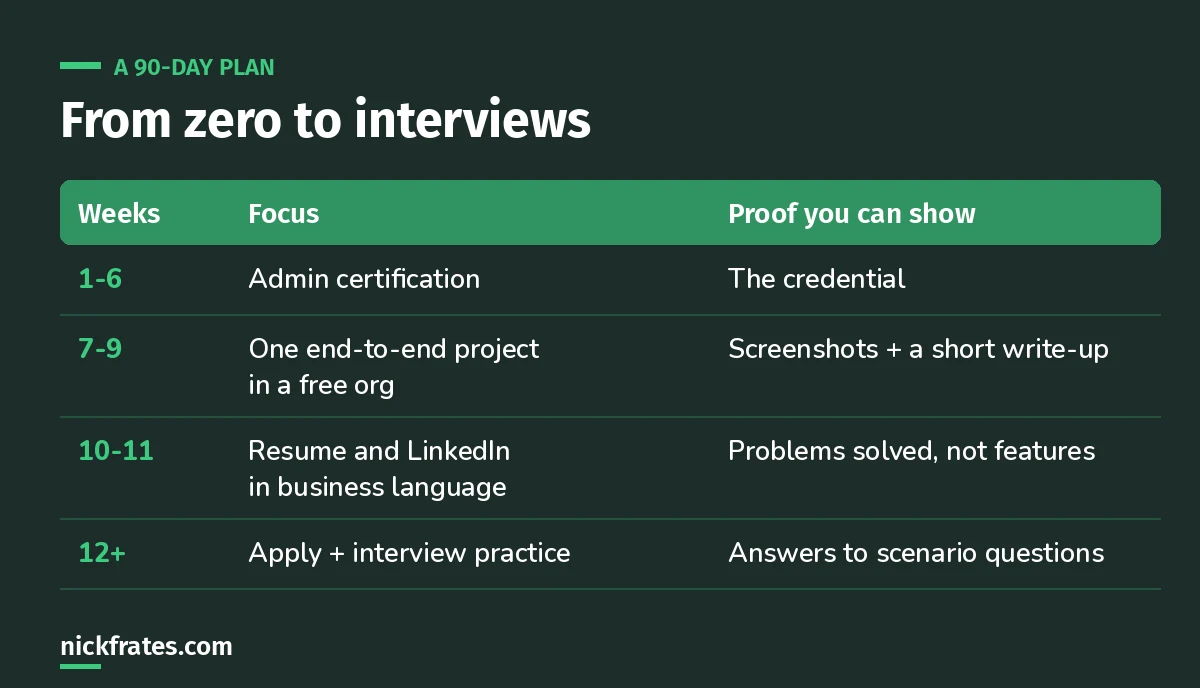
About 90 days at evenings-and-weekends pace.
Step 1: Get the Admin certification
It's the most recognized entry credential for this role. You can prepare for free (here is how), and my 6-week study plan fits around a full-time job.
Career certificate vs certification: Salesforce's Platform Administrator certification is the proctored exam employers ask for by name. Course completion certificates show you studied; they don't replace the certification.
Cert Lab by Nick Frates
Start with the free Admin Cert Lab
All 8 Admin exam sections, with lessons, practice questions and flashcards. Free, no card.
Start the free Admin Cert Lab →Step 2: Build one real project
Pick a small business you know (a gym, a nonprofit, a friend's shop) and build their system in a free Developer Edition org:
- A custom object with a master-detail relationship and a roll-up summary.
- A security model: two profiles or permission sets and a Private sharing default. (Guide.)
- A record-triggered flow and a validation rule.
- A report and dashboard the owner would actually use.
- A clean data import with the Data Import Wizard.
Write a one-page summary: the problem, what you built, and what you'd do next. That page is your interview story.
Step 3: Resume and LinkedIn
- Lead with problems solved: "cut duplicate leads with matching and duplicate rules", not "knows duplicate rules".
- Put transferable experience first. Ops, sales, support and finance people already understand the business side, which is half the job.
- List the certification and link your Trailhead profile.
Step 4: Where to look
- Your current company. If it uses Salesforce, offer to help the admin team. Internal moves are the easiest first role.
- Junior or associate admin roles on an existing team, where someone reviews your work.
- Nonprofits and small businesses, often happy to give a motivated person a chance.
- Consulting partners hiring associate consultants, if you like variety and client work.
Step 5: Practice interviews
Practice scenario questions out loud. I collected the common ones, with sample answers, in Salesforce admin interview questions.
What slows people down
- Collecting badges and certifications instead of building one real project.
- Applying only to "Salesforce Administrator, 3+ years" roles. Look for junior and adjacent roles too.
- Talking about features in interviews instead of business problems.
Cert Lab by Nick Frates
Start the free Admin Cert Lab
Lessons, practice questions and flashcards for the Salesforce Platform Administrator exam, in one free course.
Start the free Admin Cert Lab →Hope this helps!
Best,
Nick


