📊 Goodhart's Law ⚠️

Every day in business we are asked to measure things.

  • KPIs
  • OKRs
  • Metrics
  • Trends
  • Performance

The list can be quite long.

Numbers are essential for understanding the world we live in.

Many times though, a number is just a proxy. A rough substitute for something else we're actually interested in.

That's where Goodhart's Law comes in.

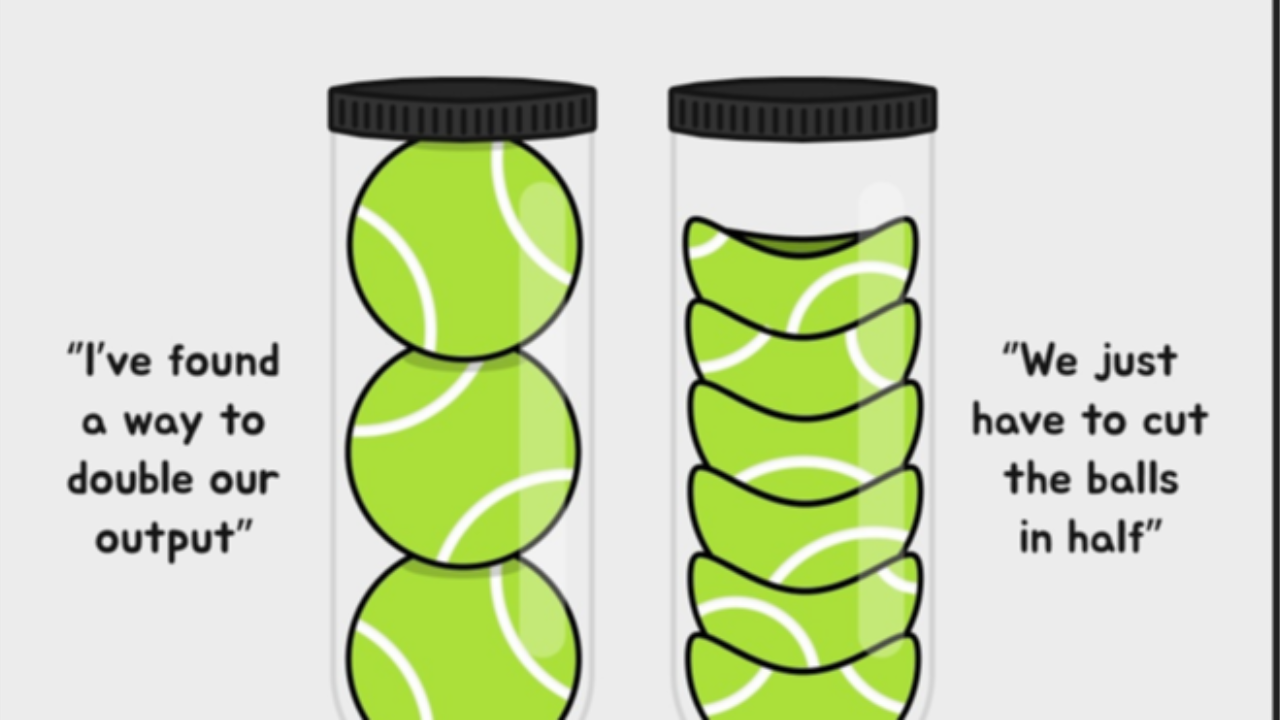
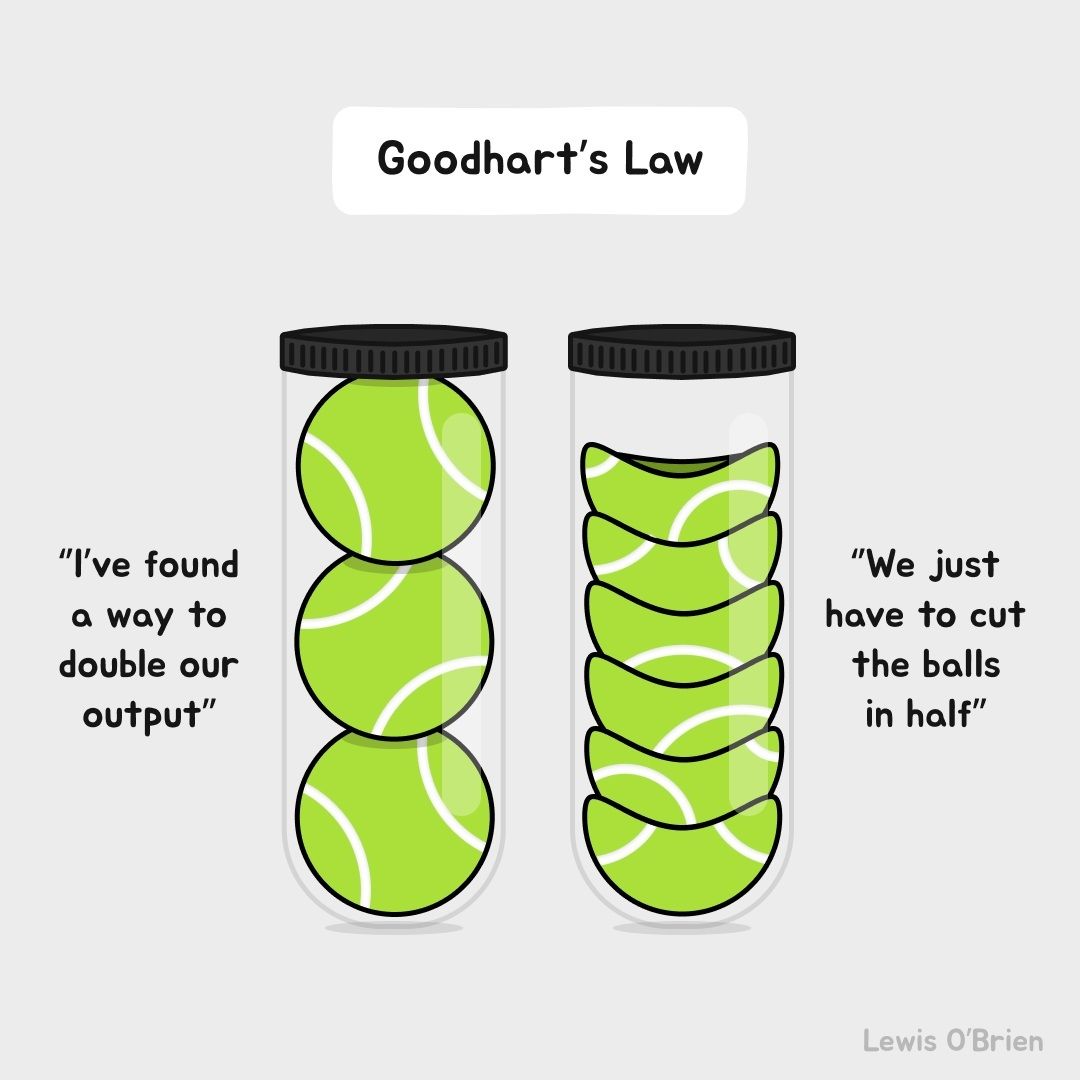
Goodhart's Law: When a measure becomes a target, it ceases to be a good measure.

Basically, when you start treating a metric itself as an end objective, you set yourself up for unintended consequences.

An example:

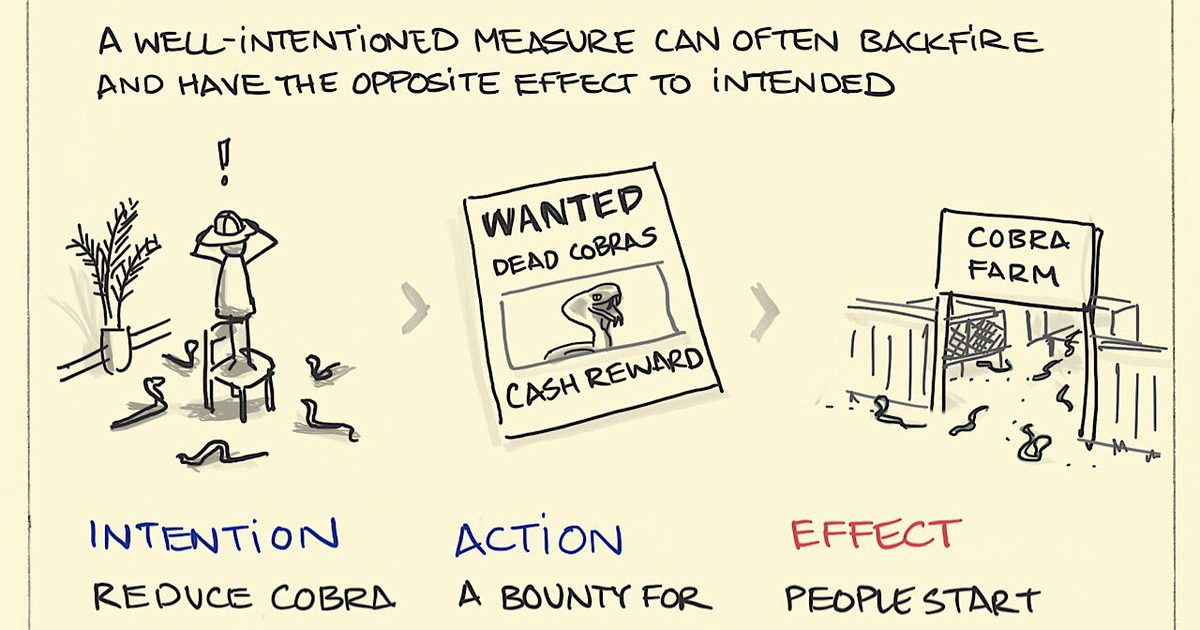
During British colonial rule in India the British became concerned about the large number of venomous cobras in cities, which posed a threat to both health and trade.

What to do?

The British decided to offer a bounty for every dead cobra brought to them by residents as a way to address the snake infestation.

They reasoned that more dead cobras = fewer total snakes.

Their metric: dead cobras.

What happened?

Instead of merely hunting wild cobras, city residents began breeding them in cobra farms as an easy way to maximize their earnings.

Eventually the British realized what was happening and canceled the bounty.

Faced with now-worthless cobra farms, the residents released the cobras into the wild, leading to an even larger cobra population than before the bounty program started.

Oops!


This is why the best thinkers always ask: "What happens next?"

Understanding second-order effects, i.e. how people adapt to a metrics, will make you a sharper decision-maker.

For example, guessing that the cobra bounty program could be "gamed" before it happened.

Someone who did this well was Bill Atkinson, an engineer who worked at Apple in the 1980s.

Bill Atkinson

In 1982, during the development of the Apple Lisa, managers introduced a system where engineers had to report the number of lines of code they wrote each week.

Bill, who was working on QuickDraw (a 2D graphics library), strongly disagreed with this approach.

He thought his goal was to write as small and fast a program as possible, and that the lines of code metric only encouraged writing sloppy, bloated, broken code.

When he optimized QuickDraw's region calculation system, he reduced the code by about 2,000 lines, making it six times faster.

Instead of reporting a positive number, he humorously filled in "-2000" on the form, highlighting the absurdity of measuring productivity by lines of code alone.

Atkinson clearly saw the flaw in the lines of code metric, and proved that great engineering is about impact, not volume.

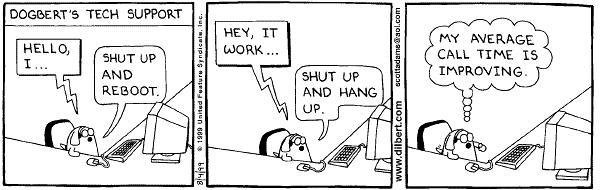
But metrics that produce silly effects are everywhere (and probably always will be).


Dilbert by Scott Adams

How This Applies to Salesforce

As a Salesforce professional, you’ll often be asked to build reports, dashboards, and tracking systems that help teams measure performance.

And these tools can be incredibly valuable.

But before you set up that next leaderboard or KPI, remember Goodhart’s Law.

Because when people are only judged by a number, they may game the system instead of actually improving.

Take these Salesforce examples:

  • Sales Teams: If sales reps are ranked by the number of calls made, they might spam low-quality calls just to hit their quota—without actually closing more deals.
  • Support Teams: If support agents are graded on speed alone, they may rush through tickets, solving the wrong problem just to get a fast resolution.
  • Marketing Teams: If marketers are measured by email open rates, they might write misleading subject lines to trick people into opening emails—damaging trust in the long run.

So how do you prevent this?

Do what Andy Grove, the legendary CEO of Intel, did.

He didn’t just track one metric—he paired it with a second metric to keep people honest.

For example:

  • Instead of just tracking calls made, pair it with deals closed to make sure quality matters.
  • Instead of only measuring resolution speed, track customer satisfaction to ensure agents aren’t rushing through bad fixes.
  • Instead of ranking email open rates, also include unsubscribe rates so marketing isn’t annoying people just to boost numbers.

This is a simple but powerful fix—and as a Salesforce pro, you can use it to build better dashboards, reports, and incentives that actually drive the right behavior.

The lesson?

Numbers don’t lie—but they can mislead if you don’t track the right ones. So always measure the metric that measures the metric.


Hope this helps!


Best,

Nick