Hey friends,
Here are 25 free Salesforce Admin practice questions for the Platform Administrator exam (the certification most people still call Salesforce Admin). I wrote every one myself from the official exam outline, weighted them like the real exam, and put the answer and a full explanation under each question.
Answer each question before you open its toggle, then score yourself at the end. Question 1 is right below.
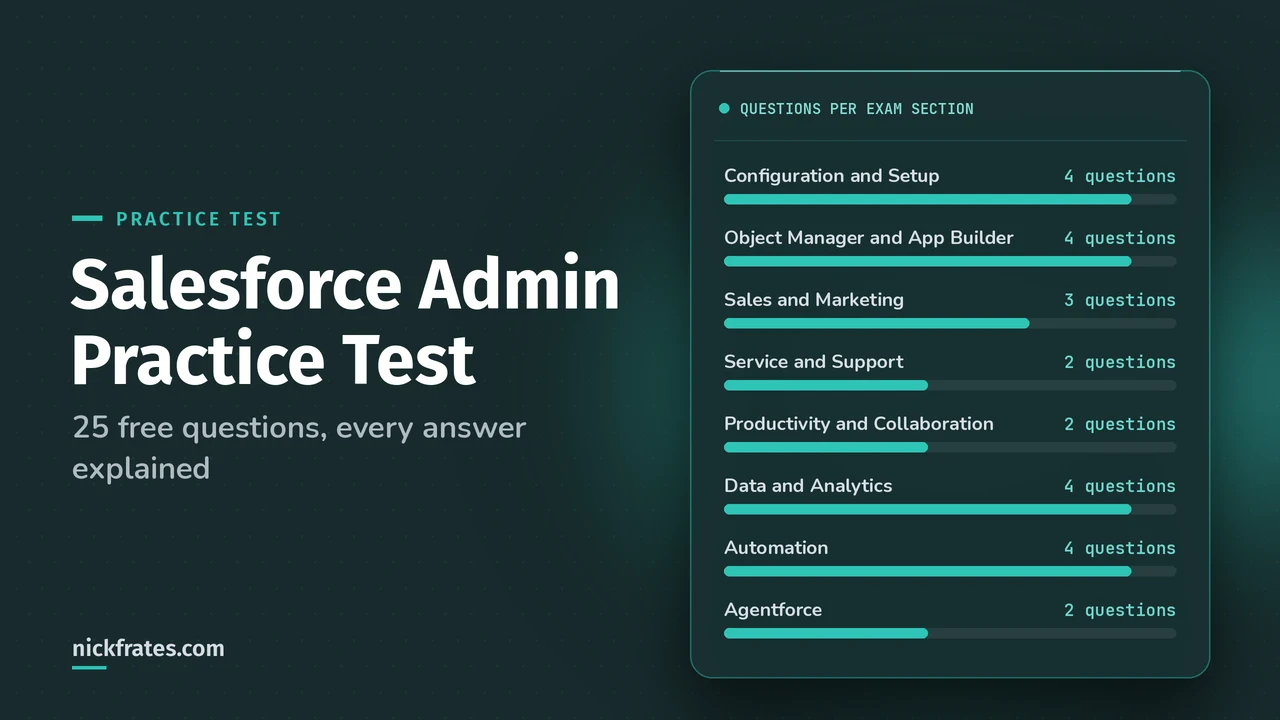
How the 25 questions are split: Configuration and Setup 4, Object Manager and Lightning App Builder 4, Sales and Marketing Applications 3, Service and Support Applications 2, Productivity and Collaboration 2, Data and Analytics Management 4, Automation 4 and Agentforce 2. That's the official weighting from the Platform Administrator exam guide (15, 15, 10, 10, 10, 17, 15 and 8%) scaled to 25 and rounded.
Configuration and Setup (15%): 4 questions
Question 1. Your Sales Ops permission set group bundles three permission sets. One of them, Report Power User, includes the Export Reports permission, and it's also assigned directly to employees outside the group. A new team of contractors needs everything in Sales Ops except Export Reports. What should the admin do?
- A. Remove Export Reports from the Report Power User permission set
- B. Assign a muting permission set directly to each contractor
- C. Create a Contractor permission set group with the same three permission sets, and add a muting permission set to it that mutes Export Reports
- D. Remove Export Reports from the contractors' profile
Show the answer and explanation
Answer: C. A muting permission set lives inside a permission set group and turns off the permissions you pick for that group's members only. The permission sets themselves don't change, and people assigned to them directly keep everything. A new group for contractors leaves the existing Sales Ops group untouched. (Each group can have one muting permission set.)
Editing Report Power User takes Export Reports away from everyone who has that permission set, employees included. Muting permission sets only work inside a permission set group, so you can't assign one to a user on its own. And permissions add up: removing Export Reports from a profile doesn't take away a permission that a permission set grants.
Exam section: Configuration and Setup (15%). Source: Mute a Permission in a Permission Set Group.
Question 2. You're creating a user in production for a new hire, jordan.lee@acme.com. Salesforce won't save the user because of a duplicate username, but your org has no user with that username, active or inactive. What's the best way forward?
- A. Change the new hire's email address, because the username and email must match
- B. Give the user a unique username in email format, such as jordan.lee@acme.com.prod, and keep jordan.lee@acme.com in the Email field
- C. Leave the Username field blank so Salesforce generates one
- D. Wait until the other user is deleted
Show the answer and explanation
Answer: B. A username must be unique across all Salesforce orgs of the same kind, not just yours. Production usernames are checked against every production and trial org, including orgs at other companies, so a former employer or an old trial org probably already uses it. The username has to look like an email address, but it doesn't have to be a working inbox. The Email field can stay the real address, and that's where password resets go.
The username and email don't have to match, and several users can share one email address. Username is a required field, so you can't leave it blank. Waiting doesn't help: you can't see or manage users in another org, and Salesforce users are deactivated, not deleted.
Exam section: Configuration and Setup (15%). Source: Duplicate Username error, Trailhead: Add Users.
Question 3. Project__c is a custom object with an org-wide default of Private. Project managers say they can't see projects owned by the people who report to them, even though the role hierarchy is set up correctly. Standard objects behave as expected. What's the most likely cause?
- A. The managers' profile is missing the View Setup and Configuration permission
- B. Project__c needs a master-detail relationship to the User object
- C. The org-wide default must be Public Read/Write for the role hierarchy to work
- D. Grant Access Using Hierarchies is turned off for Project__c in Sharing Settings
Show the answer and explanation
Answer: D. For custom objects, an admin can deselect Grant Access Using Hierarchies in the org-wide defaults (unless the object is Controlled by Parent). When it's off, only the record owner and people given access through sharing features can see the records, so managers lose their automatic access. Standard objects don't let you change this setting, which is why they still work.
View Setup and Configuration is about Setup pages, not record access. Relationships don't control role hierarchy access, and User can't be the master in a master-detail relationship anyway. The role hierarchy is designed to open up Private records to managers, so Private is the normal setting. Public Read/Write would show every project to everyone.
Exam section: Configuration and Setup (15%). Source: Controlling Access Using the Role Hierarchy.
Question 4. A sales rep can open a colleague's Opportunity but sees no Edit button on it. Which two could explain this? (Choose two.)
- A. The Opportunity compact layout doesn't include the Stage field
- B. The org-wide default for Opportunity is Public Read Only, she doesn't own the record, and nothing (role hierarchy, sharing rule or team) gives her edit access to it
- C. Field history tracking isn't turned on for Opportunity
- D. Her profile and permission sets don't grant Edit on the Opportunity object
Show the answer and explanation
Answer: B and D. To edit a record, a user needs both object permission (Edit on Opportunity, from her profile or a permission set) and record access (Read/Write on that particular record, from ownership, the role hierarchy, sharing rules, teams or manual sharing). If either one is missing, the Edit button doesn't show.
The compact layout only controls which fields appear in the highlights panel, not what anyone can edit. Field history tracking just records changes and has no effect on access.
Exam section: Configuration and Setup (15%). Source: Trailhead: Data Security, Set Your Internal Organization-Wide Sharing Defaults.
Object Manager and Lightning App Builder (15%): 4 questions
Question 5. An admin plans to delete Legacy_Region__c, a custom field on Account. Which two statements are true? (Choose two.)
- A. If another field, such as a formula field, references Legacy_Region__c, Salesforce won't let the admin delete it until that reference is removed
- B. Deleting the field also deletes every Account that had a value in it
- C. The field and its data can be restored from the object's Deleted Fields list for up to 15 days, unless the org erases it permanently first
- D. The deleted field goes to the Recycle Bin, where any user can restore it
Show the answer and explanation
Answer: A and C. Salesforce blocks deleting a custom field that something else references, such as another field, a field update or Apex. Check where the field is used, remove those references, and then delete it. After deletion, the field and its data are kept for 15 days (or until someone erases them permanently), and the admin can restore them from Deleted Fields. Field history data for the field is deleted, though, so plan for that.
Deleting a field removes that field's values, not the records. Deleted fields don't go to the Recycle Bin. They sit in the object's Deleted Fields list, and only admins with the right permissions can restore them.
Exam section: Object Manager and Lightning App Builder (15%). Source: Delete Fields.
Question 6. Reps want a New Contact button on the Account record page that opens a short form with five fields and saves the contact already linked to that account. What should the admin create?
- A. A global action that creates a Contact
- B. An object-specific quick action on Account that creates a Contact, with a five-field action layout, added to the Account page's actions
- C. A new Contact record type with a five-field page layout
- D. A validation rule that requires the Account Name field on Contact
Show the answer and explanation
Answer: B. An object-specific create action lives on a parent object and automatically relates the new record to the record it was launched from. You choose the five fields on the action layout, then add the action to the Account page layout's Mobile and Lightning Actions section (or to Dynamic Actions on the Lightning page).
Global actions work anywhere, but the records they create aren't automatically related to the record the user is looking at. A record type changes picklist values and the page layout, but it doesn't add a button or link anything. A validation rule would force reps to fill in the account by hand, which is the opposite of what they asked for.
Exam section: Object Manager and Lightning App Builder (15%). Source: Trailhead: Quick Actions.
Question 7. Account managers want every Account to show the Close Date of its most recent Closed Won opportunity, kept up to date automatically with no code. What should the admin create?
- A. A cross-object formula field on Opportunity that references the Account
- B. A formula field on Account that uses the MAX() function on Opportunity Close Date
- C. A roll-up summary field on Account that uses MAX on Close Date, filtered to Stage equals Closed Won
- D. A lookup filter on the Opportunity's Account field
Show the answer and explanation
Answer: C. Roll-up summary fields usually need a master-detail relationship, but Salesforce supports them on Accounts using values from related opportunities. MAX works on date fields, and the filter limits it to Closed Won deals. The value recalculates whenever a related opportunity changes.
A cross-object formula on Opportunity looks up to the Account, which is the wrong direction. Formula fields can't aggregate child records, because the MAX() formula function compares values on the same record. A lookup filter only limits which accounts users can pick.
Exam section: Object Manager and Lightning App Builder (15%). Source: Roll-Up Summary Fields.
Question 8. On the Opportunity record page, a Rich Text component with deal desk guidance should appear only for users who have the Deal Desk custom permission. Everyone else uses the same page. What's the best approach?
- A. Add a component visibility filter based on the user's Deal Desk custom permission
- B. Clone the record page and assign the copy to a Deal Desk profile
- C. Hide the component with field-level security
- D. Put the guidance in a page layout section
Show the answer and explanation
Answer: A. Component visibility filters in Lightning App Builder can use record fields, the user, user permissions (including custom permissions) and the device. One page, one filter, and access follows the permission wherever it's assigned.
A cloned page works, but now you have two pages to keep in sync, and access depends on profiles rather than the permission. Field-level security applies to fields, not components. Page layout sections show the same content to everyone assigned that layout.
Exam section: Object Manager and Lightning App Builder (15%). Source: Dynamic Lightning Pages: component visibility.
Sales and Marketing Applications (10%): 3 questions
Question 9. An admin is setting up lead assignment so web leads from Germany, Austria and Switzerland go to a DACH queue and every other lead goes to a General queue. Which two statements are true? (Choose two.)
- A. A lead that matches several entries is assigned to every matching queue
- B. Assignment rules re-run automatically every time any user edits a lead
- C. Only one lead assignment rule can be active at a time, so both routing conditions belong in entries of the same rule
- D. Rule entries are evaluated in order, so the DACH entry should come before a catch-all entry that sends everything else to General
Show the answer and explanation
Answer: C and D. For each rule type, only one assignment rule can be in effect at a time, and one rule can hold many entries. Entries run in their sort order, and the first entry a lead matches decides the owner. Put the specific DACH entry first and the catch-all last.
A record has one owner, so a lead can't be assigned to several queues. Assignment rules run for leads from Web-to-Lead and imports, or when someone saves with the option to assign using the active assignment rule. They don't fire on every edit.
Exam section: Sales and Marketing Applications (10%). Source: Assignment Rules.
Question 10. Sales leadership wants reps to see coaching tips and the two or three fields that matter most at each opportunity stage, right on the record. What should the admin set up?
- A. A validation rule for each stage
- B. A Kanban list view grouped by stage
- C. A separate record type for each stage
- D. A path for Opportunity, with key fields and guidance for success on each stage
Show the answer and explanation
Answer: D. Path is built for this. At each step you can highlight key fields and add guidance for success, and reps see both at the top of the record as the stage changes.
Validation rules block a save when data is wrong, but they don't coach anyone. A Kanban view shows many records by stage, with no per-stage guidance on the record itself. Record types don't change as a deal moves through stages, and one per stage would be a maintenance mess.
Exam section: Sales and Marketing Applications (10%). Source: Guide Users with Path.
Question 11. Marketing invited 2,000 leads and contacts to a webinar. The campaign should show how many people actually attended, separate from people who only registered. What should the admin configure?
- A. A custom Webinar Status picklist on Lead
- B. A Chatter group for attendees
- C. Campaign member statuses such as Registered and Attended, with only Attended marked as Responded
- D. A task on each attendee's record
Show the answer and explanation
Answer: C. Each campaign has its own member status values, and each status can be marked as Responded. Update members to Attended after the webinar, and the campaign's response totals count only attendees, while the member list still shows who registered.
A picklist on Lead misses contacts, needs a new field for every event and doesn't roll up to the campaign. A Chatter group is for collaboration, not tracking. Tasks add clutter and don't feed campaign totals.
Exam section: Sales and Marketing Applications (10%). Source: Trailhead: Track Campaign Members.
Service and Support Applications (10%): 2 questions
Question 12. When a customer submits a case through Web-to-Case, they should get an email right away confirming their case number. Premium customers should get a different email that includes their dedicated support line. What should the admin configure?
- A. A case escalation rule
- B. A case auto-response rule with a Premium entry listed before a general entry, each with its own email template
- C. A case assignment rule that emails the new case owner
- D. An Omni-Channel routing configuration
Show the answer and explanation
Answer: B. Auto-response rules send the customer an email when a case is created through Web-to-Case or Email-to-Case. Only one auto-response rule can be active, entries are checked in order, and the first match sends its template. So the specific Premium entry goes first and the general entry goes after it.
Escalation rules act on cases that stay unresolved too long. Assignment rules set the case owner and can notify that owner, not the customer. Omni-Channel routes work to available agents.
Exam section: Service and Support Applications (10%). Source: Trailhead: Automate Case Management.
Question 13. Cases where Preferred Language is Spanish should go to a shared pool that any Spanish-speaking agent can pick up. Which two things should the admin configure? (Choose two.)
- A. A queue that supports the Case object, with the Spanish-speaking agents as members
- B. A case escalation rule that reassigns Spanish cases after one hour
- C. A criteria-based sharing rule that gives the Spanish-speaking agents Read access to all cases
- D. An entry in the active case assignment rule that sends cases with Preferred Language equal to Spanish to that queue
Show the answer and explanation
Answer: A and D. A queue is the shared pool. Members can see the queue's list view and take ownership of cases from it. The assignment rule entry puts matching cases in the queue when they arrive through Web-to-Case or Email-to-Case, or when someone saves with the active assignment rule.
Escalation rules are time-based, for cases that sit unresolved, and this requirement is about routing on arrival. A sharing rule lets people see records, but it doesn't make anyone the owner.
Exam section: Service and Support Applications (10%). Source: Create Queues, Assignment Rules.
Productivity and Collaboration (10%): 2 questions
Question 14. Field reps say the Account record page is too crowded in the Salesforce mobile app. Desktop users are happy with it. How can the admin give phone users a simpler page without changing the desktop page?
- A. Build a simpler Lightning record page and activate it for the Phone form factor for the right apps, record types and profiles
- B. Remove fields from the Account page layout
- C. Create a separate Account record type for mobile users
- D. Ask reps to use the mobile browser instead of the app
Show the answer and explanation
Answer: A. Lightning record page assignments are made per form factor. When you activate a page for an app, record type and profile, you choose Desktop, Phone or both, so phone users can get a different page while desktop users keep theirs.
Changing the page layout changes the desktop page too. Record types are about business processes and picklists, and they follow the record, not the device. Switching to a browser doesn't simplify the page.
Exam section: Productivity and Collaboration (10%). Source: Activate Lightning Record Pages.
Question 15. Your company is adding an e-signature app from AppExchange. IT wants the vendor to deliver upgrades, and the vendor doesn't want customers editing its code. Which option fits?
- A. An unmanaged package, installed straight into production
- B. A change set sent from the vendor's org
- C. An unmanaged package, installed in a sandbox first
- D. A managed package, installed and tested in a sandbox before production
Show the answer and explanation
Answer: D. Managed packages are how AppExchange vendors ship apps they keep maintaining. They can be upgraded, and the vendor's code and locked components can't be edited by subscribers. Installing in a sandbox first lets you check permissions, page layouts and how it behaves alongside your own automation.
Unmanaged packages are fully editable after install and can't be upgraded, so they suit templates and one-time handoffs, wherever you install them. Change sets only move metadata between orgs connected to the same production org, never from a vendor's org to yours.
Exam section: Productivity and Collaboration (10%). Source: AppExchange Application Installation Guide: FAQ, Managed Package Types.
Data and Analytics Management (17%): 4 questions
Question 16. Every month an admin loads 30,000 Product records from an ERP export. Some products are new and some already exist in Salesforce. The file has no Salesforce IDs, but each row has the ERP product code, which Salesforce stores on Product in ERP_Code__c, an External ID field. What's the best approach?
- A. Use the Data Import Wizard, matching on ERP_Code__c
- B. Use Data Loader to upsert, matching on ERP_Code__c
- C. Use Data Loader to insert every row, then let a duplicate rule clean up
- D. Mass delete all products and insert them again each month
Show the answer and explanation
Answer: B. Upsert updates records that match on the external ID and inserts the rest, in one pass. Data Loader works with Products and handles this volume easily.
The Data Import Wizard handles accounts, contacts, leads, solutions, person accounts, campaign members and custom objects. Products aren't on that list. Inserting everything creates duplicates, and duplicate rules don't merge records you've already loaded. Deleting and reloading would break everything that points to those products, such as price book entries.
Exam section: Data and Analytics Management (17%). Source: Import Data with the Data Import Wizard, Data Loader.
Question 17. A sales manager wants a report grouped by opportunity owner that shows each rep's win rate: won opportunities divided by closed opportunities. What's the best way to build it?
- A. Add a row-level formula to the report
- B. Create a bucket field on Stage
- C. Add a summary formula, such as
WON:SUM / CLOSED:SUM, to an Opportunities report grouped by owner - D. Create a roll-up summary field on User
Show the answer and explanation
Answer: C. Summary formulas calculate at each grouping level from summarized values. Opportunity reports include Won and Closed fields you can sum, so the formula gives each owner's ratio, plus a grand total. Set the output type to Percent. I walk through a version of this report in How to Calculate Opportunity Win Rate in Salesforce.
A row-level formula calculates one value per record, so it can't produce a rate across many opportunities. A bucket field groups values into categories, with no ratio. Roll-up summary fields need a master-detail relationship (or one of the few supported standard pairs), and you can't create one on User for opportunities.
Exam section: Data and Analytics Management (17%). Source: Trailhead: Use Summary Formulas in Your Reports.
Question 18. Leadership wants one sales dashboard where viewers can switch between the North, South, East and West regions, without the admin building four dashboards. What should the admin add?
- A. A dynamic dashboard
- B. Four copies of the dashboard, one per region
- C. A report filter that the admin changes whenever someone asks for another region
- D. A dashboard filter on the Region field
Show the answer and explanation
Answer: D. A dashboard filter lets viewers pick a value, and every component built from a report with that field updates to match. One dashboard covers all four regions.
A dynamic dashboard shows each viewer the data they have access to, which is a different question from picking a region. Four copies means four dashboards to maintain. Editing the report for every request is slow and changes it for everyone.
Exam section: Data and Analytics Management (17%). Source: Filter a Dashboard.
Question 19. A report is saved in a folder shared with the Sales Reps public group. Two reps run it. Which two statements are true? (Choose two.)
- A. Because the folder is shared, both reps see every record the report's creator can see
- B. Each rep sees only the records they can access through the org's sharing settings, so their results can differ
- C. Folder sharing controls who can see and run the report, not which records appear in it
- D. Reports ignore field-level security, so hidden fields appear in the results
Show the answer and explanation
Answer: B and C. A report runs with the access of the person viewing it. Record visibility comes from org-wide defaults, the role hierarchy, sharing rules and the rest of the sharing model. Folder access only decides who can find, run or edit the report.
The creator's access doesn't carry over to other people. (Dashboards are different: a dashboard can run as a specified user.) Reports respect field-level security, so fields a user can't see don't appear for them.
Exam section: Data and Analytics Management (17%). Source: Share a Lightning Report or Dashboard Folder, Control Who Sees What.
Automation (15%): 4 questions
Question 20. Seven days before each Contract's End Date, the contract owner should get a reminder email. What's the best solution?
- A. A record-triggered flow on Contract with a scheduled path set to 7 days before End Date
- B. A workflow rule with a time-dependent action
- C. A screen flow the owner runs from the contract
- D. An approval process on Contract
Show the answer and explanation
Answer: A. Scheduled paths in a record-triggered flow run actions at a time relative to a date field on the triggering record. Set the time source to End Date and the offset to 7 days before, and add a Send Email action to that path.
Workflow Rules reached end of support on December 31, 2025, so they're not the answer for new automation. A screen flow needs someone to start it, which defeats the purpose of a reminder. Approval processes are for approving or rejecting records.
Exam section: Automation (15%). Source: Scheduled Paths.
Question 21. Any discount on an Opportunity needs approval from the owner's manager. If the discount is over 20%, the VP of Sales must also approve, after the manager. If anyone rejects it, Approval_Status__c should be set to Rejected. What should the admin build?
- A. One approval process with two steps: step 1 goes to the manager, step 2 has entry criteria of Discount greater than 20% and goes to the VP, and a final rejection action sets Approval_Status__c to Rejected
- B. Two separate approval processes on Opportunity, one for the manager and one for the VP
- C. A validation rule that blocks discounts over 20%
- D. A record-triggered flow that emails the manager and the VP
Show the answer and explanation
Answer: A. Approval steps run in order, and each step can have its own entry criteria, so the VP step only applies to big discounts. If a record doesn't meet step 2's criteria, you can set the step to approve the record and finish. Final rejection actions, such as a field update, run whenever the request is rejected. (This describes a classic approval process. Salesforce also offers newer, flow-based Flow Approval Processes.)
When a record is submitted, only one approval process runs: the first one, in process order, whose entry criteria the record meets. Two processes won't chain the manager and the VP together. A validation rule blocks big discounts instead of routing them for approval. An email has no approve or reject action, no record locking and no approval history.
Exam section: Automation (15%). Source: Approval Step Entry Criteria.
Question 22. Which two requirements are a good fit for a record-triggered flow? (Choose two.)
- A. When a Case's Priority changes to High, create a follow-up task for the account owner
- B. Walk a service agent through a troubleshooting script, collecting answers on several screens
- C. When an Opportunity is created, set its Next Step field on that same record
- D. Every Monday at 6 AM, update all open tasks that are past due
Show the answer and explanation
Answer: A and C. Record-triggered flows start when a record is created, updated or deleted. The Next Step update is a same-record change, so it fits a flow optimized for fast field updates (before save). Creating a related task needs actions and related records (after save).
A guided, multi-screen script is a screen flow, because it needs a person entering answers. A job that runs every Monday is a schedule-triggered flow, because it starts on a schedule rather than a record change.
Exam section: Automation (15%). Source: Flow Types, Triggered Flows.
Question 23. A record-triggered flow on Opportunity, set to run before the record is saved, fills in Region__c when it's blank. A validation rule says Region__c is required. A rep saves an opportunity with Region__c blank. What happens?
- A. The save fails, because custom validation rules run before any flow
- B. The save fails, because before-save flows run after the record is committed
- C. The record saves, because before-save flows run before custom validation rules, so the rule sees the value the flow filled in
- D. It depends on which automation was created first
Show the answer and explanation
Answer: C. In the save order of execution, before-save record-triggered flows run first, then before triggers, and then custom validation rules. By the time the rule checks Region__c, the flow has already filled it in.
Custom validation rules run after before-save flows, not before them. Before-save flows run before anything is written to the database, which is what makes them fast. The order is defined by the platform, not by which automation is older.
Exam section: Automation (15%). Source: Triggers and Order of Execution.
Agentforce (8%): 2 questions
Question 24. You've deployed an Agentforce employee agent in Lightning Experience. A rep asks it to update the Next Step on an opportunity owned by a colleague, and the update fails. The same request works when you test it as a system administrator. What's the most likely reason?
- A. The agent's language model is too small to run update actions
- B. Agents can only read data and can never update records
- C. The rep needs to be added to the agent user's profile
- D. Employee agents act with the logged-in user's permissions and sharing, and the rep doesn't have edit access to that opportunity
Show the answer and explanation
Answer: D. Employee agents run in the security context of the person using them: their profile, permission sets, field-level security and record sharing. If the rep can't edit that record herself, the agent can't either, and that's working as intended. Don't widen her access just to make the agent work. (Service agents on customer channels are different: they run as a dedicated agent user, so you give that user only the permissions it needs.)
Model choice doesn't bypass security. Agents can update records through their actions when the user has access. And you can't add a person to another user's profile, because every user has exactly one profile of their own.
Exam section: Agentforce (8%). Source: Trailhead: Get Started with Agentforce for Employees.
Question 25. An Agentforce Service agent's Returns subagent (Salesforce called subagents topics before April 2026) sometimes promises customers a refund, but only a human is allowed to approve refunds. Which two steps should the admin take? (Choose two.)
- A. Give the agent user the Modify All Data permission so it can process refunds on its own
- B. Update the subagent's instructions so the agent explains the refund policy and hands refund requests to a human instead of promising anything
- C. Delete the subagent and rebuild the whole agent from scratch
- D. Test the change with sample conversations in the Agentforce Builder preview before activating the new version
Show the answer and explanation
Answer: B and D. Instructions tell the agent how to handle a job, so that's where the refund rule goes. Then test realistic conversations in the builder's preview (the exam guide calls it conversation preview) before you activate. If refunds must never happen through the agent, also make sure it has no action that can issue one. Instructions guide the AI, but leaving the action out is the hard stop.
Modify All Data is the opposite of least privilege and would let the agent change far more than refunds. Rebuilding the agent is a lot of work for a problem that a clear instruction and a test can fix.
Exam section: Agentforce (8%). Source: Subagents, Migrate to Agentforce Builder.
Score yourself
Count your correct answers. For the choose-two questions, count it only if you got both. Then enter your number in my Salesforce exam score calculator. That link opens it set to Platform Administrator in questions-correct mode with the total already set to 25, so you only type your number.
The real exam's passing score is 68%, which is 17 of these 25. Treat that as a rough signal, not a prediction. 25 questions is a small sample, and the real exam has 60 scored questions. If you miss more than one in a section, that's the section to study next.
The real exam at a glance
- Questions: 60 scored multiple-choice and multiple-select questions, plus up to 5 unscored ones that don't count
- Time: 105 minutes
- Passing score: 68% for the English exam (65% for Japanese)
- Cost: US$200, and US$100 to retake, plus applicable taxes
- Prerequisite: none, though Salesforce suggests 6 or more months of admin experience
- Delivery: proctored, at a test center or online
Last verified October 7, 2026 against the official exam guide on Salesforce Help and the Trailhead Academy exam page. Salesforce updates exams, so check the guide before you book.
Where to go next
- Admin Cert Lab: my free course for this exam. Configuration and Setup is live with 9 short lessons, a practice quiz and flashcards. Object Manager and Lightning App Builder has its quiz and flashcards live, and the other sections are rolling out. You need a free account to save your progress. There's no card and no paid tier. (What's in Cert Lab?)
- Salesforce Administrator certification study guide: every exam section in depth, with cheat sheets, a six-week plan and more practice questions.
- Salesforce Admin certification guide: what the certification costs, who it's for, how to book it and an 8-week study plan.
- Prepare for Your Salesforce Platform Administrator Certification: the free Trailmix the exam guide recommends.
- All my Salesforce certification study guides, including App Builder and Advanced Administrator for after Admin.
About these questions
I'm Nick Frates, a senior Salesforce developer with 17 Salesforce certifications. This site is independent and isn't affiliated with, sponsored by or endorsed by Salesforce. Every question here is original, written from the public exam outline and checked against Salesforce's own documentation. None of them are real exam questions, and no practice set can guarantee a passing score. Salesforce, Agentforce, Trailhead and AppExchange are trademarks of Salesforce, Inc.
If you spot something that's changed in a recent release, let me know and I'll update it.
Hope this helps, and good luck on the exam!
Best,
Nick