Most people study for Salesforce certifications the same way they studied in school: read the material, highlight it, reread it, and hope it sticks. It feels productive. Unfortunately, decades of learning research say it's one of the least effective ways to prepare for an exam.
This guide explains what the research actually says about learning and memory, and turns it into a practical system for Salesforce exams: active recall, retrieval practice and the testing effect, spaced repetition, interleaving, what Chessable's MoveTrainer gets right, and a step-by-step workflow for turning an official exam guide into an Anki deck.
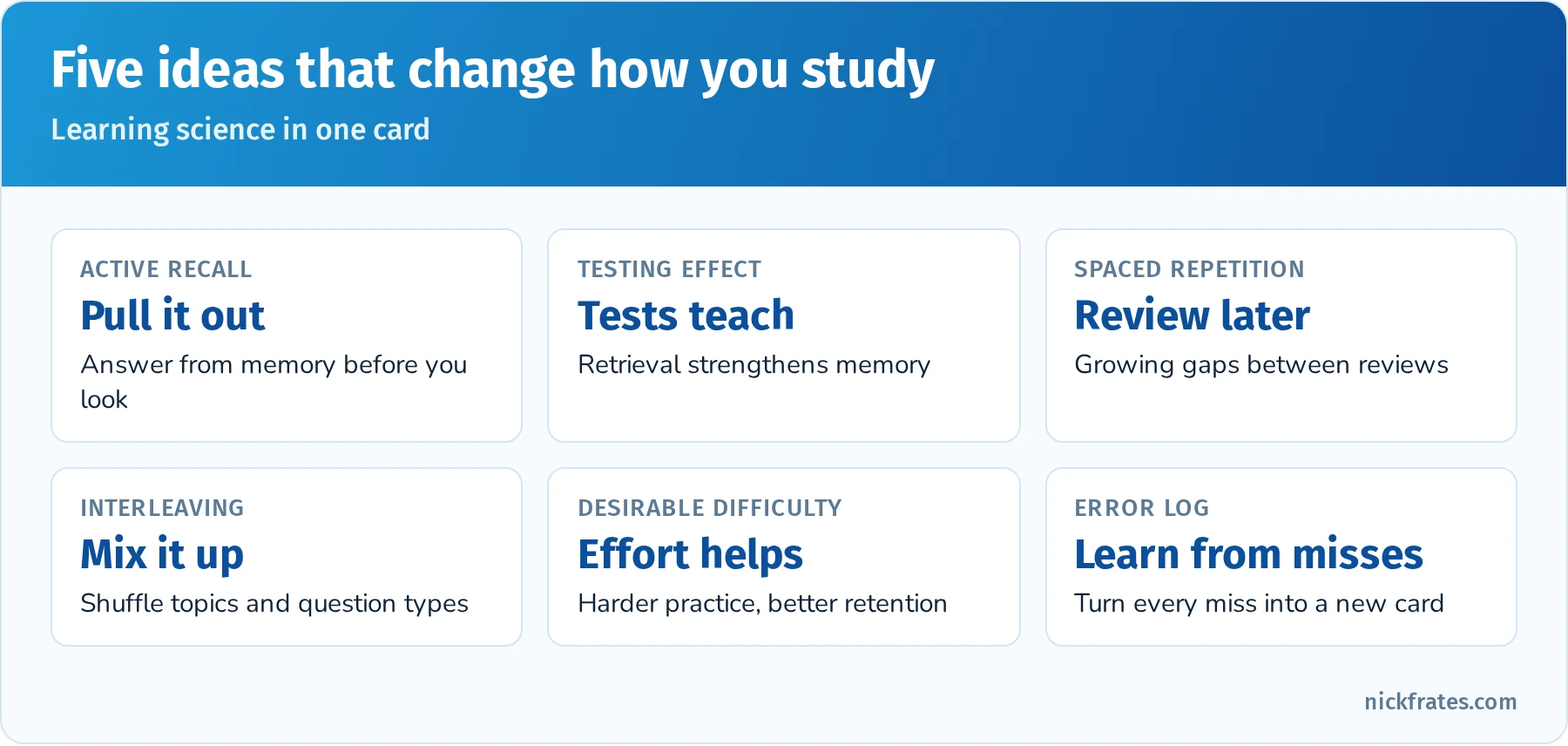
The ideas this guide covers, on one card.
Contents
- Why rereading and highlighting feel good but don't work
- Active recall: pull information out, don't push it in
- Retrieval practice and the testing effect
- Spaced repetition: beat the forgetting curve
- Interleaving: mix topics like the real exam does
- Desirable difficulties
- What Chessable's MoveTrainer gets right
- The workflow: from exam guide to Anki deck
- A 6-week study plan built on the science
- Sleep, breaks and exam day
- Putting it together: a sample week
- Common mistakes
- Frequently asked questions
- Related study guides
Why rereading and highlighting feel good but don't work
When you reread a Trailhead module, the content feels familiar. That familiarity is easy to mistake for knowing it. Psychologists call this the fluency illusion: recognizing something when it's in front of you isn't the same as being able to recall it, or apply it, when it isn't.
Salesforce exams punish that gap. A question doesn't ask whether you've seen the phrase "master-detail relationship." It describes a scenario and asks which relationship, sharing setting or automation tool fits, with three plausible distractors. That's a retrieval and application task, so you should practice retrieval and application.
In 2013, John Dunlosky and colleagues published a large review in Psychological Science in the Public Interest that rated 10 common study techniques by how well the evidence supports them. Two techniques earned the top "high utility" rating: practice testing and distributed practice (spacing). Rereading, highlighting and summarizing were rated low utility. Interleaved practice, elaborative interrogation and self-explanation landed in the middle.
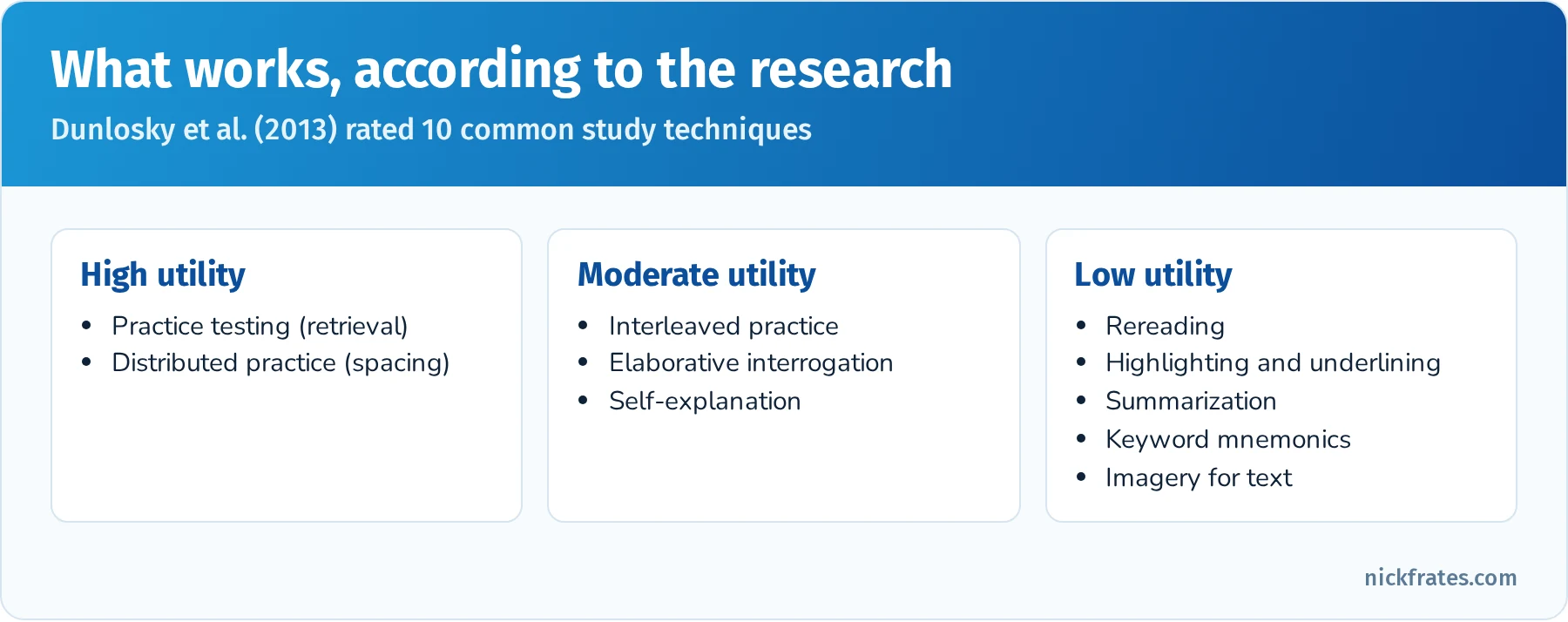
The two highest-rated techniques are the core of this system.
Active recall: pull information out, don't push it in
Active recall means trying to retrieve information from memory before you look at the answer. Close the module and ask yourself: "What are the four organization-wide default settings for a custom object, and what does each allow?" Then check.
It works because each successful retrieval strengthens the memory and the paths to it. Failed retrieval helps too: when you struggle, then see the answer, you encode it more deeply than if you'd just read it.
How to use active recall for Salesforce exams:
- After each section of a study guide, close it and write down everything you remember about that section, then compare.
- Turn headings into questions. "Sharing rules" becomes "When would I use a criteria-based sharing rule instead of an owner-based one?"
- Explain a concept out loud as if teaching a new admin, without notes.
- Use flashcards, but always answer before flipping.
Retrieval practice and the testing effect
The testing effect is the finding that taking a test doesn't just measure learning, it causes it. In a well-known 2006 study, Henry Roediger and Jeffrey Karpicke had students read prose passages, then either reread them or take recall tests. After five minutes, rereading looked slightly better. After one week, the students who'd practiced recall remembered far more: in their experiment, about 61% for the repeated-testing group vs. about 40% for the repeated-study group.
In 2011, Karpicke and Janell Blunt reported in Science that retrieval practice produced better learning than elaborative concept mapping, even on questions requiring inference.
What this means for you: practice questions aren't something to save for the last week. They're a primary study method from week one. Each guide on this site includes dozens of practice questions with explanations for exactly this reason.
Rules for retrieval practice:
- Answer before you look. Commit to an answer, even a guess.
- Read every explanation, including for questions you got right. You might have been right for the wrong reason.
- Log your misses in an error log: the question topic, why you chose the wrong answer, and the rule that would have gotten it right.
- Come back later. Retrying the same question a few days later is more retrieval practice, not cheating, as long as you reason it through rather than remember the letter.
Spaced repetition: beat the forgetting curve
In 1885, Hermann Ebbinghaus described what we now call the forgetting curve: without review, memory drops quickly at first, then more slowly. Every time you successfully retrieve something, the curve flattens, so you can wait longer before the next review.
Spaced repetition schedules reviews just as you're about to forget: maybe one day later, then three days, then a week, then a few weeks. The spacing effect is one of the most replicated findings in psychology. A large 2008 study by Nicholas Cepeda and colleagues found that the best gap between study sessions depends on how long you need to remember; for exams weeks away, gaps of several days to a week or more outperformed cramming by a wide margin.
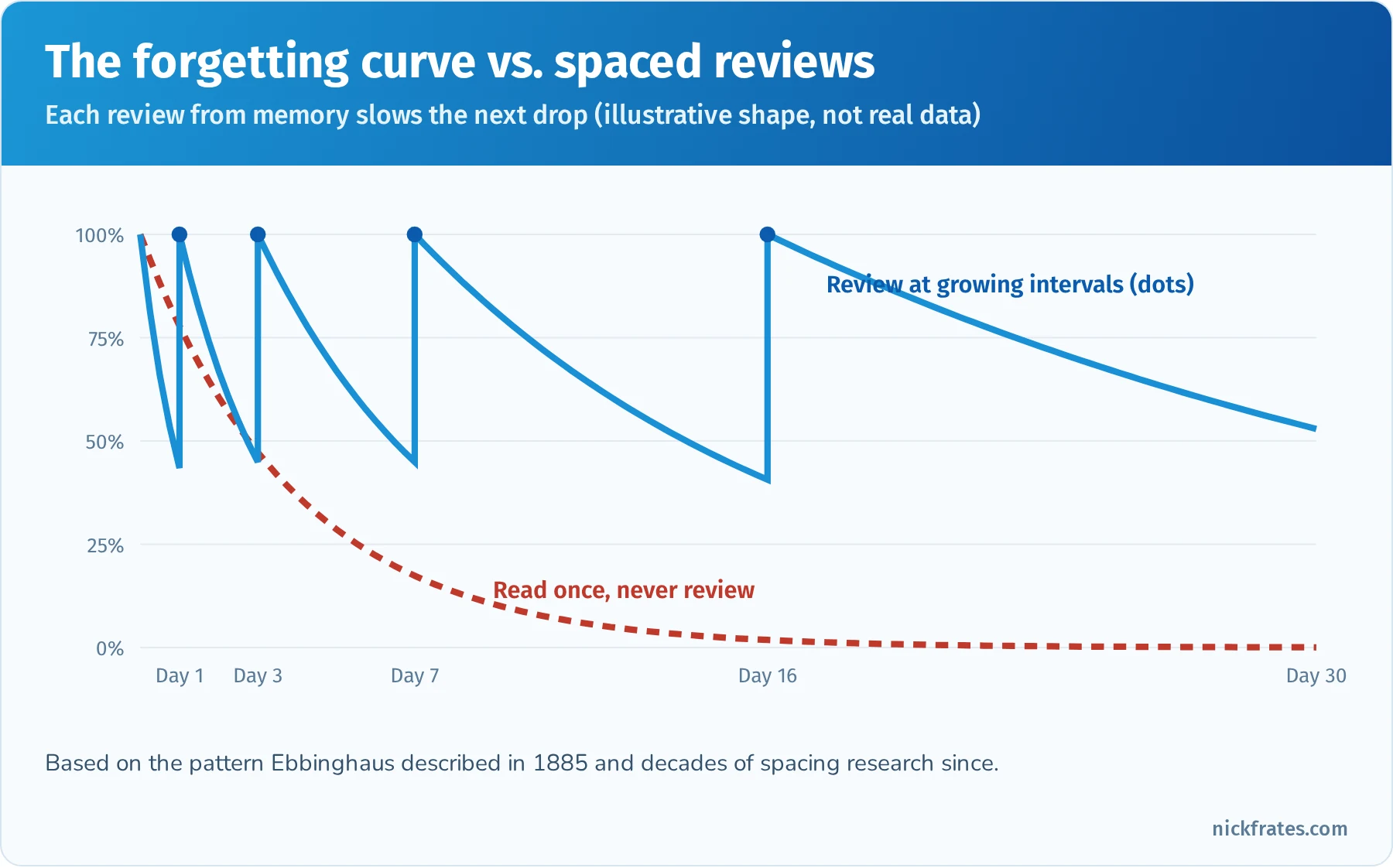
The shape of forgetting, and how spaced reviews flatten it.
Why cramming feels effective. Massed study, such as a weekend of nonstop reading before the exam, produces strong short-term performance. But it fades fast, and certifications have maintenance modules and real jobs after them. Spacing also feels harder, because you've partly forgotten by the time you review. That difficulty is the point.
Spaced repetition software handles the scheduling for you. Anki is the most popular free option (desktop and Android are free; the iOS app is paid). It shows each card when it's due and adjusts the next interval based on how well you recalled it. Newer versions of Anki also offer the FSRS scheduler, which models your memory to set intervals.
Interleaving: mix topics like the real exam does
Blocked practice means doing all the security questions, then all the Flow questions. Interleaved practice means mixing them. Blocked practice feels smoother. Interleaved practice feels harder, and it usually works better for tests that mix topics, because it trains you to identify which kind of problem you're facing before you solve it.
In a 2007 math study by Doug Rohrer and Kelli Taylor, students who practiced problem types interleaved did much better on a delayed test than students who practiced them blocked, even though the blocked group did better during practice. Nate Kornell and Robert Bjork found a similar pattern in 2008 when people learned to recognize painters' styles from mixed vs. blocked examples.
Salesforce exams are interleaved by design. One question is about sharing, the next about report types, the next about Flow. The hardest part is often recognizing which tool the scenario is really about.
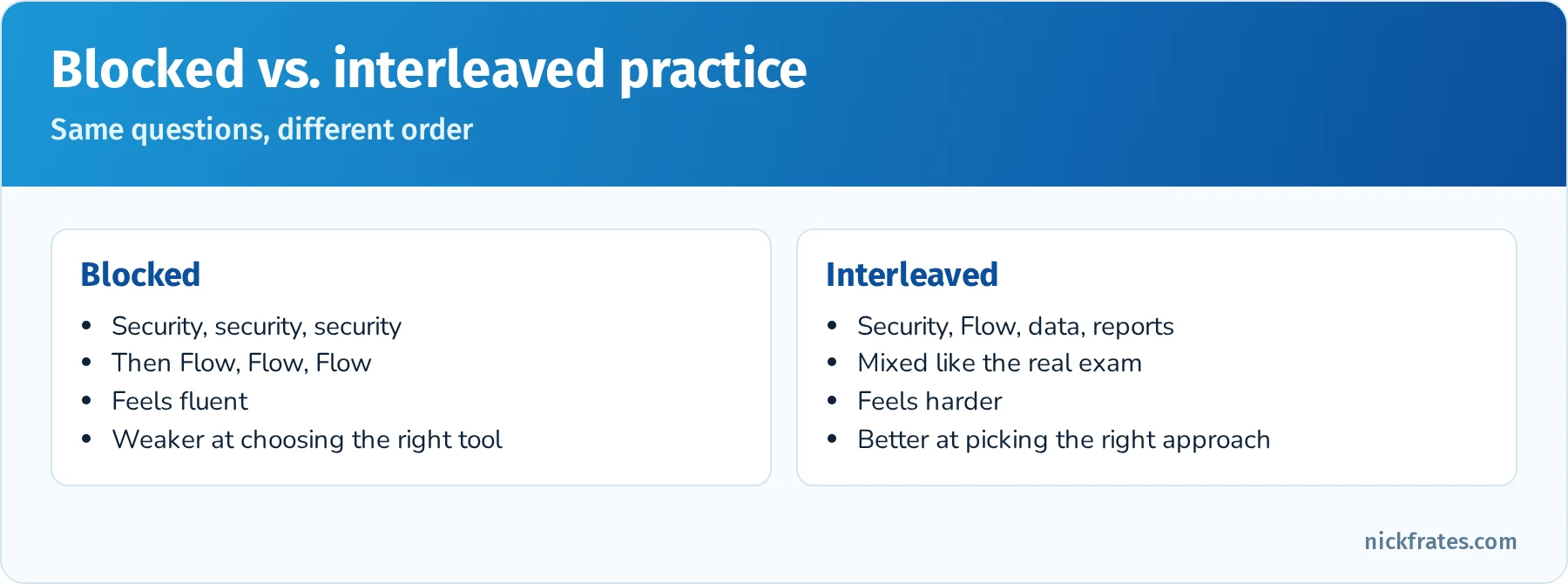
Interleaving trains the skill the exam tests: choosing the right tool.
How to interleave:
- Once you've studied two or more sections, practice with mixed question sets, not section-by-section quizzes.
- In Anki, study a parent deck (which mixes all subdecks) rather than one section at a time.
- Do mixed review sessions on weekends that pull from every section you've covered.
Desirable difficulties
Robert Bjork coined the term desirable difficulties for study conditions that make learning feel harder in the moment but improve long-term retention and transfer: retrieval instead of rereading, spacing instead of massing, interleaving instead of blocking, and generating answers instead of being shown them.
The practical takeaway: if a study session feels easy, it probably isn't doing much. If it feels effortful but you're mostly succeeding, you're in the right zone. If you're failing almost everything, step back and relearn the material before testing yourself again.
What Chessable's MoveTrainer gets right
Chessable is a chess training site built around spaced repetition. Its training method, MoveTrainer, works like this:
- Learn: you're shown a line of moves with explanations of the ideas behind them.
- Recall: later, you have to play the moves on the board from memory, not just recognize them.
- Schedule: moves you get right are scheduled for review after longer and longer gaps.
- Reset: moves you get wrong come back sooner.
Three ideas transfer directly to Salesforce exams:
- Recall in the format you'll be tested. Chess players are tested by playing moves, so MoveTrainer makes you play moves. You'll be tested by choosing the right solution to a scenario, so your cards and practice should make you choose solutions to scenarios, not just define terms.
- Small units, reviewed often. A chess line is broken into individual moves. Break an exam outline into individual decisions: "lookup or master-detail?", "before-save or after-save flow?", "permission set or profile?"
- Let the schedule decide. You don't decide what to review; the algorithm does, based on what you're about to forget. That keeps you from reviewing only what you already like and know.
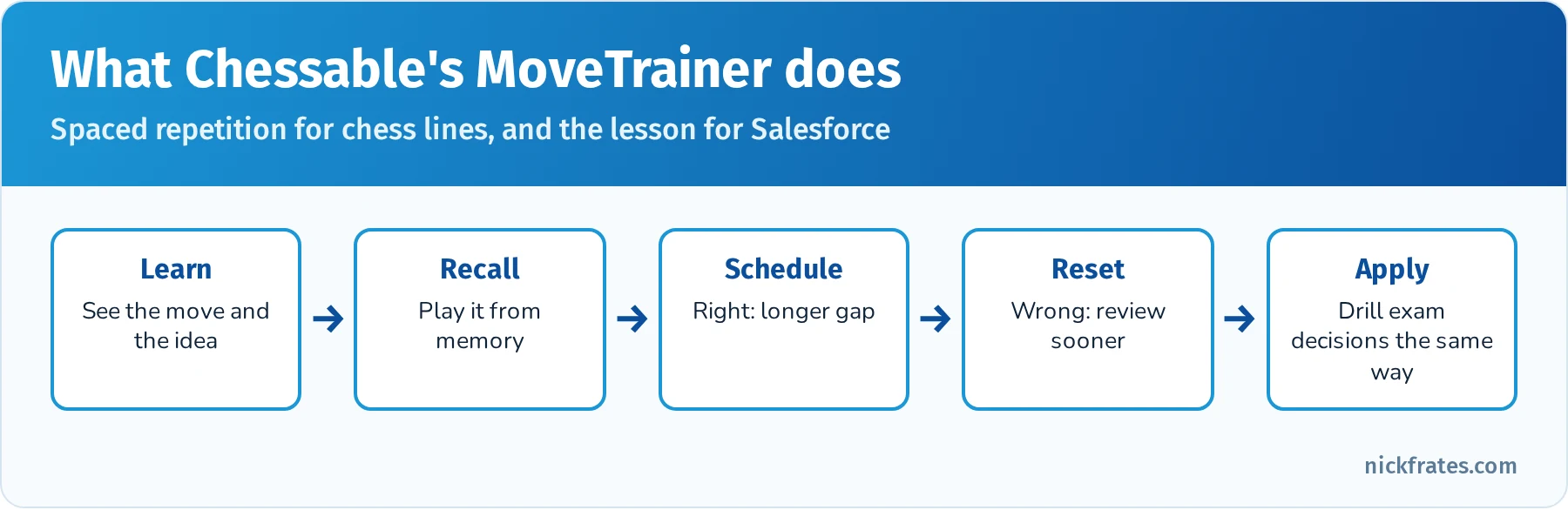
The MoveTrainer loop, applied to exam decisions.
The workflow: from exam guide to Anki deck
This is the core system. It works for any Salesforce certification.
Step 1: Get the official exam guide. Every Salesforce exam has an official guide on Salesforce Help or Trailhead listing the sections, weights and objectives. Copy every objective into a checklist. Each study guide on this site links to its official guide.
Step 2: Create the deck structure. In Anki, create one deck for the exam with one subdeck per section (for example, Admin::Configuration and Setup). Add a tag for each section so you can filter. Note the weight of each section so you know where to spend card-writing time.
Step 3: Learn first, then card. Study a section (with a guide, Trailhead and hands-on practice in a Developer Edition org). Then write cards from what you learned, mapped to the objectives. Don't make cards for things you don't understand yet.
Step 4: Write good cards.
- One idea per card. "What are the differences between lookup and master-detail?" is too big. Split it into cascade delete, required parent, roll-ups, ownership and sharing.
- Use cloze deletions for definitions and numbers: "Records stay in the Recycle Bin for {{c1::15}} days."
- Write scenario cards for decisions: "A company wants managers to see their team's opportunities, but reps shouldn't see each other's. What's the baseline OWD and what opens access?" Answer: Private, then role hierarchy.
- Add the why on the back. "Because master-detail children inherit sharing from the parent" is more useful than just "master-detail."
- Use images where helpful: a screenshot from your own org, or a diagram you drew.
- Don't copy exam dumps. Using actual exam questions violates Salesforce's certification agreement, and memorized answers don't transfer to new scenarios.
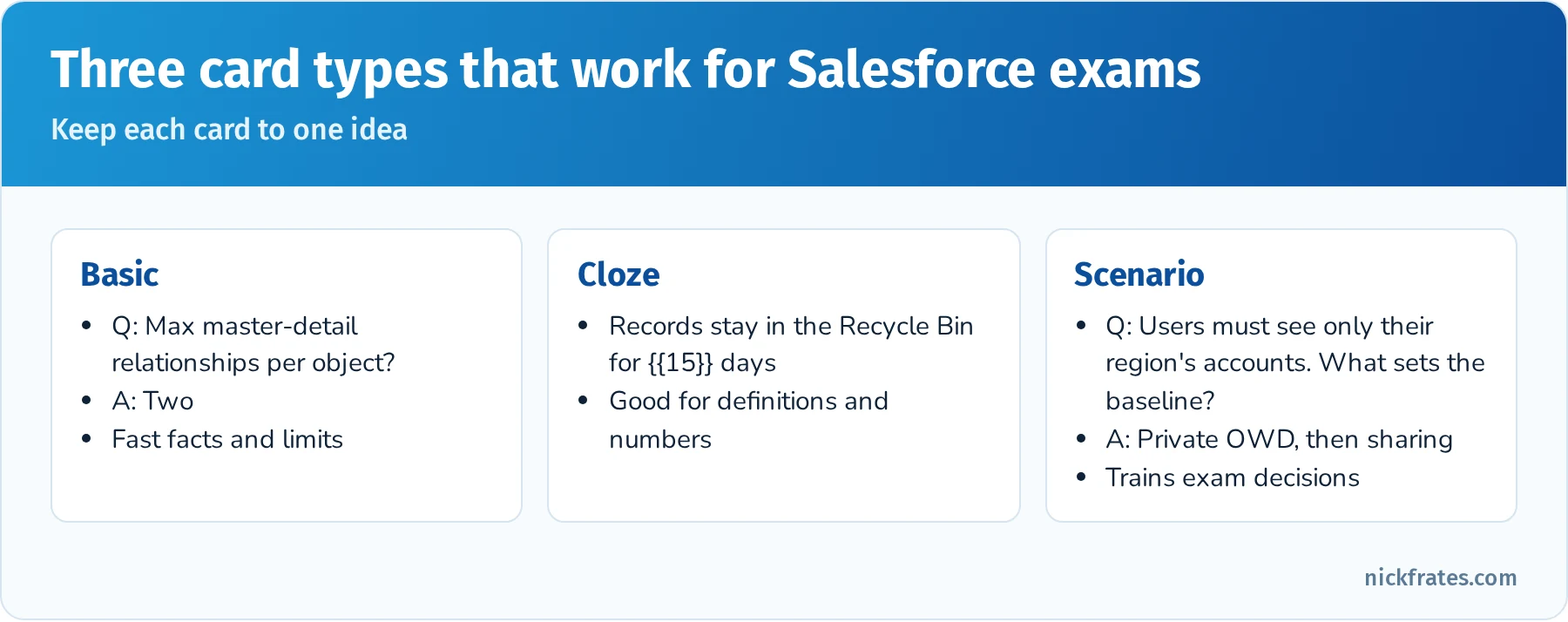
Mix all three, and keep one idea per card.
Step 5: Review every day. Do your due reviews before learning new material. Fifteen to twenty minutes a day is enough for most exam decks. Add new cards in small batches (15 to 25 a day) so reviews stay manageable. Missing days lets reviews pile up; consistency matters more than session length.
Step 6: Practice mixed questions. From the second week, do mixed practice questions across every section you've covered. Time yourself: most Salesforce exams give about 1 minute 45 seconds per question.
Step 7: Turn misses into cards. Every practice question you miss goes into your error log, and the rule behind it becomes a new card. This is how the deck becomes personal to your weak spots.
Step 8: Track readiness by section. Before booking the exam, aim for consistent results above the passing score on mixed, timed practice, with no section far behind. Section weights tell you where a weak area costs the most.
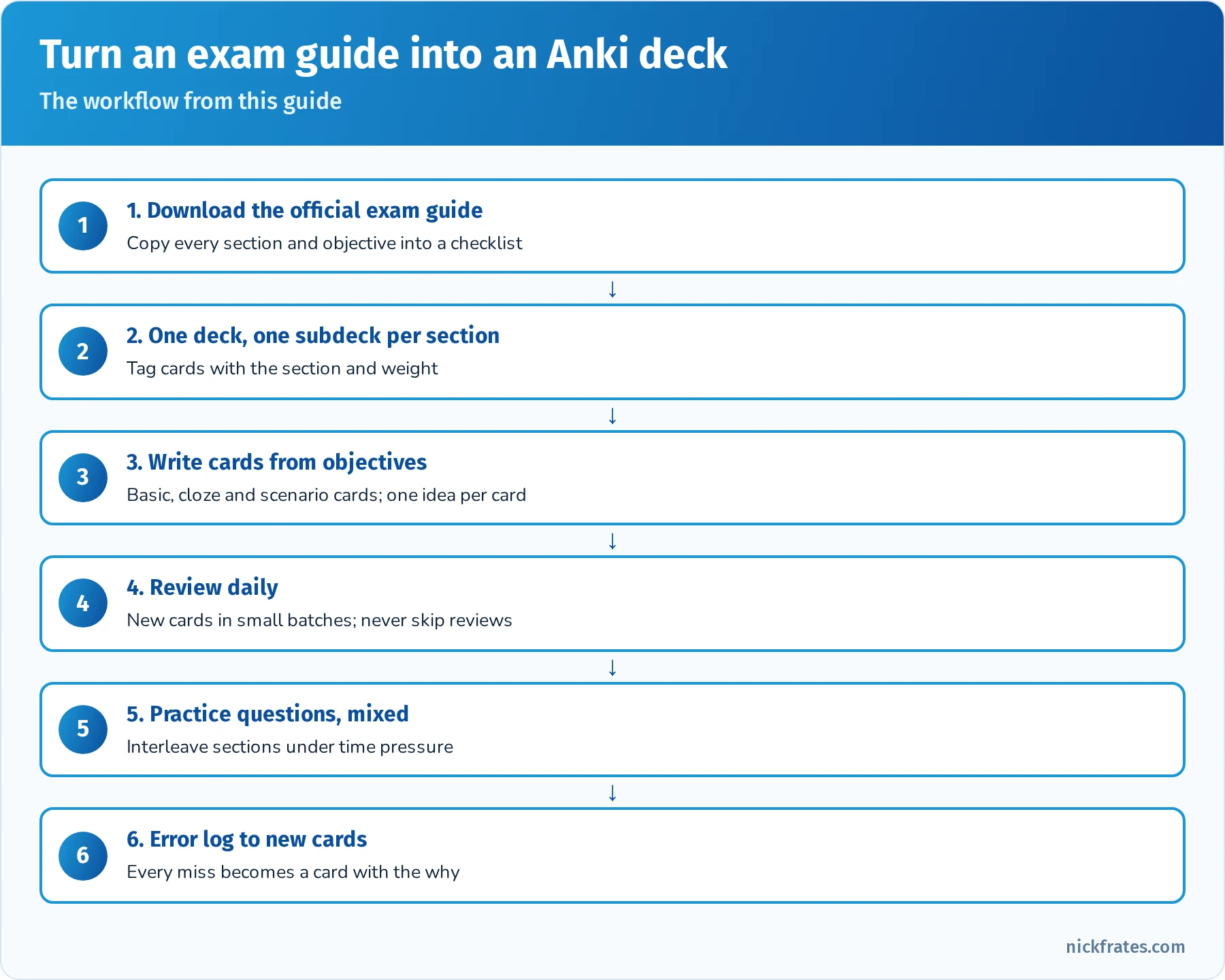
The full workflow in six steps.
Recommended Anki settings for a 6 to 8 week exam timeline:
| Setting | Suggestion | Why |
|---|---|---|
| New cards per day | 15 to 25 | Keeps daily reviews manageable |
| Maximum reviews per day | 200 or higher | Don't let the cap hide due cards |
| Scheduler | FSRS (if available) or the default | FSRS adapts intervals to your memory |
| Desired retention (FSRS) | About 0.9 | A good balance of retention and workload |
| Study order | Parent deck, mixed | Interleaves sections |
| Answer buttons | Be honest with Again | Pretending you knew it breaks the schedule |
A 6-week study plan built on the science
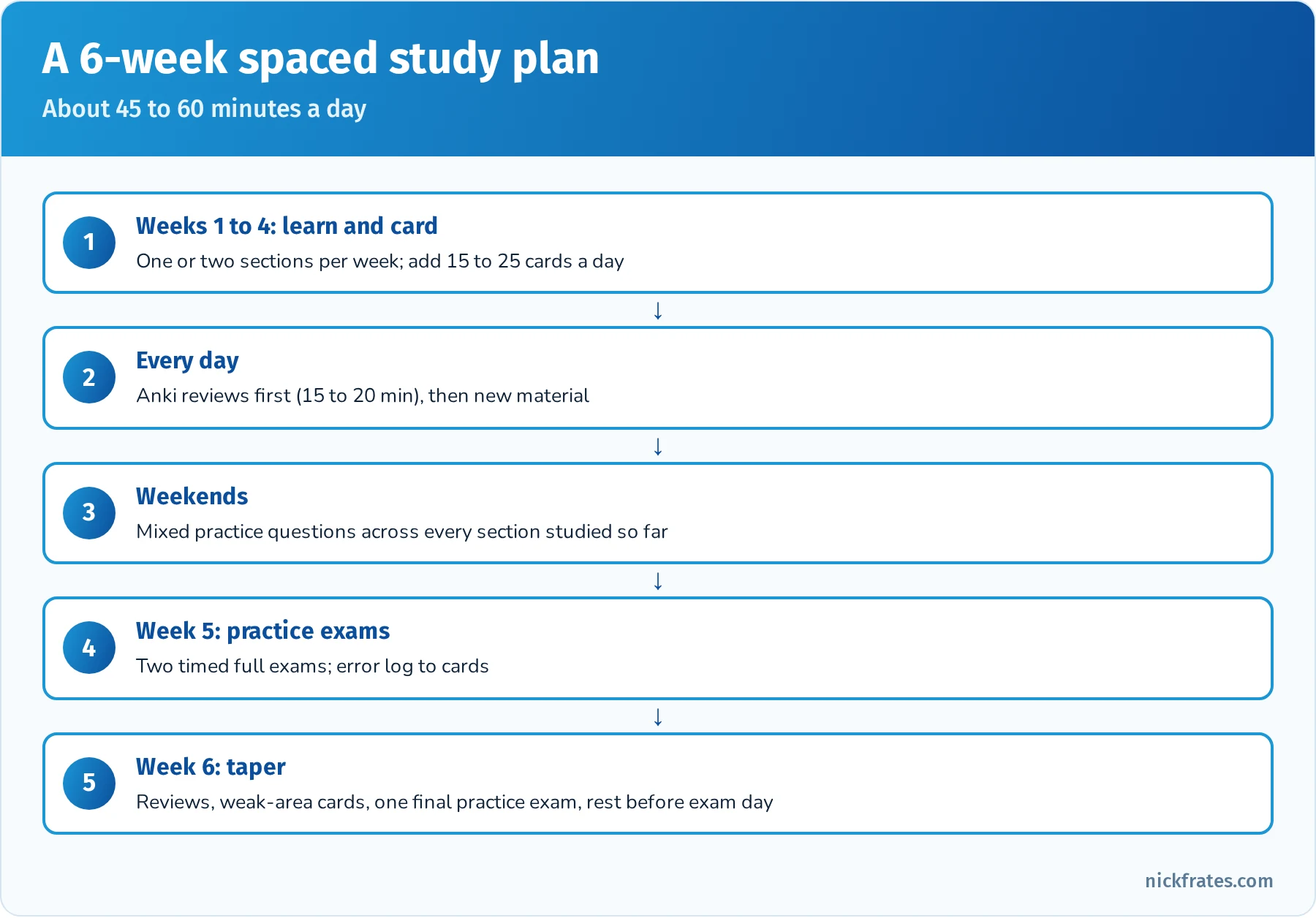
A plan for 45 to 60 minutes a day.
| Week | Focus | Daily routine |
|---|---|---|
| 1 | Highest-weight section | Reviews (5 to 10 min), study and hands-on (30 min), write cards (10 min) |
| 2 | Next sections | Reviews (10 to 15 min), study (30 min), cards (10 min); weekend mixed quiz |
| 3 | Remaining sections | Reviews (15 min), study (30 min), cards (10 min); weekend mixed quiz |
| 4 | Finish outline, hands-on gaps | Reviews (15 to 20 min), practice questions (30 min) |
| 5 | Full timed practice exams | Reviews, then one exam or half-exam, error log to cards |
| 6 | Taper | Reviews, weak sections, one final practice exam, sleep well |
Adjust to your exam. Platform Foundations might need three weeks; architect exams might need ten.
Sleep, breaks and exam day
- Sleep consolidates memory. All-night cramming trades long-term retention for short-term familiarity, and leaves you tired on exam day.
- Short sessions beat marathons. Several focused 25 to 50 minute blocks with breaks work better than one four-hour session.
- Exercise helps. Even a short walk before studying can improve focus. See walks, exercise snacks and the Salesforce life.
- Practice under exam conditions at least twice: timed, no notes, at the same time of day as your exam if you can.
- On exam day, read each question's last line first to find the actual ask, eliminate clearly wrong options, flag and move on when stuck, and come back at the end.
Putting it together: a sample week
Here's what a week looks like for someone preparing for Platform Administrator, using everything above:
- Monday: 15 minutes of Anki reviews. Read the Object Manager section of the Administrator study guide. Build two custom objects with a master-detail relationship in a Developer Edition org. Write 20 cards.
- Tuesday: Reviews. Close the guide and write everything you remember about relationships. Answer the section's practice questions; log misses.
- Wednesday: Reviews. Study validation rules and record types; build examples; write cards.
- Thursday: Reviews. Practice questions for Wednesday's material plus five mixed questions from last week's section.
- Friday: Reviews only (a light day).
- Saturday: 30 mixed practice questions across all sections studied so far, timed. Error log to cards.
- Sunday: Rest, or a short review session.
Common mistakes
- Making too many cards. If daily reviews take over an hour, you're adding new cards too fast or writing cards that are too big.
- Making cards before understanding. Cards are for retention, not first learning.
- Skipping hands-on practice. Salesforce exams test applied knowledge. Build things in a free org.
- Only doing section quizzes. Interleave once you've covered two sections.
- Memorizing answer letters. If you recognize a question, explain why each option is right or wrong before answering.
- Using exam dumps. They violate the certification agreement, can get your credentials revoked and don't prepare you for new scenarios.
Frequently asked questions
Do I have to use Anki? No. Any spaced repetition tool works, and so does a paper Leitner box. Anki is free on desktop and Android, flexible and widely used.
Should I download shared Salesforce decks? Shared decks can be a starting point, but writing your own cards is itself a form of active learning, and shared decks are often out of date or contain exam dump content. If you use one, verify every card against current documentation.
How many practice questions should I do? Enough to see every section many times in mixed sets, and to score consistently above the passing score on timed, full-length practice. The study guides on this site have 40 to 70 questions each with explanations, which is a good start.
How long should I keep reviewing after I pass? Many people keep a small deck going for the maintenance modules and for job interviews. Delete cards you no longer need.
Does this work for architect exams? Yes, but use more scenario cards and more hands-on practice, because architect exams focus on trade-offs.
Related study guides
- All Salesforce certification study guides and the 2026 roadmap.
- Salesforce Administrator study guide.
- Salesforce Platform App Builder study guide.
- Salesforce Platform Developer (PD1) study guide.
- Steph Curry's 500 shots and Salesforce practice rituals.
Want to go deeper on automation? Flow shows up on almost every Salesforce exam, and it is the only supported declarative automation tool now that Workflow Rules and Process Builder are past end of support. My Salesforce Flows course walks through record-triggered, screen, scheduled and platform event flows with real-world challenges.
Hope this helps!
Best,
Nick