This is a deep study guide for the Salesforce Certified Agentforce Service Consultant exam (exam code Service-Con-201), the credential formerly called Service Cloud Consultant. It walks through every section of the official exam outline with plain-English explanations, original diagrams, quick-reference tables, a worked implementation example and 60 original practice questions with answers and explanations.
Updated for 2026: Salesforce renamed 16 certifications on July 24, 2026, and Service Cloud Consultant became Agentforce Service Consultant. The current exam guide aligns questions to the Summer '25 release, sets the passing score at 78% and spreads the outline across eight sections, with agentic service (AI agents in the service process) now written into the objectives. I also call out the product renames since then (Enhanced Chat, Enhanced Omni-Channel, Salesforce Voice, Command Center for Service) so the names on the exam and the names in your org don't trip you up.
| Section | Weight | Approx. questions |
|---|---|---|
| Industry Knowledge | 12% | ~7 |
| Implementation Strategies | 12% | ~7 |
| Agentforce Service Solution Design | 15% | ~9 |
| Knowledge Management | 12% | ~7 |
| Intake and Interaction Channels | 13% | ~8 |
| Case Management | 13% | ~8 |
| Contact Center Analytics | 13% | ~8 |
| Integrations | 10% | ~6 |
| Exam fact | Detail |
|---|---|
| Official name | Salesforce Certified Agentforce Service Consultant (formerly Service Cloud Consultant) |
| Exam code | Service-Con-201 |
| Format | 60 scored multiple-choice/multiple-select questions, plus up to 5 unscored questions |
| Time | 105 minutes |
| Passing score | 78% (about 47 of 60) |
| Fee | $200 USD, retake $100 USD, plus applicable taxes |
| Prerequisite | Salesforce Certified Platform Administrator (required) |
| Release alignment | Summer '25 |
| Delivery | Onsite at a testing center or online proctored; no reference materials allowed |
| Languages | English, Japanese, French, Spanish |
| Maintenance | Complete the annual Platform Administrator maintenance badge on Trailhead |
| Official resources | Exam guide, credential page, prep Trailmix, Trailhead Academy registration |
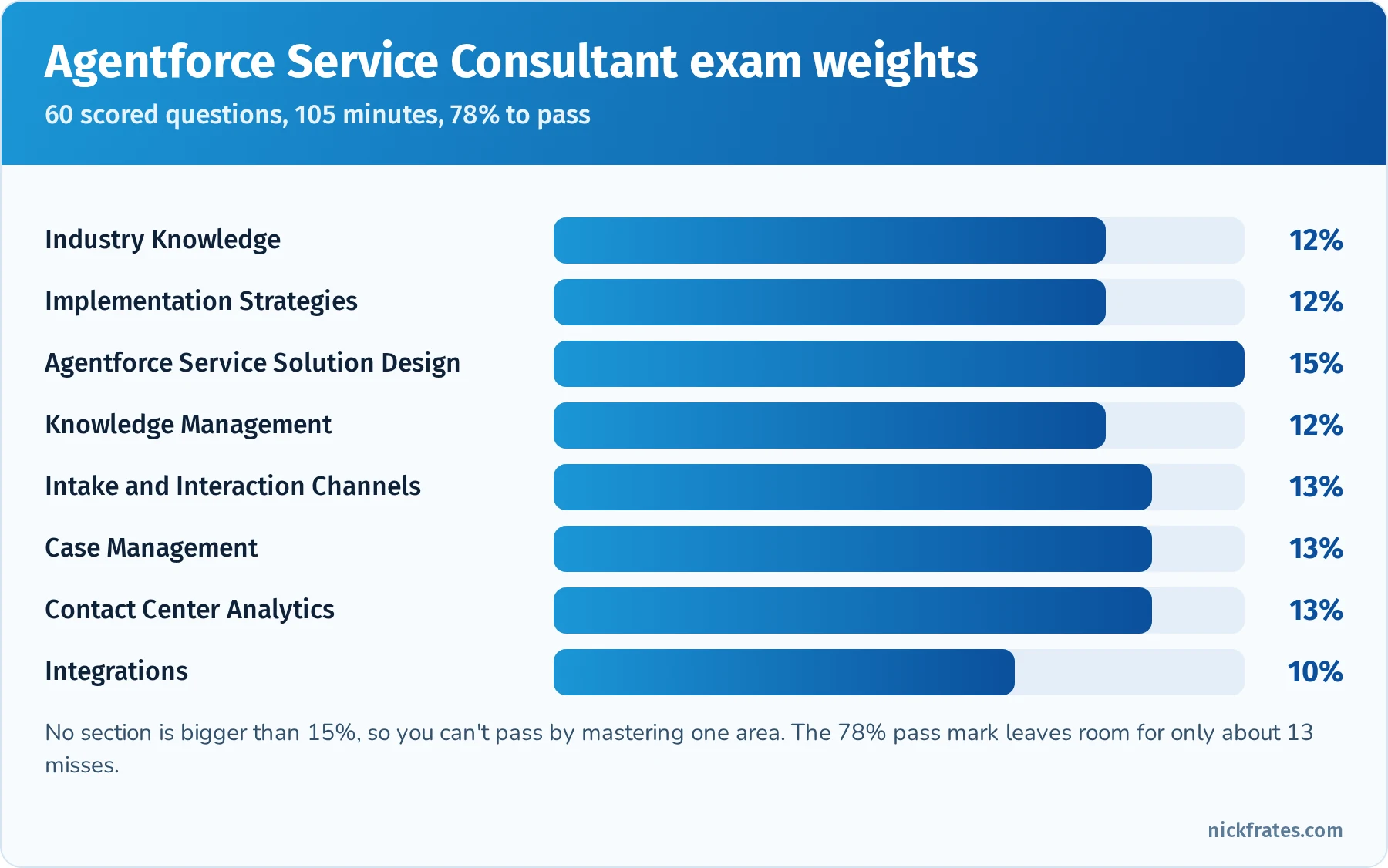
Eight sections between 10% and 15%. There's no single section you can lean on.
The one-line takeaway: this is a consultant exam, not a click-path exam. Most questions give you a business scenario and ask for the best design, so you need to know what each service feature does, what it can't do, and when a simpler standard feature beats a custom one.
Contents
- Who this certification is for
- What changed for 2026
- How to use this guide
- The service solution in one picture
- Industry Knowledge (12%)
- Implementation Strategies (12%)
- Agentforce Service Solution Design (15%)
- Knowledge Management (12%)
- Intake and Interaction Channels (13%)
- Case Management (13%)
- Contact Center Analytics (13%)
- Integrations (10%)
- Worked example: designing service for a growing company
- Design decisions at a glance
- Hands-on checklist
- Common exam traps
- Flashcard terms
- Mixed practice exam: 4 final questions
- Quick-reference cheat sheet
- Frequently asked questions
- Related study guides
Who this certification is for
Salesforce describes the Agentforce Service Consultant as someone who designs and implements solutions that support customer support processes using Agentforce Service (the product formerly called Service Cloud). The exam guide's target candidate typically has 2 to 5 years of professional experience with customer support knowledge and hands-on Salesforce implementation experience.
The guide lists what that person knows, can do and can explain. Paraphrased, it covers:
- Knowledge: when to bring AI agents into service processes, support workflows, Knowledge-Centered Support (KCS), incident management, contact center KPIs such as average handle time and deflection, intake channels, automation, and data migration and quality.
- Skills: entitlements, milestones and SLAs; end-to-end case management; the rep experience in the Service Console (layouts, Dynamic Forms, record pages); recommending channels (bots, embedded chat, telephony, messaging, social, Slack); Web-to-Case and self-service sites; routing, auto-response and queues; and setting up Omni-Channel.
- Abilities: analytics and dashboards, requirements gathering, prioritizing the right solution, explaining standard vs. custom trade-offs, managing stakeholders and scope, telephony, SMS and Salesforce Voice, and knowing when declarative tools are enough.
You need the Platform Administrator certification before you can register. That's a real advantage: queues, record types, page layouts, sharing, reports and Flow all come straight from Admin, and this exam assumes you already know them. If you're rusty, skim my Salesforce Administrator study guide first.
If you're coming from an admin background, the hard parts are usually the consulting questions (engagement, change management, data migration) and the contact center vocabulary. If you're coming from a contact center background, the hard parts are usually Omni-Channel configuration details and the Salesforce data model behind cases, entitlements and Knowledge.
What changed for 2026
The exam outline is aligned to Summer '25, but the product kept moving. Here's what you'll see in study material and in a current org, and how it maps to the exam.
| Change | What it means for you |
|---|---|
| Credential renamed (July 24, 2026) | Service Cloud Consultant is now Agentforce Service Consultant. Same exam code (Service-Con-201), and the old exam guide link redirects to the new guide. |
| Agentic service in the outline | Intake and Interaction Channels now includes recommending AI agents in the service process and explaining agentic service capabilities and configuration. |
| Legacy Chat retired (February 14, 2026) | Enhanced Chat (formerly Messaging for In-App and Web) replaces it. Older guides that teach Live Agent chat buttons and deployments are out of date. |
| Standard Omni-Channel retired (Summer '26) | Salesforce upgrades orgs to Enhanced Omni-Channel, which supports Agentforce agents, Voice, Case and Enhanced Messaging channels. |
| Supervisor view renamed | The Omni-Channel supervisor experience is now documented as Command Center for Service. |
| Voice renamed | Service Cloud Voice became Salesforce Voice, and the telephony models are now grouped as Salesforce Voice with Telephony Providers (and more recently under Partner Contact Center). The exam guide itself says "Salesforce Voice." |
| Topics became subagents | In the new Agentforce Builder, the "topics" an agent uses are now called subagents. Same idea: a job the agent can do, with instructions and actions. |
| Passing score: 78% | One of the higher pass marks in the Salesforce catalog. You can miss only about 13 of 60 scored questions. |
My advice: learn the concepts by job (route work, deflect work, commit to an SLA, measure it), then learn both the old and new names. A question written for Summer '25 might say "Messaging for In-App and Web" while your org says "Enhanced Chat." They're the same feature.
How to use this guide
- Get a free org. A Trailhead Playground or Developer Edition org has Cases, queues, assignment rules, Knowledge and Omni-Channel setup pages. Reading about routing is ten times harder than building one queue and watching a case land.
- Study by the flow of work: industry context and engagement first, then cases, channels and routing, then Knowledge and AI, then design, analytics and integrations.
- Answer the practice questions at the end of each section and read every explanation, including why the wrong answers are wrong. That's where most of the learning happens.
- Finish with the worked example and the mixed practice exam, then do a timed run: 60 questions in 105 minutes is 1 minute 45 seconds per question.
- Use active recall and spaced repetition. Turn the flashcard terms near the end into cards. If you want the why behind that, read The Science of Studying for Salesforce Certifications.
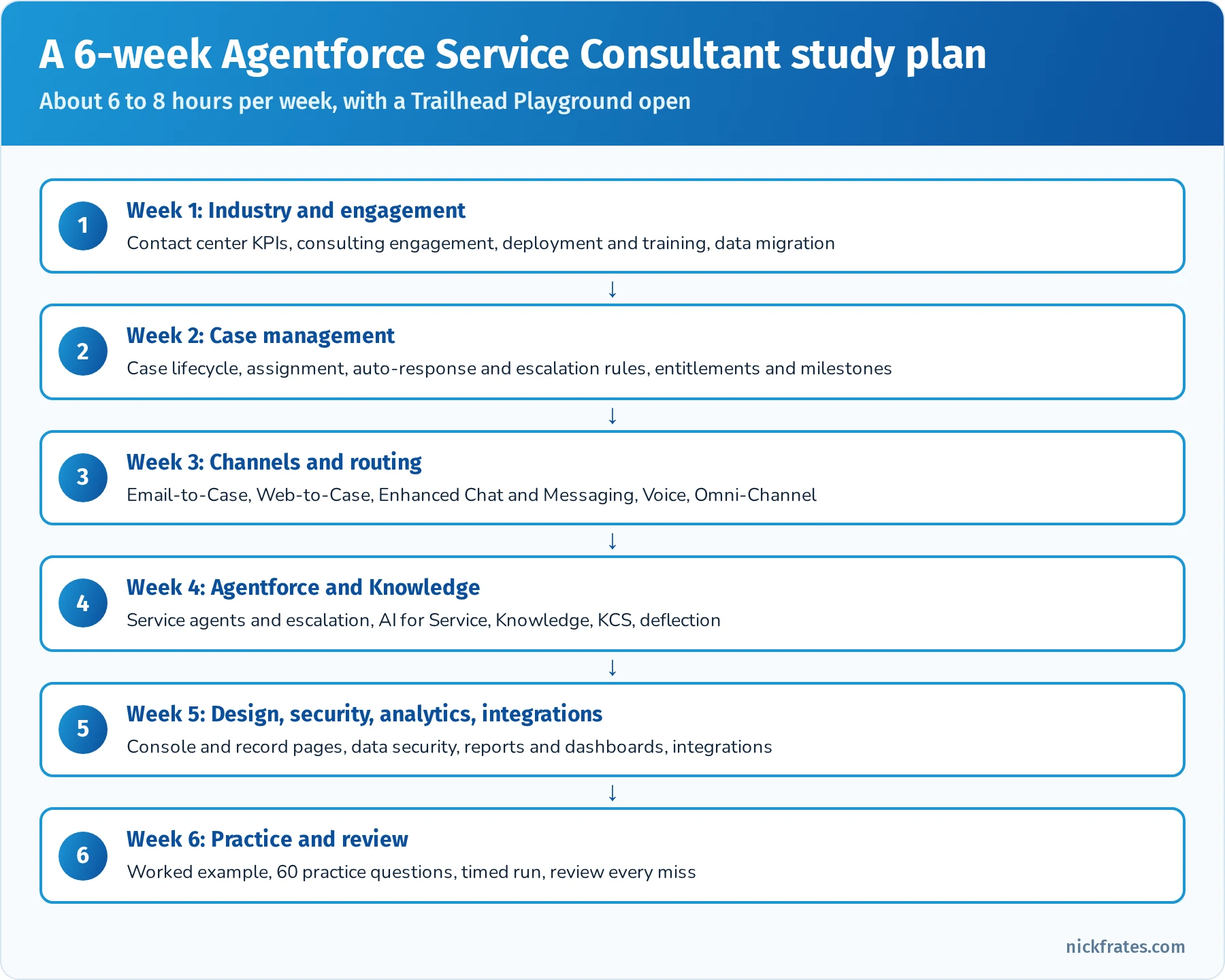
A six-week plan for someone who already holds Platform Administrator.
The service solution in one picture
Before the sections, here's the mental model I use. Almost every scenario on this exam fits somewhere on this path:
- Intake. A customer reaches out by email, web form, chat, messaging app, phone or a self-service help center.
- Route. Omni-Channel pushes the work to the right place: an Agentforce Service agent, a queue, a rep with the right skills, or a specific rep.
- Work. The rep works in the Service Console with a well-designed record page, Knowledge, macros and AI assistance.
- Resolve. The answer comes from Knowledge, an AI-drafted reply, a colleague in a Slack swarm, or a fix in a back-office system.
- Commit. Entitlements, entitlement processes, milestones and business hours make sure the case meets the promised service level.
- Measure. Reports, dashboards and the supervisor view show whether KPIs like handle time, first contact resolution and SLA attainment are improving.
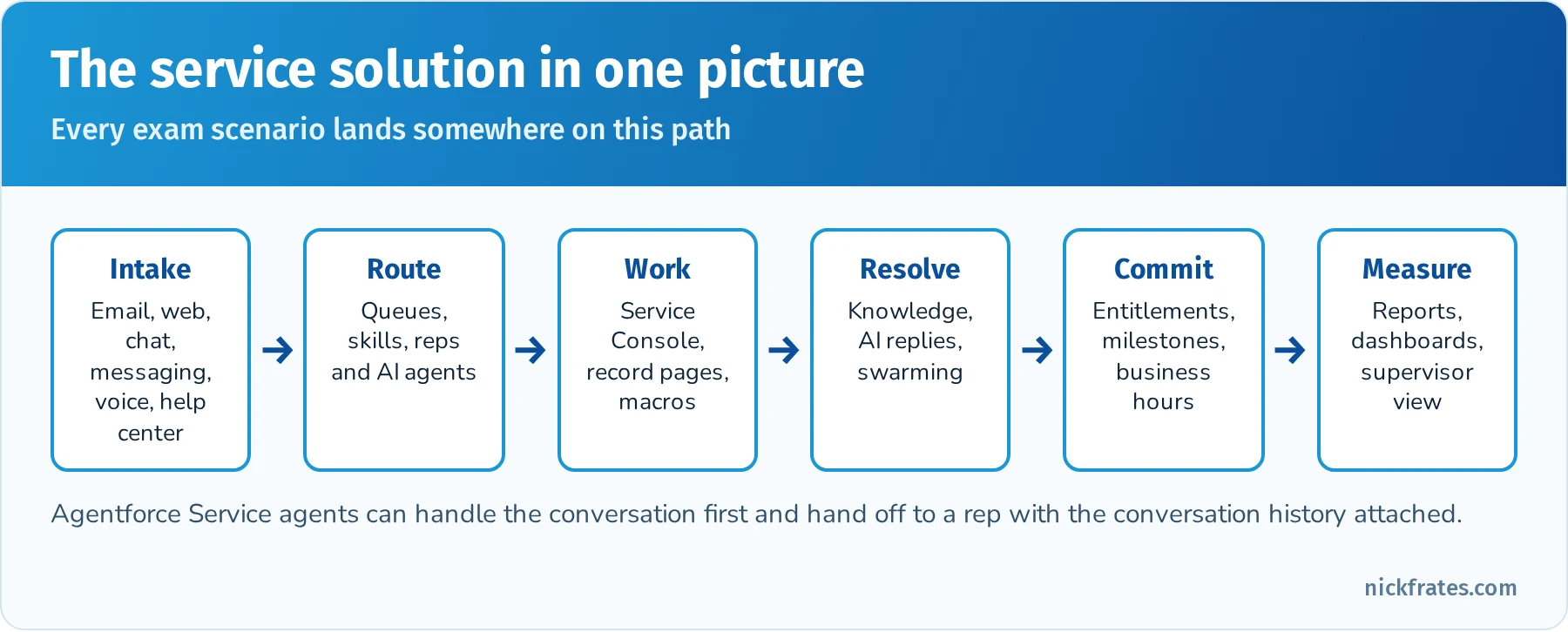
The six stages behind almost every exam scenario.
When a question feels vague, ask yourself which stage it's really about. "Customers wait too long" is usually Route or Commit. "Reps can't find answers" is Resolve. "Leadership can't see what's happening" is Measure.
Industry Knowledge (12%)
This section tests whether you understand how contact centers run, independent of Salesforce. The two objectives are explaining what influences key contact center metrics and KPIs, and determining the risks, benefits and business challenges of meeting a client's desired outcome.
Know the metrics cold. You won't be asked to calculate complex formulas, but you will be asked which design choice improves which metric, and what the side effects are.
| KPI | What it measures | Design levers that improve it | Watch the trade-off |
|---|---|---|---|
| Average handle time (AHT) | Average time a rep spends on an interaction, including talk or chat time and wrap-up work | Console layout with fewer clicks, macros, quick text, Knowledge in context, AI work summaries | Pushing AHT down too hard can hurt resolution and satisfaction |
| First contact resolution (FCR) | Share of issues solved in the first interaction | Skills-based routing, Knowledge at hand, empowered reps, good intake data | Can raise AHT, since reps spend longer to fully solve |
| Case deflection | Issues solved without a rep (self-service or AI agent) | Help center with Knowledge, case deflection on contact forms, Agentforce Service agent | Bad deflection frustrates customers; measure it honestly |
| Service-level (SLA) attainment | Share of commitments met on time (first response, resolution) | Entitlement processes, milestone warning actions, priority routing | Gaming the clock (closing too early) hurts CSAT |
| Customer satisfaction (CSAT) | Customer's rating of the interaction | Faster, accurate answers in the customer's preferred channel | Survey fatigue; low response rates |
| Net Promoter Score (NPS) | Likelihood to recommend the company | Overall relationship, not one interaction | Lagging indicator |
| Average speed to answer / wait time | How long customers wait for a rep | Capacity planning, queue priority, Omni-Channel routing, callbacks | More staff costs money |
| Backlog | Open work waiting to be handled | Capacity, routing priority, deflection, supervisor visibility | Old backlog hides SLA risk |
| Rep utilization and occupancy | How much of a rep's time is spent on work | Omni-Channel capacity, presence statuses | Burnout when it's too high |
| Cost per contact | Cost to handle each interaction | Channel shift to self-service and AI, automation | Cheap channels can lower satisfaction |
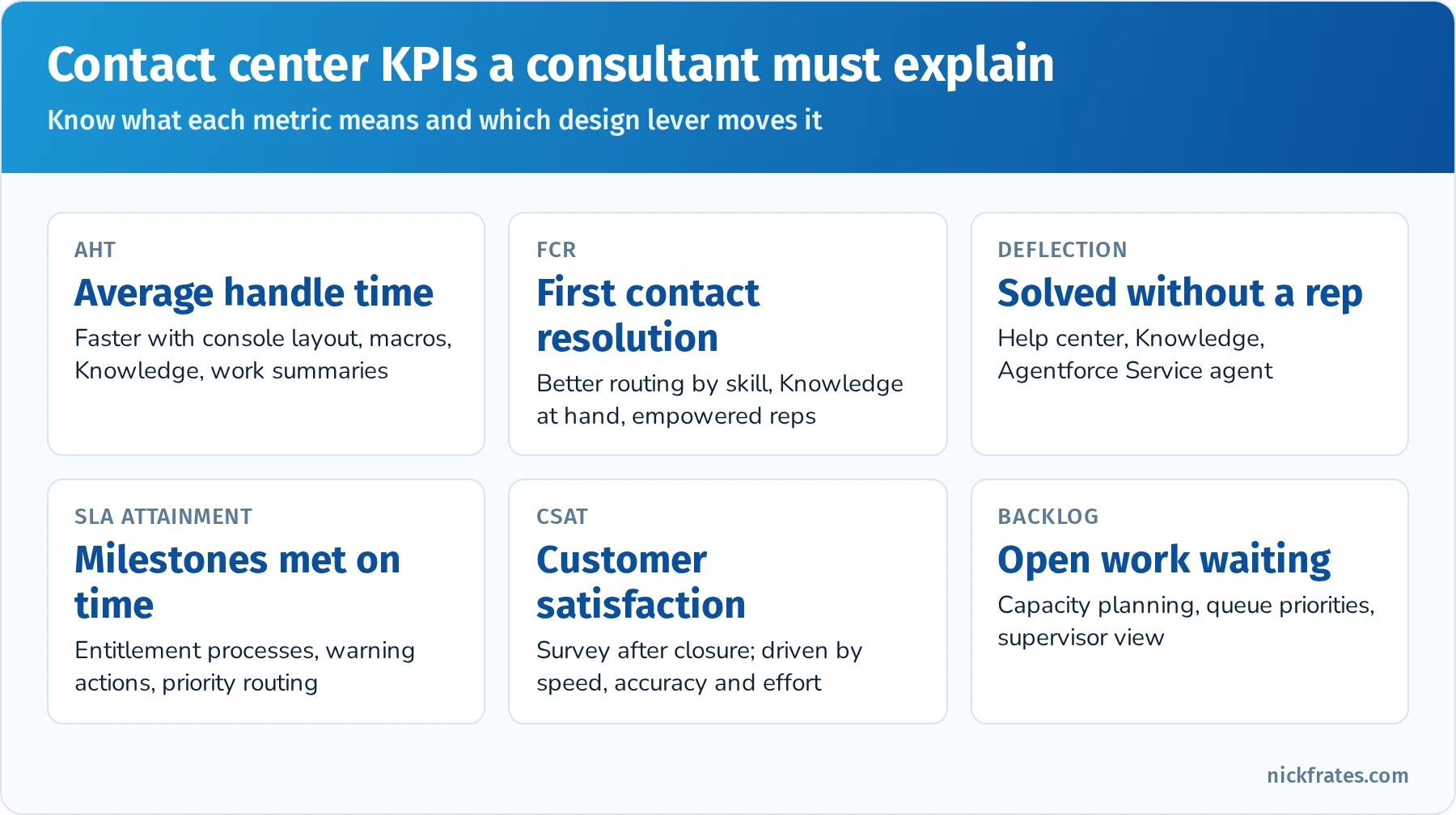
Match each KPI to the Salesforce feature that moves it.
Benefits, risks and business challenges. The second objective is consulting judgment. A client says, "We want to cut handle time by 30% and add WhatsApp next quarter." A good consultant asks what's driving handle time today, whether reps have the right information, whether the knowledge base is healthy, whether WhatsApp volume justifies the investment, and what happens to existing SLAs during rollout.
Common risks to recognize:
- Adoption risk. Reps keep using spreadsheets or email because the new console is slower than what they had.
- Data risk. Duplicate contacts and messy account data break routing, entitlements and reporting.
- Scope risk. "Just add one more channel" without staffing, routing or Knowledge to support it.
- AI risk. An AI agent that answers without grounded, current Knowledge, or without a clean escalation path, damages trust fast.
- Compliance risk. Regulated data (health, financial, personal data) in channels or transcripts without the right controls.
Industry trends the guide names: artificial intelligence, generative AI, Agentforce agents and data issues. The exam's angle is practical. AI helps when it's grounded in good data and Knowledge, has clear guardrails, and hands off to humans cleanly. A trend answer that skips data quality is usually wrong.
Organization business units. The guide calls out the difference between technical support and customer support processes. Technical support often needs tiered escalation, deeper troubleshooting, incident and problem management, and engineering handoffs. Customer support is often higher volume and shorter (orders, billing, account changes), which suits deflection, AI agents and macros.
Incident management. When one underlying issue (an outage, a bad product batch) generates many cases, you don't want 500 reps solving it 500 times. Salesforce's Customer Service Incident Management features use Incident, Problem and Change Request records, link the affected cases, and support Slack swarming so experts collaborate on the fix. Communicate once, resolve once, close the related cases together.
Practice questions: Industry Knowledge
Question 1. A support director wants to raise first contact resolution without hiring. Reps often transfer cases because they lack product expertise. What should the consultant recommend first?
- A. Lower the target handle time so reps move faster
- B. Route work by skills so cases reach reps with the right product expertise, and surface Knowledge on the case page
- C. Add a new email channel
- D. Require supervisors to approve every transfer
Answer: B. Transfers caused by missing expertise are a routing and knowledge problem. Skills-based routing sends the case to someone who can solve it, and Knowledge in context helps them do it. Cutting AHT targets (A) usually lowers FCR.
Question 2. After a self-service help center launch, case volume dropped 20%, but CSAT for remaining cases fell. Which explanation should the consultant investigate first?
- A. The remaining cases are more complex, because simple issues are now deflected
- B. The help center is broken
- C. Reps stopped using macros
- D. Email-to-Case stopped working
Answer: A. Deflection removes easy cases, so the remaining mix is harder and handle time and CSAT often shift. That's normal and should be planned for in staffing, skills and targets.
Question 3. Which KPI most directly measures whether a contact center is meeting its contractual response commitments?
- A. Net Promoter Score
- B. Service-level (SLA) attainment based on milestones
- C. Rep utilization
- D. Cost per contact
Answer: B. SLA attainment tracks whether first response and resolution commitments were met. In Salesforce, milestones on entitlement processes are how you measure it.
Question 4. A telecom company has a network outage, and 2,000 customers open cases about the same issue within an hour. What approach best fits?
- A. Assign each case to a different rep to solve individually
- B. Manage it as an incident: link the related cases to one incident, swarm the fix, communicate once and close the related cases together
- C. Turn off Web-to-Case until the outage ends
- D. Merge all 2,000 cases into one case
Answer: B. That's the incident management pattern. Merging (D) is for true duplicates from the same customer and is limited to a few cases at a time. Turning off intake (C) hides the problem.
Question 5. A client wants to deploy an AI agent next month to "answer everything." Their Knowledge base has 300 articles, many of them out of date. What's the biggest risk to raise?
- A. The AI agent will be too fast
- B. The agent's answers will only be as good as the content and data it's grounded in, so outdated articles become wrong answers at scale
- C. AI agents can't use Knowledge
- D. Customers don't use chat
Answer: B. Grounding is everything. Fix content health (and plan a clean escalation path) before scaling an AI agent.
Question 6. Which two changes are most likely to reduce average handle time without hurting resolution quality? (Choose two.)
- A. Macros for repetitive multi-step tasks
- B. Removing Knowledge from the console to reduce clutter
- C. A record page that shows the customer's entitlements, recent cases and recommended articles in one place
- D. Forcing reps to close cases within 5 minutes
Answer: A and C. Macros and a well-designed record page remove clicks and searching. Removing Knowledge (B) slows reps down, and a hard time limit (D) hurts quality.
Implementation Strategies (12%)
This section is about running the project: participating in a successful consulting engagement, recommending deployment and training strategies, and explaining the considerations for data migration, data quality, data governance and large data volumes.
A successful engagement. The exam favors consultants who listen first, document decisions and recommend standard functionality before custom code.
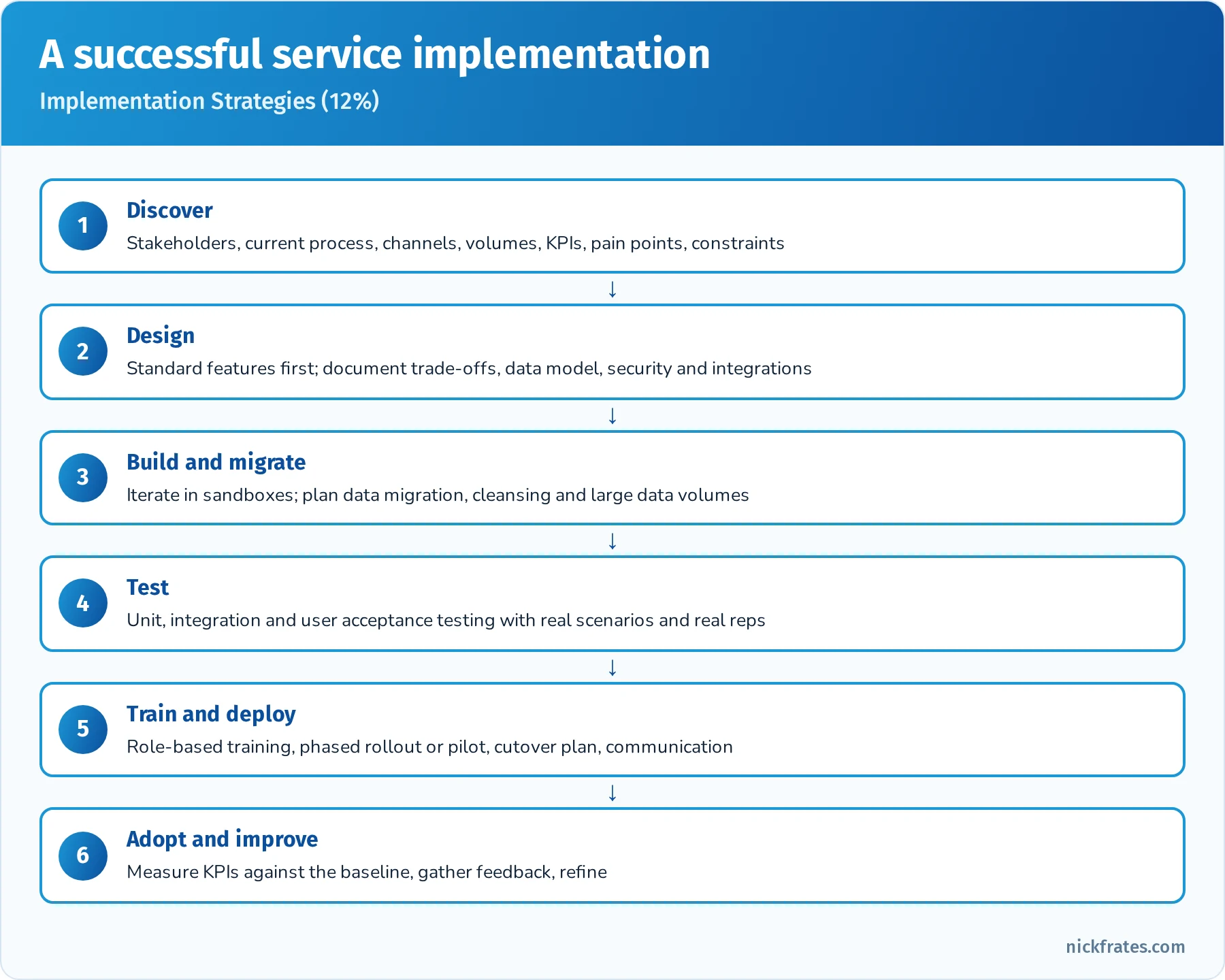
Discovery and adoption are where service projects succeed or fail.
Discovery checklist for a service project:
- Stakeholders: support leadership, supervisors, frontline reps, Knowledge managers, IT, security and compliance, and (for B2B) account teams.
- Current state: channels in use, volumes per channel, hours of operation, tiers, escalation paths, existing tools, and what reps do in other systems.
- Goals and KPIs: the baseline today (AHT, FCR, CSAT, SLA attainment) and the target. No baseline means no proof of success.
- Service commitments: support tiers, entitlements, SLAs, holidays and business hours by region.
- Data: where customer, product, asset, order and contract data lives, and its quality.
- Constraints: budget, licenses (for example, add-ons for Voice, Enhanced Messaging or AI features), timelines, regulations.
Standard vs. custom. The guide explicitly asks you to explain benefits and limitations of standard solutions compared with custom ones. Standard features (assignment rules, Omni-Channel, entitlements, Knowledge, macros) are faster to deliver, upgrade automatically with releases and are easier to maintain. Custom solutions (Apex, custom Lightning components, custom objects that duplicate standard ones) are justified only when a real requirement can't be met declaratively. On the exam, "build a custom object to track SLAs" is almost always wrong when entitlements and milestones exist.
Deployment strategies.
| Strategy | When it fits | Risk |
|---|---|---|
| Big bang | Small team, simple process, hard cutover date | Everything changes at once; issues hit everyone |
| Phased by channel | Start with email and web, then add messaging, then voice | Customers may see inconsistent experiences for a while |
| Phased by team or region | Large organizations with regional teams | Longer total timeline; parallel systems |
| Pilot | New or risky capability, such as an AI agent or a new routing model | Pilot results may not represent all teams |
Training strategies. Train by role: reps learn the console, macros and Knowledge workflow; supervisors learn queues, Command Center for Service and dashboards; Knowledge authors learn the article lifecycle and KCS practices; admins learn the configuration. Use realistic scenarios from their own cases, a sandbox with representative data, short job aids, and floor support (super users) during go-live. In-app guidance and Trailhead modules help with ongoing training.
Data migration. Service migrations usually move accounts, contacts, assets, entitlements and contracts, open cases (sometimes closed history), Knowledge articles and attachments. The questions to answer:
- What to migrate: do you need ten years of closed cases in Salesforce, or two years plus an archive?
- Order of load: parents before children. Accounts, then contacts and assets, then entitlements, then cases, then case comments, emails and files.
- Data quality: deduplicate and standardize before loading. Bad data in means bad routing and reporting out.
- Tools: the Data Import Wizard handles up to 50,000 records for supported objects; Data Loader supports files of up to 5 million records and all objects, including custom objects; very large or recurring loads use Bulk API-based tools or integration middleware.
- Keep the history honest: decide how to map old statuses to new support processes, and whether to store legacy IDs in external ID fields for traceability and upserts.
- Automation during loads: consider temporarily bypassing assignment rules, auto-response rules and flows so a historical load doesn't email 100,000 customers.
Large data volumes (LDV). Contact centers create a lot of records: cases, emails, messaging sessions, voice calls, chat transcripts. Plan for selective list views and reports on indexed fields, archiving strategies for old cases and interactions, avoiding ownership skew (one user or queue owning huge numbers of records) and parent skew (one account with a huge number of child cases), and asynchronous processing for bulk updates.
Data governance. Define data owners, retention policies (how long to keep transcripts and recordings), field-level access for sensitive data, duplicate rules, validation rules and a plan for ongoing data quality.
Practice questions: Implementation Strategies
Question 7. A company with 400 reps across three regions is moving from a legacy ticketing tool. Leadership wants low risk and a fast learning loop. What deployment approach should the consultant recommend?
- A. Big bang for all regions on the same day
- B. A pilot with one team, then a phased rollout by region using lessons from the pilot
- C. Let each region decide whether to adopt
- D. Run both systems indefinitely
Answer: B. A pilot followed by a phased rollout reduces risk and lets you improve the configuration and training before most users switch.
Question 8. During discovery, a stakeholder asks for a custom object to track response deadlines per customer tier. What should the consultant recommend?
- A. Build the custom object with Apex triggers to calculate deadlines
- B. Use entitlements and entitlement processes with milestones, business hours and milestone actions
- C. Track deadlines in a spreadsheet
- D. Use a formula field on Account
Answer: B. Entitlement management is the standard feature built for exactly this. Recommending custom work when standard functionality fits is a classic wrong answer.
Question 9. A client is migrating 3 million historical cases with related emails. Which tool fits best?
- A. Data Import Wizard
- B. Data Loader or another Bulk API-based tool, loading parents before children
- C. Manual entry by reps
- D. Web-to-Case
Answer: B. The Data Import Wizard tops out at 50,000 records. Data Loader handles files of up to 5 million records and supports all objects.
Question 10. Before loading historical cases, what should the consultant make sure of to avoid surprising customers?
- A. That auto-response rules, assignment notifications and record-triggered flows that send emails are bypassed or deactivated during the load
- B. That all reps are logged in
- C. That Knowledge is disabled
- D. That Omni-Channel presence statuses are deleted
Answer: A. Historical loads can fire automation. Plan to bypass customer-facing automation during migration and re-enable it afterward.
Question 11. Six months after go-live, the support VP asks whether the project worked. The team can't answer. What was most likely missed during discovery?
- A. Capturing baseline KPIs and agreed success measures before the project started
- B. Creating more page layouts
- C. Buying more licenses
- D. Enabling field history tracking on every field
Answer: A. Without a baseline (AHT, FCR, CSAT, SLA attainment before go-live), you can't show improvement.
Question 12. Which training approach is most effective for frontline reps before a Service Console go-live?
- A. A two-hour lecture covering every Setup page
- B. Role-based, scenario-driven practice in a sandbox with realistic cases, plus job aids and floor support during go-live
- C. A link to the Salesforce Help home page
- D. No training, since the console is intuitive
Answer: B. Reps learn by doing their real work. Scenario practice, job aids and super users on the floor drive adoption.
Question 13. One integration user owns 4 million cases created by an inbound integration, and list views and sharing recalculations are slow. What's the most likely issue?
- A. Ownership skew
- B. Too many page layouts
- C. Too many queues
- D. Missing email templates
Answer: A. One user owning a very large number of records is ownership data skew, which hurts sharing performance. Distribute ownership (for example, across queues) and keep the owner out of the role hierarchy or at the top of it, following Salesforce's large data volume guidance.
Agentforce Service Solution Design (15%)
This is the largest section. It has three objectives: design the service rep experience, design the customer experience, and design a solution that secures customer data and meets compliance requirements. Each one is "given a scenario, analyze requirements and pick the design," so capabilities, limitations and trade-offs matter more than click paths.
The service rep experience
The Service Console is a Lightning console app built for high-volume work. Key ideas:
- Workspace and subtabs. A case opens as a workspace tab, and related records (the contact, the account, an asset) open as subtabs, so reps keep context without losing their place.
- Split view shows a list view next to the open records, which is handy for working through a queue.
- Utility bar gives persistent tools at the bottom of the screen, such as the Omni-Channel widget, macros, history and softphone.
- Lightning record pages built in Lightning App Builder decide what the rep sees: highlights panel, related lists, Knowledge component, case feed, milestone tracker and AI components.
- Dynamic Forms place fields and field sections directly on the Lightning page and show or hide them with visibility rules, so a billing case and a technical case can show different fields without separate page layouts.
- Page layouts and record types still control which picklist values (through support processes for case status) and which actions are available by profile and record type.
Productivity tools to recommend:
| Tool | What it does | Pick it when |
|---|---|---|
| Macros | Runs a set of instructions in one click, such as choosing an email template, inserting text, updating case status and sending | Reps repeat the same multi-step task many times a day |
| Bulk macros | Runs a macro on multiple records at the same time | A spike of cases about the same issue needs the same response |
| Quick text | Inserts predefined messages into emails, chats and other fields | Consistent greetings, answers and closing lines |
| Email templates | Reusable, merge-field-driven email content | Standard customer communications and auto-responses |
| Knowledge component | Suggests and searches articles in the context of a case | Reps need answers without leaving the record |
| Service Email Assistant and AI replies | Drafts responses from case data and grounded content | Reduce writing time while keeping a human in the loop |
| Work summaries | AI-generated summaries of conversations for wrap-up | Reduce after-call work and improve case notes |
A macro gotcha the exam likes: macros that send an email or update a record with a "Submit Action" instruction are irreversible, and users need the Manage Macros Users Can't Undo permission to create, edit and run them.
The customer experience
The customer-side design questions are about meeting customers in their preferred channel, keeping context across channels, and resolving issues with the least customer effort.
- Self-service first for simple, repeatable questions: a help center built on Experience Cloud with Knowledge, search and a contact form that suggests articles before a case is created.
- Conversational channels for questions that need back-and-forth: Enhanced Chat on the website or in your app, and Enhanced Messaging on WhatsApp, SMS, Facebook Messenger, Apple Messages for Business and LINE.
- AI agents for common requests that can be completed with your data and actions (order status, return start, appointment change), with a clean handoff to a human.
- Voice for urgent, complex or emotional issues.
- Proactive service when you know about an issue before the customer does: notify affected customers instead of waiting for 2,000 cases.
- Personalization and context: pre-chat forms and verified identities let the conversation start with the customer's record, entitlements and history, so they never repeat themselves.
Securing customer data
Service data includes personal data, payment details, health information and private conversations. The exam expects layered security thinking, built on what you learned for Platform Administrator:
| Layer | Service-specific design choices |
|---|---|
| Object and field access | Profiles, permission sets and permission set groups for reps, supervisors and Knowledge authors; field-level security on sensitive case fields |
| Record access | Case org-wide default (often Private), queues and role hierarchy for team visibility, sharing rules for cross-team cases, case teams for collaboration |
| External users | Experience Cloud external org-wide defaults, sharing sets and sharing rules so customers see only their own cases |
| Knowledge visibility | Data category visibility by role, permission set or profile, and channel settings (internal, customer, partner, public knowledge base) |
| AI and agents | The Agentforce Service agent runs as a dedicated agent user, so its permission sets limit what it can read and do; the Einstein Trust Layer applies to generative AI features |
| Encryption and monitoring | Shield Platform Encryption for data at rest, Event Monitoring and Field Audit Trail when regulations require them (add-on products) |
Least privilege is the default answer. If a scenario asks how to let a Tier 2 team see escalated cases without opening every case to everyone, the answer is a queue or a criteria-based sharing rule, not changing the case org-wide default to Public Read/Write.
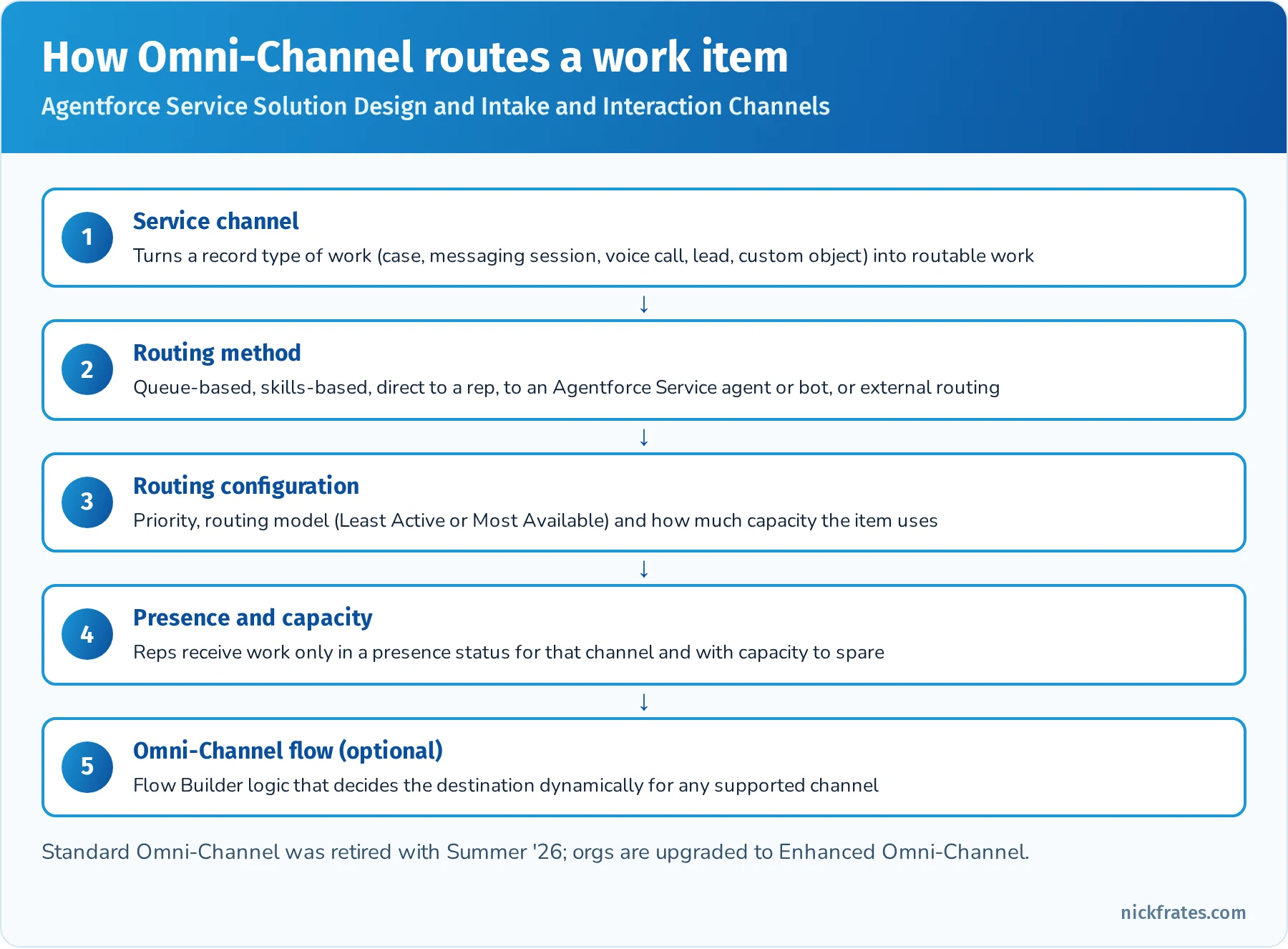
The building blocks behind every routing question.
Omni-Channel design (it shows up everywhere)
Omni-Channel isn't its own section, but it runs through solution design, channels and case management. Here are the building blocks:
- Service channel: makes an object routable (Case, Messaging Session, Voice Call, Lead, custom objects).
- Queues hold work and connect to a routing configuration.
- Routing configuration: routing priority (lower numbers route first), routing model and how much capacity each item uses (units or a percentage).
- Routing models: Least Active routes to the rep whose work uses the smallest amount of capacity; Most Available routes to the rep with the greatest available capacity. If there's a tie, the work goes to the rep who has waited longest since receiving work.
- Presence configuration sets each rep's overall capacity and behavior; presence statuses decide which channels a rep receives work from. Reps receive work only when they're in a status for that channel.
- Skills-based routing matches the skills a work item needs to the skills a rep has. Skills are assigned to service resources with an optional skill level from 1 (novice) to 10 (expert), and a rep must have every required skill to receive the work. Skill mapping sets define which field values map to which skills per object.
- Omni-Channel flows bring routing logic into Flow Builder and route voice calls, chats, messaging sessions, cases, leads and custom objects to a queue, skill, rep, bot or Agentforce Service agent. For non-real-time objects such as cases, you call the Omni-Channel flow as a subflow, for example from a record-triggered flow.
- External routing lets a third-party routing engine decide where work goes while Omni-Channel delivers it.
- Command Center for Service gives supervisors real-time views of reps, queues, backlog and flags, lets them read transcripts, send whisper messages that only the rep sees, and change rep queues and skills.
Capacity models. This is a favorite comparison:
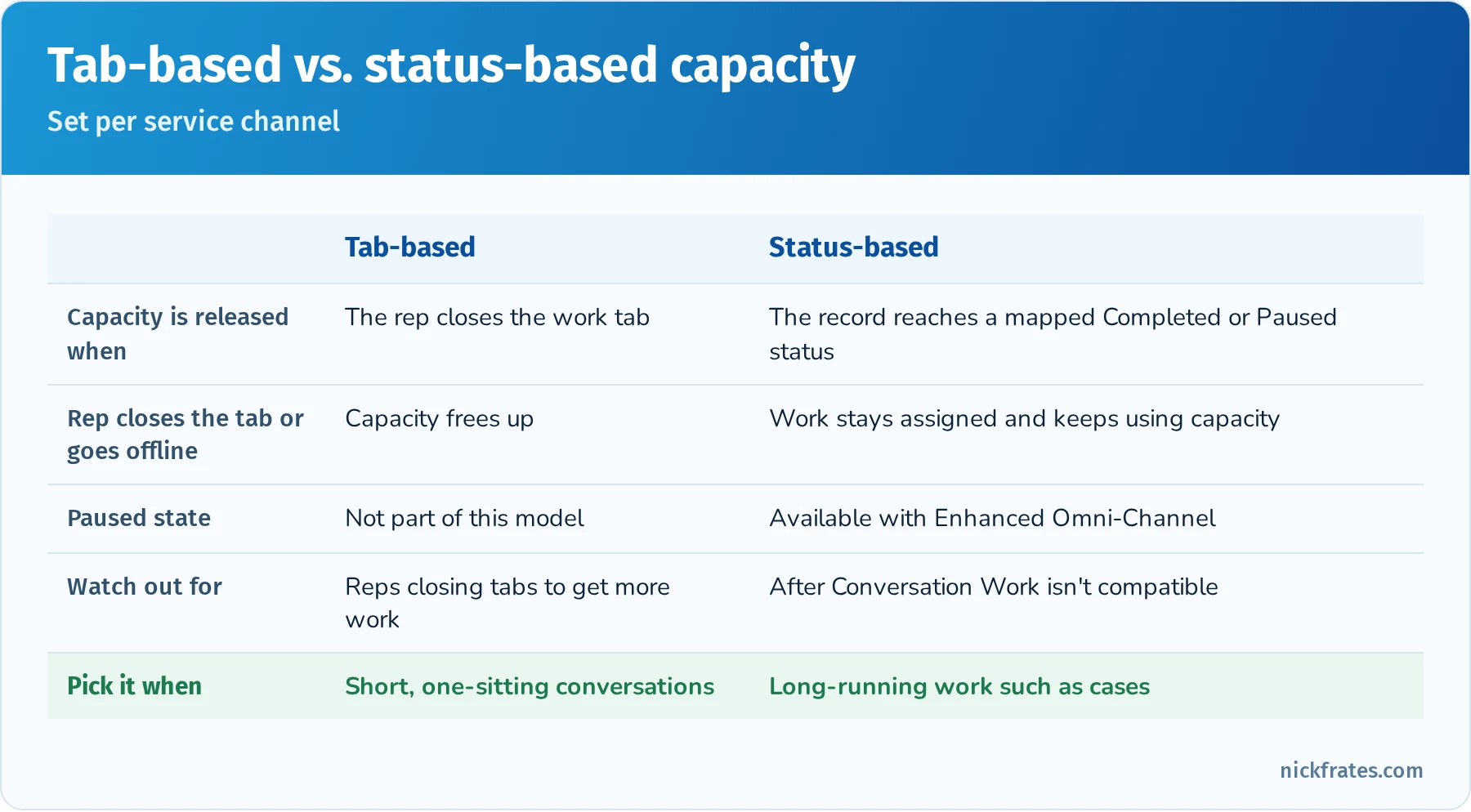
Capacity model is set per service channel.
With the status-based capacity model, work stays assigned and keeps using the rep's capacity until the record reaches a status you've mapped to Completed (or Paused, which needs Enhanced Omni-Channel). With the tab-based model, capacity frees up when the rep closes the tab. Also know that After Conversation Work isn't compatible with status-based capacity, and that routing logic runs when work is assigned, so changing a field on a work item after it's routed doesn't re-route it.
Practice questions: Agentforce Service Solution Design
Question 14. Billing cases and technical cases share one case record type, but reps want different fields to appear based on the case reason, without maintaining extra page layouts. What should the consultant recommend?
- A. Create a custom Lightning component
- B. Use Dynamic Forms on the Lightning record page with field visibility rules based on case reason
- C. Create two profiles
- D. Use a validation rule
Answer: B. Dynamic Forms show and hide fields and sections declaratively based on record values, without extra layouts.
Question 15. Reps spend several minutes on every warranty claim: choose an email template, fill in standard text, set status to Awaiting Customer and send. What's the best standard solution?
- A. A macro that performs all four steps
- B. A new page layout
- C. An escalation rule
- D. A custom Apex button
Answer: A. That's the textbook macro use case. Because the macro sends an email, it's irreversible, so authors need the Manage Macros Users Can't Undo permission.
Question 16. A company's cases can take days to resolve while waiting on customers. Reps close tabs at the end of their shift and then receive too much new work. Which Omni-Channel change fixes this?
- A. Switch the case service channel to the status-based capacity model and map Waiting on Customer to Paused or Completed as appropriate
- B. Increase every rep's capacity
- C. Use Most Available routing
- D. Turn off Omni-Channel for cases
Answer: A. With status-based capacity, work keeps using capacity until it reaches a mapped status, regardless of open tabs. Mapping waiting statuses to Paused (available with Enhanced Omni-Channel) frees capacity while the case waits.
Question 17. Spanish-speaking customers with billing questions must reach reps who speak Spanish and know the billing system. What's the best routing design?
- A. Queue-based routing with one queue per rep
- B. Skills-based routing with Spanish and Billing skills mapped from case fields
- C. Assignment rules that assign to a random rep
- D. Round-robin assignment through Apex
Answer: B. Skills-based routing sends work to a rep who has every required skill and available capacity.
Question 18. A supervisor wants to see in real time which reps need help and to coach them during live chats without the customer seeing. What should the consultant configure?
- A. A weekly dashboard
- B. Command Center for Service, with rep flags and whisper messages
- C. A report subscription
- D. A case team
Answer: B. Command Center for Service (the Omni-Channel supervisor experience) shows live rep status and flags and lets supervisors send whisper messages that only the rep sees.
Question 19. A Tier 2 team must see escalated cases, but the case org-wide default is Private and Tier 1 cases must stay hidden from other teams. What's the best design?
- A. Change the case org-wide default to Public Read/Write
- B. Route escalated cases to a Tier 2 queue (or use a criteria-based sharing rule on an Escalated flag) so only the Tier 2 group gains access
- C. Give Tier 2 the View All Data permission
- D. Make Tier 2 users system administrators
Answer: B. Queues and criteria-based sharing open access only where it's needed. The other options break least privilege.
Question 20. An Agentforce Service agent can't update a customer's shipping address, even though the action exists. What should the consultant check first?
- A. The agent user's permission sets and the action's configuration for that subagent
- B. The org's business hours
- C. The Omni-Channel presence statuses
- D. Email-to-Case settings
Answer: A. Service agents run as a dedicated agent user, so missing object or field permissions (or an action not assigned to the right subagent) are the usual cause.
Question 21. A healthcare client must encrypt specific patient fields at rest and prove who viewed sensitive records. Which combination fits?
- A. Field history tracking only
- B. Shield Platform Encryption for the fields, with Event Monitoring for user activity, plus field-level security
- C. A validation rule
- D. Data categories
Answer: B. Shield Platform Encryption covers encryption at rest and Event Monitoring covers detailed user activity. Field-level security still controls who can see the fields at all.
Question 22. Which statement about Omni-Channel routing is true?
- A. If a field changes after a work item is routed, Omni-Channel re-routes it automatically
- B. Routing logic runs when work is assigned; changing a field afterward doesn't re-route the item
- C. Omni-Channel works only with cases
- D. Least Active routing sends work to the rep with the most total capacity
Answer: B. Salesforce documents that routing logic is applied when work is assigned to an owner and isn't reapplied when field values change later.
Knowledge Management (12%)
Two objectives: explain the Knowledge article lifecycle, Knowledge-Centered Service (KCS) and Knowledge configuration; and configure Knowledge to deliver service support and self-service.
Lightning Knowledge basics
- Articles are records. In Lightning Knowledge, the Knowledge object is a standard object, and you use record types (instead of the old Classic article types) to give different kinds of articles different layouts and fields, such as FAQ, How-To or Troubleshooting.
- It's a one-way switch. Once you enable Lightning Knowledge, you can't disable it, and orgs with multiple Classic article types need data migration to consolidate them. Test in a sandbox first.
- Users need Knowledge access. Authors need the Knowledge User feature license (the "Knowledge User" checkbox on the user record) and the right permissions to create, edit, publish and archive articles.
- Channels control where an article appears: internal app (reps), customer site, partner site and public knowledge base.
- Data categories organize articles in hierarchies (for example, Products or Regions) and, with data category visibility, control who sees which articles. Orgs get 3 active data category groups by default, and Salesforce Support can raise that to 6.
- Data category visibility can be All, None or Custom, set by role, permission set, permission set group or profile. Making a category visible also makes its whole family line (ancestors and descendants) visible.
- Standard sharing for Lightning Knowledge is also available, with org-wide defaults, role-hierarchy access and sharing rules.
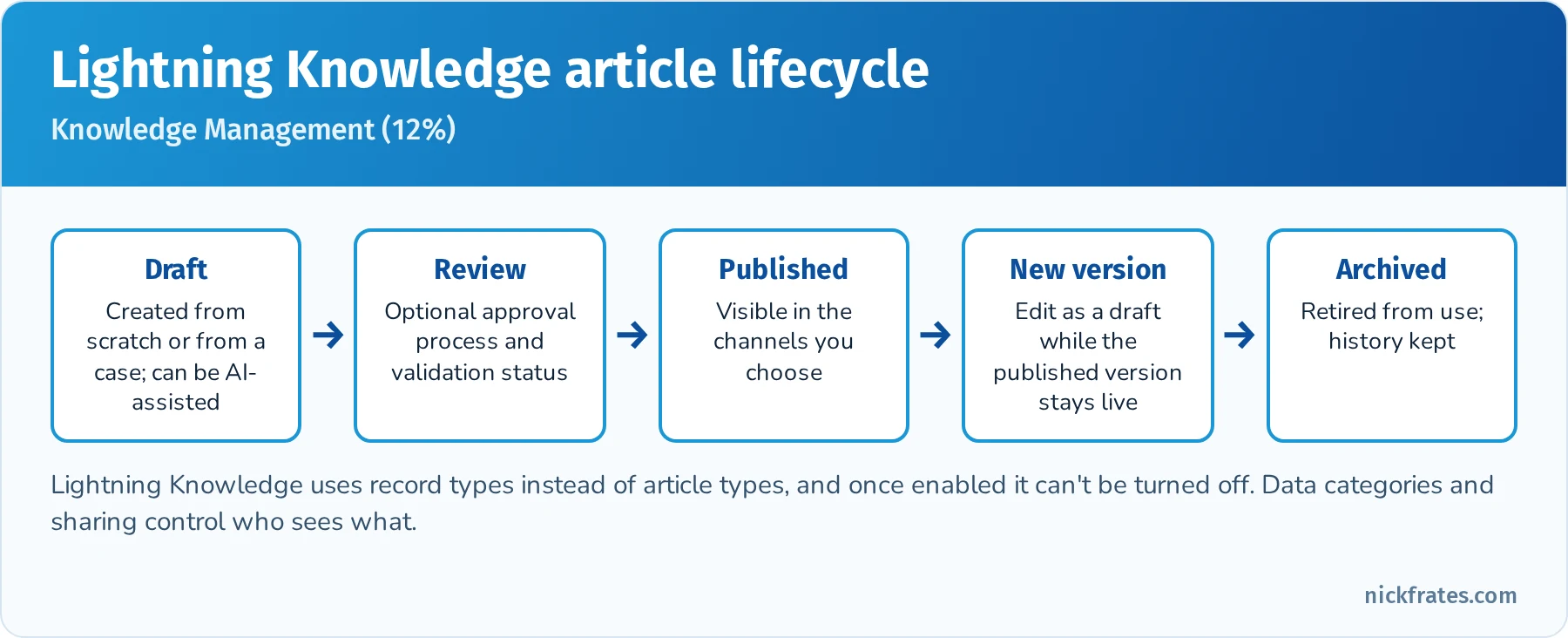
The article lifecycle the exam expects you to explain.
The article lifecycle
- Draft. Created from scratch, from a case (attach the new article to the case it solved), or drafted with AI using Einstein Knowledge Creation.
- Review and approval (optional). Approval processes and a validation status picklist (for example, Not Validated and Validated) let a team mark articles as reviewed before they're published externally.
- Published. Visible in the channels you selected. Published articles are what reps, customers and AI agents use.
- New version. To update a published article, create a new version. The draft version is edited while the published version stays live, then the new version replaces it on publish.
- Archived. Retired articles are archived, keeping history but removing them from use.
Also good to know: articles can be translated (in-house or through a vendor) for multilingual service, Knowledge Feedback collects article feedback from internal and external users, and newer features such as Knowledge Blocks (reusable content), Knowledge Similarity (find similar articles before creating duplicates) and Knowledge Maps (hierarchical navigation) help keep large knowledge bases clean.
Knowledge-Centered Service (KCS)
KCS is a methodology from the Consortium for Service Innovation: knowledge is created and improved as a by-product of solving cases, rather than by a separate writing team. Salesforce Service Cloud and Knowledge are KCS v6-Verified.
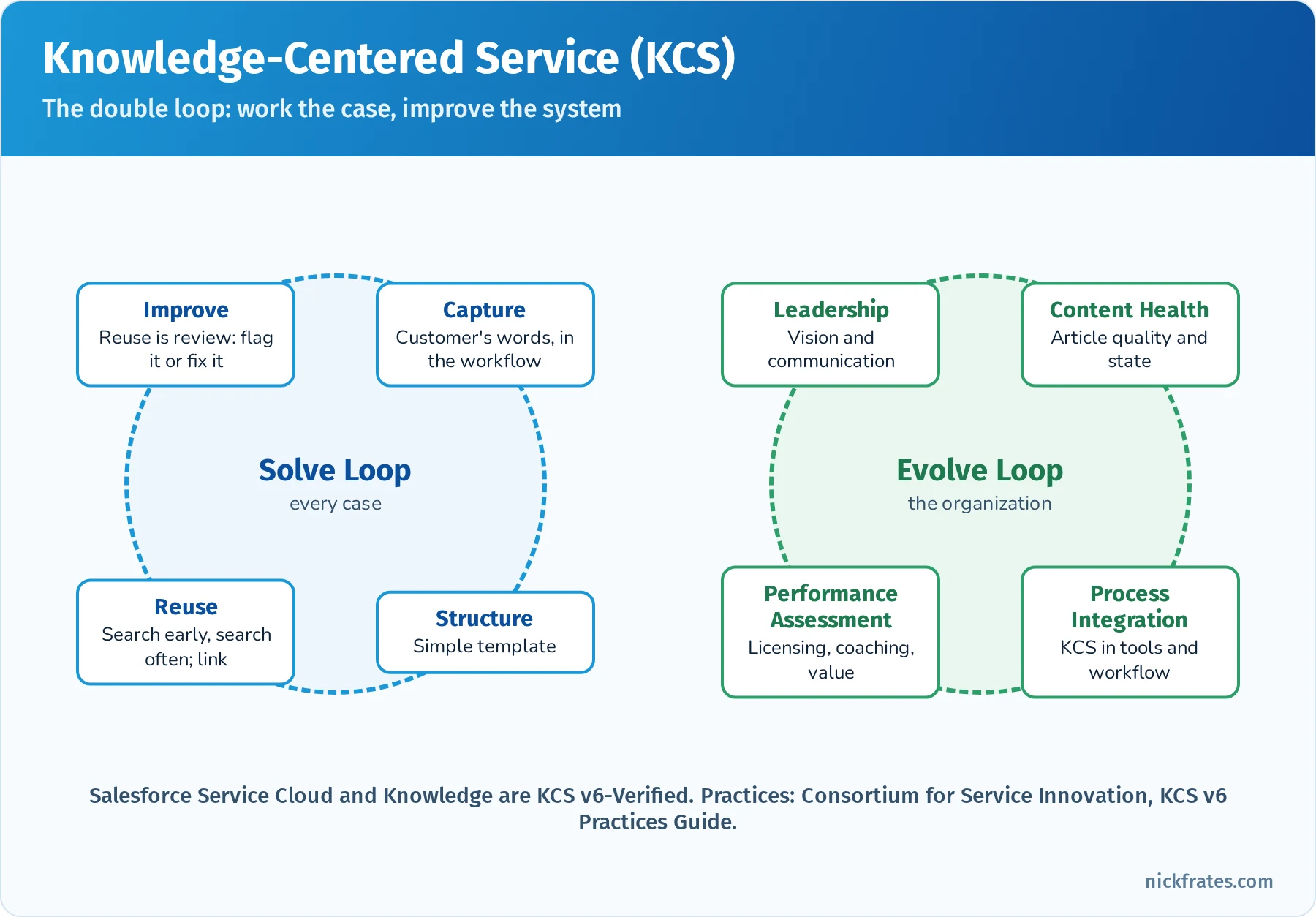
KCS turns every solved case into better knowledge.
The Solve Loop (every case):
- Capture the customer's context in their own words, in the workflow.
- Structure articles with a simple, consistent template.
- Reuse: search early, search often, and link the article to the case.
- Improve: reuse is review. If an article is wrong or unclear, flag it or fix it depending on your KCS license level.
The Evolve Loop (the organization): Content Health, Process Integration, Performance Assessment, and Leadership and Communication. This is where managers look across many cases to find patterns, improve content standards, fix root causes and recognize knowledge contributions.
How Salesforce supports KCS: case-to-article linking, creating articles from cases, article templates through record types and layouts, validation status to represent article confidence, permissions that mirror KCS licenses (who can publish vs. who can only draft or flag), and reports on article use and case links.
Configuring Knowledge for service and self-service
| Requirement | Configuration |
|---|---|
| Reps should see suggested articles while working a case | Knowledge component on the case record page; Einstein Article Recommendations suggests articles based on case details |
| Reps should attach the article they used | Attach articles to cases from the Knowledge component; track case-article links |
| Customers should find answers before opening a case | Publish to the customer channel; help center on Experience Cloud with search and a contact form that suggests articles |
| Partners should see partner-only articles | Publish to the partner channel and use data category visibility |
| Different regions need different articles | Data categories (for example, a Region group) with category visibility by role or permission set |
| Article quality must be reviewed before external publishing | Approval process and validation status |
| AI agents should answer from approved content | Ground the Agentforce Service agent in published Knowledge |
Practice questions: Knowledge Management
Question 23. A company wants different layouts and fields for FAQ articles and troubleshooting articles in Lightning Knowledge. What should the consultant use?
- A. Article types
- B. Record types on the Knowledge object
- C. Separate custom objects
- D. Data categories
Answer: B. Lightning Knowledge uses record types. Article types are the Classic Knowledge model.
Question 24. A rep finds a published article with an outdated step. The rep isn't authorized to publish. According to KCS, what should happen?
- A. Ignore the article
- B. Flag the article so a licensed author can fix it
- C. Delete the article
- D. Create a duplicate article with the correct step
Answer: B. "Flag it or fix it." If you're not licensed to fix it, flag it. Duplicates (D) make the knowledge base worse.
Question 25. European customers must see only EU-specific product articles on the help center, while reps see all articles. What's the best configuration?
- A. Separate Experience Cloud sites with copied articles
- B. A Region data category group, with category visibility for the site's users limited to EU, and internal users set to All
- C. A validation rule on Knowledge
- D. A separate Knowledge record type per region
Answer: B. Data categories plus category visibility control which articles each audience sees without duplicating content.
Question 26. A team must update a published article without taking the current version offline. What happens when they edit it?
- A. The published article is unpublished until the edit is done
- B. A new draft version is created and edited while the published version stays live, then published to replace it
- C. Edits are made directly to the live article
- D. The article must be archived first
Answer: B. Lightning Knowledge versions let you edit a draft while the published version stays available.
Question 27. An admin plans to enable Lightning Knowledge in a production org that uses several Classic article types. What should the consultant warn about?
- A. Lightning Knowledge can't be disabled once enabled, and multiple article types need to be consolidated through migration, so test in a sandbox first
- B. Nothing changes
- C. Lightning Knowledge can be turned off any time
- D. Data categories are deleted
Answer: A. It's a one-way switch, and article types become record types, so plan the migration carefully.
Question 28. Which two practices belong to the KCS Solve Loop? (Choose two.)
- A. Capture
- B. Performance Assessment
- C. Reuse
- D. Leadership and Communication
Answer: A and C. The Solve Loop practices are Capture, Structure, Reuse and Improve. Performance Assessment and Leadership and Communication are Evolve Loop practices.
Question 29. A support center needs four active data category groups (Product, Region, Audience and Release). What should the consultant know?
- A. Any number of groups can be active
- B. The default is 3 active data category groups; Salesforce Support can increase it to a maximum of 6
- C. Only one group can ever be active
- D. Data categories aren't used in Lightning Knowledge
Answer: B. Three active groups is the default limit, with an increase to six available through Support.
Intake and Interaction Channels (13%)
Five objectives: recommend the right approach to intake channels, discuss channel use cases, assess channel design considerations, recommend appropriate uses for AI agents in service, and explain agentic service capabilities and configuration.
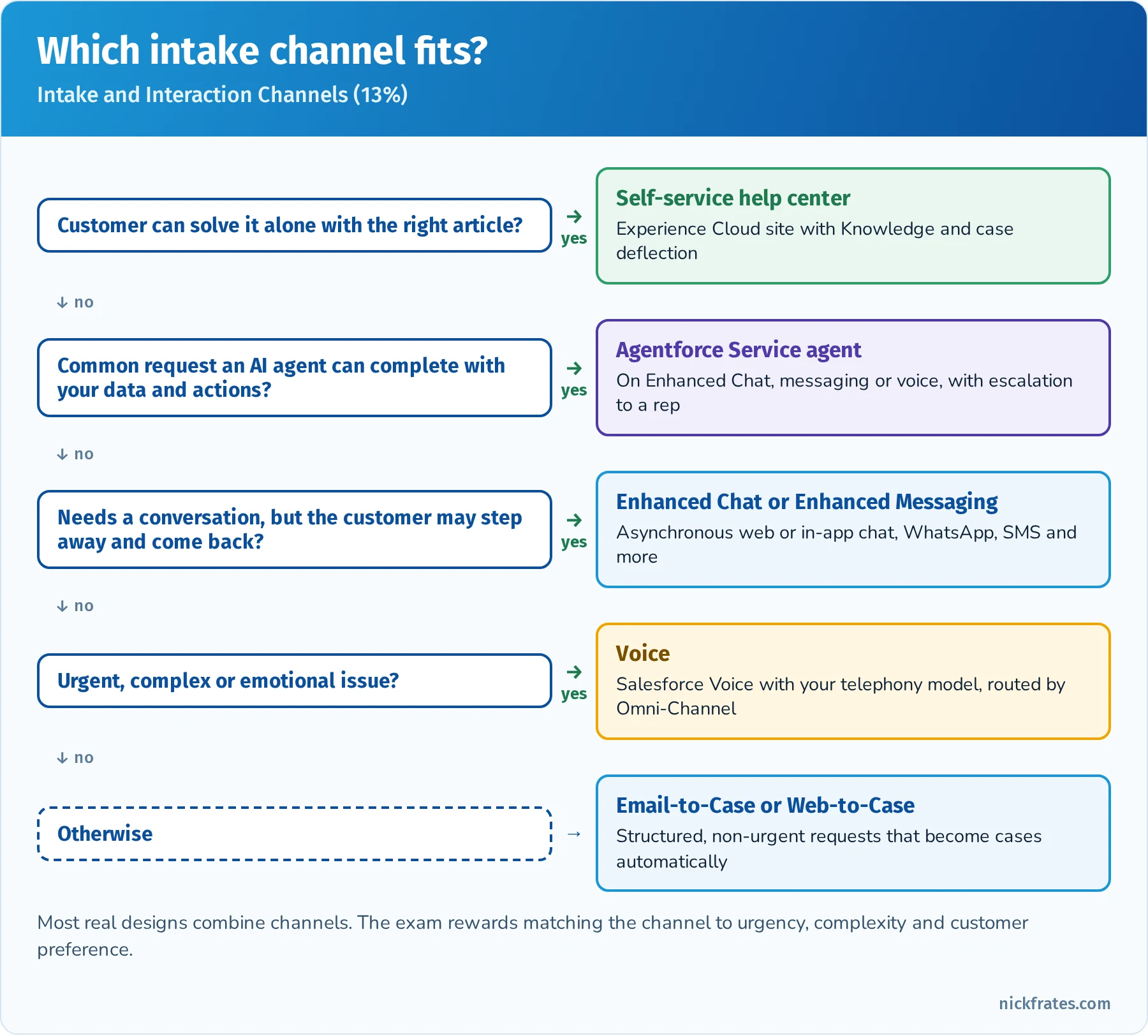
Match the channel to urgency, complexity and customer preference.
Email-to-Case and Web-to-Case
Email-to-Case turns customer emails into cases. On-Demand Email-to-Case runs as a Salesforce service, so email traffic stays outside your network's firewall. You set up routing addresses, and email threading makes sure replies attach to the same case so reps see the whole conversation in the case feed. Getting your email system's forwarding right matters, because forwarding problems are a common cause of broken threading.
Web-to-Case generates an HTML form for your website that creates cases. Things to know:
- It can capture up to 5,000 cases in a 24-hour period. Extra requests go into a pending queue shared with Web-to-Lead (up to 50,000 combined requests) and are submitted when the limit refreshes.
- reCAPTCHA verification is recommended to block spam; requests that fail it don't create cases.
- You set a default case origin and a default response template, which is used when no auto-response rule entry applies.
- Cases from Web-to-Case and Email-to-Case run through the active assignment rule and auto-response rule.
Pick Web-to-Case for a simple form on a public website. Pick an Experience Cloud contact form when you also want logged-in context, Knowledge suggestions before submission (deflection), and customers tracking their own cases.
Enhanced Chat and Enhanced Messaging
- Enhanced Chat (formerly Messaging for In-App and Web) provides web and in-app chat. Conversations are asynchronous by default, so customers can stop and resume without losing history and can continue across tabs and devices. It also supports synchronous conversations with a clear start and end, plus pre-chat forms, branding, user verification and push notifications.
- Legacy Chat was retired on February 14, 2026, so any design that uses legacy chat buttons and deployments is out of date.
- Enhanced Messaging channels include WhatsApp, Facebook Messenger, SMS, Apple Messages for Business and LINE, plus Bring Your Own Channel for other messaging platforms.
- Conversations become messaging session records and route through Omni-Channel, usually with an Omni-Channel flow.
- Reporting changes too: enhanced channels report on messaging sessions and related objects, not legacy chat transcripts.
Voice
Salesforce Voice (formerly Service Cloud Voice) brings phone calls into the Service Console with call controls, routing through Omni-Channel, real-time transcription and AI assistance. The telephony models are:
| Model (current name) | Formerly | Best for |
|---|---|---|
| Salesforce Voice with Amazon Connect (now grouped under Partner Contact Center) | Service Cloud Voice with Amazon Connect | Teams that want Salesforce to set up most of the Amazon Connect contact center |
| Salesforce Voice with Partner Telephony | Service Cloud Voice with Partner Telephony | Teams happy with an existing supported telephony provider |
| Salesforce Voice with Partner Telephony from Amazon Connect (bring your own) | Service Cloud Voice with Partner Telephony from Amazon Connect | Teams that already built their own Amazon Connect contact center |
| Native telephony (Agentforce Contact Center) | Salesforce Voice native telephony | Fast end-to-end setup with built-in telephony from Salesforce |
For the exam, focus on the trade-off: Voice gives an integrated rep experience (one console, transcripts, AI, unified routing and reporting), while a basic Open CTI integration with a third-party softphone may be enough when the client only needs click-to-dial and screen pops.
AI agents in the service process
The guide asks you to recommend appropriate uses for AI agents and explain agentic service capabilities. Here's how to think about it:
Good fits for an Agentforce Service agent:
- High-volume, well-defined requests: order status, return or exchange start, appointment changes, password and account help, warranty checks.
- Answering questions grounded in published Knowledge.
- Collecting information and creating a well-formed case before handing off.
Poor fits (or "human-required"): emotionally charged complaints, high-risk financial or medical decisions, complex troubleshooting with no documented path, and anything the client's policy says a person must approve.
How it works:
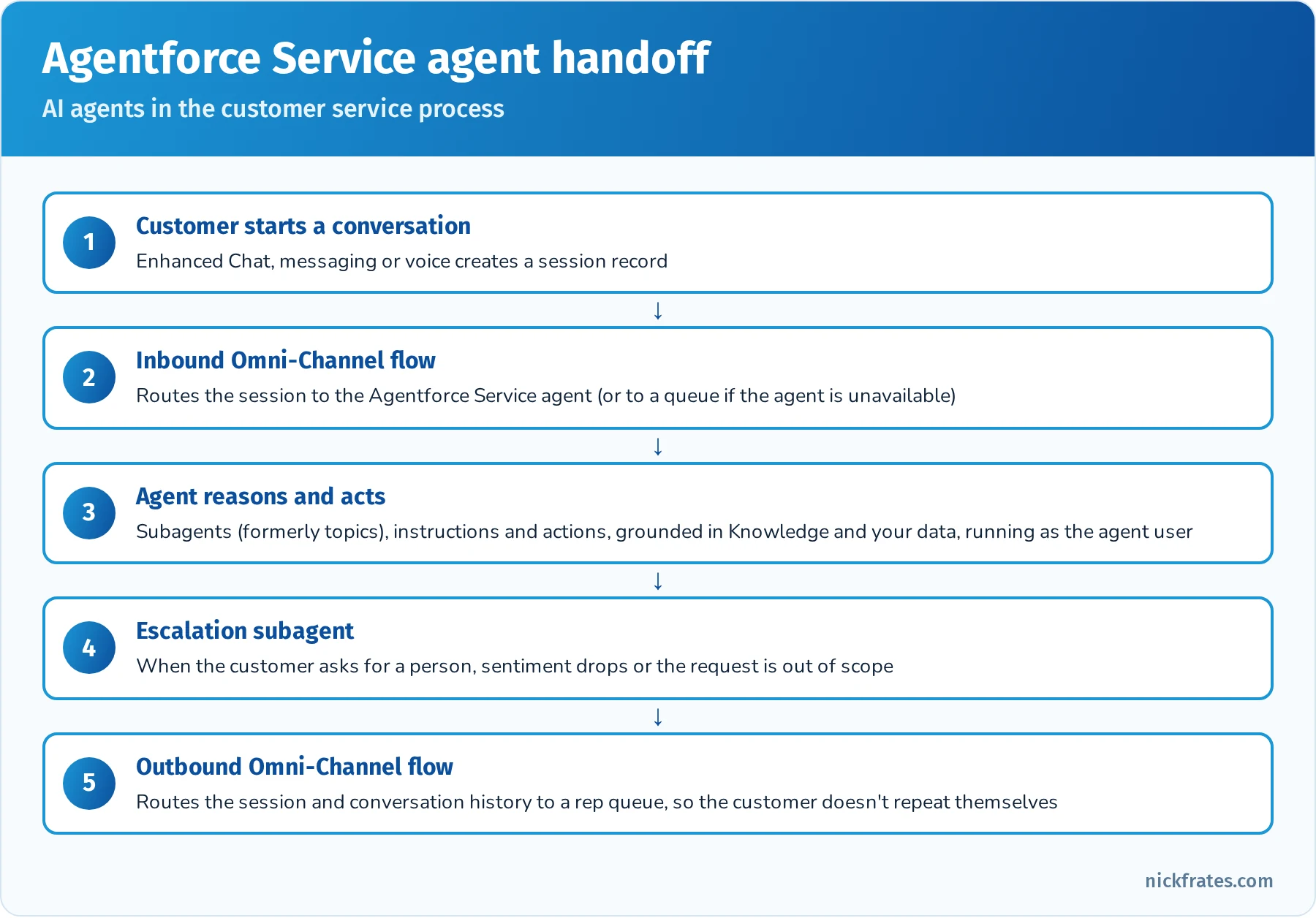
The agent handles what it can, then hands off with context.
- The customer starts a conversation on Enhanced Chat, an Enhanced Messaging channel or voice.
- An inbound Omni-Channel flow routes the messaging session to the Agentforce Service agent. If routing to the agent isn't possible, the flow can send it to a rep queue instead.
- The agent uses subagents (formerly called topics), each with instructions and actions (flows, Apex, prompt templates and standard actions), grounded in Knowledge and customer data. It runs as a dedicated agent user, so its permissions limit what it can access.
- When the customer asks for a person, sentiment turns negative or the request is out of scope, the Escalation subagent triggers an outbound Omni-Channel flow that routes the session and conversation history to a queue of service reps. If no rep is available, the agent resumes the conversation, and escalation is attempted once per session.
Other AI for Service features (availability depends on edition and add-ons):
| Feature | What it does |
|---|---|
| Einstein Case Classification | Recommends or fills case field values (such as reason or priority) based on past cases |
| Einstein Case Wrap-Up | Recommends case field values at the end of a chat or messaging conversation |
| Einstein Article Recommendations | Suggests relevant Knowledge articles on cases |
| Einstein Reply Recommendations | Suggests replies in chat and messaging |
| Einstein Service Replies | Generates grounded draft replies for reps |
| Einstein Work Summaries | Generates summaries of conversations for wrap-up |
| Einstein Knowledge Creation | Drafts Knowledge articles from case and conversation details |
| Einstein Bots (enhanced bots) | Rules-based conversational bots; still supported, but new designs usually start with Agentforce agents |
Practice questions: Intake and Interaction Channels
Question 30. A retailer's customers want to message support on WhatsApp and pick the conversation back up hours later. What should the consultant recommend?
- A. Legacy Chat
- B. Enhanced Messaging for WhatsApp, routed by Omni-Channel
- C. Web-to-Case
- D. Email-to-Case with a WhatsApp forwarding address
Answer: B. Enhanced Messaging supports WhatsApp and asynchronous conversations, and sessions route through Omni-Channel.
Question 31. A company still runs legacy chat buttons in 2026, and the web chat stopped working. What's the most likely cause and fix?
- A. Legacy Chat was retired on February 14, 2026; migrate to Enhanced Chat
- B. The chat button needs a new color
- C. Omni-Channel presence statuses expired
- D. Web-to-Case reached its daily limit
Answer: A. Legacy Chat was removed on that date. Enhanced Chat (formerly Messaging for In-App and Web) is the replacement, and Salesforce provides a migration tool and readiness report.
Question 32. A marketing site needs a simple support form that creates cases, and the client is worried about spam. What should the consultant configure?
- A. Web-to-Case with reCAPTCHA verification required
- B. Email-to-Case
- C. An Agentforce Service agent
- D. A public Chatter group
Answer: A. Web-to-Case with reCAPTCHA blocks spam submissions; requests that fail verification don't create cases.
Question 33. A popular product launch causes 7,000 Web-to-Case submissions in one day. What happens to the submissions beyond the daily limit?
- A. They're lost
- B. They go to a pending request queue and are submitted when the 24-hour limit refreshes, and the default case owner receives an email with the details
- C. They create leads instead
- D. They're converted to emails
Answer: B. Web-to-Case captures up to 5,000 cases in 24 hours; extra requests queue (up to 50,000 combined with Web-to-Lead) and process when the limit refreshes.
Question 34. Which request is the best candidate for an Agentforce Service agent?
- A. A customer disputing a large, unexplained charge who's threatening legal action
- B. "Where's my order?" for customers who are verified and have order data available through an action
- C. A complex outage requiring engineering diagnosis
- D. A bereavement-related account closure
Answer: B. It's high-volume, well-defined and backed by data the agent can retrieve. The others need human judgment and empathy.
Question 35. An Agentforce Service agent should hand off to a human when the customer asks for one, and the rep shouldn't need to ask the customer to repeat anything. What makes this work?
- A. An outbound Omni-Channel flow connected to the agent's escalation settings that routes the messaging session (with its conversation history) to a rep queue
- B. An email alert to the supervisor
- C. Web-to-Case
- D. A new page layout
Answer: A. The Escalation subagent triggers the outbound Omni-Channel flow, which routes the session and history to reps.
Question 36. A client already uses a supported cloud telephony provider and wants calls, transcripts and routing inside the Service Console. Which option fits?
- A. Salesforce Voice with Partner Telephony
- B. Legacy Chat
- C. Web-to-Case
- D. Enhanced Messaging for SMS
Answer: A. Partner telephony keeps the client's provider while giving reps the integrated Voice experience.
Question 37. Reps spend time typing notes after every messaging conversation. Which AI feature most directly reduces this work?
- A. Einstein Work Summaries
- B. Einstein Case Classification
- C. Data categories
- D. Escalation rules
Answer: A. Work summaries generate summaries of conversations for wrap-up, cutting after-conversation work.
Case Management (13%)
Four objectives: design a case management solution from creation to closure, explain how case deflection works in Experience Cloud sites, Agentforce and Knowledge, explain and configure entitlements, milestones, assets, business hours and SLAs, and differentiate the use cases of Agentforce Service automation.
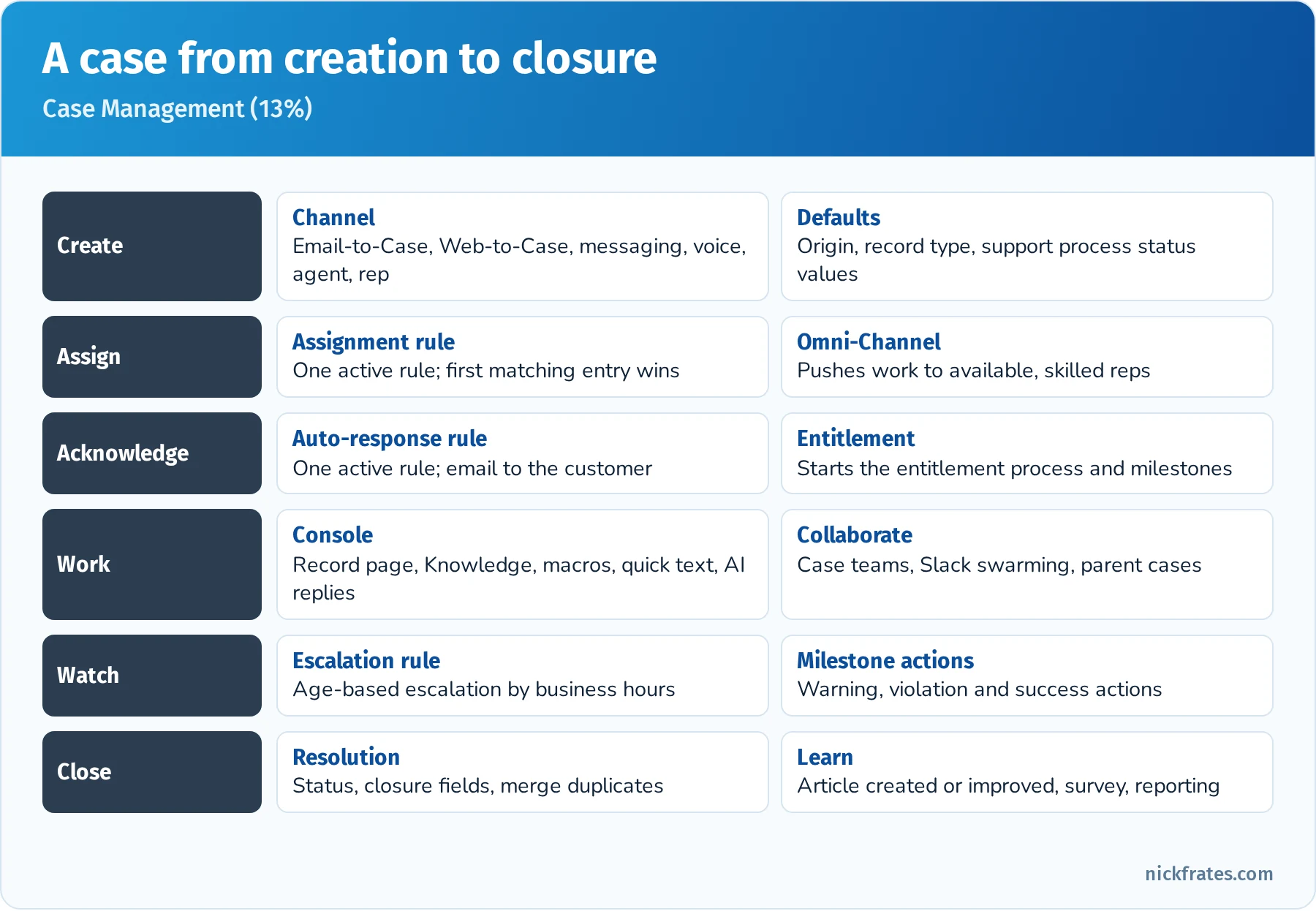
Know which tool does what at each stage.
Designing the case lifecycle
Record types and support processes. A support process defines which case Status values are available, and you assign it to a case record type. That's how a Technical Support record type can have statuses like Troubleshooting and Waiting on Engineering, while a Billing record type has Pending Refund.
Queues and ownership. A queue holds cases until a member takes ownership (pull) or Omni-Channel routes them (push). With a private case sharing model, queue membership is also how a team gets access to the cases in its queue.
Case automation rules (one active rule of each type):
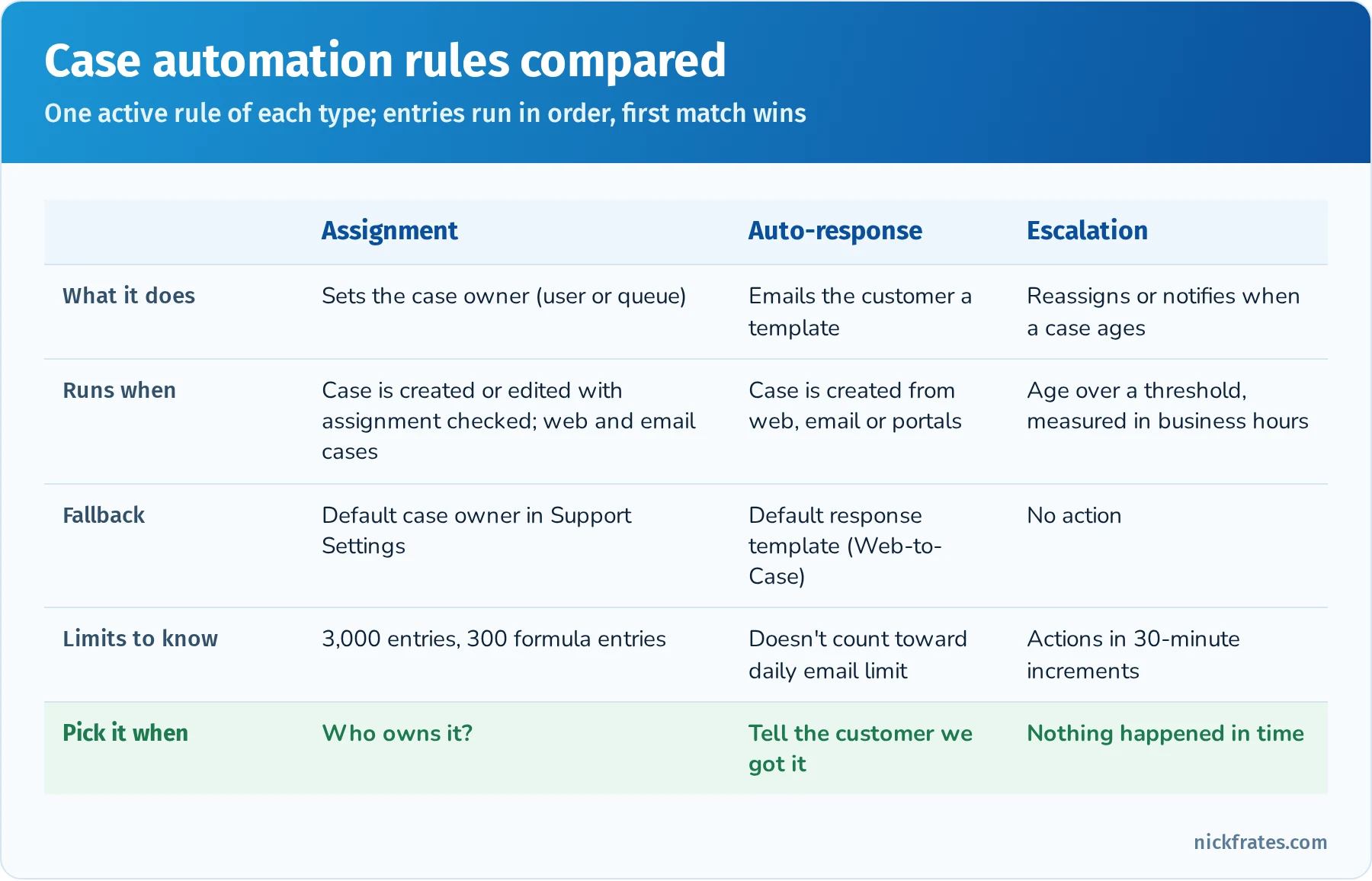
Who owns it, tell the customer, and nothing happened in time.
- Assignment rules. Only one case assignment rule can be active at a time. A rule can hold up to 3,000 rule entries, including 300 formula entries, evaluated in order. The first matching entry wins and evaluation stops. If nothing matches, the case goes to the default case owner set in Support Settings. Entries can also add predefined case teams and notify the new owner with an email template. Tip from Salesforce: end the rule with a catch-all entry that has no criteria.
- Auto-response rules. Send an email to the customer when a case is submitted through Web-to-Case, Email-to-Case, On-Demand Email-to-Case or a portal. One active case rule at a time; first matching entry wins. Emails from case auto-response rules don't count toward the daily outbound email limit.
- Escalation rules. Reassign cases and notify people when a case has been open (or unchanged) too long. Entries use business hours and an Age Over threshold, with escalation actions set in 30-minute increments. Activating a rule deactivates any other active escalation rule.
When to use Flow instead. Rules are simple and fast to configure. Flow handles logic the rules can't, such as updating related records, calling an Omni-Channel flow for routing, or complex branching. For the exam: use the standard rule when it meets the requirement, and use Flow for what rules can't do. (Workflow Rules and Process Builder are past end of support, so they're never the answer for new automation.)
Collaboration on cases.
- Case teams give a set of people defined roles and access on a case (for example, a product specialist with read/write access).
- Parent and child cases (case hierarchy) group related work, such as an umbrella case with child cases per site.
- Slack swarming brings experts together in a Slack channel to solve a case or incident quickly.
- Merge cases: reps can merge up to three duplicate cases into a master case in Lightning Experience. Related lists, feed items and child records move to the master. If the admin chose to delete duplicates, they go to the Recycle Bin (soft deleted for 15 days); otherwise "Merged" is added to their subject.
Closure. Define what "closed" means: required closure fields (resolution, root cause), a satisfaction survey, an article created or linked under KCS, and closed statuses mapped in the support process.
Case deflection
Deflection means customers solve their own issue without a rep. The exam objective names three places it happens:
- Experience Cloud sites: a help center with Knowledge search, topics and community answers. A Contact Support form paired with a Case Deflection component suggests articles and discussions as the customer types the subject, before the case is created. You measure the results with the Site Case Deflection Metrics reports and the Case Deflection dashboard.
- Agentforce: the Agentforce Service agent answers grounded questions and completes actions on channels like Enhanced Chat, deflecting work from reps (and handing off when it can't).
- Knowledge: well-structured, findable articles are the foundation of both. Bad articles mean failed deflection.
Measure deflection honestly. Track deflection signals, article views on the help center, and case volume per topic over time. A customer who reads an article and then calls anyway wasn't deflected.
Entitlements, milestones, assets, business hours and SLAs
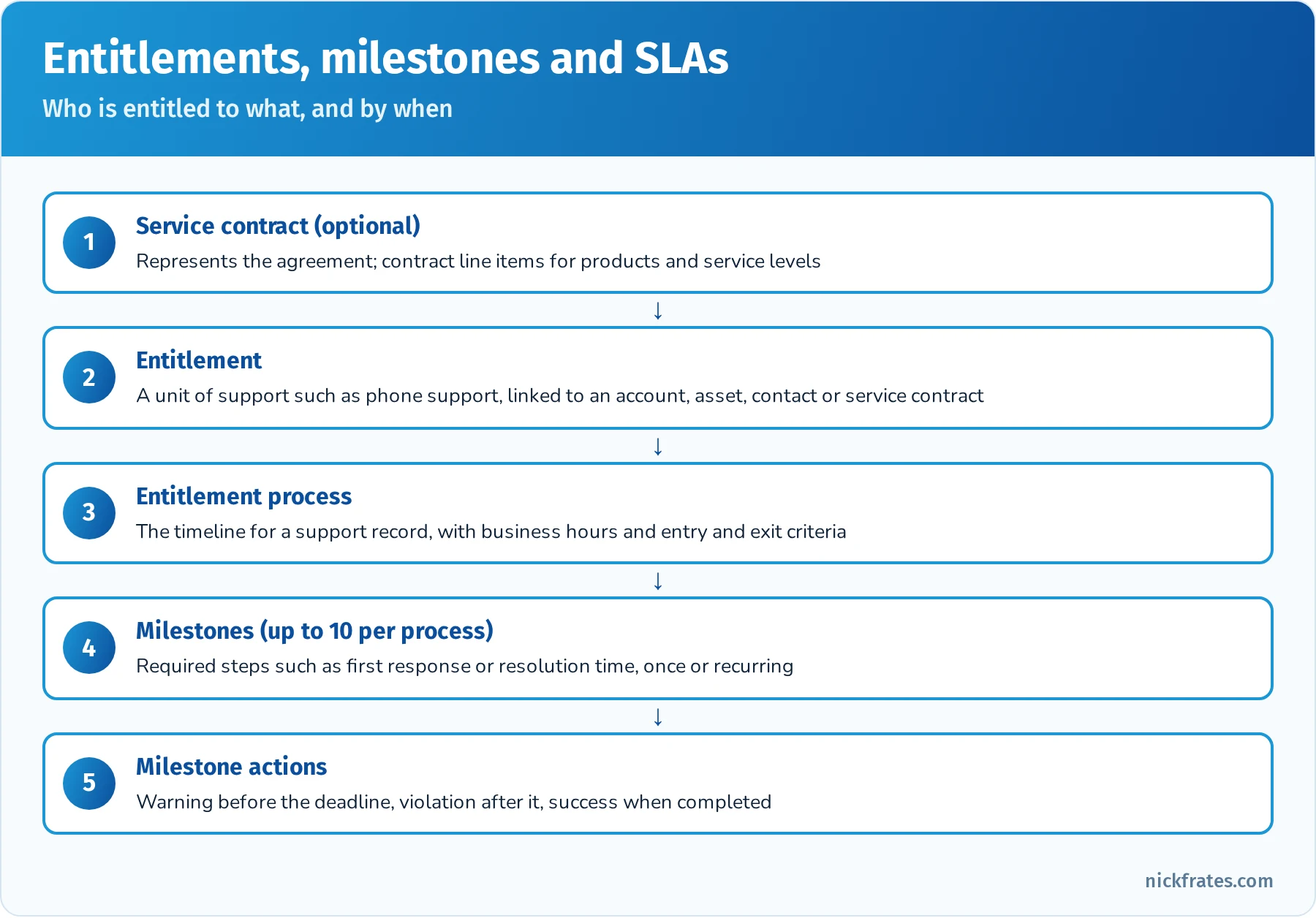
Entitlements answer "is this customer entitled?" and milestones answer "by when?"
Entitlements: terms to know
| Term | What it is |
|---|---|
| Entitlement | A unit of customer support, such as "phone support" or "web support," usually representing service agreement terms. Associated with accounts, assets, contacts and service contracts. |
| Service contract | A customer service agreement. Contract line items represent the specific products or services covered. Used for more complex SLAs with renewals and multiple service levels. |
| Asset | A specific product a customer owns (with serial number, install date and so on). Entitlements can be tied to assets for product-level support. |
| Entitlement process | A timeline of the steps (milestones) a support record must complete, with entry and exit criteria and business hours. Applies to cases and work orders. |
| Milestone | A required, time-dependent step such as first response or resolution time. An entitlement process can have up to 10 milestones. Each milestone has a recurrence type: No Recurrence (occurs once), Independent (occurs whenever its criteria are met) or Sequential (occurs on repeat whenever its criteria are met). |
| Milestone actions | Time-dependent actions: warning actions fire before a milestone is violated, violation actions fire when it's violated, and success actions fire when it's completed. Actions include tasks, email alerts, field updates and outbound messages. |
| Business hours | The hours your team works, plus holidays. Entitlement processes and milestones use them so SLA clocks don't run overnight or on holidays unless you want them to. |
| Milestone tracker | A component that shows reps upcoming, completed and overdue milestones with countdowns. |
Setup order (simplified): enable Entitlement Management, configure entitlement fields and related lists, set up milestones (and the milestone tracker), create the entitlement process with its milestones and actions, then create entitlements (or entitlement templates for products) and make sure cases get the right entitlement. Milestones can be auto-completed with a flow or an Apex trigger when case criteria are met.
A note on the "entitlement on contacts" gotcha: in Lightning Experience, the Entitlements related list isn't available on Contacts, even though entitlements can be associated with contacts through entitlement contacts.
Differentiating Agentforce Service automation
| Need | Best fit |
|---|---|
| Assign new cases by simple criteria | Case assignment rule |
| Push work to available reps with capacity and skills | Omni-Channel (queue- or skills-based routing, Omni-Channel flows) |
| Acknowledge new cases by email | Auto-response rule |
| Escalate aging cases | Escalation rule, or milestone warning and violation actions for SLA-based escalation |
| Multi-step logic, related record updates, integrations | Flow (record-triggered, screen, autolaunched), Omni-Channel flows for routing |
| Repetitive rep actions in one click | Macros |
| Classify incoming cases | Einstein Case Classification |
| Resolve common requests conversationally | Agentforce Service agent |
| Approvals (refunds over a threshold) | Approval process (or Flow-based approvals) |
Practice questions: Case Management
Question 38. A company sells Gold and Silver support. Gold customers need a first response within 1 business hour and resolution within 8 business hours. Supervisors want a warning 15 minutes before a Gold first response is late. What's the best design?
- A. Escalation rules only
- B. Entitlements with a Gold entitlement process using business hours, First Response and Resolution milestones, and a milestone warning action
- C. A custom object with a scheduled Apex job
- D. A formula field showing the case age
Answer: B. Entitlement processes with milestones and warning actions are built for tiered SLAs, and business hours keep the clock honest.
Question 39. Cases about hardware should go to the Hardware queue and everything else to the General queue. Hardware cases keep landing in General. The rule has entry 1 "Origin equals Web → General" and entry 2 "Type equals Hardware → Hardware." What's wrong?
- A. Assignment rules can't use the Type field
- B. Entries are evaluated in order and the first match wins, so web hardware cases match entry 1 first; reorder so the specific entry comes first
- C. Only one entry is allowed per rule
- D. The Hardware queue needs a routing configuration
Answer: B. First match wins. Put specific criteria before broad ones, and end with a catch-all.
Question 40. A rep finds three duplicate cases from the same customer about the same issue. What's the best standard approach?
- A. Close two of them as duplicates manually and copy the emails over
- B. Merge the cases (up to three) into one master case, keeping the related records
- C. Delete the duplicates
- D. Create a parent case and link all three as children
Answer: B. Case merge combines up to three cases and moves related lists, feed items and child records to the master.
Question 41. A company wants customers to see suggested articles while they type a support request on the help center, and wants to measure how many requests that prevents. What should the consultant configure?
- A. Web-to-Case on the corporate website
- B. A Contact Support form with the Case Deflection component on the Experience Cloud site, and report on deflection metrics
- C. An escalation rule
- D. Email-to-Case
Answer: B. The Case Deflection component suggests articles and discussions as customers type, and deflection signals can be reported.
Question 42. An entitlement process needs a "Customer Update" milestone that restarts every time the case returns to In Progress. What should the consultant configure?
- A. A milestone with a recurring recurrence type (instead of No Recurrence) and milestone criteria on the status
- B. Ten identical milestones
- C. An auto-response rule
- D. Another entitlement process
Answer: A. No Recurrence milestones happen once. Independent and Sequential milestones occur again whenever their criteria are met.
Question 43. The Technical Support team needs case statuses that Billing never uses. What's the standard way to deliver this?
- A. A validation rule that blocks some statuses
- B. Separate support processes assigned to separate case record types
- C. A custom status field
- D. Different queues
Answer: B. Support processes control the available case Status values per record type.
Question 44. Supervisors want to be alerted 30 minutes before a Resolution milestone is missed so they can step in. Which milestone action type should the consultant configure?
- A. Success action
- B. Warning action with a time trigger before the target
- C. Violation action
- D. Auto-response rule
Answer: B. Warning actions fire when a milestone is about to be violated. Violation actions fire when it's violated, and success actions fire when it's completed.
Question 45. Which two statements about case assignment rules are true? (Choose two.)
- A. Only one case assignment rule can be active at a time
- B. If no entry matches, the case remains unassigned with no owner
- C. Rule entries can add predefined case teams to the case
- D. A rule can contain only 10 entries
Answer: A and C. One active rule, and entries can add predefined case teams. If nothing matches, the case goes to the default case owner, and a rule can have up to 3,000 entries.
Contact Center Analytics (13%)
One objective, but it's worth 13%: given a scenario, develop reports and dashboards in Salesforce that give relevant information to different stakeholders. Expect questions about choosing the right report type and format, the right dashboard component and filters, and the right audience.
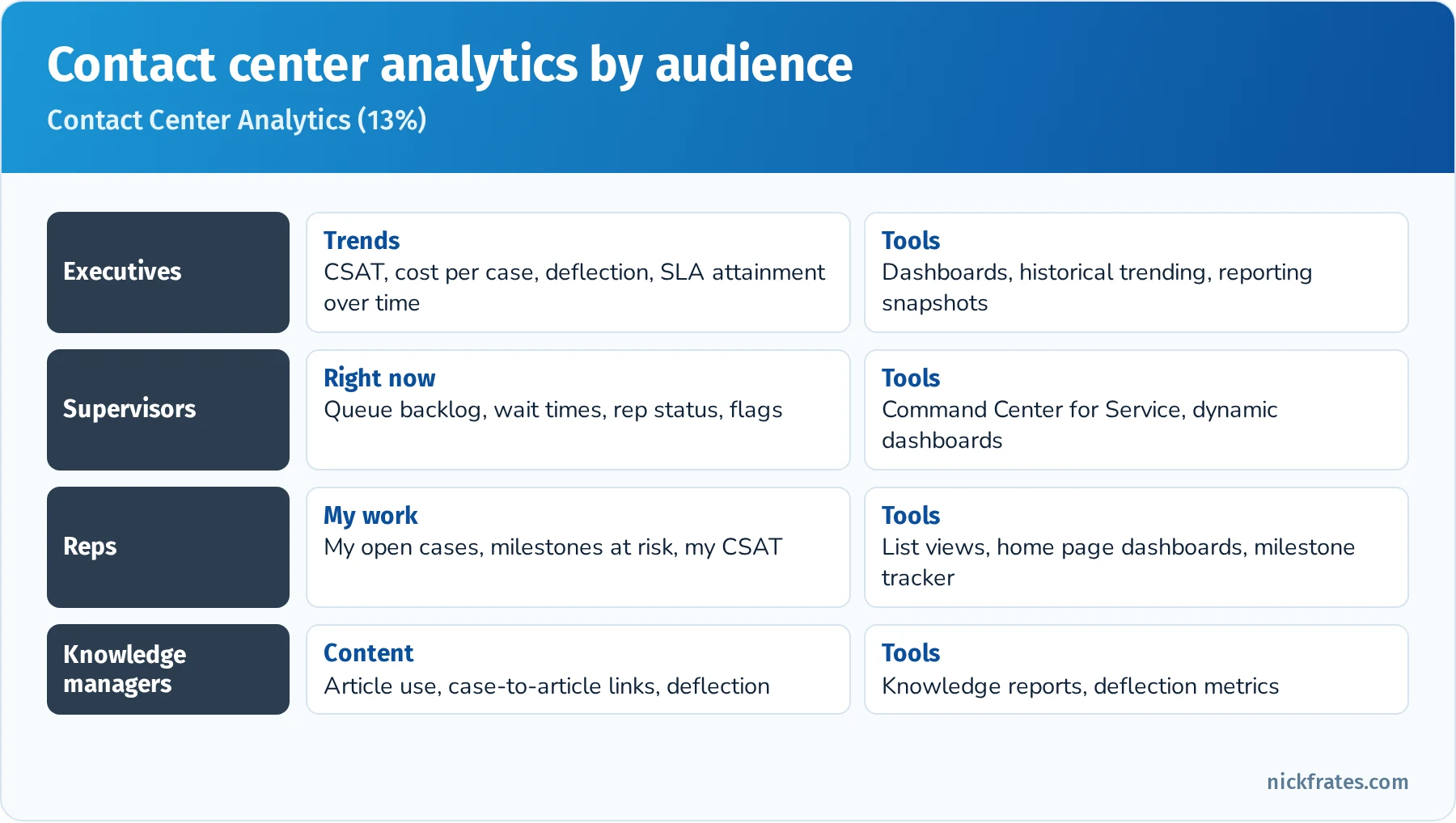
Start with the audience, then pick the metric and the tool.
Report building blocks (Admin refresher with a service lens):
- Report types decide which objects and fields you can report on. Standard ones include Cases, Cases with Milestones, Cases with Articles (case-article links) and many more. Create a custom report type when you need a specific object relationship (for example, cases with or without related records).
- Report formats: tabular (lists), summary (grouped with subtotals), matrix (grouped by rows and columns, such as cases by status and priority), joined (multiple report blocks side by side).
- Bucket fields group values without changing data (for example, case age buckets of 0–1 day, 2–3 days, 4+ days).
- Row-level and summary formulas compute values such as percentage of cases closed within SLA.
- Historical trend reporting and reporting snapshots let you analyze how data changed over time, such as daily backlog. Use reporting snapshots when you need to store point-in-time results in a custom object for trending.
- Report subscriptions email results on a schedule or when conditions are met.
Dashboards:
- Components: charts, gauges (great for SLA attainment against a target), metrics (one number), tables and Lightning tables.
- Dynamic dashboards run as the logged-in viewer, so each supervisor sees their own team's data with one dashboard.
- Dashboard filters let viewers change the view (by region, channel or product) without separate dashboards.
Metrics by stakeholder:
| Stakeholder | What they need | Typical tool |
|---|---|---|
| Executives | Trends: CSAT, cost per case, deflection, SLA attainment, volume by channel | Dashboards with historical trending, scheduled refresh |
| Supervisors | Live queue backlog, wait times, rep status, flags, milestones at risk | Command Center for Service, dynamic dashboards, list views |
| Reps | My open cases, milestones due today, my CSAT | Home page dashboard components, list views, milestone tracker |
| Knowledge managers | Article views and use, articles linked to cases, gaps (searches with no results), deflection | Knowledge reports, case-article reports, deflection metrics |
| Workforce planners | Volume by hour and channel, handle times, capacity | Reports on cases, messaging sessions and voice calls; AgentWork data |
Omni-Channel data. When work routes through Omni-Channel, AgentWork records track assignment, acceptance and handle time. With enhanced channels, messaging session data replaces legacy chat transcript reporting. Know that the objects behind your reports change when the channel changes.
Service Intelligence and AI analytics. Add-on analytics such as Service Intelligence and Einstein Conversation Mining (which analyzes conversation transcripts to find common reasons customers contact you) give deeper insight. Recognize them as options; the core exam focus is standard reports and dashboards.
Practice questions: Contact Center Analytics
Question 46. Each of 12 support managers needs to see a dashboard showing only their own team's cases, and the admin doesn't want to maintain 12 dashboards. What should the consultant recommend?
- A. 12 dashboards with different filters
- B. A dynamic dashboard that runs as the logged-in user
- C. A report subscription per manager
- D. A joined report
Answer: B. Dynamic dashboards show data based on the viewer's access, so one dashboard serves every manager.
Question 47. Leadership wants to see how the open case backlog changed each day over the last quarter. What's the best approach?
- A. A standard case report filtered to open cases
- B. A reporting snapshot that captures open case counts daily (or historical trend reporting where it fits)
- C. A list view
- D. A dashboard gauge
Answer: B. A normal report shows current data only. Reporting snapshots store point-in-time results for trending.
Question 48. A supervisor wants a single number showing the percentage of cases this month that met their resolution milestone, compared with a 95% target. Which dashboard component fits best?
- A. A gauge based on a report with a summary formula
- B. A table listing every case
- C. A donut chart by case origin
- D. A funnel chart
Answer: A. A gauge shows progress against a target, and a summary formula calculates the percentage.
Question 49. A Knowledge manager wants to know which articles are most often attached to cases. Which report type should they start with?
- A. Cases with Milestones
- B. A report type that includes case-article links (such as Cases with Articles)
- C. Opportunities
- D. Campaigns
Answer: B. Case-article link reporting shows how often articles are used to solve cases.
Question 50. Supervisors want real-time visibility into which reps are online, how much work each has, and which queues are backing up right now. What should they use?
- A. A weekly scheduled report
- B. Command Center for Service
- C. Reporting snapshots
- D. An email alert
Answer: B. Command Center for Service shows live rep and queue status. Reports and snapshots are better for trends.
Question 51. Case age needs to be grouped into 0–1 day, 2–3 days and 4+ days in a report without creating a new field. What should the admin use?
- A. A bucket field
- B. A validation rule
- C. A new formula field on Case
- D. A dashboard filter
Answer: A. Bucket fields group values in the report itself.
Integrations (10%)
One objective: explain the use cases and considerations for core Agentforce Service integrations, including third-party solutions and connections to external sources of data.
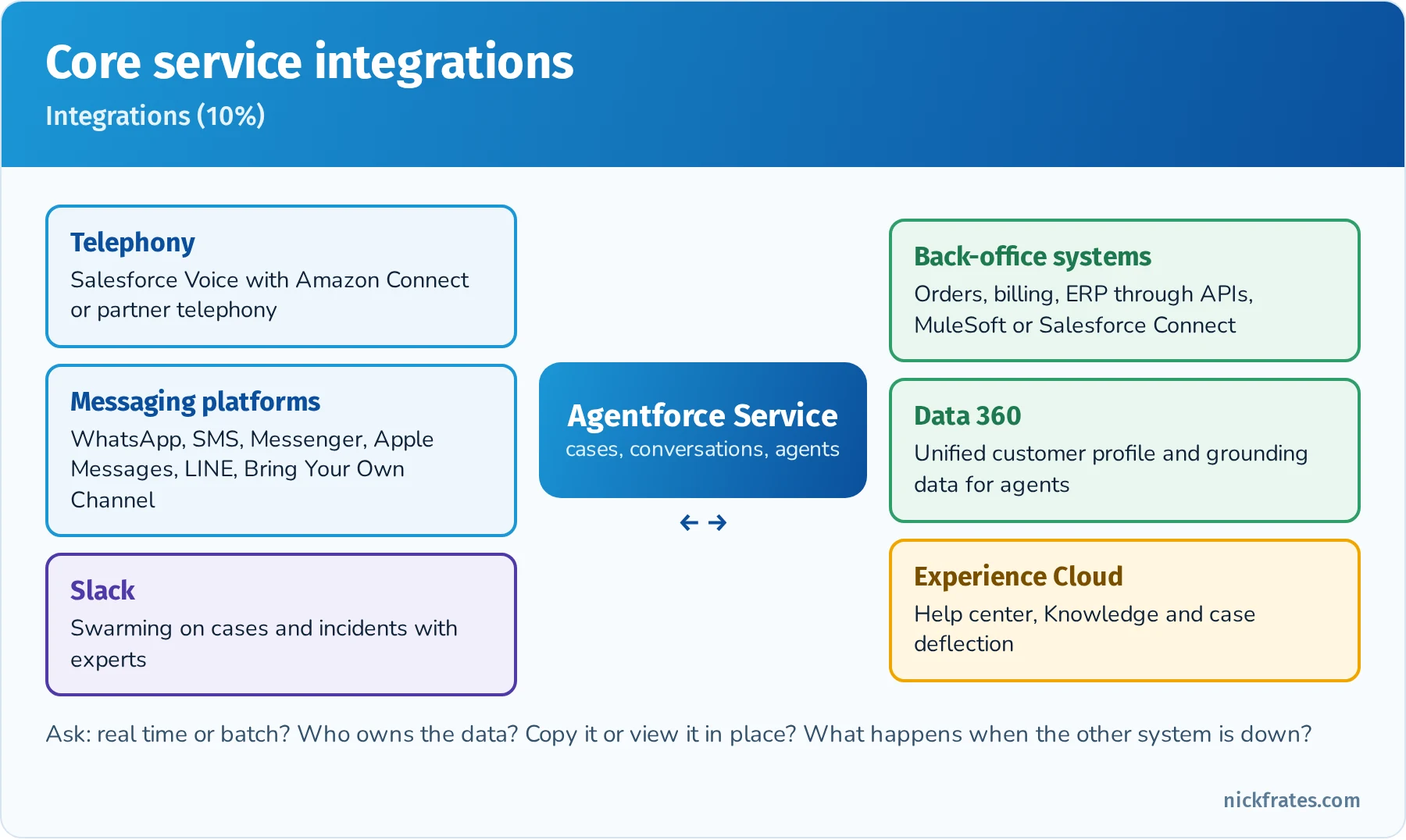
Ask how fresh the data must be, who owns it and what happens when a system is down.
Common service integration patterns:
| Integration | Use case | Key considerations |
|---|---|---|
| Telephony (Salesforce Voice, Open CTI) | Calls in the console, screen pops, transcripts, routing | Voice gives the deepest integration; Open CTI connects a third-party softphone for click-to-dial and screen pops; licensing and provider support |
| Messaging platforms | WhatsApp, SMS, Messenger, Apple Messages, LINE; Bring Your Own Channel for others | Channel-specific rules (opt-in, templates for proactive messages), routing through Omni-Channel |
| Back-office systems (ERP, order management, billing) | Show order and invoice status on the case; let reps and agents act on orders | Real-time callouts vs. batch sync; Salesforce Connect (external objects) to view data in place without copying; middleware such as MuleSoft for orchestration |
| Data 360 | Unified customer profile, engagement history and grounding data for AI agents | Identity resolution quality; what data the agent can access |
| Slack | Swarming, expert finding, case notifications | Which cases warrant a swarm; channel hygiene |
| Experience Cloud | Help center, customer case tracking, Knowledge, deflection | External user licenses, sharing for external users |
| Field service | Dispatch technicians from cases (work orders, service appointments) | Field Service licensing and scheduling; this has its own certification |
| Agentforce actions | Let an AI agent check an order, start a return or update an address | Actions built on flows, Apex or APIs; agent user permissions; error handling and escalation |
How to choose:
- Copy the data or view it in place? If reps only need to see a record that lives in another system, and it changes often, viewing it in place with Salesforce Connect avoids storing and syncing copies. If you need to report on it, automate on it or use it offline, a copy (synced by integration) may be better.
- Real time or batch? Order status during a chat needs real time. Nightly product catalog updates can be batch.
- Which direction? Does Salesforce read, write, or both? Who's the system of record?
- What happens on failure? Timeouts, retries and a fallback message so the rep (or the AI agent) isn't stuck.
- Security: named credentials for authentication, integration users with least privilege, and no sensitive data where it isn't needed.
Standard before custom applies here too. If an AppExchange connector or a standard feature (Salesforce Voice, Enhanced Messaging, Salesforce Connect) meets the need, it beats a custom integration on cost and maintenance.
Practice questions: Integrations
Question 52. Reps need to see a customer's current invoices from an ERP system on the case page. Invoices change constantly and must not be stored in Salesforce. What should the consultant recommend?
- A. A nightly batch copy into a custom object
- B. Salesforce Connect with external objects to view the invoice data in place
- C. Ask customers to email invoices
- D. Web-to-Case
Answer: B. External objects show the data in real time without copying it into Salesforce.
Question 53. A company wants agents to click a phone number to dial, and a screen pop of the caller's contact record, using its existing third-party softphone. Budget is limited and transcription isn't needed. What's the simplest fit?
- A. An Open CTI integration with the existing softphone
- B. Build a custom telephony system
- C. Enhanced Messaging for SMS
- D. Legacy Chat
Answer: A. Open CTI integrates a third-party softphone for click-to-dial and screen pops. Salesforce Voice adds deeper capabilities, such as transcripts and AI, when those are needed.
Question 54. An Agentforce Service agent must check order status in an external order management system. What's required?
- A. An action (for example, a flow or Apex that calls the system through a named credential) assigned to the agent's subagent, with the agent user permitted to run it
- B. A new email template
- C. A data category
- D. A case escalation rule
Answer: A. Agents act through actions, and the actions call external systems securely. The agent user's permissions must allow it.
Question 55. A field technician must be dispatched when a case can't be solved remotely. Which integration area does this point to?
- A. Field service (work orders and service appointments created from the case)
- B. Knowledge
- C. Web-to-Case
- D. Data categories
Answer: A. Field service work orders and service appointments handle onsite work generated from cases.
Question 56. A client wants an AI agent to use a unified profile combining web behavior, purchases and loyalty data from several systems. Which product is designed for this?
- A. Data 360
- B. Email-to-Case
- C. Macros
- D. Case teams
Answer: A. Data 360 unifies data from multiple sources into profiles that Agentforce can use for grounding.
Worked example: designing service for a growing company
Consultant exam scenarios are easier once you've walked through a whole design yourself. Here's a fictional company, end to end. Every choice maps back to an exam objective.
The client. Peak Gear is an outdoor equipment retailer with 120 service reps in two regions. Customers reach them by phone, email and a website form. Leadership wants faster responses for premium members, less repetitive work for reps, and an AI agent on the website and WhatsApp. They currently track cases in a shared inbox and a spreadsheet.
Step 1: Discover (Industry Knowledge, Implementation Strategies). Interview stakeholders, map the current journey, and agree on KPIs: first contact resolution, average handle time, CSAT and SLA attainment for premium members. Capture today's baseline numbers so you can prove improvement later. Pick a phased rollout: core case management and Email-to-Case first, then Knowledge and the help center, then Messaging and the Agentforce Service agent.
Step 2: Model cases (Case Management). Two case record types (Product Support and Orders) with their own support processes. Required closure fields for resolution and root cause. Queues for each region and team, with a private case sharing model so teams see their own work.
Step 3: Intake (Intake and Interaction Channels). Email-to-Case for the support address, with threading so customer replies land on the same case. Web-to-Case replaced by a Contact Support form on an Experience Cloud help center, so customers see suggested articles before submitting. Auto-response rules acknowledge new cases with a case number.
Step 4: Route (Solution Design). Enhanced Omni-Channel with skills-based routing: product line and language as skills, with skill levels for complex products. Status-based capacity so each rep's workload reflects the work they actually have open. Routing priority puts Orders cases from the checkout flow ahead of general questions.
Step 5: Promise and protect (Case Management). Entitlements for premium members with an entitlement process using regional business hours, First Response and Resolution milestones, warning actions that alert supervisors, and violation actions that escalate.
Step 6: Knowledge (Knowledge Management). Lightning Knowledge with record types for How-To and Troubleshooting, data categories by product line, and KCS practices: reps search first, link articles to cases and create articles in the workflow. Article quality reviews by trained KCS coaches.
Step 7: AI (Solution Design, Channels). An Agentforce Service agent on Enhanced Chat and WhatsApp, grounded in published Knowledge, with actions to check order status and start returns. The Escalation subagent hands customers to reps through Omni-Channel when they ask for a person or the request is out of scope. Reps get AI help with reply recommendations, work summaries and Knowledge suggestions.
Step 8: Measure (Contact Center Analytics). Dynamic dashboards for regional managers, Command Center for Service for live supervision, reporting snapshots for backlog trends, and case-article reports plus deflection metrics for the Knowledge team.
Step 9: Connect (Integrations). Order data stays in the order management system and appears on cases through an integration (Salesforce Connect if reps only need to view it, or API-based actions if the agent needs to change it). Salesforce Voice replaces the old phone system in the second phase.
Step 10: Adopt and improve. Train reps on the console, macros and KCS. Review KPIs after each phase and tune routing, articles and agent instructions.
Design decisions at a glance
| If the scenario says... | Lean toward... | Not... |
|---|---|---|
| "Route to the rep with the right language and product expertise" | Skills-based routing | Queue-based routing with dozens of queues |
| "Reps get too much work at once" | Capacity models (status-based in Enhanced Omni-Channel) and routing configuration sizes | Manual assignment |
| "Different SLAs for premium customers" | Entitlements, entitlement processes and milestones | Escalation rules alone |
| "Same steps over and over in the console" | Macros (and quick text for repeated phrases) | Custom Apex |
| "Customers should help themselves" | Experience Cloud help center, Knowledge, Case Deflection, Agentforce Service agent | More reps |
| "Answers must be consistent and reusable" | Lightning Knowledge with KCS practices | Shared documents |
| "Show external data without copying it" | Salesforce Connect external objects | Nightly batch import |
| "Each manager sees their own team" | Dynamic dashboard | One dashboard per manager |
| "Experts must collaborate quickly on a complex issue" | Slack swarming, case teams | Long email chains |
| "Many customers affected by one outage" | Incident Management with related cases | Hundreds of unlinked cases |
| "AI agent must always verify identity before an order change" | Deterministic flow or action logic, not just instructions | Hoping the model remembers |
| "Old chat or old Omni setup" | Enhanced Chat (Messaging for In-App and Web) and Enhanced Omni-Channel | Legacy Chat, which retired Feb 14, 2026 |
Hands-on checklist
You can do almost all of this in a free Developer Edition org or Trailhead Playground. Hands-on time is the best preparation for scenario questions, and it's also the honest way to practice. More on that in the FAQ.
- Create two case record types with separate support processes, and confirm reps see different status values.
- Build a case assignment rule with three entries and a catch-all, then test with sample cases. Set the default case owner.
- Create an auto-response rule with an email template.
- Configure an escalation rule with business hours, and watch when it fires.
- Set up Email-to-Case (On-Demand), send yourself a test email, then reply to check threading.
- Set up Web-to-Case or a Contact Support form with the Case Deflection component on an Experience Cloud site.
- Enable Lightning Knowledge. Create two article record types, a data category group and an article, then publish it and attach it to a case.
- Enable Omni-Channel. Create a service channel, a routing configuration, a queue and a presence status, and route cases to yourself. Then try skills-based routing.
- Enable Entitlement Management. Build an entitlement process with two milestones and warning and violation actions, then apply it to a case.
- Create two macros, including one that updates the status and sends an email.
- Build a case report with a bucket field, a summary formula and a chart, and a dynamic dashboard.
- Complete the Agentforce Service agent setup trails on Trailhead, including connecting it to a messaging channel with an escalation path.
Common exam traps
- "Best" means standard first. If a standard feature meets the requirement, it beats custom code or a heavy integration.
- Old names vs. new names. Service Cloud Voice is now Salesforce Voice, Messaging for In-App and Web is now Enhanced Chat, Omni Supervisor features live in Command Center for Service, and Agentforce topics are now subagents. Questions may use either name.
- Rules have limits. One active rule per type, first matching entry wins, and the default case owner catches what's left.
- Escalation rules vs. milestones. Escalation rules handle "case is too old." Entitlements and milestones handle "promised response times by customer tier."
- Routing isn't reapplied. Omni-Channel doesn't re-route a work item just because a field changed after routing. Plan for re-routing explicitly.
- Skills must all match. In skills-based routing, a rep needs every required skill (at or above the level) to receive the work.
- Knowledge visibility has layers. Channels, data category visibility and sharing all affect who sees an article.
- KCS is a practice, not a feature. Reps capture and improve knowledge while solving cases; it isn't a separate team writing articles later.
- AI agents need permissions and escalation. An agent that can't act usually lacks an action or the agent user lacks access. Every customer-facing agent needs a path to a human.
- Reports show "now." For trends over time, use historical trending or reporting snapshots.
Flashcard terms
- Agentforce Service: the new name for Service Cloud's service capabilities, including AI agents.
- Support process: the set of case Status values available to a case record type.
- Default case owner: the user or queue that gets cases no assignment rule entry matches.
- Case assignment rule: assigns case owners; one active rule, up to 3,000 entries, first match wins.
- Auto-response rule: sends an acknowledgment email based on case criteria.
- Escalation rule: reassigns or notifies when cases age past a threshold within business hours.
- Case team: people with defined roles and access working together on a case.
- Email-to-Case: turns emails into cases. On-Demand Email-to-Case processes email in Salesforce, without an agent behind your firewall.
- Web-to-Case: turns website form submissions into cases, up to 5,000 per 24 hours.
- Entitlement: a unit of support a customer is eligible for.
- Entitlement process: a timeline of milestones with business hours.
- Milestone: a required, time-dependent step (once, independent or sequential recurrence).
- Milestone actions: warning, violation and success actions.
- Omni-Channel: routes work to reps and agents based on availability, capacity and skills.
- Service channel: turns an object (like Case or Messaging Session) into routable work.
- Routing configuration: sets routing model, priority and work item size for queues.
- Presence status: tells Omni-Channel whether a rep is available for which channels.
- Capacity model: tab-based (open tabs) or status-based (work item status).
- Skills-based routing: routes to reps who have all required skills.
- Command Center for Service: supervisor workspace for live monitoring and intervention.
- Lightning Knowledge: knowledge base built on record types and standard Salesforce security.
- Data categories: classify articles and control article visibility.
- KCS: Knowledge-Centered Service, a methodology for capturing and improving knowledge in the flow of work.
- Enhanced Chat: web and in-app messaging (formerly Messaging for In-App and Web).
- Salesforce Voice: native telephony integration (formerly Service Cloud Voice).
- Open CTI: API for connecting third-party telephony to Salesforce.
- Macro: a set of instructions that performs repetitive console actions in one click.
- Agentforce Service agent: an AI agent that resolves customer requests and escalates to reps.
- Escalation subagent: transfers a conversation to a human through Omni-Channel.
- Salesforce Connect: shows external data in Salesforce as external objects without copying it.
- Dynamic dashboard: shows data based on the logged-in viewer's access.
- Reporting snapshot: stores report results at scheduled times for trend reporting.
Mixed practice exam: 4 final questions
These mix sections the way the real exam does. If you've done all 56 questions above, these get you to 60.
Question 57. A client has four regional teams, each with its own case queue. Supervisors complain that reps cherry-pick easy cases from the queue, and premium customers wait. What should the consultant recommend first?
- A. Omni-Channel to push work to reps based on availability and capacity, with routing priority for premium cases
- B. More list views
- C. A daily email listing waiting cases
- D. Remove queue access entirely
Answer: A. Push routing removes cherry-picking, and routing priority puts important work first.
Question 58. During discovery, a client says, "We want to cut costs by deflecting 20% of cases." What's the best next consultant action?
- A. Immediately buy more licenses
- B. Establish the current baseline (volume by topic, current self-service rate, top contact reasons) so the goal can be measured and the right deflection tools chosen
- C. Turn off phone support
- D. Write 500 articles before analyzing anything
Answer: B. You can't prove deflection without a baseline, and the contact reasons tell you which articles and AI agent topics will matter most.
Question 59. An AI agent on WhatsApp should hand customers to a human when they ask for one, but customers say they get stuck in a loop. What should the consultant check?
- A. That the Escalation subagent is active and the Omni-Channel flow routes to a queue with available reps, and what happens when nobody is available
- B. The case page layout
- C. Report folder sharing
- D. The Web-to-Case limit
Answer: A. Escalation needs the subagent and a working route to humans. If no reps are available, the agent resumes the conversation, so plan the experience for that moment.
Question 60. Which two practices are part of KCS? (Choose two.)
- A. Search the knowledge base early in the case, and reuse and improve articles as you solve ("reuse is review")
- B. Write articles only after the quarter ends
- C. Capture knowledge in the customer's context while solving the issue
- D. Let only one specialist edit articles
Answer: A and C. KCS captures knowledge in the workflow and improves it through reuse. Batch writing and single-editor bottlenecks go against the methodology.
Quick-reference cheat sheet
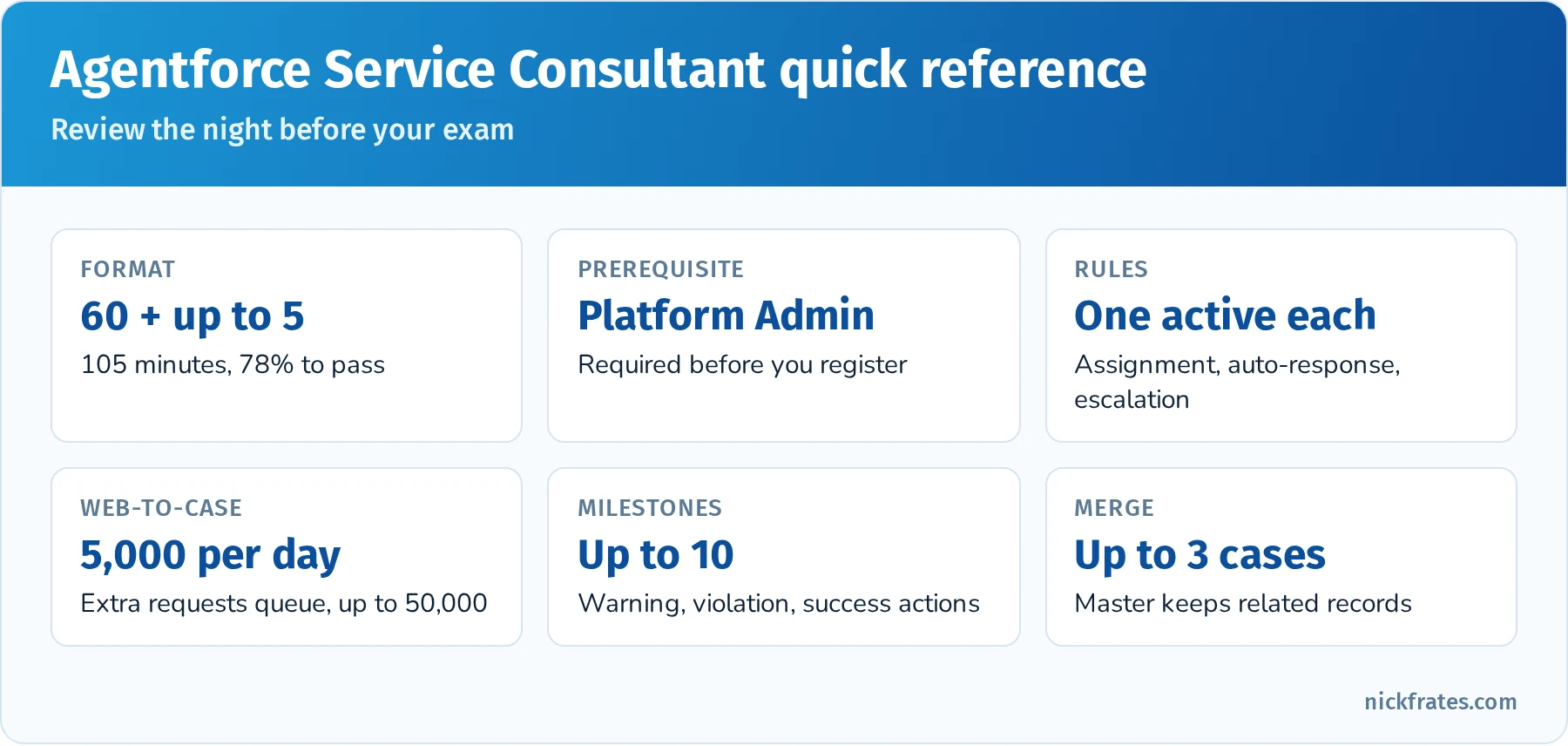
Save it and review it the night before.
| Topic | Remember |
|---|---|
| Passing score | 78% of 60 scored questions (about 47 correct) in 105 minutes |
| Prerequisite | Platform Administrator certification |
| Largest section | Agentforce Service Solution Design 15%; the rest are 10–13% |
| Case rules | One active rule per type, first match wins, default case owner catches the rest |
| Assignment rule limits | 3,000 entries, including 300 formula entries |
| Web-to-Case | 5,000 cases per 24 hours |
| Merge | Up to 3 cases into a master |
| Omni-Channel | Service channel, routing configuration, queue or skills, presence status, capacity |
| Routing models | Least Active or Most Available |
| Capacity | Tab-based or status-based; Enhanced Omni-Channel is the standard |
| SLAs | Entitlements, entitlement processes (up to 10 milestones), business hours, warning/violation/success actions |
| Knowledge | Lightning Knowledge, record types, data categories, channels, KCS |
| Channels | Email-to-Case, Web-to-Case, Enhanced Chat, Enhanced Messaging, Salesforce Voice |
| Legacy | Legacy Chat retired Feb 14, 2026; Standard Omni-Channel upgrades to Enhanced |
| AI | Agentforce Service agent, Escalation subagent, Einstein features for reps |
| Analytics | Dynamic dashboards, reporting snapshots, Command Center for Service |
| Integrations | Salesforce Voice or Open CTI, Salesforce Connect, APIs and MuleSoft, Data 360, Slack |
Frequently asked questions
Is Agentforce Service Consultant the same as Service Cloud Consultant? Yes. Salesforce renamed Service Cloud Consultant to Agentforce Service Consultant as part of the certification renames effective July 24, 2026. The exam code is Service-Con-201, and the old exam guide link redirects to the new one.
How much does the exam cost? $200 USD to register and $100 USD to retake, plus applicable taxes (JPY 30,000 and JPY 15,000 in Japan).
What's the passing score? 78%. With 60 scored questions, that's about 47 correct answers. There are also up to five unscored questions that don't count.
Are there prerequisites? Yes. You must hold the Salesforce Certified Platform Administrator credential. If you don't have it yet, start with my Salesforce Administrator study guide.
How hard is it? It's one of the tougher consultant exams because the 78% passing score leaves less room for error than most. The exam guide says candidates typically have two to five years of experience implementing service solutions. If you've built cases, Omni-Channel, Knowledge and entitlements by hand, the scenarios get much easier.
How long should I study? It depends on your hands-on experience. People who already configure Service Cloud day to day often need a few focused weeks; newer admins should plan longer and spend most of that time building in a Developer Edition org.
Should I use exam dumps? No. Dumps violate the Salesforce Certification Program agreement and can cost you your credentials, and they often contain wrong answers. Real preparation works better anyway: the official exam guide, the Trailmix, hands-on practice, and original practice questions like the ones in this guide. My post on the science of studying for Salesforce certifications explains how to use active recall and spaced practice so it sticks.
How do I keep the certification? Complete the annual Platform Administrator maintenance module on Trailhead, as listed in the exam guide.
Does the exam cover Agentforce? Yes. The current objectives include designing service solutions that use AI agents and knowing how agents and human reps work together. For deeper agent-building knowledge, see the Agentforce Specialist study guide.
What languages is it offered in? Trailhead Academy lists English, Japanese, French and Spanish.
Related study guides
- Salesforce Administrator (Platform Administrator) study guide, the required prerequisite.
- Agentforce Specialist study guide for building and testing AI agents.
- Agentforce Sales Consultant study guide, the sister consultant exam for sales (formerly Sales Cloud Consultant).
- Salesforce Data 360 Consultant study guide for unified profiles and grounding data.
- Salesforce Advanced Administrator study guide for deeper security, automation and data management.
- Salesforce Business Analyst study guide for discovery, requirements and user stories.
- The science of studying for Salesforce certifications.
- All Salesforce certification study guides.
Want to go deeper on automation? Flow powers routing, case automation, and many Agentforce actions, and it's the only supported declarative automation tool now that Workflow Rules and Process Builder are past end of support. My Salesforce Flows course walks through record-triggered, screen, scheduled and platform event flows with real-world challenges.
Hope this helps!
Best,
Nick